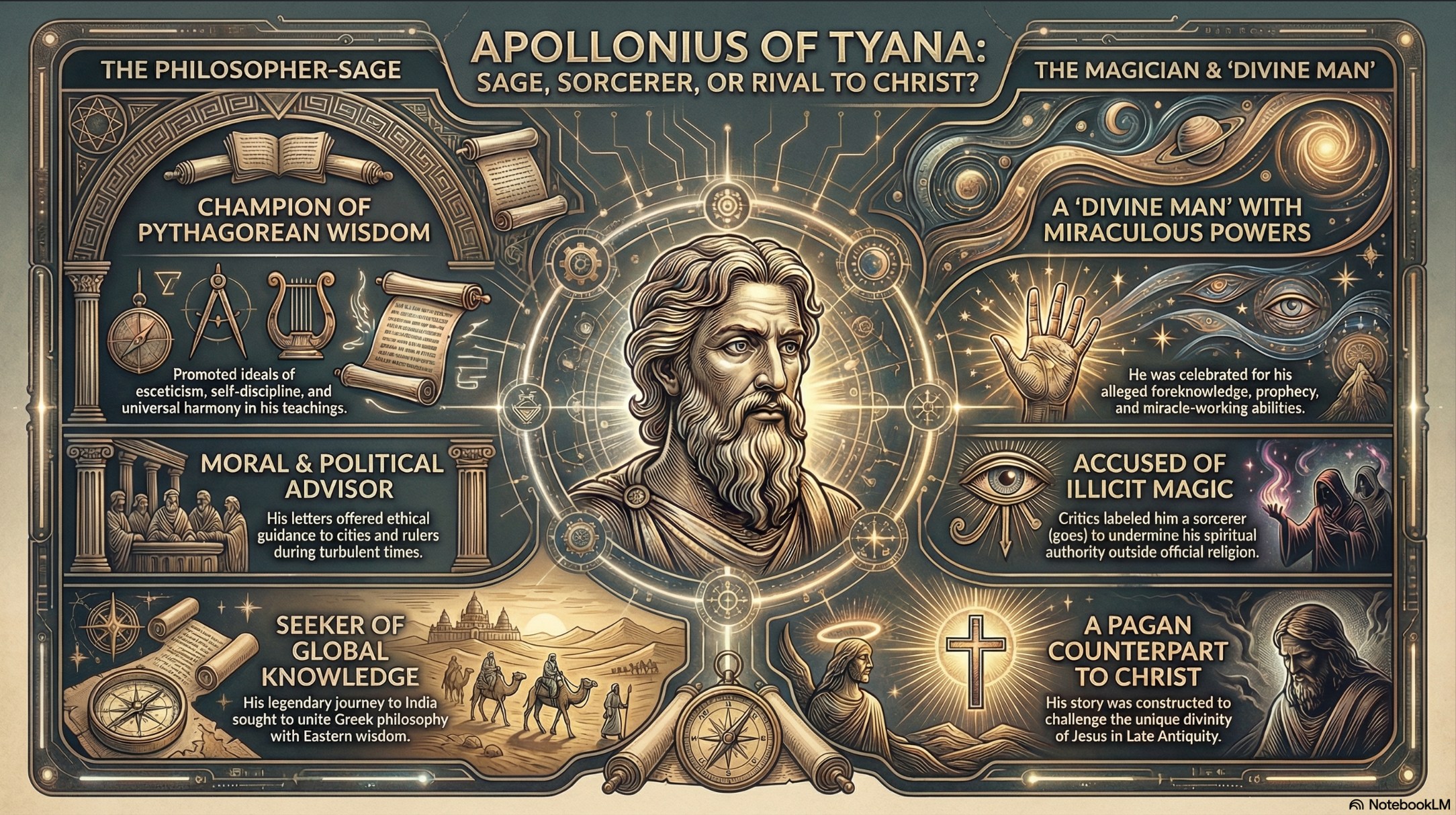
ON OUR YOUTUBE CHANNEL Rachav – Foundation – YouTube
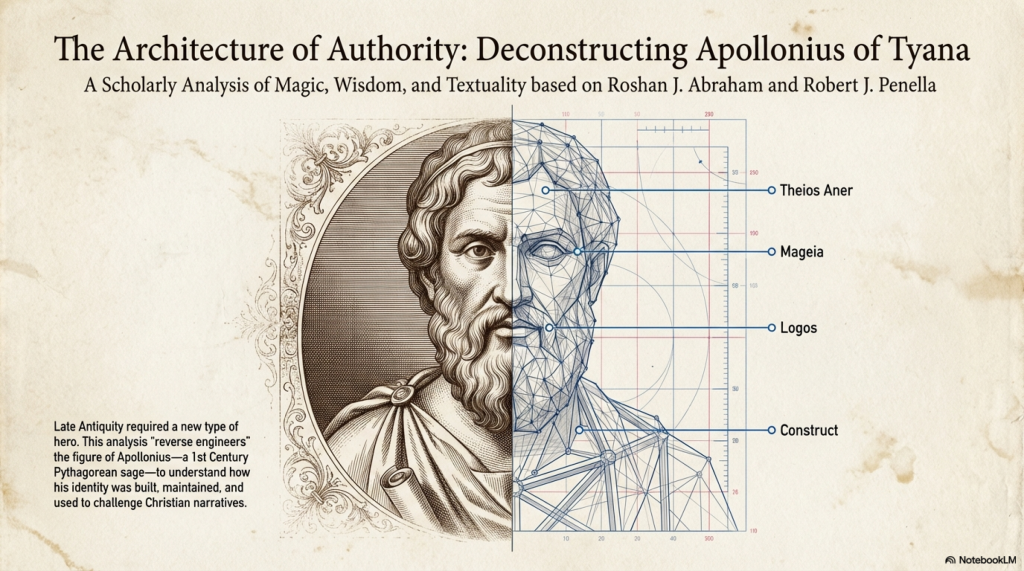
The Architecture of Authority
Welcome. Today, we “reverse engineer” the figure of Apollonius of Tyana, a first-century Pythagorean sage. While his historical reality remains elusive, his literary identity—constructed primarily by Philostratus in the third century—serves as a masterclass in how authority is built, maintained, and deployed. We will examine four primary axes: his status as a Theios Aner (Divine Man), the problem of Mageia (Magic), his use of Logos (Reason), and his existence as a calculated Construct designed to challenge emerging Christian narratives of unique divinity.
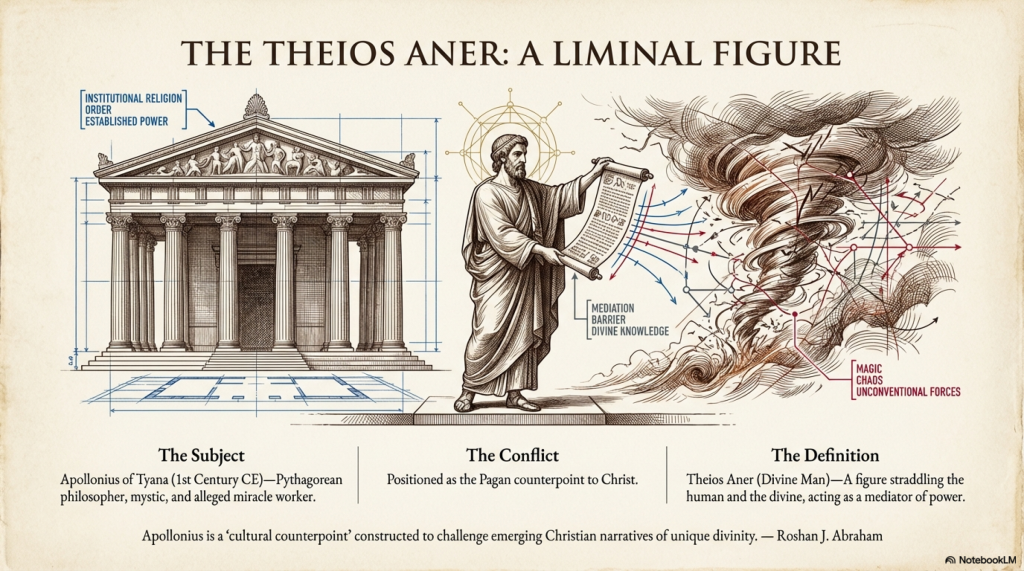
The Theios Aner: A Liminal Figure
Apollonius is a liminal figure, straddling the boundary between the human and the divine. On one side, we have Institutional Religion and the established power of the Roman state. On the other, the “chaos” of Unconventional Forces and magic. As a Theios Aner, Apollonius acts as a Mediation Barrier, a vessel of divine knowledge that brings order to these unconventional forces without succumbing to them. In the eyes of scholars like Roshan J. Abraham, he is a “cultural counterpoint” constructed to prove that paganism could produce a holy man every bit as divine as Christ.
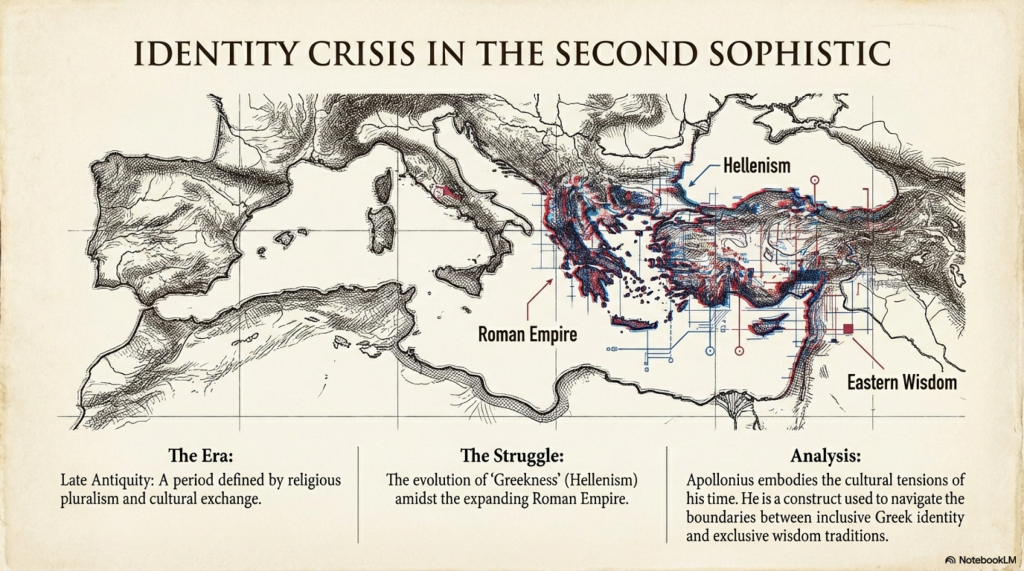
Identity Crisis in the Second Sophistic
To understand Apollonius, we must understand his era: Late Antiquity. This was a period of intense religious pluralism and cultural exchange within the Roman Empire. The “Struggle” depicted here is the evolution of “Greekness” (Hellenism) in a Roman world. Apollonius embodies these tensions. He uses Eastern Wisdom to refine and reinforce Greek philosophical ideals, navigating the boundaries between an inclusive Greek identity and exclusive, “barbarian” traditions.
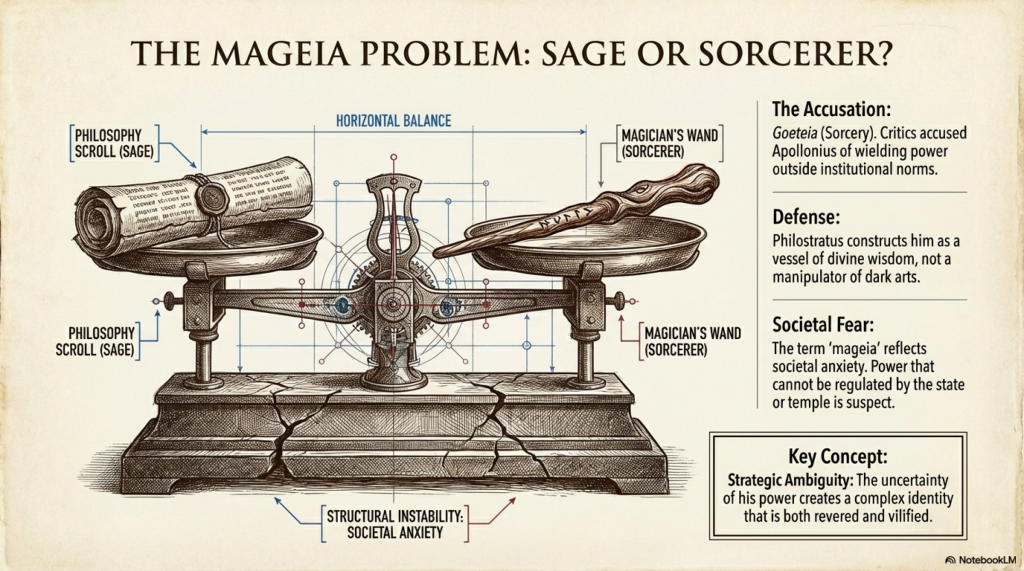
The Mageia Problem: Sage or Sorcerer?
The core of the Apollonius “problem” is Strategic Ambiguity. Was he a Sage of philosophy or a Sorcerer of magic?. His critics accused him of Goeteia (sorcery)—power wielded outside institutional norms. Philostratus, however, defends him as a vessel of divine wisdom. This “Structural Instability” reflects societal anxiety; power that cannot be regulated by the state or the temple is inherently suspect. By remaining ambiguous, Apollonius becomes both revered and vilified.
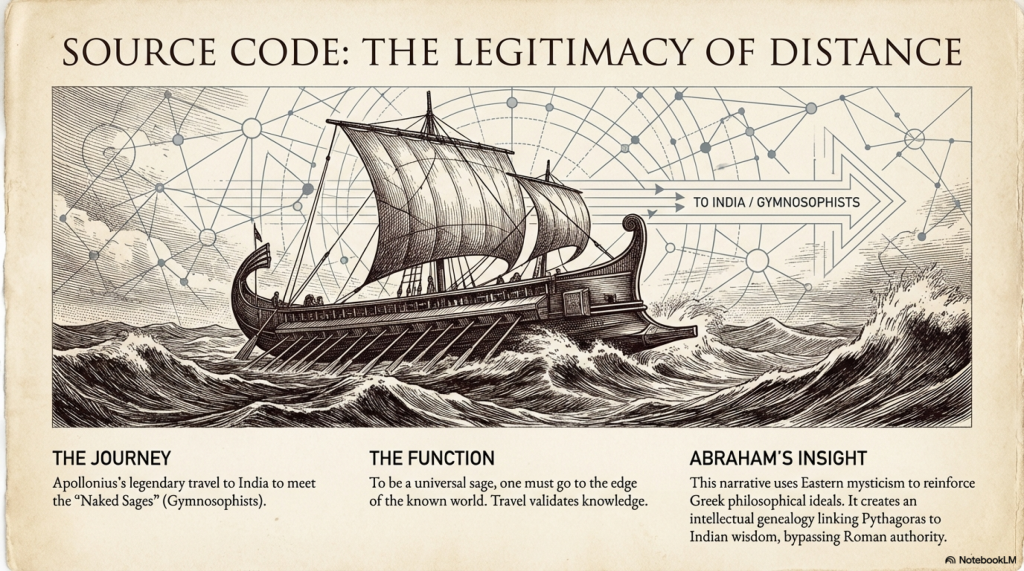
Source Code: The Legitimacy of Distance
Validation of knowledge in the ancient world often required Travel. Apollonius’s legendary journey to India to meet the “Naked Sages” (Gymnosophists) serves a vital function. By going to the “edge of the known world,” he acquires a legitimacy that Roman authority cannot touch. Abraham notes that this narrative creates an intellectual genealogy linking Pythagoras directly to Indian wisdom, effectively bypassing Roman cultural hegemony.
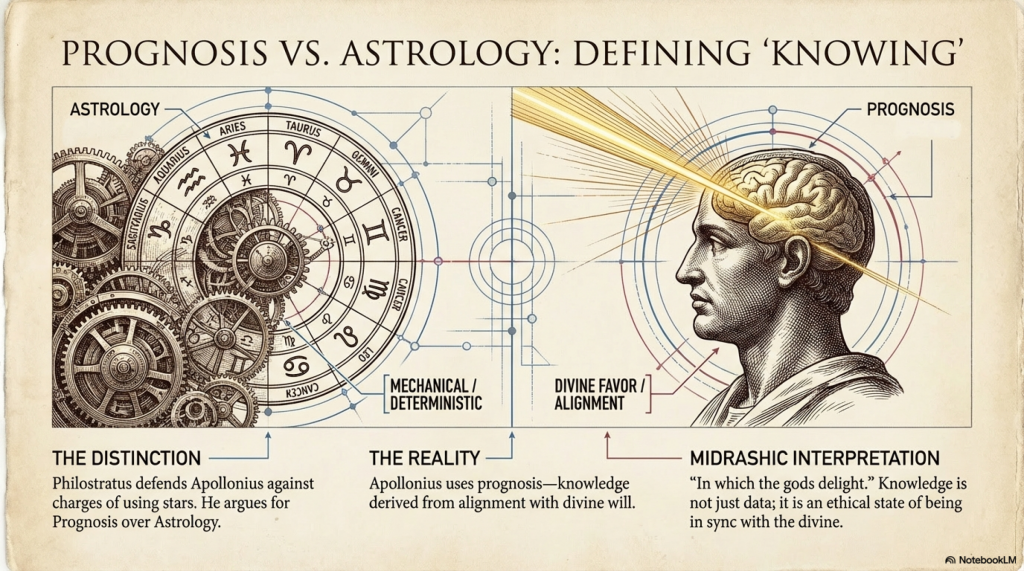
Prognosis vs. Astrology: Defining ‘Knowing’
Philostratus goes to great lengths to distinguish Apollonius’s “knowing” from mechanical Astrology. Astrology is viewed as deterministic and mechanical, a study of the stars that any man might learn. In contrast, Apollonius practices Prognosis: knowledge derived from a state of alignment with divine will. This is an ethical state of being—knowing “in which the gods delight”—rather than just a collection of data.
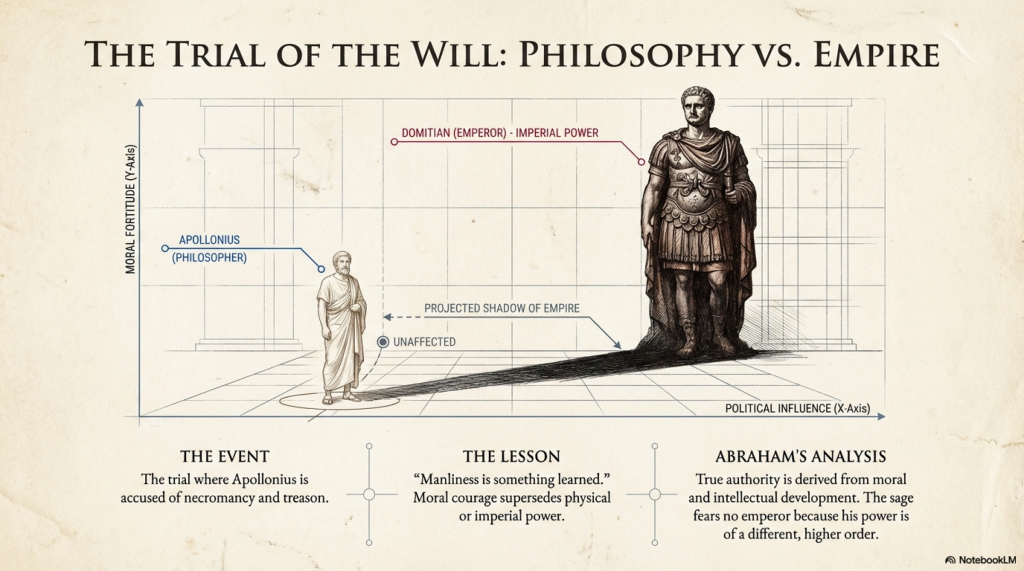
The Trial of the Will: Philosophy vs. Empire
The trial of Apollonius before Emperor Domitian is the ultimate collision of two types of power. While the Emperor wields the shadow of empire and political influence, Apollonius stands as a beacon of Moral Fortitude. Accused of necromancy and treason, he demonstrates that “manliness is something learned”—a form of moral courage that supersedes imperial force. True authority, he proves, is derived from intellectual and moral development.
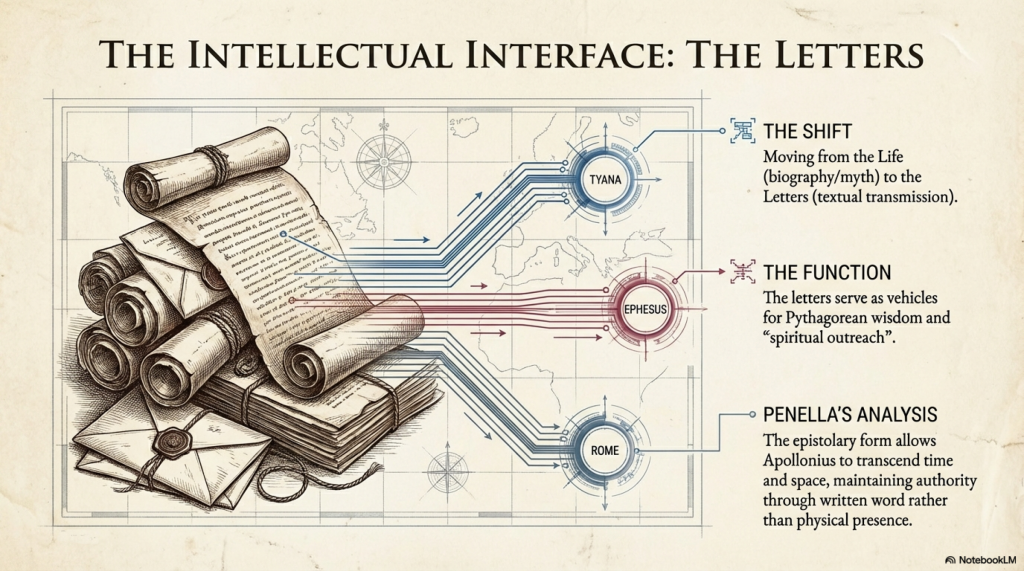
The Intellectual Interface: The Letters
We now shift from the Life (biography) to the Letters (textual transmission). As analyzed by Robert J. Penella, these letters serve as vehicles for spiritual outreach and Pythagorean wisdom. The epistolary form allows Apollonius to transcend time and space. He maintains authority not through his physical presence, but through the written word, connecting intellectual centers like Tyana, Ephesus, and Rome.
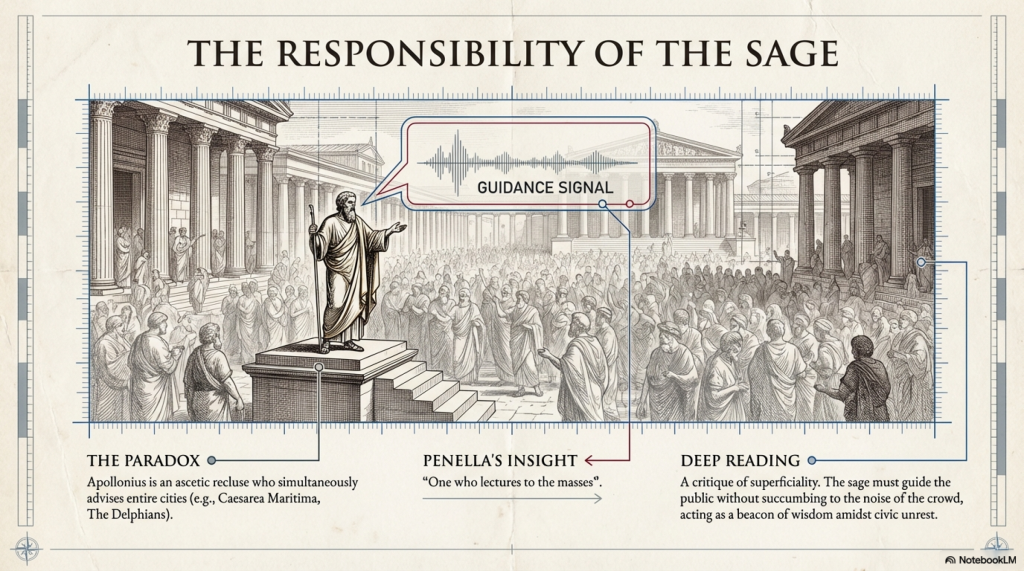
The Responsibility of the Sage
Here we see the paradox of the sage: Apollonius is an ascetic recluse who nevertheless advises entire cities, such as Caesarea Maritima and The Delphians. He is “one who lectures to the masses,” acting as a guidance signal amidst civic unrest. His role is to provide a “deep reading” of society, critiquing superficiality and guiding the public without being consumed by the “noise of the crowd”.
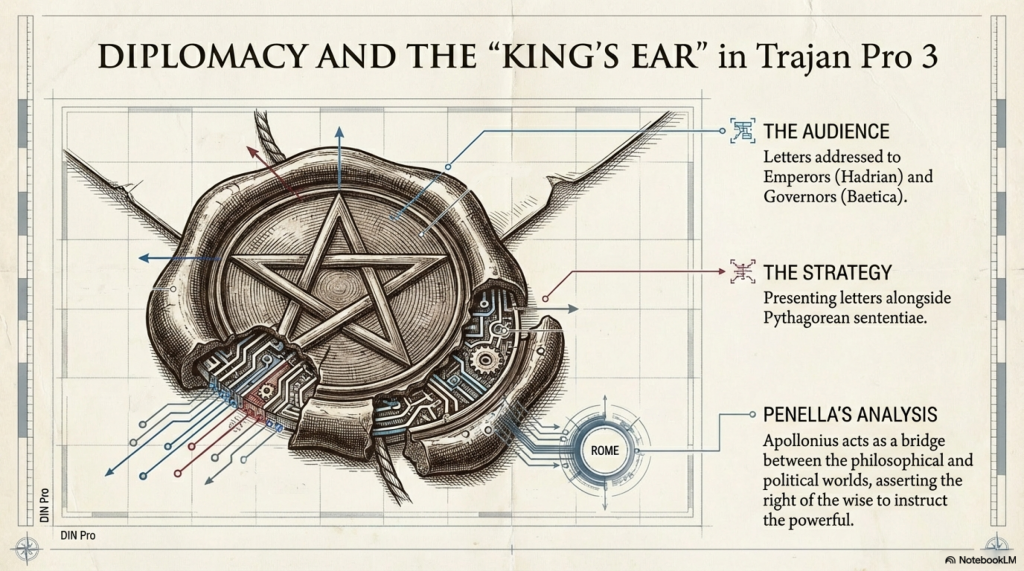
Diplomacy and the “King’s Ear”
Apollonius’s authority extends even to the highest levels of governance, as seen in his letters to Emperor Hadrian and the governors of Baetica. He presents these letters alongside Pythagorean sententiae (wisdom sayings). As Penella argues, Apollonius acts as a bridge between the philosophical and political worlds, asserting that it is the right—and indeed the duty—of the wise to instruct the powerful.
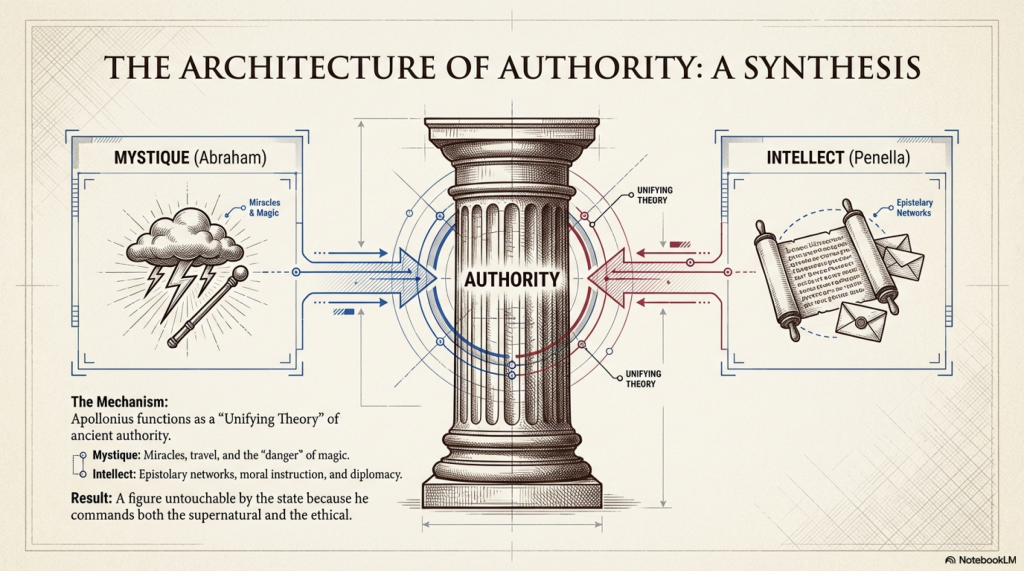
The Architecture of Authority: A Synthesis
We arrive at the “Unifying Theory” of ancient authority. Authority is built from two pillars: Mystique (the miracles, the travels, and the “danger” of magic) and Intellect (the letters, the diplomacy, and moral instruction). The result is a figure who is untouchable by the state because he commands both the supernatural and the ethical. He is the perfect Architecture of Authority.
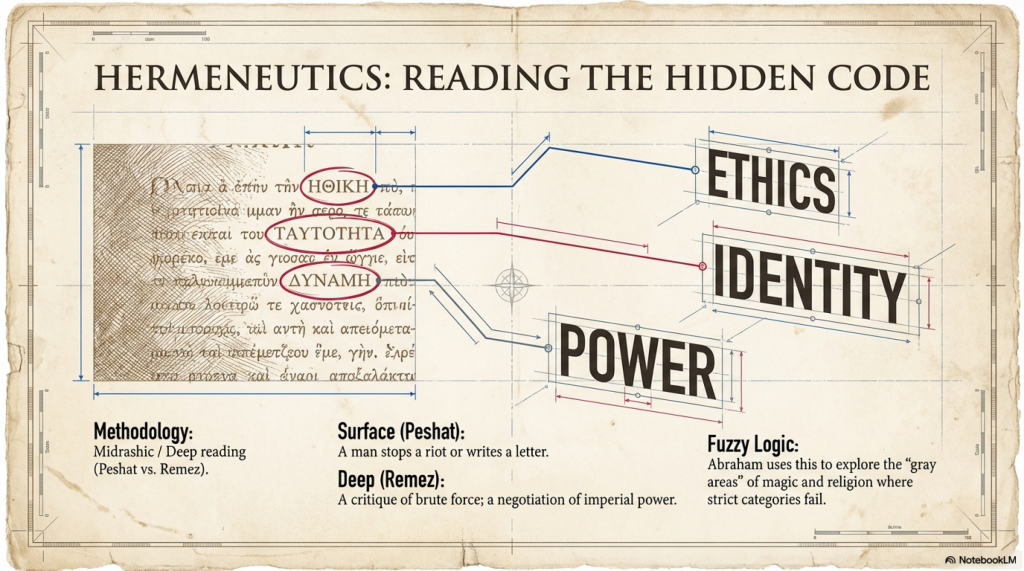
Hermeneutics: Reading the Hidden Code
To truly understand Apollonius, we must employ “Deep Reading” (moving from Peshat or surface meaning to Remez or deep meaning). On the surface, he is a man stopping a riot or writing a letter. On a deeper level, he is engaging in a critique of brute force and a negotiation of imperial power. Abraham uses “Fuzzy Logic” to explore the gray areas where strict categories of “religion” and “magic” fail.
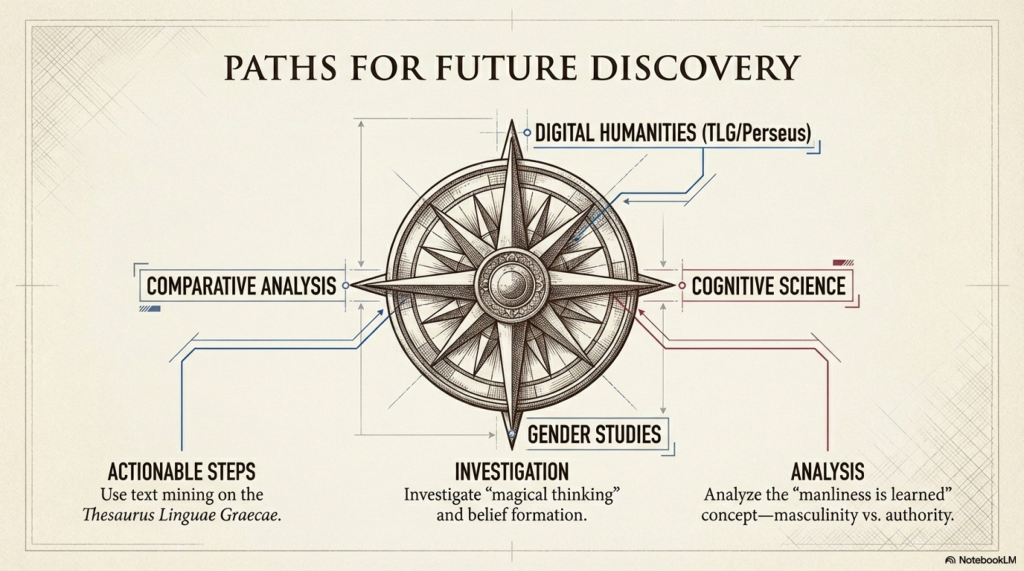
Paths for Future Discovery
The study of Apollonius is far from complete. Future paths include:
- Digital Humanities: Using text mining on the Thesaurus Linguae Graecae.
- Cognitive Science: Investigating “magical thinking” and belief formation.
- Gender Studies: Analyzing how “manliness is learned” and the relationship between masculinity and authority
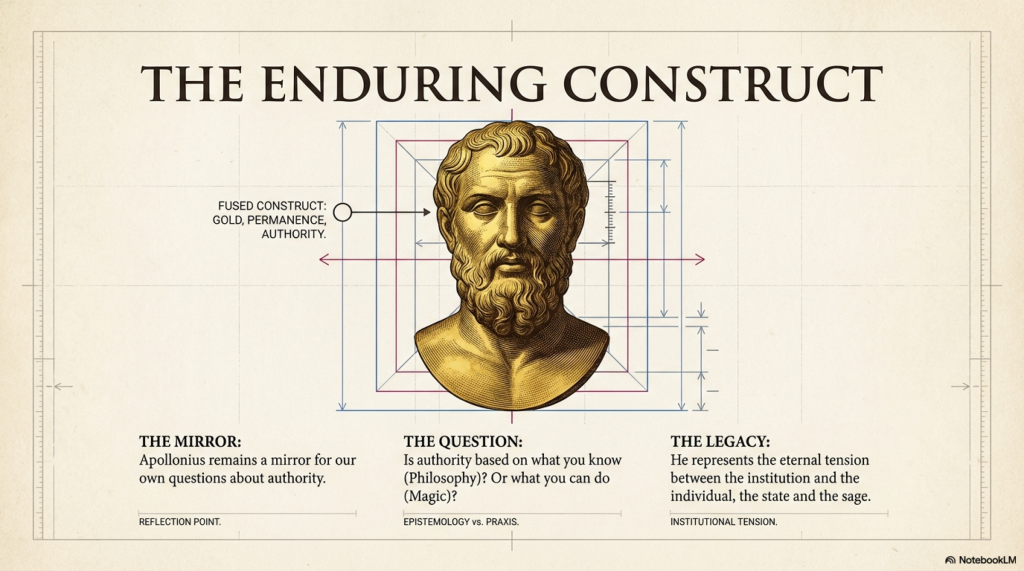
The Enduring Construct
Ultimately, Apollonius remains a mirror for our own questions about Authority. Is true authority based on what you know (Philosophy) or what you can do (Magic)?. He represents the eternal tension between the Institution and the Individual, the state and the sage. He is a fused construct—golden, permanent, and inherently authoritative.
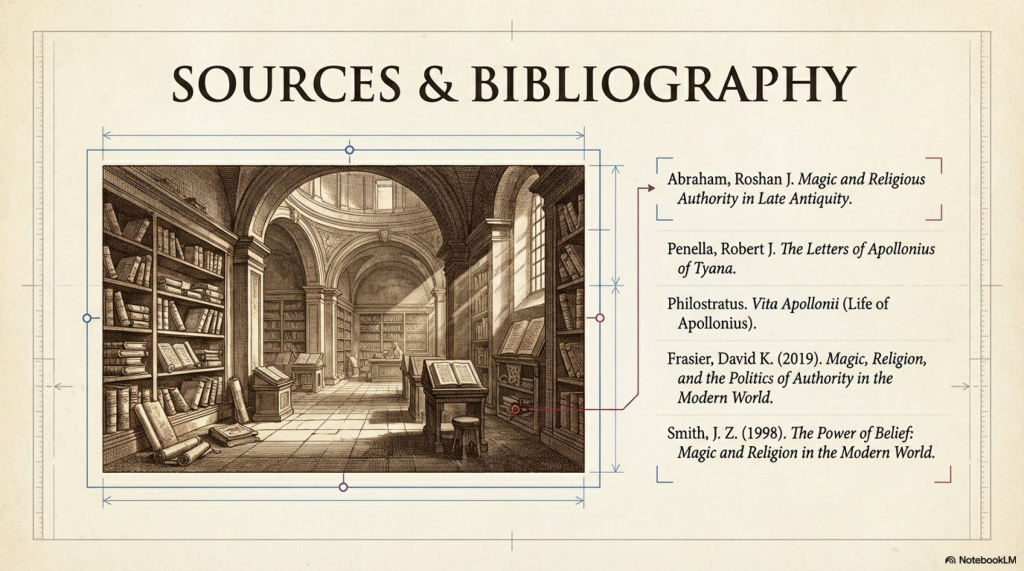
Sources & Bibliography
Our analysis is grounded in the foundational works of Roshan J. Abraham, Robert J. Penella, and the primary text of Philostratus’s Vita Apollonii.
An In-depth Audio Presentation
On the Scholarly Portrayal of Apollonius of Tyana
Executive Summary
This briefing synthesizes scholarly analysis of Apollonius of Tyana, a first-century AD Greek philosopher, mystic, and miracle-worker. The analysis is drawn from two key academic works: Roshan J. Abraham’s Magic and Religious Authority in Late Antiquity and Robert J. Penella’s The Letters of Apollonius of Tyana.
Abraham’s research positions Apollonius as a significant figure in the pagan response to the rise of Christianity. His life, primarily documented in Philostratus’s semi-fictional Life of Apollonius, was constructed as a counter-narrative to that of Christ, embodying a pagan model of the “divine man” (theios aner). The work delves into the cultural tensions of Late Antiquity, particularly the ambiguous and often contentious relationship between legitimate religious authority, philosophical wisdom, and practices labeled as magic or sorcery (mageia, goeteia).
Penella’s work provides a deep textual analysis of the letters attributed to Apollonius, examining their transmission, authenticity, and philosophical content. The letters are presented as vehicles for Pythagorean wisdom, offering ethical and moral guidance to individuals and communities across the Roman Empire. This scholarship highlights Apollonius’s role as a public intellectual and spiritual advisor who navigated the complex socio-political landscape of his time, emphasizing themes of asceticism, self-discipline, and the harmony between public engagement and philosophical detachment.
Collectively, these sources reveal that the legacy of Apollonius is a study in the construction of authority. Both his life story and his correspondence were instrumental in shaping a complex identity—a sage, a mediator of cultural traditions, a moral teacher, and a figure who constantly navigated the fine line between the divine and the profane. The foundational text for this legacy is Philostratus’s Vita Apollonii, a work that blends history with narrative artistry to create an idealized philosophical hero.
——————————————————————————–
1. The Figure of Apollonius of Tyana in Late Antiquity
Apollonius of Tyana (1st century AD) was a Pythagorean philosopher, teacher, and mystic whose life and legacy are primarily preserved through the semi-biographical work Life of Apollonius (Vita Apollonii). This text was commissioned by the Empress Julia Domna in the early 3rd century CE and written by Philostratus. He is portrayed as a celebrated “divine man” (theios aner), a figure who straddled the boundaries of myth, history, philosophy, and supernatural power. Scholarly analysis of Apollonius reveals him to be a focal point for understanding the cultural anxieties, religious pluralism, and intellectual currents of the ancient Mediterranean world.
2. Core Theme: The Construction of Religious and Intellectual Authority
A central theme across the scholarship is how Apollonius’s identity was deliberately constructed to establish a unique form of religious and intellectual authority, distinct from both traditional institutions and emerging Christian narratives.
Apollonius as a Pagan Counterpoint to Christianity
Roshan J. Abraham’s analysis posits that Philostratus constructed Apollonius as a significant figure in the pagan response to Christianity.
• A Rival to Christ: Apollonius was portrayed as a wise sage whose miraculous abilities and divine authority were meant to challenge the Christian narrative of Christ’s unique divinity.
• Influence on Power: His depiction as an advisor influencing emperors like Aurelian illustrates the tension between paganism and Christianity, serving to elevate Apollonius’s status within the imperial context [Ch. 2, Abraham].
The Legitimization of Wisdom
Apollonius’s authority was validated through narrative elements that emphasized his pursuit and mastery of universal wisdom.
• Travel to India: His legendary journey to India to meet the “Naked Sages” (Gymnosophists) is a central episode in Philostratus’s biography [Ch. 2, Abraham]. This journey frames him as a seeker of transcendent truth, legitimizing his claim to esoteric knowledge by connecting him with the Greco-Roman fascination with Eastern mysticism.
• Universal Philosophical Ideals: The Indian journey serves to elevate Apollonius above other philosophers by asserting the universality of Greek philosophical ideals, positioning him as a bridge between Eastern and Western traditions.
Role as Moral and Political Advisor
Robert J. Penella’s study of the letters highlights Apollonius’s active engagement with the world as a moral teacher and public intellectual.
• Guidance to Communities: Many letters are addressed to cities or individuals, offering advice on governance, ethics, and spiritual practice. This establishes his role as a source of wisdom amidst the socio-political turbulence of the Roman Empire, such as the Jewish uprising in Caesarea Maritima [Ch. 6, Penella].
• Pythagorean Ideals in Practice: The letters disseminate Pythagorean philosophy, focusing on harmony, virtue, self-discipline, and the unity of the cosmos. They demonstrate the tension between active public engagement and the philosophical ideal of inner tranquility and self-mastery.
3. Core Theme: The Ambiguity of Magic and Philosophy
Apollonius’s legacy is defined by the contentious relationship between philosophy and practices deemed magical. His ability to wield supernatural power both enhanced and undermined his reputation.
Sage vs. Sorcerer
• Accusations of Goeteia: Critics, including rival philosophers like Euphrates, accused Apollonius of practicing goeteia (sorcery) to discredit him [Ch. 1, Abraham Summary]. The term mageia was also used in accusations, reflecting societal fears surrounding magic and its practitioners who operated outside traditional religious structures [Ch. 5, Abraham].
• A Dual Identity: This tension created a dual identity for Apollonius as a figure who was both revered for his wisdom and vilified for his methods. This duality reflects broader societal ambivalence toward magic, which could be seen as a source of divine insight or a threat to established norms.
The Nature of Foreknowledge
Philostratus carefully framed Apollonius’s prophetic abilities to distinguish them from less reputable forms of divination.
• Prognosis vs. Astrology: Abraham’s analysis shows that Philostratus contrasts Apollonius’s prognosis (foreknowledge) with deterministic practices like astrology. Apollonius’s insight is presented as a divine gift, elevating him above ordinary diviners and reinforcing his connection to the gods [Ch. 3, Abraham].
The Trial Before Domitian
The trial of Apollonius serves as a narrative climax in his story, dramatizing the conflict between philosophical integrity and tyrannical power.
• Martyr for Wisdom: In Philostratus’s account, Apollonius faces the emperor Domitian on charges of goeteia and necromancy [Ch. 4, Abraham]. The episode frames him as a martyr for truth who transcends earthly authority.
• Philosophical Threat: The trial highlights the precarious position of philosophers under authoritarian rule, where the pursuit of truth and the possession of spiritual power could be interpreted as political threats.
4. Core Theme: Narrative, Text, and Transmission
The scholarly works emphasize that our understanding of Apollonius is mediated through texts that are themselves objects of interpretation and construction.
The Foundational Role of Philostratus’s Vita Apollonii
Both Abraham and Penella identify Philostratus’s work as the primary source, while also recognizing its nature as a semi-fictional, literary creation.
• Cultural Propaganda: The Life of Apollonius is described as a “masterful work of cultural propaganda” that elevates its subject to a paragon of wisdom and divine favor. It blends historical details with fictionalized accounts to create an idealized figure.
• Narrative Framing: Penella’s work shows how the Vita Apollonii is crucial for understanding the letters, as it provides the context and often the direct quotations of the correspondence, thereby shaping their interpretation [Ch. 3, Penella Summary].
The Letters as Philosophical and Cultural Artifacts
Penella’s scholarship offers a detailed examination of Apollonius’s letters.
| Aspect of the Letters | Scholarly Insight (Penella) |
|---|---|
| Philosophical Content | The letters are vehicles for Pythagorean wisdom, emphasizing asceticism, self-discipline, and virtue. |
| Historical Transmission | Their transmission is complex; some are quoted by Philostratus, while others exist in separate collections, raising questions of authenticity. |
| Literary Purpose | The letters function as tools of self-presentation and spiritual outreach, inviting diverse communities into a shared philosophical discourse. |
| Authenticity | The authenticity of some letters is questioned, suggesting that the collection may have been shaped by later writers to fit a constructed image of Apollonius. |
| Cultural Significance | The letters reveal Apollonius’s engagement with the socio-political issues of his time and contributed to his enduring legacy in medieval and Renaissance thought. |
5. Scholarly Methodologies
The analyses of Apollonius employ interdisciplinary approaches to deconstruct the layers of meaning in the primary texts.
• Abraham’s Methodology: Combines literary analysis, historical context, ethnographic considerations (especially regarding the journey to India), and philosophical discourse. The analysis is noted for its use of “midrashic interpretation,” using a “fuzzy logic” approach to explore deeper hermeneutical layers in the text.
• Penella’s Methodology: Employs a rigorous combination of historical, philosophical, and textual analysis. His work is a critical edition that involves meticulous examination of manuscripts, editorial conventions, and textual transmission to reconstruct the letters and provide detailed commentary.
Midrashic Interpretations in the Texts
The sources highlight several passages where deeper, multi-layered interpretations are invited:
• “Manliness is something learned” (Plutarch, cited by Abraham [Ch. 2]): On the surface, an educational principle. Deeper meanings suggest a cultural critique of militaristic values and a shift toward an intellectual and ethical definition of masculinity.
• The term “mageia” (Abraham [Ch. 5]): The surface meaning is a legal accusation of magic. Deeper implications reveal societal fears and the strategic ambiguity of Apollonius’s complex identity, which straddled the sacred and profane.
• “One who lectures to the masses” (Penella [Ch. 6]): The surface meaning denotes Apollonius’s role as a public speaker. A deeper reading suggests a critique of the superficiality of mass communication, hinting at the philosophical depth beneath his public persona.
About the Author