via IFTTT
Beyond the Border: 5 Surprising Lessons from History’s Most Influential Outsiders
The experience of the “outsider”—of standing on the periphery of a community, looking in—is a universal human condition. While often viewed as a position of inherent vulnerability, the annals of cultural history and theology suggest that the outsider is frequently the most critical catalyst for transformation. Within the biblical canon, two figures from vastly different socio-economic strata illustrate this power: Rahab of Jericho and the Queen of Sheba.
One was a marginalized zonah (prostitute or innkeeper) in a city under the herem ban (the decree of utter destruction); the other was a sovereign monarch from a remote kingdom at the “ends of the earth.” Yet, both functioned as “outside voices” that fundamentally reshaped the identity of the “elect” community. Their narratives offer a sophisticated inquiry into how those on the fringes navigate, challenge, and ultimately redefine the centers of power.
1. Marginality is a Strategic Vantage Point
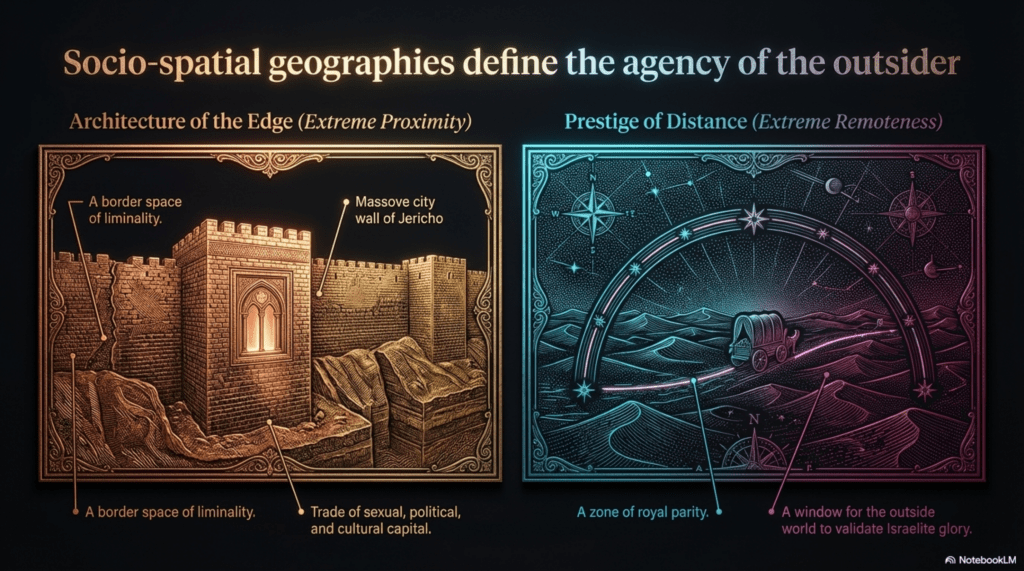
An individual’s physical and social location dictates the limits of their vision. In the case of Rahab, her identity was constructed through a convergence of ethnic, gendered, and socio-economic marginalization. She lived at the literal and metaphorical edge of her society, providing her with a perspective unavailable to those in the center.
“Her physical dwelling, integrated into the city wall, serves as a potent architectural metaphor for her liminality.”
Residing on the “outer side of the city wall,” Rahab’s house functioned as a “border space” or a “contact zone.” While the male citizens of Jericho were paralyzed by nationalistic loyalty to a failing king, Rahab’s status as a zonah granted her a radical agency. In the Deuteronomistic tradition, a zonah was a woman whose sexuality was not owned by a single man and who existed outside traditional patrilineal structures. This autonomy allowed her to trade in the “rumors” of the arriving Israelites without the constraints of tribal allegiance. From her vantage point on the fringe, she could see the shifting tides of history more clearly than those protected by the city’s interior.
2. The Shift from “Hearing” to “Knowing”
Both Rahab and the Queen of Sheba demonstrate that there are multiple, equally valid paths to truth-seeking. Their journeys reflect a transition from the processing of external reports to the attainment of internal conviction, though their methods differed based on their social standing.
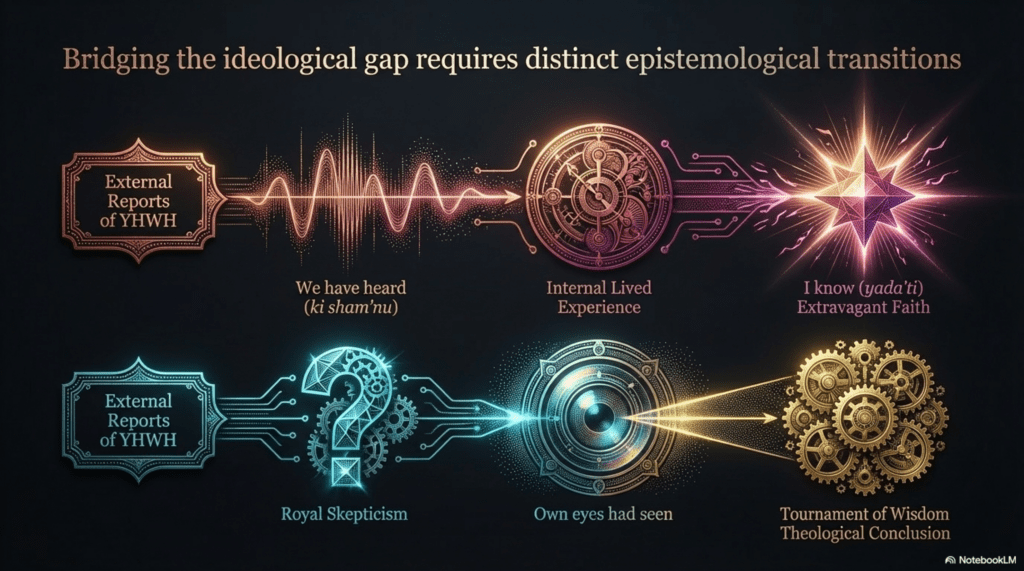
- Rahab and the Faith of the Heard Rumor: Rahab’s transformation began with ki sham’nu (“for we have heard”). She listened to reports of the Red Sea crossing and the defeat of the Amorites. However, she moved beyond the collective fear of her city to an assertive theological conclusion: yada’ti (“I know”). She recognized a divine trajectory that exceeded the perception of even the Israelite spies, confessing a God of “heaven above and earth below.”
- The Queen of Sheba and Empirical Verification: The Queen’s approach was rooted in the “prestige of distance” and royal skepticism. Having traveled 3,000 kilometers from her remote kingdom, she refused to believe reports of Solomon’s wisdom until her “own eyes had seen it.” Her “breathless” reaction to the material reality—the architecture, the food, and the conduct of officials—was evidence of a “listening heart” that found spiritual truth through material manifestation.
Whether through the intuitive response to a “rumor” or the rigorous 3,000-kilometer quest for “seeing,” both women bridged the ideological gap between their native paganism and a new, universalizing faith.
3. The “Noble Lie” and the “Riddle” as Survival Tools
Navigating a dominant or foreign culture requires sophisticated strategies of engagement. For Rahab and the Queen, these were not mere “tricks,” but essential methods of negotiating power and establishing parity in a world that viewed them as “other.”
Rahab employed the “Noble Lie,” a post-colonial strategy of resistance where deception serves a redemptive purpose. Her defiance of the King of Jericho’s messengers is intertextually linked to the Egyptian midwives, Shiphrah and Puah, who disobeyed Pharaoh to preserve life. By wearing the “mask” of a loyal subject while secretly collaborating with the spies, she utilized subterfuge to secure her family’s survival.

“This act of deception is not presented as a moral failing but as a ‘daring act of faith’.”
In contrast, the Queen of Sheba used the “riddle” (hidot) as a diplomatic “tournament of wisdom.” Midrashic tradition suggests her riddles probed the boundaries of the Mosaic Law, such as distinguishing gender or identifying matters of circumcision and menstruation. She did not arrive as a supplicant but as a peer, using these intellectual tests to establish a concordia (agreement) between her kingdom and Solomon’s.
4. Subverting the “Dangerous Foreigner” Archetype
In the Deuteronomistic and Wisdom traditions, the “Foreign Woman” is typically cast as a temptress—an agent of apostasy. Rahab and the Queen of Sheba represent a revolutionary subversion of this trope, becoming what we might call a “decolonial project” that undoes traditional hierarchies.
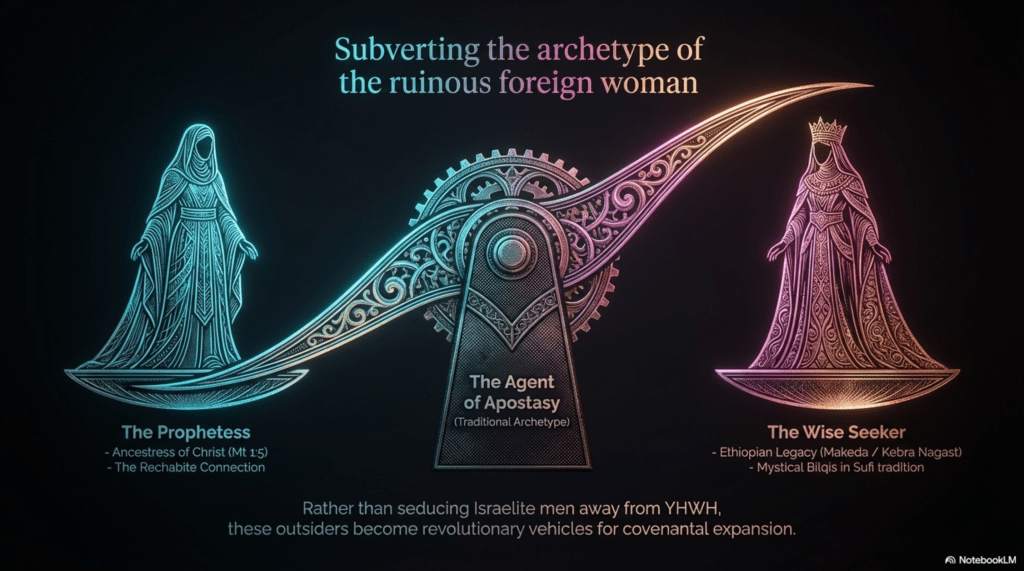
Rahab is transformed from a Canaanite social outcast into a “prophetess” and a foundational ancestress in the genealogy of Christ (Matthew 1:5). The Queen of Sheba becomes an authoritative Gentile voice who validates the divine source of wisdom rather than leading the king away from it. This creates a “creative oxymoron”—a collision of opposites where the harlot becomes a spy and the foreign queen becomes a witness. By including these “hybrid women” in the national narrative, the community is forced to expand toward a more universal vision, accepting that the marginalized can be glorious contributors to the divine line.
5. The Outsider as the Ultimate Internal Critic
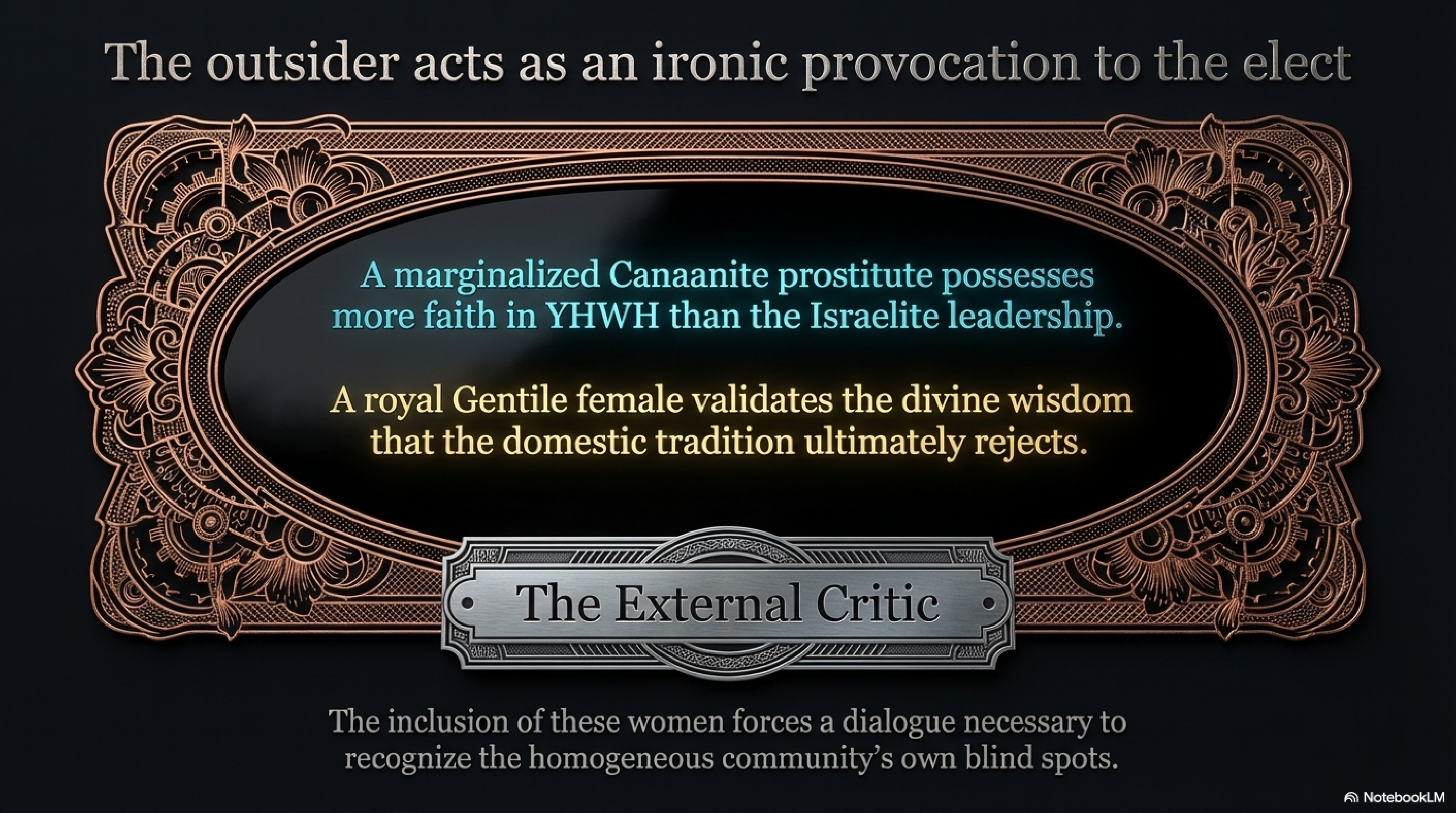
The most vital role of the outsider is to provide an “ironic provocation” to the established community. Rahab and the Queen of Sheba belong to a “triad of important Gentiles”—alongside Jethro—who sought the truth and, in doing so, offered a critique that the community could not provide for itself.
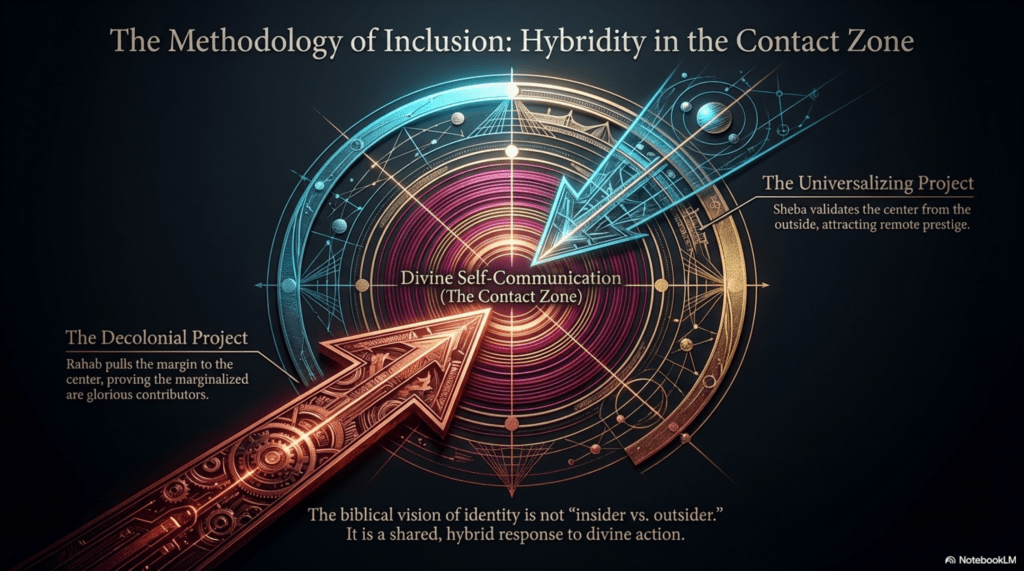
Rahab’s speech revealed that a marginalized foreigner understood the power of God better than the Israelite leadership. Similarly, the Queen’s visit represents the climax of the National Narrative; her praise of Solomon’s wisdom serves as a poignant reminder of what was later lost during the kingdom’s “downward spiral” into division and apostasy. Their presence forced the “homogeneous community” to recognize that God often communicates to the “elect” through those specifically marked as “unchosen.”
——————————————————————————–
Conclusion: Constructing Your Own “Borderland”
The “Epistemologies of the Borderland” embodied by these two women suggest that identity is not a matter of ancestry or geography, but a “shared and bold response” to history. Rahab and the Queen of Sheba occupied “contact zones”—spaces where disparate cultures meet and grapple with one another—to construct new bridges of understanding.
In our own lives, we must ask: Who are the “outsiders” currently standing on our city walls or arriving from the “ends of the earth”? What essential truths might they hold that we, as insiders, have forgotten? By valuing the “outside voice,” we move beyond the simple binary of insider versus outsider and open ourselves to a faith that is as complex, inclusive, and transformative as the women who first dared to cross the border.
About the Author