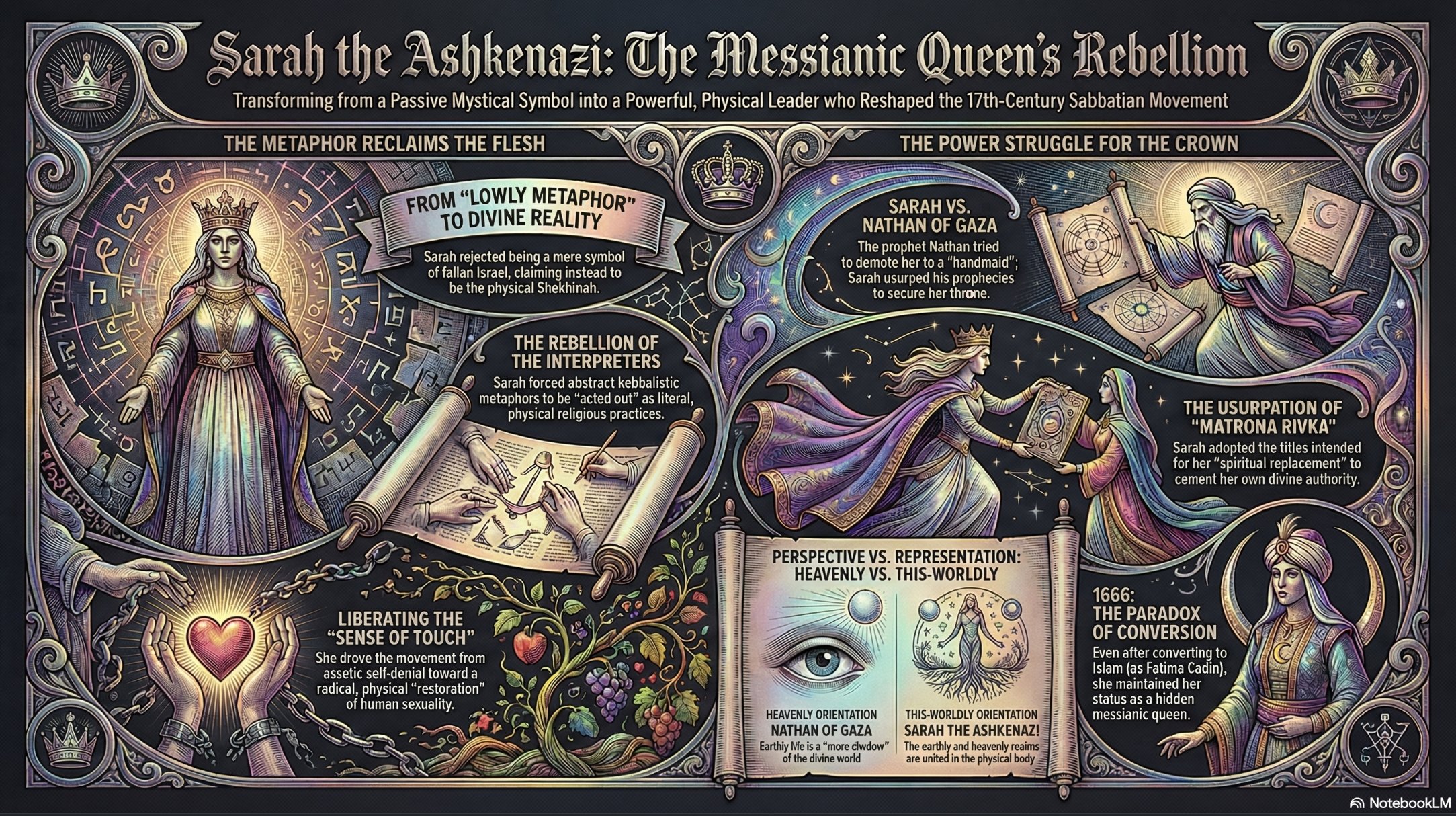
The Sabbatian movement of the 17th century is often viewed through the lens of its male protagonists: the “Manic-Depressive Messiah” Sabbatai Zevi and his brilliant theologian, Nathan of Gaza. However, a closer look at the movement’s evolution reveals a profound internal conflict between the “Heavenly” ascetic impulse and the “This-Worldly” carnal reality of Sarah the Ashkenazi. Sarah was not merely a consort; she was a revolutionary who refused to be a passive symbol, effectively forcing the Shekhinah (Divine Presence) down to earth.
Origins and Early Life: From Tragedy to Prophecy
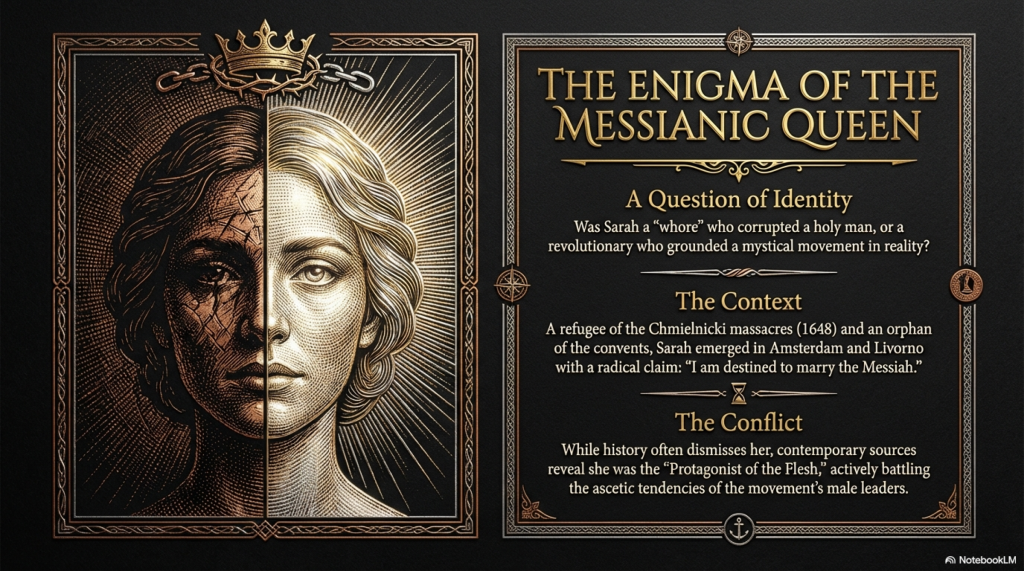
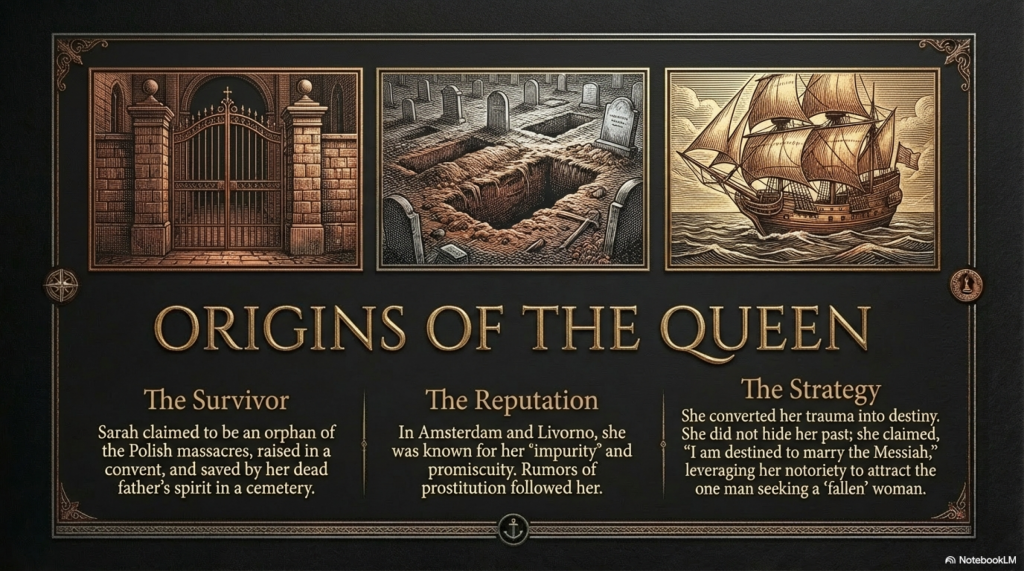
Sarah’s story begins in the ash and trauma of Jewish history. She was an Ashkenazi orphan, a refugee from the horrific Chmielnicki massacres (1648–1649) in Poland—events that decimated communities and left deep spiritual scars on European Jewry.
According to the chronicle of Leyb ben Oyzer, Sarah claimed to be the daughter of a Rabbi Meir. Separated from her father during the pogroms, she was placed in a convent (or similar Christian institution) until her teens. Leyb ben Oyzer recounts a narrative Sarah herself likely propagated: that her deceased father appeared to her in the night, carried her from the convent, and left her in a Jewish cemetery where she would be found by her people. Even at this early stage in Amsterdam (around 1655), she was already displaying the characteristics of a “religious virtuoso,” claiming she was destined to marry the Mashiakh (Messiah).
From Amsterdam, she traveled to Livorno, Italy. It was here that her reputation took a turn that would define her theological role. Rumors circulated that she lived a life of promiscuity and prostitution. Rather than hiding this, it seems this reputation became central to her identity within the movement.
The Theological “Rebellion” of Sarah
This is where the history becomes truly gripping for us. Alexander van der Haven argues that Sarah represented a radical shift in Jewish mysticism. Prior to this, Kabbalistic concepts like the union of the male and female aspects of the Divine were treated as metaphors. The mystic might visualize the Shekinah (the Divine Presence), but he would never equate her with a physical woman of flesh and blood.
Sarah refused to be a metaphor. She embodied a “this-worldly” approach to redemption. While Nathan of Gaza (Sabbatai’s prophet) focused on spiritual, cosmic realms, Sarah pushed for the physical enactment of redemption. Her influence led to the breaking of Halakha (Jewish law). Because the “Messianic Age” had supposedly arrived, the fast of the Ninth of Av (Tisha B’Av) was turned into a feast, and women were liberated from traditional restrictions, even being called to read from the Torah.
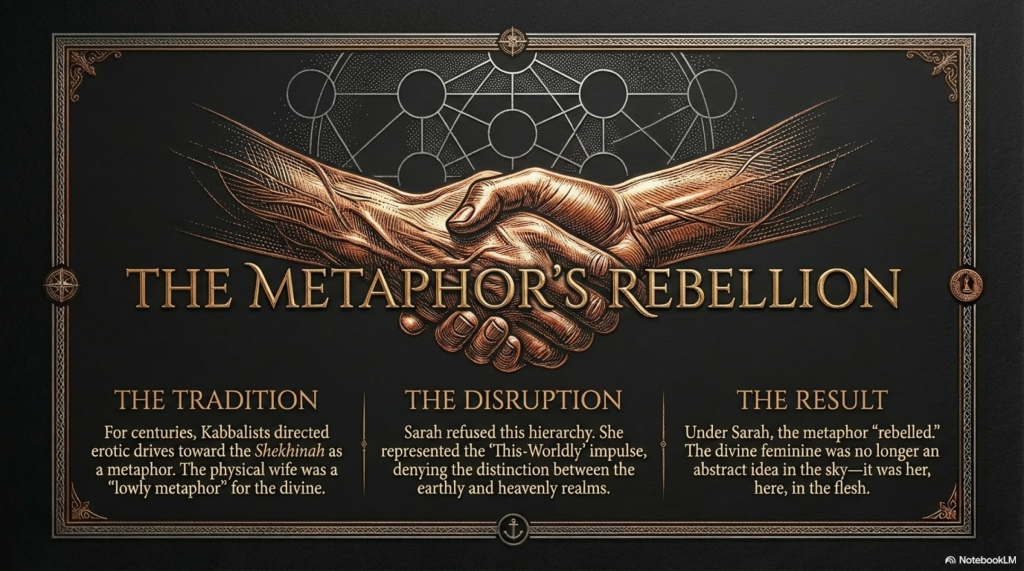
Van der Haven describes this as the “metaphor’s rebellion.” Sarah did not want to be a symbol of the Shekinah; she aimed to become the earthly vessel for it, collapsing the distance between the Divine and the physical body.

The Messianic Marriage
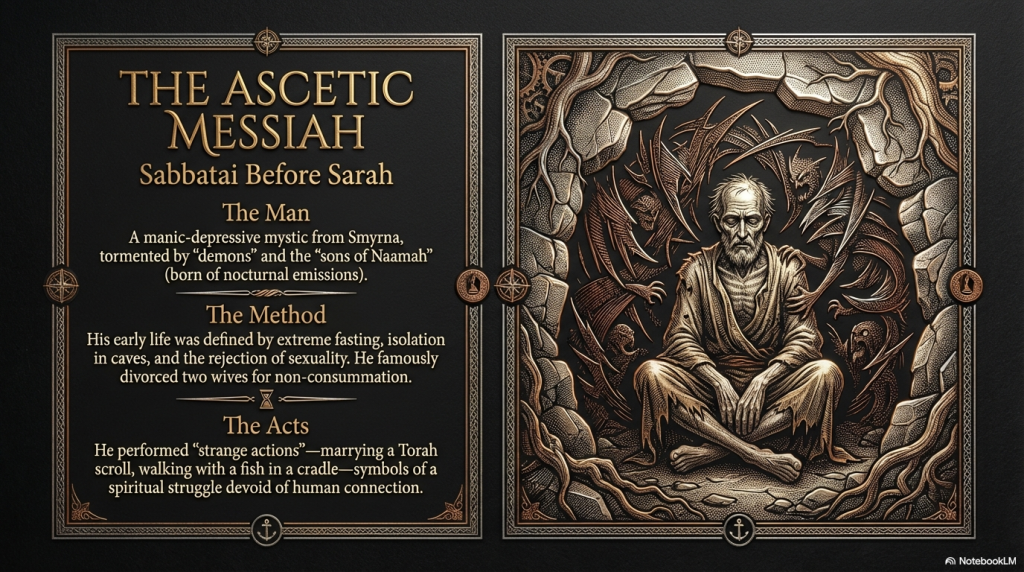
In 1664, Sarah traveled to Cairo, where she married Sabbatai Tsevi. This was not a conventional union. Sabbatai, who had previously divorced two wives because he failed to consummate the marriages due to his ascetic practices, specifically chose Sarah.
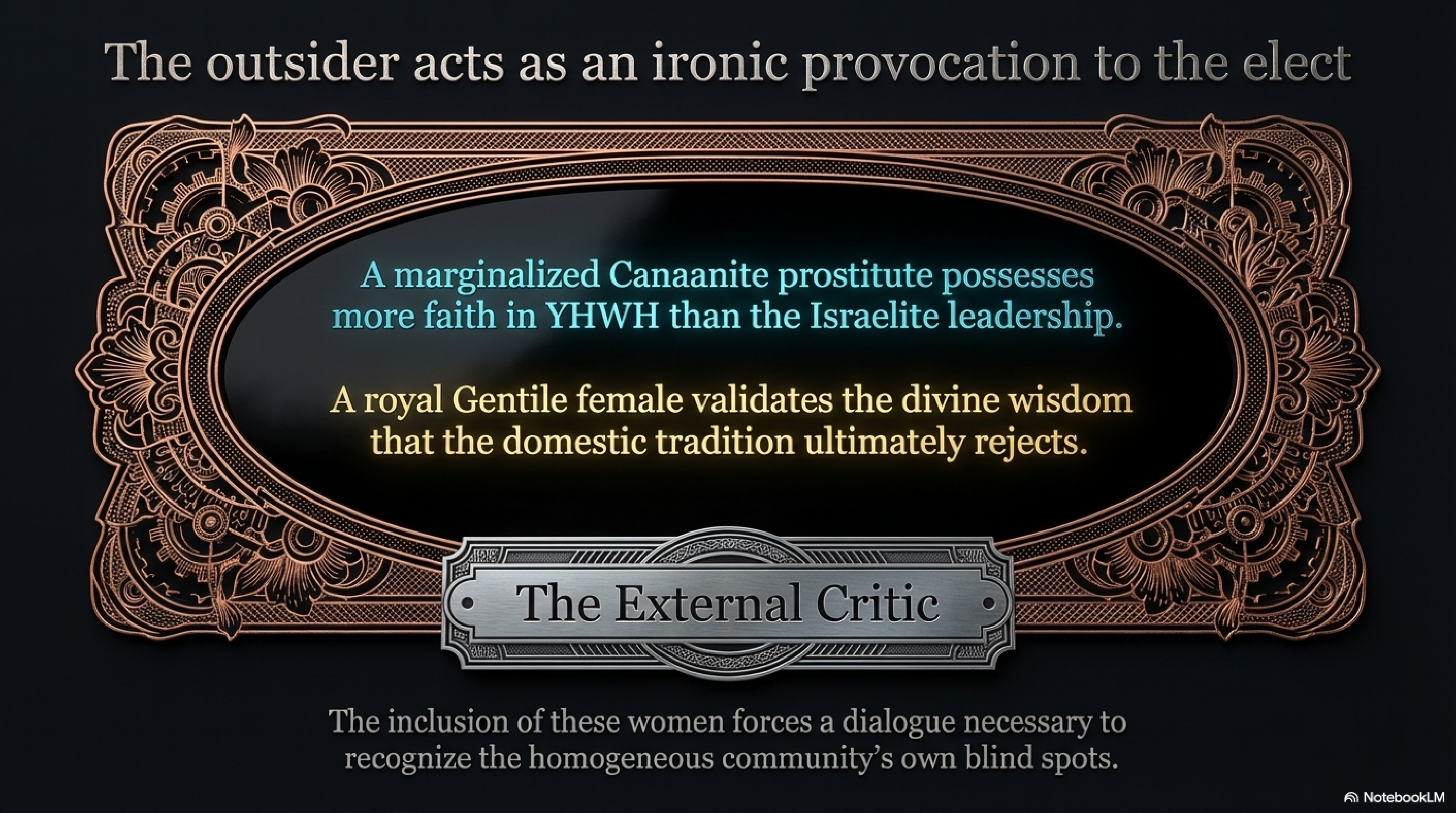
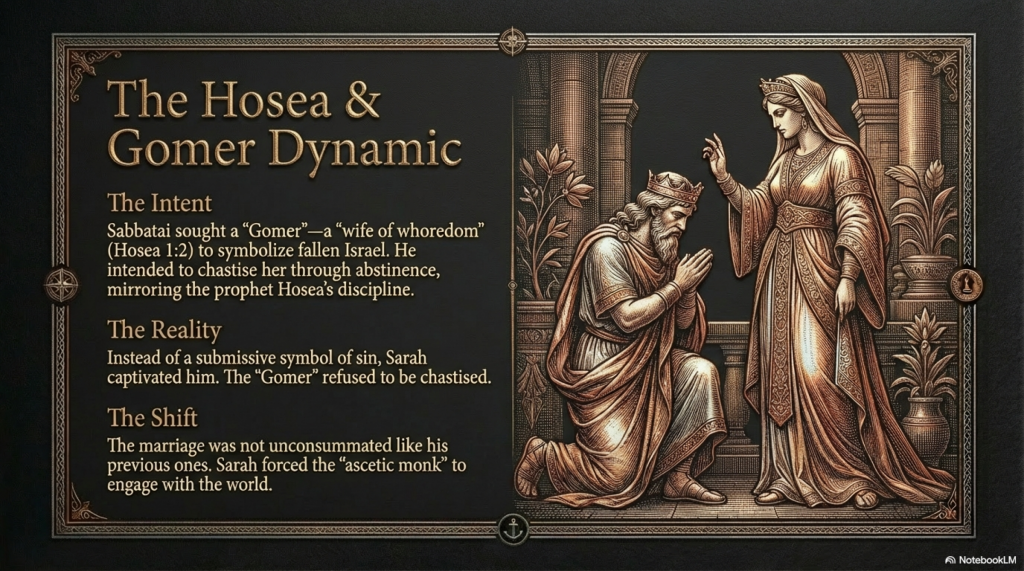
Why would a man known for asceticism marry a woman with a reputation for licentiousness? The sources suggest a theological motivation rooted in the Nevi’im (Prophets). Sabbatai Tsevi modeled this union on the Prophet Hosea (Hoshea), whom God commanded to marry a “wife of whoredom” (Gomer) to symbolize the relationship between God and a wayward Israel. By marrying Sarah, Sabbatai was performing a tikkun (repair), engaging with the “fallen” aspects of the world to redeem them.
Conflict with Nathan of Gaza
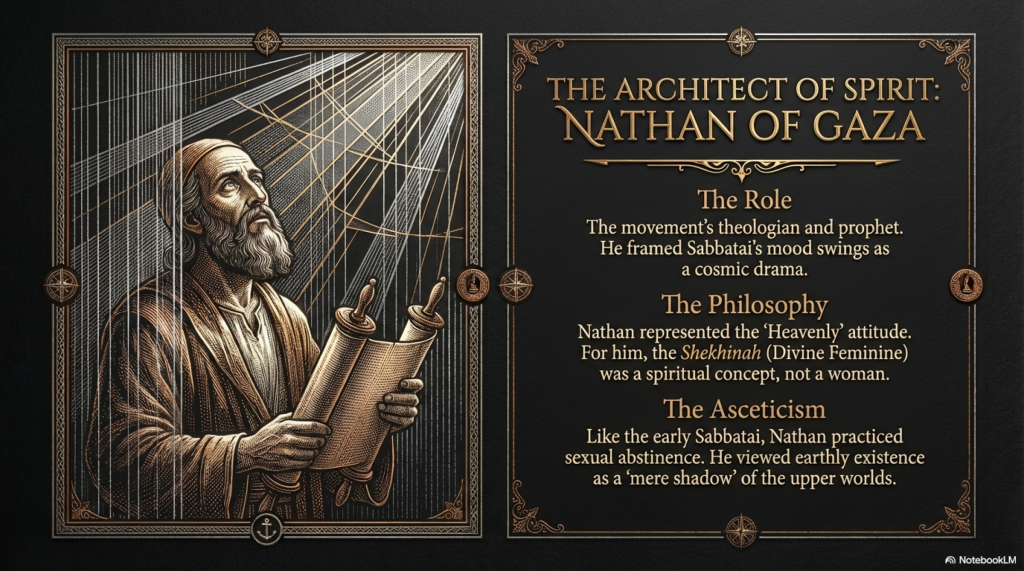
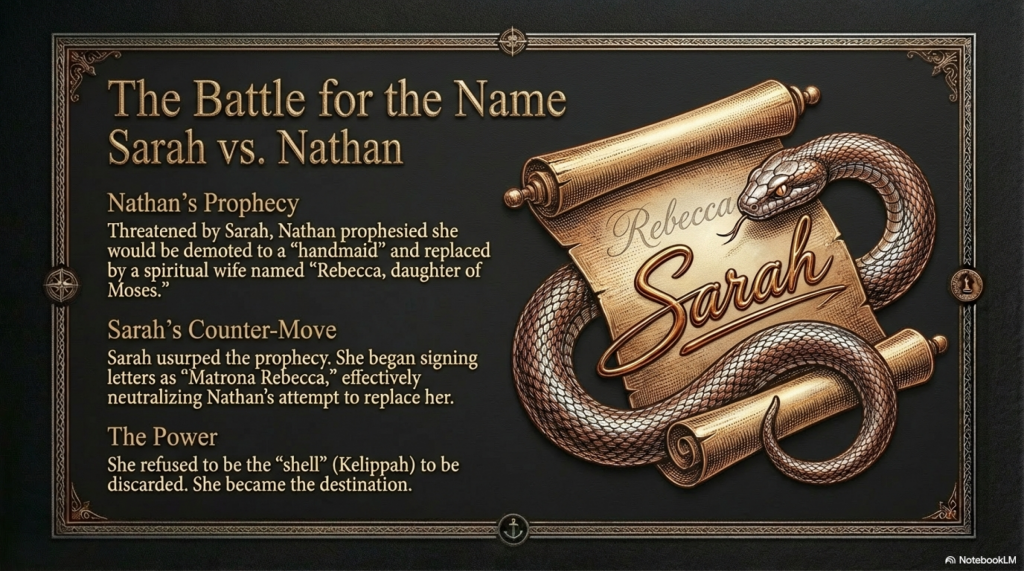
There was significant tension between Sarah and Nathan of Gaza. Nathan, who maintained a more ascetic and spiritual outlook, viewed Sarah as a liability or a necessary evil (the “Gomer” to be chastised). In a prophecy, Nathan predicted that after the redemption, Sarah (whom he referred to as a “handmaid” or concubine) would be replaced by a celestial queen named Rebecca, the daughter of Moses.
Sarah, however, was politically astute. She countered this theological attack by signing her letters as “Matrona Rivka” (Queen Rebecca), effectively usurping the spiritual title Nathan had reserved for her replacement. She refused to be sidelined or treated merely as a sinful vessel for Sabbatai’s use; she asserted her status as the queen of the movement.
The Landscape of Redemption
The movement arose from a period of profound trauma. The Chmielnicki massacres of 1648 had shattered the Jewish world, leaving a desperate void that the community sought to fill with the hope of a Messiah. Sarah herself was a product of this trauma—a refugee of the massacres and an orphan who emerged in Amsterdam and Livorno with a radical, preordained claim: “I am destined to marry the Messiah”.
The Ascetic vs. The Carnal
Before Sarah, Sabbatai Zevi’s messianism was defined by extreme asceticism. Tormented by “demons,” his early life was characterized by isolation in caves and the rejection of sexuality, famously divorcing two wives for non-consummation. Nathan of Gaza, the movement’s architect, reinforced this “Heavenly” attitude. To Nathan, the Shekhinah was a spiritual concept, and the earthly wife was merely a “lowly metaphor” for the divine.
The Battle for the Name
The tension between the ascetic and the carnal manifested as a power struggle between Sarah and Nathan. Threatened by her influence, Nathan prophesied that Sarah would be replaced by a “pure” spiritual wife named “Rebecca”. In a brilliant counter-move, Sarah usurped the prophecy by signing her letters as “Matrona Rebecca,” effectively neutralising Nathan’s attempt to discard her.
Descent into the Kelippot
In 1666, the movement faced its greatest crisis when Sabbatai converted to Islam. Sarah converted with him, becoming “Lady Fatima”. For believers, this was not a betrayal but a heroic descent into the Kelippot (husks of evil) to redeem trapped sparks of holiness. Despite a brief attempt by Nathan to convince Sabbatai to divorce her in 1671—calling her a “snake” and “leprosy”—Sabbatai found he could not function without her. His return to Sarah proved that their “sinful” connection was, in fact, the source of his messianic energy.


Legacy: Spousal Theosis
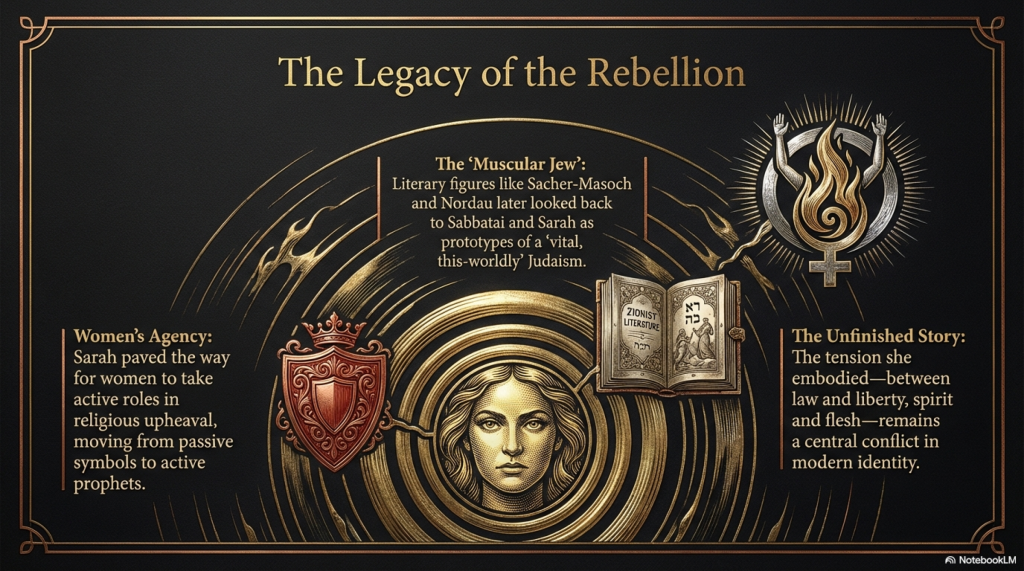
The union of Sabbatai and Sarah represented “Spousal Theosis”—the collapse of the metaphor into the flesh. They did not just point to the divine; they claimed to be the divine incarnation on earth. Sarah’s rebellion paved the way for women to move from passive symbols to active prophets in religious upheaval. Her legacy lives on in the “this-worldly” muscular Judaism later admired by early Zionist thinkers, embodying a permanent tension between law and liberty, and spirit and flesh.

Scholarly Bibliography: Gender, Agency, and Messianic Transgression in Jewish History
1. Introduction: The Intersection of Gender and Messianism
This bibliography serves as a strategic intervention into Jewish historiography, mapping the evolution of female agency through the dialectic of messianic transgression and radical institutional reform. Collectively, these sources illuminate a recurring tension: the collision between rigid, patriarchal communal structures and the disruptive potential of movements that sought to redefine the boundaries of the sacred. By examining the 17th-century Sabbatian movement alongside the 20th-century Bais Yaakov revolution, we identify two distinct modalities of religious transformation. One operated through antinomian rupture—the literalizing of kabbalistic metaphor—while the other executed a “revolution in the name of tradition,” co-opting modern structures to preserve Orthodoxy. Reclaiming figures such as Sarah the Ashkenazi and Sarah Schenirer is not merely a recovery of lost voices; it is a fundamental re-evaluation of women as the primary engines of Jewish historical change.
This analysis begins with the radical, mystical disruptions of the 17th century, where the hierarchy between metaphor and reality first collapsed into “divine flesh.”
——————————————————————————–
2. Core Text Analysis: The Sabbatian Movement and Sarah the Ashkenazi
The primary scholarly anchor for this period is Alexander van der Haven’s exploration of the physical enactment of kabbalistic metaphors.
Source Entry
Van der Haven, Alexander (2012). From Lowly Metaphor to Divine Flesh: Sarah the Ashkenazi, Sabbatai Tsevi’s Messianic Queen and the Sabbatian Movement. Amsterdam: Menasseh ben Israel Instituut (Studies nr. 7). ISBN: 978-90-815860-5-4.
Analytical Annotation
Van der Haven investigates the transition from kabbalistic abstraction to the concept of Spousal Theosis. Central to this study is the “messianic wedding” of Sarah the Ashkenazi and Sabbatai Tsevi, which occurred on March 13, 1664, in Cairo at the home of Raphael Joseph, the representative of Egyptian Jewry. Van der Haven argues that the Sabbatian movement, unlike its predecessors, rejected the strictly metaphorical interpretation of the Shekhinah (the feminine aspect of the Divine). Instead, Sarah was identified as the living, incarnate Shekhinah. This study traces Sarah’s trajectory from a refugee of the Polish pogroms with a controversial reputation in Livorno to her role as a “debaucherous prophetess” who provided the “this-worldly” grounding necessary for Tsevi’s messianic claims.
The “So What?” Layer
The significance of this work lies in its analysis of the movement’s two competing attitudes toward existence. The “Heavenly” attitude, championed by Nathan of Gaza, viewed the earthly realm as a mere shadow of the divine. Conversely, the “This-worldly” attitude, embodied by the physical union of Sabbatai and Sarah, denied hierarchical distinctions between the realms. By acting out erotic kabbalistic metaphors previously restricted to the supernatural level, the movement created a transgressive space for female prophetic authority that challenged the traditional patriarchal monopoly on the sacred.
Comparative Framework: Mystical Transitions
| Pre-Sabbatian Mystical Metaphors | Sabbatian Physical Realizations |
|---|---|
| Supernatural Restriction: Actions and unions are confined to the divine, invisible world. | This-Worldly Orientation: Hierarchical distinctions are denied; mystical union is physically acted out. |
| Language as Tool: Mystics use metaphors of encounter to describe the Godhead. | Body as Tool: Human bodies, particularly Sarah’s, become the literal site of divine activity. |
| Metaphorical Shekhinah: The feminine divine is a kabbalistic concept in the Zohar. | Incarnate Shekhinah: Sarah is viewed as the “divine flesh” of the Shekhinah. |
| Asceticism: Spiritual growth requires the denial of physical desire (Tsevi’s early practice). | Erotic Expression: Sexuality is reframed as a pathway to redemption and “Spousal Theosis.” |
These 17th-century radicalisms were captured with remarkable precision by contemporary observers who documented the movement’s rise and fall.
——————————————————————————–
3. Historical Chronology and Contemporary Accounts
The historical grounding of the Sabbatian narrative relies on chronicles that balance messianic enthusiasm with the sobering reality of the movement’s eventual fragmentation.
Primary Chronicle: Leyb ben Oyzer
Leyb ben Oyzer (1718). Bashraybung fun Shabsai Tsvi (Description of Sabbatai Tsevi). Amsterdam.
As the shamash ha-kehilla (community notary/secretary) of Amsterdam, Oyzer possessed a professional detachment that allowed him to interview contemporaries of Tsevi. His Yiddish chronicle is often paired with his manuscript Ma’asim Nora’im (Horrible Acts), which notably begins with the Gezeyros Yeshu (an abbreviated Toledot Yeshu), framing the Sabbatian movement within a broader intertextual tradition of cautionary tales regarding failed messiahs.
Critical Observations on the Ashkenazi Role:
• The Catalyst of Persecution: Oyzer posits that the messianic fever in Europe was fueled by the “bitter exile,” specifically the brutal harassment of Jews in Poland following the 1648 pogroms.
• Sarah’s Biographical Genesis: Oyzer provides the most vital early accounts of Sarah the Ashkenazi, detailing her claims of being destined for the messiah long before her arrival in Cairo.
• Post-1711 Prophetic Failure: Writing after the failed messianic prophecies of 1711, Oyzer utilizes history as a diagnostic tool to analyze how mass prophecy led to collective communal trauma.
Secondary Analysis: The Cambridge History of Judaism
Goldish, Matt (2017). “Sabbatai Zevi and the Sabbatean Movement.” In The Cambridge History of Judaism, Volume 7: The Early Modern World, 1500–1815. Edited by Jonathan Karp and Adam Sutcliffe. Cambridge University Press.
Matt Goldish emphasizes the global reach of the “Sabbatean Prophets,” illustrating how transnational networks allowed the movement to assuming unprecedented authority. Goldish situates female prophetic agency as a central sociological indicator of the movement’s mass appeal before its transformation into an underground antinomian sect.
——————————————————————————–
4. Onomastics and Identity: The Legal and Social Power of Names
Female agency is further revealed in the legal and social minutiae of medieval life, where naming practices served as both anchors of identity and points of extreme legal vulnerability.
Source Entry
Keil, Martha (2017). “Hendl, Suessel, Putzlein: Women’s Names in Ashkenazi Communities (Fourteenth-Fifteenth Centuries).” Clio. Women, Gender, History, No. 45, pp. 85–105. Published by Belin.
Functional Analysis
Martha Keil identifies two primary functions of identity in medieval onomastics: the establishment of religious affiliation and the signaling of gender. While men’s names were strictly codified to facilitate public religious roles, women’s names (e.g., Slata, Süsslein) often floated between Hebrew tradition and the secular vernacular.
The “So What?” Layer
Keil highlights the disproportionate legal risks for women regarding names. In a Gett (letter of divorce), a “faulty transcription” of a woman’s name could invalidate the document, rendering her an agunah—unable to remarry or claim alimony. Because biblical law permitted polygamy for men but not polyandry for women, clerical errors in a man’s name were minor, while errors in a woman’s name were legal catastrophes. Keil illustrates the magical/religious power of naming through the ritual of Shinnuy ha-Shem (change of name); notably, Rabbi Israel Isserlein changed a sick woman’s name from Hadassa (numerical value 74) to Rachel (numerical value 238) to outwit the Angel of Death through increased numerical power.
Key Terminology in Ashkenazi Onomastics
• Shem ha-kodesh (Sacred Name): The Hebrew name used for public, religious, and legal occasions (e.g., being called to the Torah or inscribed on a tombstone).
• Kinnuy (Secular Name): The everyday, profane name used in the vernacular. For women, this was often the only name used, frequently borrowed from German or Slavic cultures (e.g., Putzlein or Hendl).
The medieval legal constraints of naming provide a stark contrast to the 20th-century revolution, where names and “gendered idiolects” became tools of liberation.
——————————————————————————–
5. Modernity and Tradition: The Bais Yaakov Revolution
The Bais Yaakov movement represents a strategic co-opting of modernity to preserve the traditional Jewish world.
Biographical Re-evaluation: Sarah Schenirer
The YIVO archives reveal a stark divide between the hagiographic “Thumbnail Story” and the “Archival Reality” of its founder:
1. The Thumbnail Story: A simple, pious dressmaker with an eighth-grade education who saved Orthodoxy through “simple” faith.
2. The Archival Reality: A sophisticated intellectual who attended “Folk University” lectures on sexual hygiene and secular literature. She was a devotee of the German writer Herder, attending a conference on his work in Vienna. Notably, her move to Yiddish as a “project” did not occur until 1929; she was previously more fluent in Polish and German.
Strategic Analysis: “A Revolution in the Name of Tradition”
Bais Yaakov functioned as a total institution. It liberated girls from restrictive family oversight by providing an “educational sisterhood.” This allowed for independent travel, summer camps, and even “midnight mountain hikes.” The movement fostered a gendered academic idiolect, teaching girls Hebrew as a grammatical language—a practice often ignored in boys’ yeshivas—granting them a unique linguistic agency.
The “So What?” Layer: D-secularization and Protection
Bais Yaakov’s brilliance lay in co-opting socialist and Zionist models (theatrical choirs, youth groups like Bnos and Basya) to channel youthful passion back into Orthodoxy. Furthermore, it gained international support from figures like Eleanor Roosevelt by framing itself as a “Society for the Protection of Jewish Girls” against the International White Slave Trade. This “protection” served as a strategic alliance with Western feminism. This legacy of agency reached its peak in narratives like the “93 Martyrs,” where students reportedly chose death over forced prostitution, and in the movement’s expansion into vocational training (Nursing and Social Work in Lodz and Warsaw) and Aliyah training (Kibbutz Bais Yaakov in Tel Aviv, 1934).
——————————————————————————–
6. Synthesis: Supplemental References and Research Deepening
Curated Bibliographic Sources
I. Metaphor and Religious Language
1. Smith, David L. (2018). The Role of Metaphor in Religious Discourse.
2. Johnson, Rachel M. (2019). The Power of Metaphor in Religious Thought.
3. Turner, Mark (2017). Metaphor in the Bible: A Cognitive Linguistic Approach.
4. Thompson, Emily R. (2021). Divine Metaphors: Understanding God Through Language.
5. Miller, John H. (2020). The Role of Metaphor in Religious Experience.
6. Williams, Sarah K. (2022). Metaphor and Meaning in Religious Texts.
7. Green, Thomas J. (2019). The Metaphorical Construction of Religious Identity.
8. Foster, Linda C. (2020). Metaphor, Culture, and Religion.
9. Edwards, Paul R. (2021). Metaphor and the Divine: A Comparative Study.
10. Roberts, Angela T. (2023). Theological Implications of Metaphor in Worship.
II. Theology and the Divine
11. Collins, Francis S. (2006). The Language of God.
12. McClure, John S. (2012). Metaphor and the Divine: Theological Implications.
13. Kelsey, David (2010). Theology and Language: The Challenge of Metaphor.
14. Wright, N. T. (2014). Language, Metaphor, and the Divine.
15. Bauckham, Richard (2009). The Metaphor of Language: A Theological Exploration.
16. Keller, Catherine (2011). Theological Language and the Problem of Metaphor.
17. McGrath, Alister E. (2013). Language and the Divine: Theological Reflections.
18. Evans, C. Stephen (2015). The Use of Metaphor in Theology: A Critical Examination.
19. Hauerwas, Stanley (2018). The Metaphorical Turn in Theology.
20. Russell, Robert J. (2016). Language, Truth, and Theological Metaphor.
III. Literary Representations of Divinity
21. Smith, John (2018). Metaphor and Divine Representation in Literature.
22. Johnson, Emily (2021). The Role of Divine Metaphor in Modern Literature.
23. Thompson, Michael (2019). Divine Imagery in Contemporary Fiction.
24. Williams, Sarah (2020). From Symbol to Sacred: Evolution of Divine Representation.
25. Brown, David (2022). Divinity and Metaphor: A Literary Perspective.
26. Green, Laura (2017). The Divine in Literature: A Historical Overview.
27. White, Robert (2023). Metaphors of the Divine: Analyzing Literary Techniques.
28. Black, Jessica (2021). Divine Representation in Postmodern Literature.
29. Gray, Thomas (2019). The Sacred and the Secular: Literature’s Divine Dichotomy.
30. Lee, Anna (2020). Divine Metaphors: Bridging Literature and Theology.
Actionable Research Advice
• Consult the National Library of Israel specifically for the primary manuscript of Ma’asim Nora’im to analyze its intertextual links to the Sabbatian chronicle.
• Analyze Kabbalistic Texts from the Lurianic period to contrast the “Heavenly” metaphor of the Shekhinah with the “This-worldly” enactment by Sarah the Ashkenazi.
• Visit the YIVO Institute for Jewish Research to access the Polish diaries of Sarah Schenirer and the 1931 Bais Yaakov songbooks to understand the movement’s “Total Institution” culture.
Final Synthesis
The sources analyzed in this bibliography reveal that the engines of Jewish religious transformation have frequently been female. From the “Spousal Theosis” of the 17th century—where Sarah the Ashkenazi literally embodied the divine to rupture tradition—to the “Educational Sisterhood” of the 20th century—where Sarah Schenirer used modern tools to save it—women have moved from the legal and social margins to the center of the Jewish experience. Whether through the risk of a misspelled name in a medieval divorce or the vocational nursing degrees of interwar Poland, female agency remains the primary force negotiating the boundary between sacred law and radical new realities.
About the Author