Video Brief Summary on our YouTube Channel
Rachav – Foundation – YouTube
Prolegomena
Radek Chlup’s Proclus: An Introduction offers a comprehensive examination of the life and thought of the influential late Neoplatonist philosopher Proclus. The book explores his intricate metaphysical system, specifically the hierarchical emanation of reality from the “One” through a series of divine unities. Chlup illustrates how Proclus synthesised Platonic philosophy with polytheistic theology, ethics, and sacred rituals to create a unified worldview. The analysis also covers the historical legacy of these ideas, tracing their impact on medieval thought and their relevance to contemporary philosophy. Ultimately, the text serves as an accessible guide to understanding how Proclus bridged the gap between logical reasoning and spiritual practice. [From my Summary]
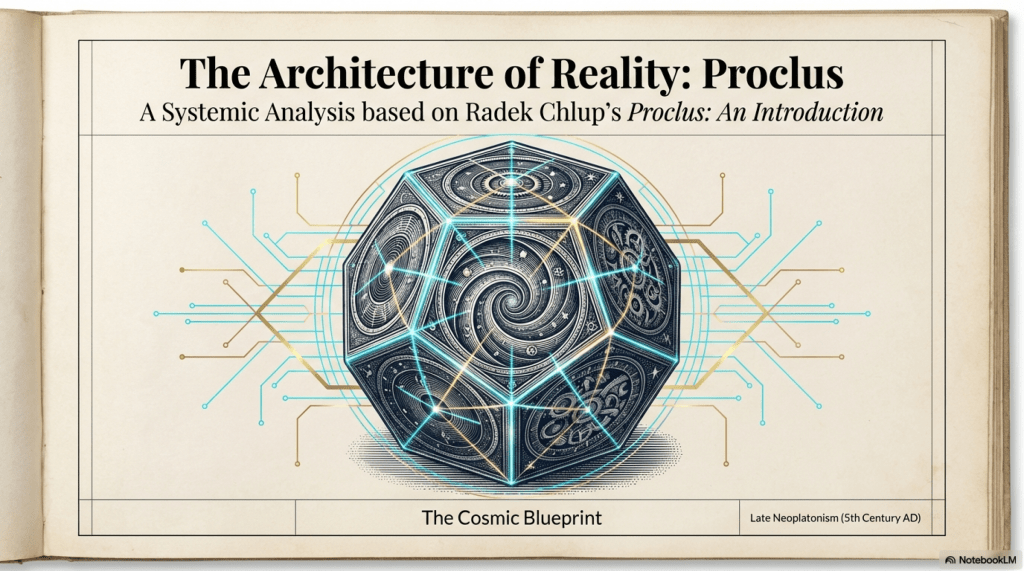
The Idea: Proclus is presented as the “Cosmic Architect,” emphasizing his role in structuring the final, most complex iteration of Neoplatonic metaphysics in the 5th Century AD.
Amplification: The imagery of a polyhedral “blueprint” suggests that for Proclus, reality is not chaotic but follows a precise, geometric, and intellectual design.
Cognate: This resonates with the Demiurge from Plato’s Timaeus, the divine craftsman who shapes the cosmos according to eternal mathematical forms.
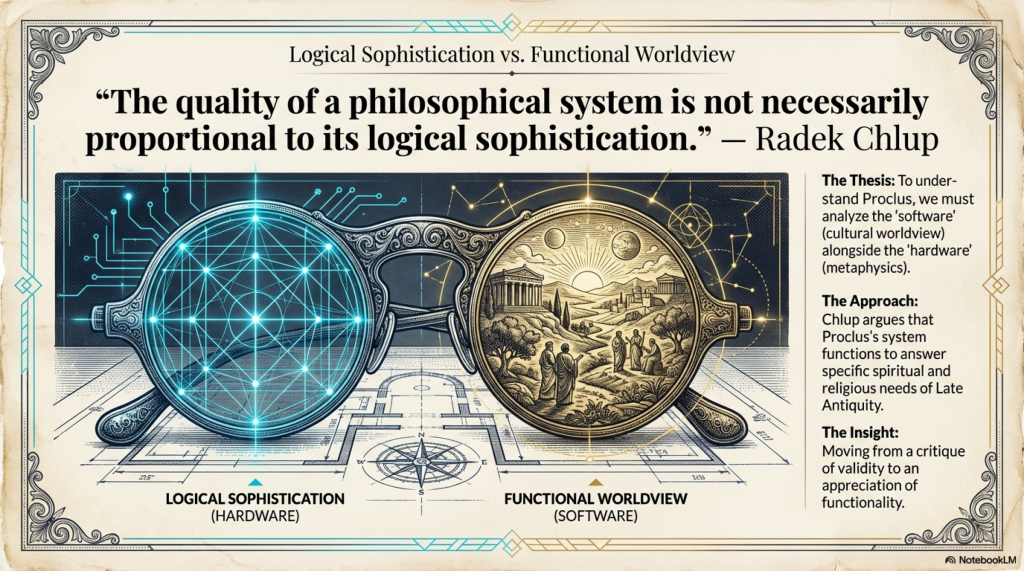
The Hardware/Software Thesis
- The Idea: To understand Proclus, one must distinguish between “Hardware” (metaphysics/logic) and “Software” (cultural/spiritual worldview).
- Amplification: Radek Chlup argues that the quality of a system isn’t just its logical sophistication, but its functionality—how well it meets the spiritual needs of its time.
- Cognate: This is a philosophical parallel to Kuhn’s Paradigm Shift, where a system is judged not just on “truth” but on its ability to solve the “puzzles” of its contemporary culture.
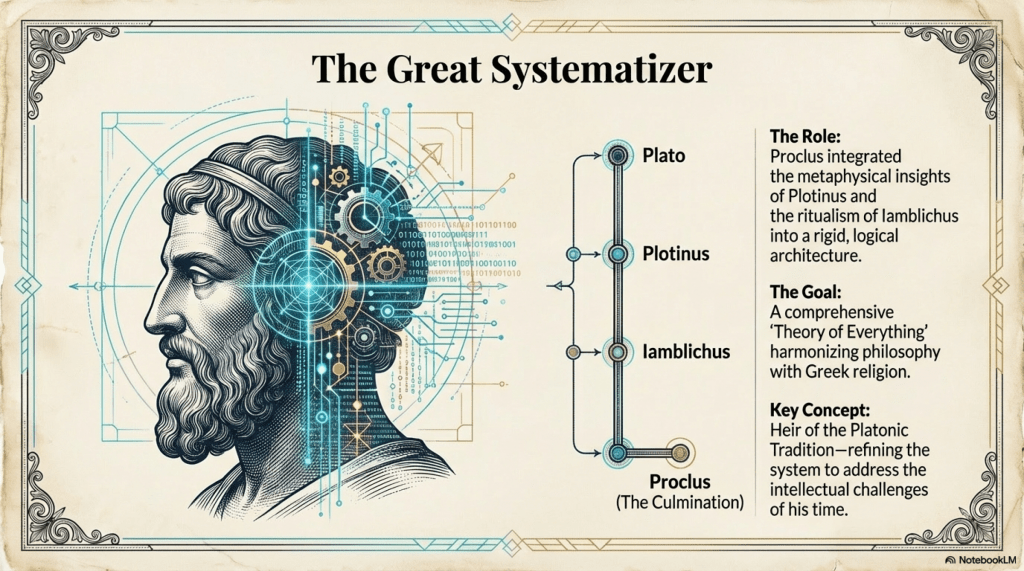
Proclus as the Great Systematizer
- The Idea: Proclus integrated the metaphysical insights of Plotinus with the ritualistic “theurgy” of Iamblichus into a rigid architecture.
- Amplification: His goal was a “Theory of Everything” that harmonized rational philosophy with traditional Greek religion.
- Cognate: Proclus acts as a Grand Unified Theory (GUT) researcher of Late Antiquity, attempting to reconcile the “Quantum Mechanics” of ritual with the “General Relativity” of metaphysics.
| hen (to hen) (εν; το εν) | ||
| (Language: Greek) | ||
| Short Description: the one Long Description: the one, which can mean: 1) Unity or Oneness in general; 2) the unity of anything that has unity or is one thing; 3) that which has unity, anything that is one; 4) the one thing we are speaking of, as opposed to ‘other ones’ (see: F.M. Cornford Plato and Parmenides, London, 1969, p.111); for Neoplatonists, the One is the ineffable source of Being, the Supreme Principle, explicitly regarded as God by Proclus; to hen transcends the demiurgic Intellect and constitutes the first divine hupostasis of Plotinus; it corresponds to Nun, the Father of the gods ( neteru) in the ancient Egyptian theology. Source(s):The Golden Chain: An Anthology of Platonic and Pythagorean Philosophy, by Dr. Algis Uždavinys | ||
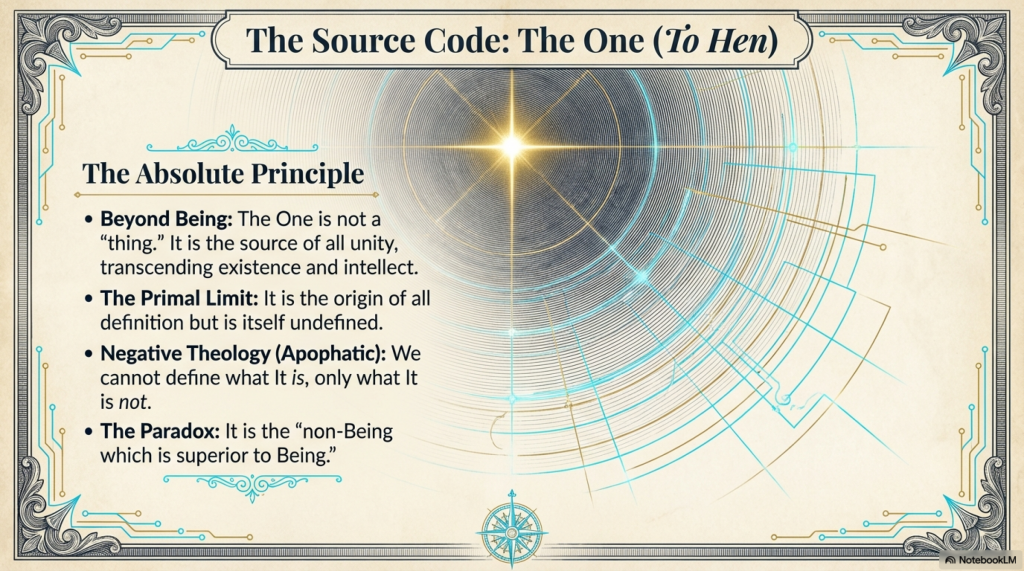
The Source Code – The One (To Hen)
- The Idea: The One is the absolute principle beyond “Being” and definition.
- Amplification: Using “Negative Theology” (Apophaticism), Proclus defines the One by what it is not, calling it a “non-Being superior to Being”.
- Cognate: This bears a striking resemblance to the Sunyata (Emptiness) in Buddhist philosophy or the En Sof in Kabbalah—the infinite source that precedes all manifestation.
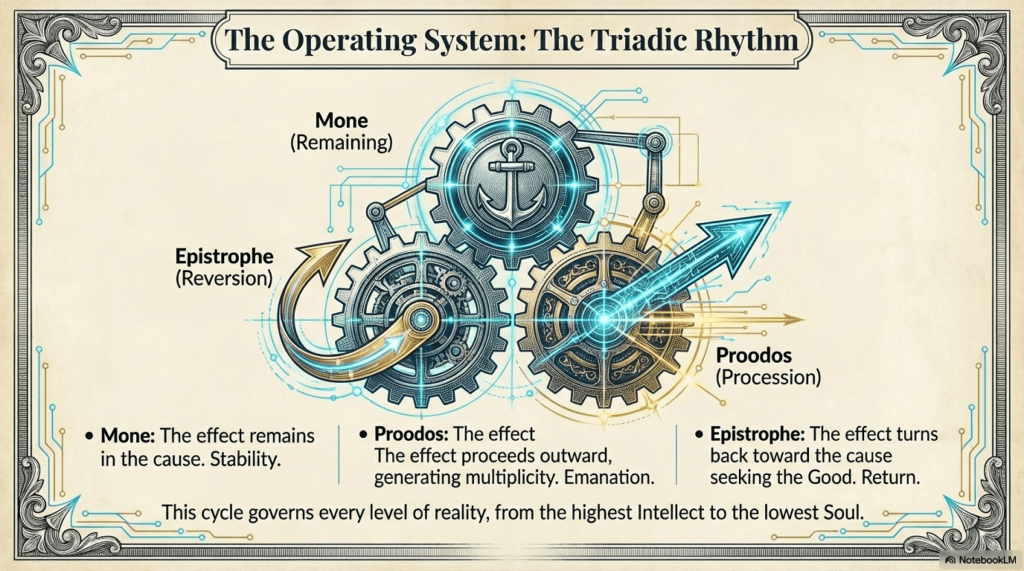
The Operating System – The Triadic Rhythm
- The Idea: Reality functions through a three-beat cycle: Mone (Remaining), Proodos (Procession), and Epistrophe (Reversion).
- Amplification: Mone is the cause’s stability; Proodos is the outward flow into multiplicity; Epistrophe is the movement of the effect back toward its source.
- Cognate: This is an ontological version of Newton’s Third Law (action and reaction) or the Breathe of Brahma in Hindu cosmology—the rhythmic out-breathing and in-breathing of the universe.
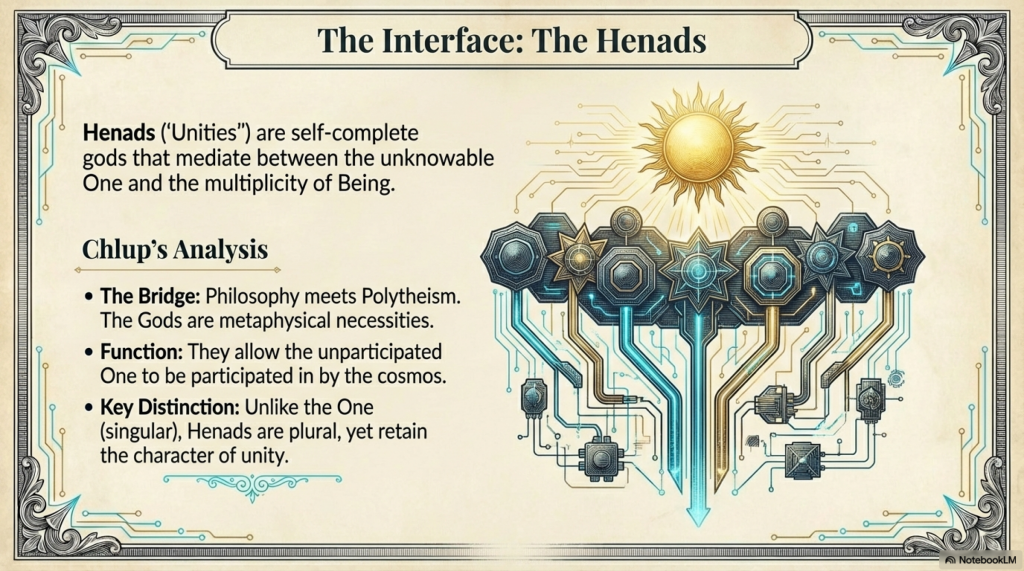
The Interface – The Henads
- The Idea: Henads (“Unities”) are self-complete gods that bridge the gap between the unknowable One and the multiplicity of Being.
- Amplification: They allow the “unparticipated” One to be “participated” in by the cosmos, essentially turning polytheism into a metaphysical necessity.
- Cognate: In modern computing, this is exactly like an API (Application Programming Interface)
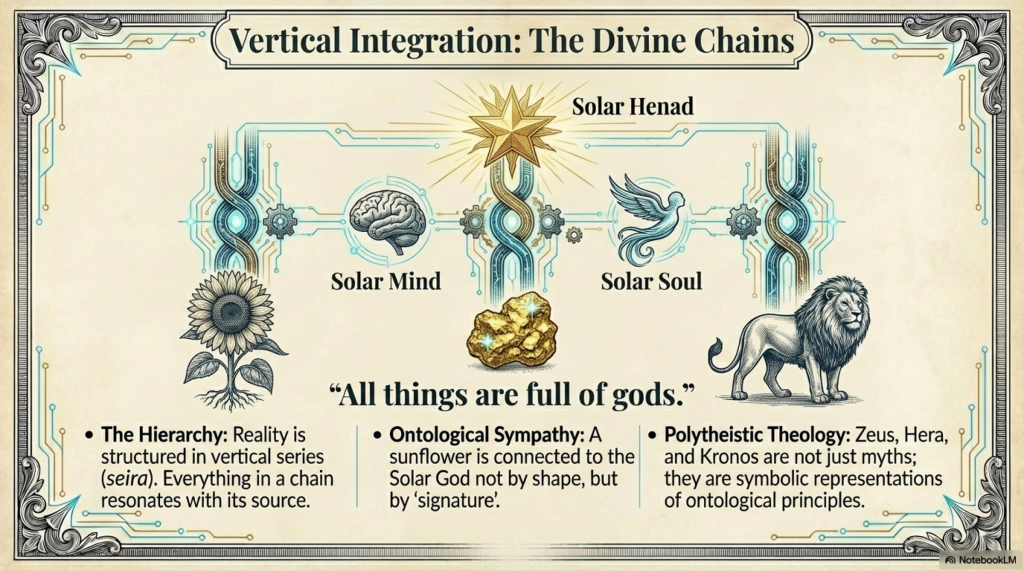
Vertical Integration – The Divine Chains
- The Idea: Reality is structured in vertical series (seira), where everything resonates with its source through “ontological sympathy”.
- Amplification: A sunflower is connected to a “Solar God” by a shared ‘signature’ rather than mere physical shape.
- Cognate: This is the precursor to the Great Chain of Being in medieval philosophy and the concept of Entanglement in physics, where distant entities remain fundamentally linked.
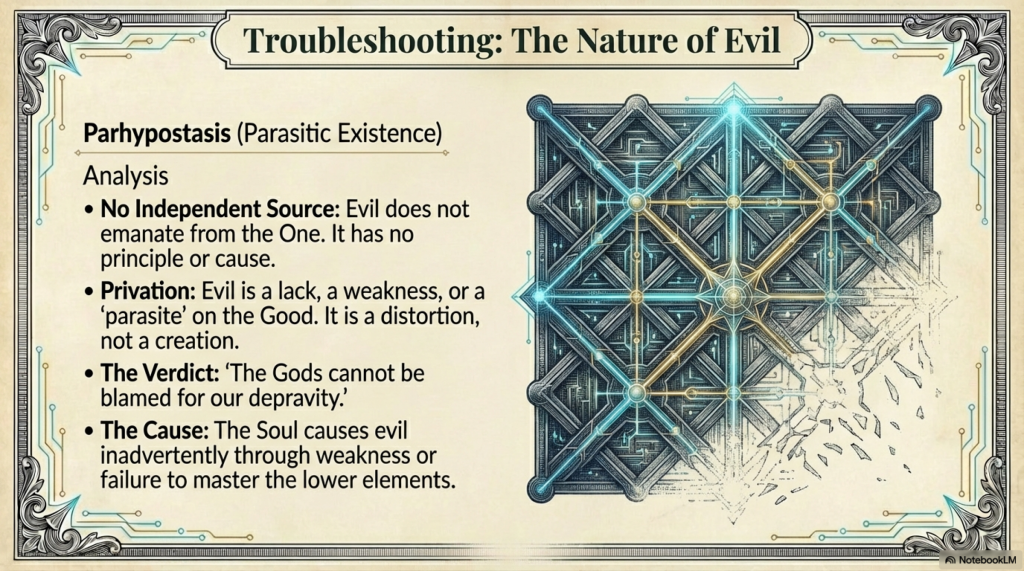
Troubleshooting – The Nature of Evil
- The Idea: Evil is Parhypostasis—a parasitic existence with no independent source or principle.
- Amplification: Evil is a “lack” or “privation” caused by the Soul’s failure to master lower elements; the Gods are not responsible for it.
- Cognate: This is the classic Augustinian Theodicy, which views evil not as a “thing” (darkness) but as the “absence of a thing” (lack of light).
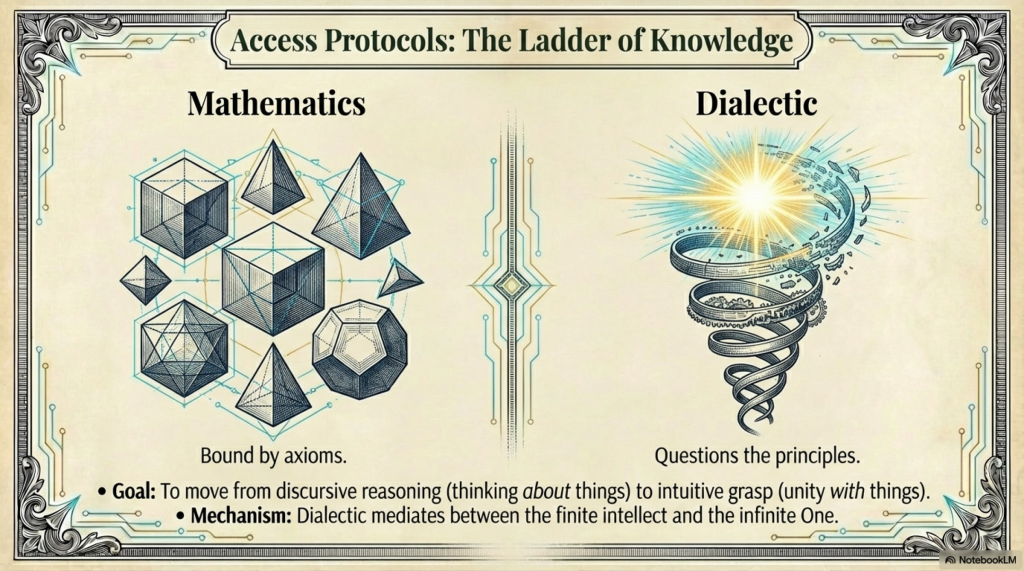
Access Protocols – The Ladder of Knowledge
- The Idea: To reach the One, one must move from Mathematics (axioms) to Dialectic (questioning principles).
- Amplification: The goal is to move from “discursive reasoning” (thinking about) to “intuitive grasp” (unity with).
- Cognate: This mirrors the Four Stages of Cognition in Plato’s Republic, leading from mere belief to the direct vision of the Good
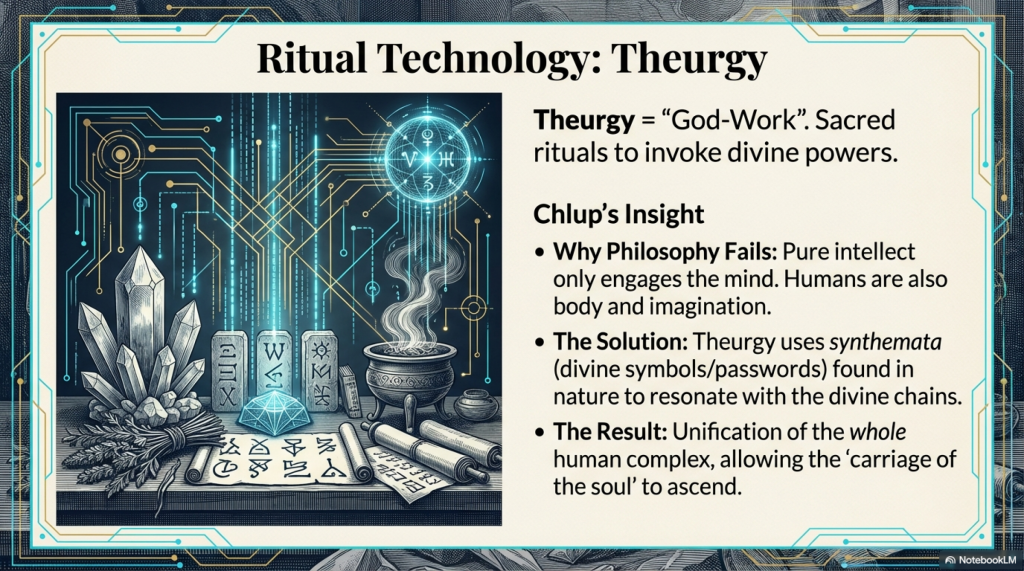
Ritual Technology – Theurgy
- The Idea: Theurgy (“God-Work”) uses symbols/passwords (synthemata) in nature to resonate with divine chains.
- Amplification: Philosophy fails if it only engages the mind; theurgy engages the whole human complex (body and imagination) to allow the soul to ascend.
- Cognate: This is a sophisticated form of Bio-resonance—using specific frequencies (symbols/rituals) to tune the human instrument to a higher cosmic “station.”
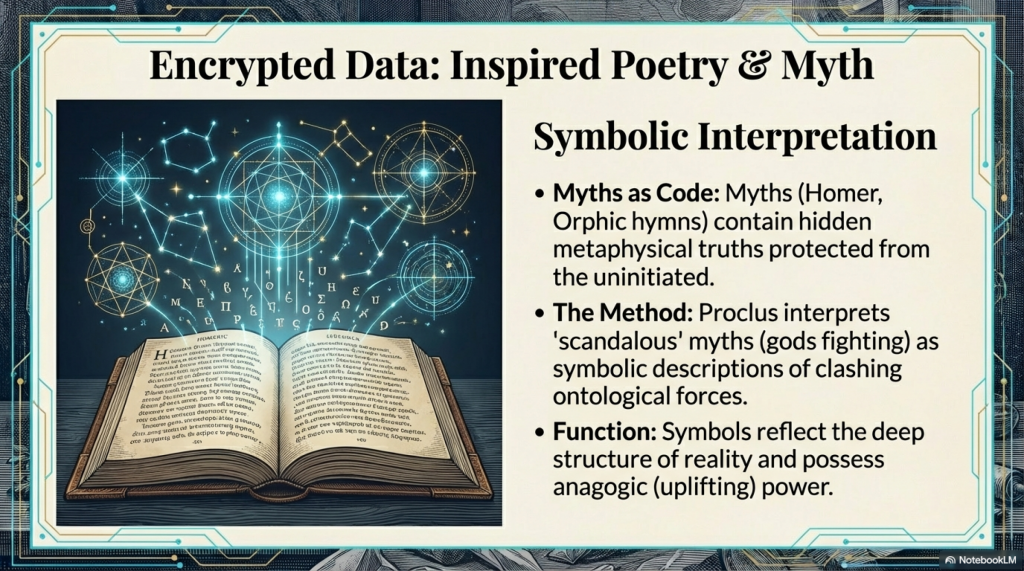
Encrypted Data – Inspired Poetry & Myth
- The Idea: Myths (Homer, Orpheus) contain hidden metaphysical truths “encrypted” for the initiated.
- Amplification: Scandalous myths (gods fighting) are interpreted as symbolic descriptions of clashing ontological forces.
- Cognate: This is the foundation of Hermeneutics, the science of interpretation where the “literal” is discarded in favor of the “deep structure.
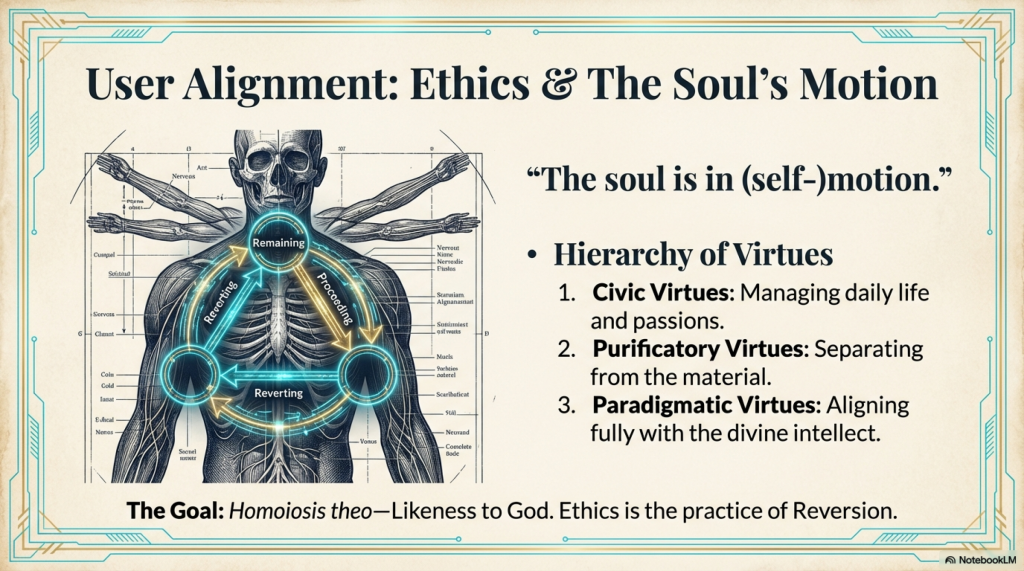
User Alignment – Ethics & the Soul’s Motion
- The Idea: Ethics is the practice of “Reversion” through a hierarchy of virtues: Civic, Purificatory, and Paradigmatic.
- Amplification: The soul is in self-motion, and its goal is Homoiosis theo—becoming like God.
- Cognate: This aligns with the Stoic concept of Prokopton (progressor), where the individual slowly aligns their personal “logos” with the “Universal Logos.”
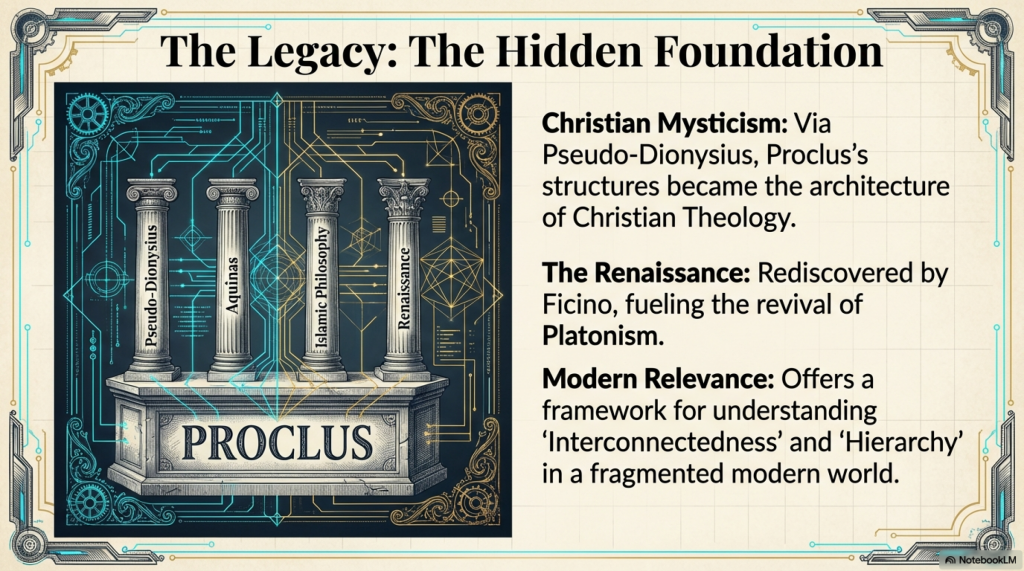
The Legacy – The Hidden Foundation
- The Idea: Proclus’s structures became the “hidden architecture” of Christian, Islamic, and Renaissance theology.
- Amplification: Through Pseudo-Dionysius, Proclus provided the framework for Christian mysticism and the Renaissance revival of Platonism.
- Cognate: Proclus is the “Root User” of Western mysticism; his code runs in the background of almost every major monotheistic system of the last 1,500 years.
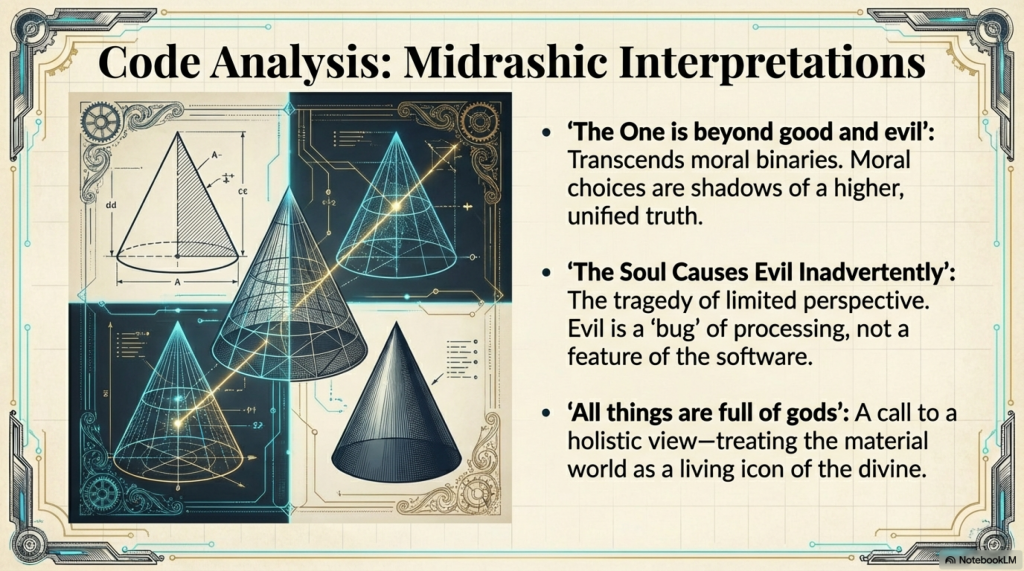
Code Analysis – Midrashic Interpretations
- The Idea: A summary of key Proclian insights: the transcendence of moral binaries and the view of evil as a “bug” of processing, not a “feature”.
- Amplification: It calls for a “holistic view,” treating the material world as a living icon of the divine.
- Cognate: This is Deep Ecology avant la lettre—the idea that the world is a sacred, interconnected whole rather than a collection of dead resources.
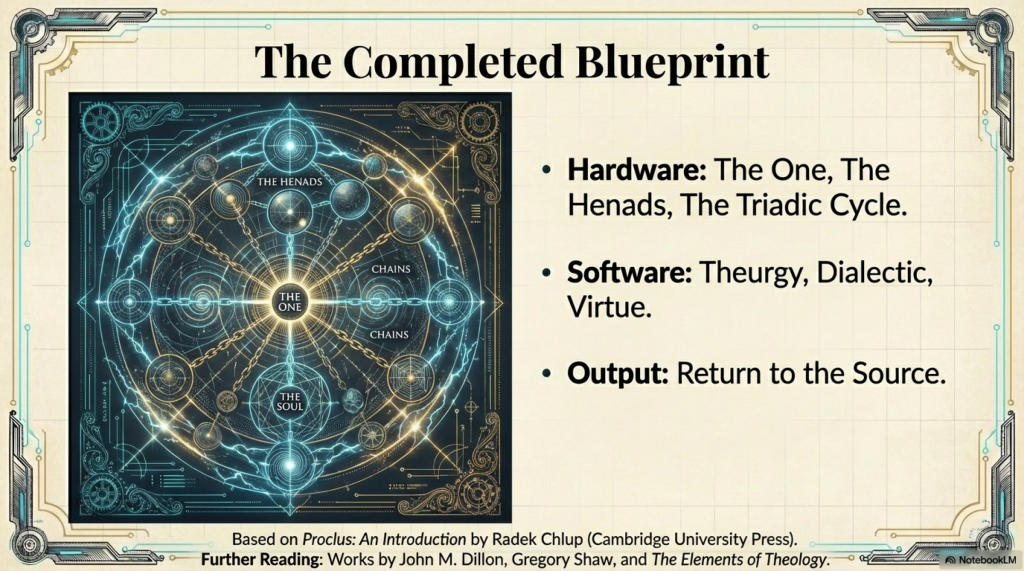
The Completed Blueprint
- The Idea: A final summary of the system: Hardware (The One/Henads/Triad) + Software (Theurgy/Dialectic/Virtue) = Return to Source.+1
- Amplification: The presentation cites Chlup as the primary source, with further reading recommended in John M. Dillon, Gregory Shaw: The Elements of Theology and many others.
An in-depth (32 Minutes) Audio presentation on Proclus
The Virtuous Ascent: Metaphysics as the Foundation of Proclean Ethics
Abstract
Proclus of Athens stands as a culminating figure in the Neoplatonic tradition, a masterful systematizer who constructed one of the most intricate philosophical frameworks in Western thought. This article’s central thesis is that Proclus’s ethical system is not a separate field of inquiry but is inextricably derived from his metaphysical principles. His concepts of virtue, human purpose, and moral responsibility are logical consequences of a hierarchical cosmos that emanates from and seeks to return to a transcendent first principle, ‘the One’. This analysis will demonstrate that for Proclus, the ethical life is a virtuous ascent through this cosmic structure, a journey of alignment with a divine and purposeful order. It will explore the metaphysical architecture of emanation and reversion, the corresponding hierarchy of virtues, and the Neoplatonic solution to the problem of evil as a privation of the good. Ultimately, the article argues that the profound coherence of Proclus’s thought offers an enduring model for integrating metaphysics, spirituality, and ethics.
——————————————————————————–
1.0 Introduction: Systematizing the Ascent
Proclus (412–485 CE) was a pivotal systematizer of the Neoplatonic tradition, inheriting and refining the philosophical currents of Plato, Plotinus, and Iamblichus to create one of the most elaborate and comprehensive metaphysical systems in Western philosophy. To engage with his thought is to enter a meticulously structured intellectual and spiritual cosmos. A crucial element for understanding this cosmos is recognizing that for Proclus, ethics is not an independent discipline concerned with societal norms or individual happiness in a vacuum. Instead, it is a direct and practical application of his foundational metaphysical and theological principles.
This article’s central argument is that Proclus’s ethical philosophy—including his concepts of virtue, the ultimate goal of human life, and the nature of evil—is a necessary and logical consequence of his hierarchical model of reality. This model posits that all existence emanates from and is ontologically oriented to return to the ultimate principle of ‘the One’. To live ethically, in this framework, is to consciously participate in this cosmic movement of reversion, ascending from the multiplicity and limitation of the material world toward the unity and perfection of the divine source.
To substantiate this claim, the analysis will first delineate the metaphysical architecture of Proclus’s cosmos. It will then explore the ethical imperative of the soul’s ascent that arises from it, followed by an examination of his theodicy, and conclude with an assessment of the system’s coherence. This exploration will begin, as it must, with the foundational principles that structure Proclus’s vision of reality.
2.0 The Metaphysical Architecture of Reality
To comprehend Proclus’s ethics, one must first grasp the ontological framework upon which it is built. For Proclus, the cosmos is not a random collection of objects but a structured, interconnected, and purposeful whole. Every entity, from the highest divinity to the lowest material form, has its place within a grand, hierarchical order. Human action, virtue, and purpose find their meaning only within this meticulously organized structure, which flows from a single, transcendent source.
2.1 The One and Hierarchical Emanation
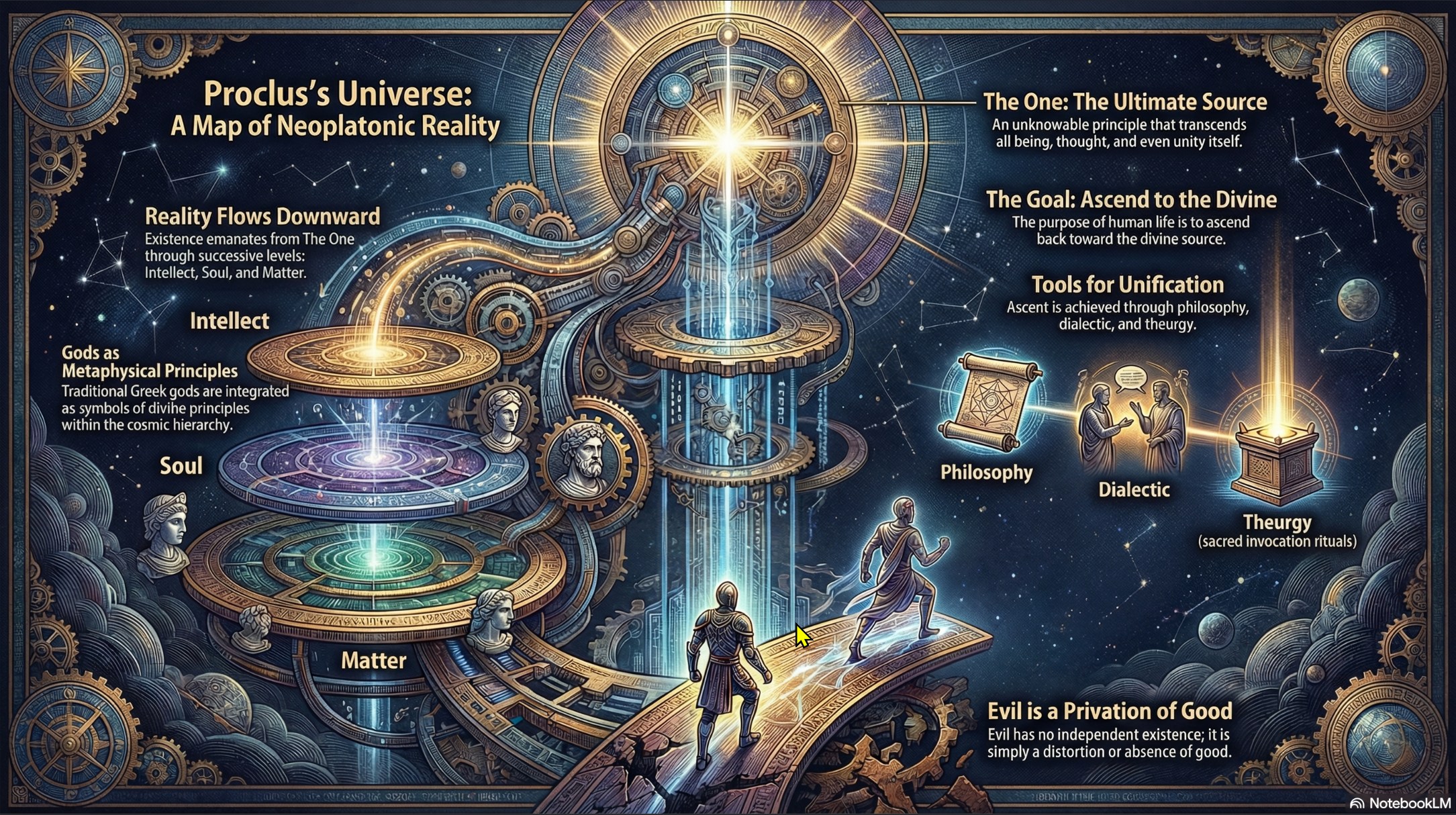
At the apex of Proclus’s system is ‘the One’ (to hen), the ultimate, transcendent principle that is the source of all existence. The One is radically simple and unified, superior to both being and intellect. It is the absolute Good from which all reality originates, yet it remains beyond any category or description that human language can apply to it.
From this ineffable source, all of reality flows in a process of hierarchical emanation. This is not a temporal creation but a timeless and continuous overflowing of reality through successive stages, each less unified and more multiplied than the last. The procession moves from the One through the levels of being, intellect, and soul, down to the sensible, material world. Proclus characterizes this entire cosmic process with his signature triadic structure, which serves not as a static classification but as the dynamic engine of the cosmos. This universal law of cause and effect, of identity and difference, governs everything from the gods to the soul’s own thoughts through three moments:
1. Remaining (monē): The inherent stability of an effect as it remains grounded within its cause.
2. Procession (proodos): The outward emanation or flowing forth of the effect from its cause, generating a lower level of reality.
3. Reversion (epistrophē): The inherent, natural drive of the emanated effect to turn back and return to its source, seeking reunification.
This triadic rhythm is the universal law of Proclus’s cosmos, and the principle of Reversion forms the metaphysical basis for his entire ethical project.
2.2 Divine Mediation and Interconnectedness
Between the absolute unity of the One and the vast multiplicity of the cosmos, Proclus introduces intermediary divine principles to ensure a seamless and interconnected reality. The primary mediators are the henads, or divine unities, which participate in the One’s supreme unity while also serving as the highest principles for the specific chains of being that flow from them.
This metaphysical structure underpins Proclus’s philosophical polytheism. He integrates the traditional Greek gods into his Neoplatonic framework not as capricious mythological figures, but as symbolic representations of powerful ontological principles. These divinities are organized in vertical “chains or series,” permeating all levels of existence and ensuring a divine presence throughout the cosmos. This vision is powerfully captured in the Proclean assertion that “all things are full of gods.” For Proclus, the universe is not a profane space with isolated sacred pockets; rather, it is a holistic and divine organism, infused with divine power at every level. This vision of a purposeful, divinely saturated reality provides the direct context for the human soul’s ethical obligations.
3.0 The Ethical Imperative: The Soul’s Ascent to the Divine
Having established the metaphysical map of Proclus’s cosmos, we now turn to the soul’s journey within it. For Proclus, ethics is fundamentally soteriological—it is the practical science of salvation and liberation. It provides the guide for the soul’s conscious participation in the cosmic principle of reversion, transforming a natural, inherent tendency into a deliberate and virtuous ascent back to its divine origin. Ethics, therefore, is the art of navigating the cosmic hierarchy.
3.1 The Goal of Human Life: Reversion to the One
The ultimate goal (telos) of human life in Proclean ethics is the soul’s ascent toward the divine. This purpose is not arbitrary or socially constructed; it is written into the very structure of being. Just as every emanated reality possesses an innate drive to return to its source, the human soul’s highest calling is to actively pursue this reversion. Ethical development is thus synonymous with this upward journey. The good life is a life spent moving from preoccupation with the material, partial, and discursive toward a direct, intuitive grasp of the intelligible, unified, and divine principles that structure reality.
3.2 The Hierarchy of Virtues
Reflecting the hierarchical structure of his metaphysics, Proclus’s ethical framework is built upon a hierarchical view of virtues. Different virtues correspond to different levels of the soul’s development and its alignment with reality. To become more virtuous is, quite literally, to embody a higher and more unified level of being. This ethical ladder encompasses multiple stages, but the primary levels of this ascent include:
• Civic Virtues: These are the practical virtues relevant to daily life and the harmonious functioning of society. They moderate the passions and ensure order in the soul’s relationship with the external world.
• Paradigmatic Virtues: These are the highest virtues, which exist perfectly in the metaphysical realm of Intellect. They are the pure forms or models (paradeigmata) of which lower virtues are mere images. By cultivating them, the soul transcends its lower functions and aligns itself directly with the divine principles that constitute the cosmic order.
This ethical hierarchy is a direct reflection of the metaphysical hierarchy. The path of moral progress is a journey upward through these levels of virtue, a process of purifying the soul and making it receptive to higher realities.
3.3 The Path to Unification: Philosophy, Dialectic, and Theurgy
Proclus advocates for a holistic path to unification with the divine that engages the soul’s intellectual, spiritual, and even material dimensions. He outlines several distinct but complementary methods for achieving this ascent.
First is the intellectual path, where philosophy and mathematics serve as essential preparatory disciplines. They train the soul to turn away from the senses and toward abstract, intelligible realities. Within philosophy, dialectic holds a special place. Unlike mathematics, which operates on the basis of accepted principles, dialectic is a more powerful and critical tool for ascending to higher knowledge because it rigorously examines the hypotheses upon which knowledge is built, enabling the soul to move beyond them toward unhypothetical first principles.
However, for Proclus, purely intellectual methods are insufficient for complete unification. He therefore places a profound emphasis on theurgy, a set of sacred rituals aimed at invoking divine powers. Theurgy is not a substitute for philosophy but its necessary complement. While philosophy purifies the intellect, theurgy purifies the lower vehicles of the soul and aligns the entire person—including the material body—with the divine chains that permeate the cosmos. It is a holistic practice that recognizes man as a microcosm of the universe, engaging both his material and spiritual dimensions to achieve a more complete and stable reversion to the divine. This comprehensive ethical system, however, must inevitably confront the most significant challenge to any philosophy grounded in a single, good source: the existence of evil.
4.0 Theodicy in a Monistic Cosmos: The Nature and Origin of Evil
The problem of evil presents a critical test for any monistic philosophical system. If all reality emanates from a single, transcendent Good—the One—then what is the nature and origin of evil? Proclus’s solution to this challenge, his theodicy, is a direct and necessary outflow of his core metaphysical commitments, demonstrating the powerful logical consistency of his thought. He constructs an argument that preserves the goodness of the divine source while fully accounting for the reality of wickedness and suffering.
4.1 Evil as Privation
Proclus’s central argument is that evil lacks independent ontological status. It is not a created thing, a substance, or a force that opposes the Good. Instead, evil is a privation or distortion of the good. It is a lack, a falling-short, a deficiency that appears at the lower levels of the cosmic hierarchy.
This privation is not an arbitrary flaw in creation but a necessary consequence of the process of emanation itself. As reality proceeds further from the absolute unity and perfection of the One, it becomes inherently more multiplied, complex, and limited. Evil arises from these necessary limitations inherent in the lower levels of reality. It is the shadow cast by existence, a by-product of the Good’s generous outpouring of being, but it has no substance or reality of its own.
4.2 The Locus of Moral Responsibility
If evil is a necessary consequence of emanation, are the gods or the One responsible for it? Proclus’s answer is a definitive no. While the gods, as creators of all things, also create the conditions for privation, they do not actively produce evil. The responsibility for moral evil rests squarely with the individual soul.
Proclus argues that “the soul causes evil inadvertently.” Wickedness, in this view, is not a conscious choice for evil as such, but arises from a “fundamental misunderstanding of good and evil.” It is a form of ignorance, where the soul, clouded by its association with the material world, mistakes a lesser good for a true good and acts accordingly. This places the burden of moral responsibility firmly on human shoulders, as Proclus asserts, “the gods cannot be blamed for our depravity.” Thus, theodicy in Proclus is not merely an explanation for evil but a reinforcement of the ethical imperative; philosophy and theurgy are the very remedies for the cognitive failure that gives rise to wickedness. The task of the individual is therefore to overcome this ignorance through the virtuous ascent, realigning the soul’s vision and will with the true Good.
5.0 Conclusion: The Coherence and Enduring Relevance of Proclean Ethics
This analysis has sought to demonstrate that the ethical framework of Proclus is neither arbitrary nor peripheral but is deeply and coherently woven into the fabric of his metaphysics. His philosophy presents a unified vision where the structure of reality dictates the purpose of human life, and ethics becomes the practical discipline of navigating that reality.
The core argument of this article is that Proclus’s views on virtue, the soul’s purpose, and the nature of evil are seamlessly integrated with his metaphysics of emanation and reversion from ‘the One’. The good life is the soul’s conscious participation in the cosmic rhythm of return to its source. The virtues are markers of the soul’s progress on this ascent, and evil is understood not as a rival power but as a privation of good that arises from ignorance and must be overcome through philosophical and spiritual discipline.
In the contemporary philosophical landscape, the “decline of metaphysical absolutism” can make grand, all-encompassing systems like that of Proclus appear distant or intellectually inaccessible. However, to dismiss his thought on these grounds would be to overlook its enduring value and profound insights. The Proclean system continues to hold relevance for modern thought in several key ways:
1. Integration of Reason and Spirituality: Proclus offers a powerful framework that harmonizes philosophical rigor with spiritual and religious practices. His system refuses to separate the intellectual quest for truth from the spiritual quest for unification, providing a model for a holistic approach to human flourishing.
2. A Model of Interconnectedness: His philosophy presents a profound vision of an interconnected cosmos, offering deep insights into the relationship between unity and multiplicity, order and chaos. In an era often characterized by fragmentation, Proclus’s emphasis on the purposeful, interconnected nature of all existence remains a compelling intellectual alternative.
3. An Ethics of Aspiration: The Proclean ethical project, grounded in the soul’s ascent toward the divine, provides a potent model of human purpose. It frames ethics not merely as a set of rules for coexistence but as an aspirational journey of self-transformation toward alignment with a transcendent Good.
Proclus stands as one of antiquity’s greatest systematizers, a philosopher who constructed one of the most comprehensive visions of the ethical life. By grounding ethics in the very structure of being, he created a system where the soul’s journey home was a perfect reflection of the cosmic rhythm: to remain in the Good, to know the Good through philosophical procession, and ultimately, to be good through a final, virtuous reversion.
A Beginner’s Guide to ‘The One’ in Proclus’s Philosophy
Welcome, students of philosophy, to an exploration of one of the most profound ideas ever conceived. Our guide on this journey is Proclus, a towering figure from late antiquity who represents the grand culmination of the Platonic tradition. Building on the work of predecessors like Plotinus, Proclus became the great systematizer of Neoplatonism, constructing one of the most comprehensive and intricate metaphysical systems in all of Western philosophy. The cornerstone of this entire edifice is a concept as powerful as it is mysterious: the One.
For Proclus, ‘the One’ is the ultimate source and highest principle of all reality. It is the beginning from which everything originates and the end to which everything strives to return. To understand this concept is to hold the key to the beautiful and complex worldview he so brilliantly articulated.
What is ‘The One’? The Source of Everything
In Proclus’s system, ‘the One’ (or to hen in Greek) is the absolute origin of everything that exists, thinks, or has being. It is not, however, a “thing” in any ordinary sense. Proclus describes it through a series of profound and often paradoxical attributes that push our language and reason to their absolute limits.
Here are its key characteristics:
• The Ultimate Source: First and foremost, the One is the origin from which all levels of existence flow or “emanate.” Imagine it as a boundless spring from which the entire river of reality—from gods and intellects down to the physical world—emerges.
• Beyond Being: The One is so primary that it transcends our fundamental categories of what it means “to be.” It is neither an object, nor a mind, nor a concept.
• Transcends Intellect and Goodness: The One is also superior to thought, intellect, and even the concept of “good.” While it is the ultimate source of all goodness—what Proclus calls the absolute Good—it is not “good” in the way we understand it within our limited moral frameworks. It exists beyond all distinctions and definitions.
To capture this paradox, Proclus uses a phrase that seems to defy logic, describing the One as a form of:
“…non-Being which is superior to Being”
This vision of the One as a transcendent, singular source immediately raises a profound question: if reality is so diverse and multifaceted, how can it all originate from a perfect unity? Proclus answers this with his dynamic theory of emanation.
The Great Flow: How Everything Comes from ‘The One’
Proclus explains the creation of reality as a process of emanation, where everything flows out from the One in a magnificent, hierarchical structure. This isn’t a single event but a constant, dynamic process. Every level of reality is connected to its source through a universal, three-step cycle.
This triadic structure governs the relationship between a cause and its effect throughout the cosmos:
1. Remaining: This is the first stage, one of stability and identity. A thing remains stable and connected to its source, holding its essential nature within that higher principle. It is a moment of unity and potential.
2. Procession: This is the creative stage of flowing outward. A thing “proceeds” from its source, creating the next, lower level of reality. This outward movement is how multiplicity and differentiation emerge from unity.
3. Reversion: This is the final and crucial stage. Every created thing possesses a natural impulse to turn back and return to the source from which it came. It is a journey of ascent, a desire for reunification.
Crucially, this cosmic hierarchy was not merely an abstract chain of principles for Proclus. He masterfully integrated the Greek religious tradition into his philosophy, envisioning these levels as populated by the gods. These deities are not whimsical figures but serve as symbolic representations of cosmic principles, forming vertical chains that link the highest divine realities to our world. Thus, his metaphysics is also a profound polytheistic theology, where “all things are full of gods.”
This elegant system explains how the world comes to be, but it simultaneously presents a formidable challenge to the human mind: how can we possibly know the source of all this?
The Unknowable Principle: Why We Can’t Grasp ‘The One’
A central tenet of Proclus’s philosophy is his insistence that the One is fundamentally unknowable. Because it transcends being, thought, and language, our finite human intellect simply cannot comprehend it directly. We cannot define what it is because any definition would place a limit on something that is limitless.
So, how can we speak about it at all? Proclus employs a method known as negative theology. We can only approach an understanding of the One by stating what it is not. For example, we can say it is not a being, not a mind, not limited, and not defined by our concepts of morality. This is powerfully captured in the statement:
“The One is beyond good and evil”
This does not mean the One is immoral or apathetic. It means that the ultimate principle of reality transcends the limited, dualistic categories of “good” and “evil” that shape human ethics. Recognizing these limitations of language, Proclus advocated for a cautious and humble approach when making claims about the divine and ultimate reality.
If the One is the unknowable source and procession is the cosmic unfolding, then the purpose of existence must lie in the final stage of the cycle.
The Journey Home: The Universal Return to ‘The One’
Just as everything flows out from the One, everything possesses an innate and powerful drive to return to it. This is the stage of reversion—the journey home. For Proclus, this is the ultimate purpose and goal of all existence.
This return is not a passive drift but an active ascent undertaken by the soul. Proclus outlines a path for this journey, one that involves aligning oneself with the divine order of the cosmos through specific practices. The soul is prepared through mathematics and philosophy, using the rigorous tool of dialectic to move beyond discursive reasoning toward a direct, intuitive grasp of divine truths. This intellectual ascent is complemented by theurgy, a set of sacred rituals designed to invoke the divine powers and purify the soul, engaging both the material and spiritual dimensions of our being in the great return.
This universal striving for reunification gives meaning to the entire cosmic drama, from the highest intellects to the journey of each human soul.
Conclusion: Grasping the Ungraspable
Proclus’s concept of ‘the One’ is one of the most sophisticated and challenging ideas in the history of philosophy. It pushes us to the very limits of our understanding and invites us to contemplate a reality far beyond our everyday experience. As you continue your studies, here are the most important takeaways to remember:
• ‘The One’ is the single, ultimate source of all existence in Proclus’s system. As the great systematizer of Neoplatonism, he presented it as the beginning and end of everything.
• It is a transcendent principle, existing beyond our concepts of being, thought, and even goodness, making it fundamentally unknowable. We can only approach it by describing what it is not.
• All of reality flows out from ‘the One’ (procession) and ultimately strives to return to it (reversion). This cosmic cycle, populated by divine beings and undertaken by the soul through philosophy and ritual, gives purpose to the entire universe.
Ultimately, ‘the One’ is a concept meant to inspire a sense of awe and intellectual humility in the face of the ultimate mystery of existence.
About the Author