Ptah
VISIT OUR YOUTUBE CHANNEL https://www.youtube.com/@Rachav-Foundation
1. Introduction: The Metaphysical Convergences of the Ancient Near East
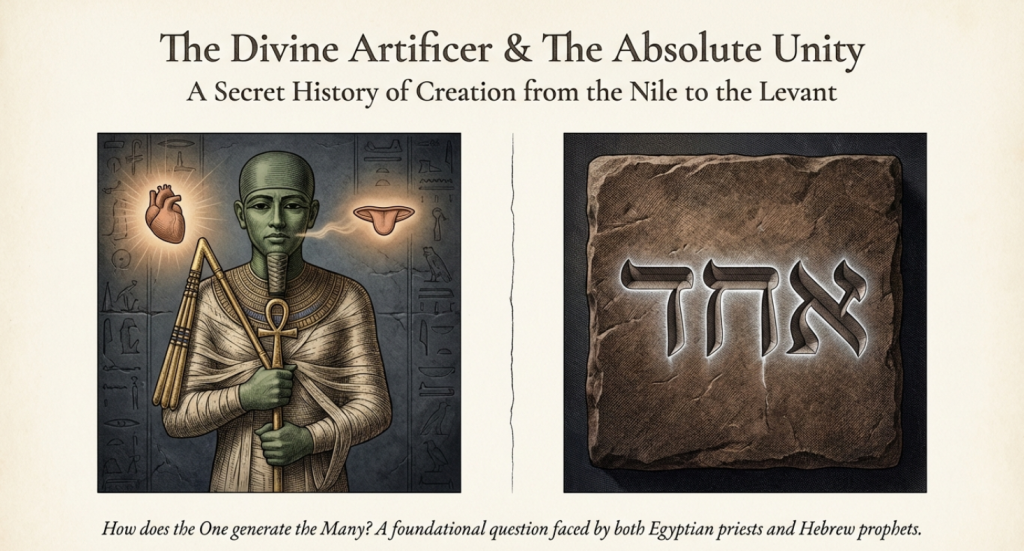
The intellectual history of the Ancient Near East has long been dominated by a binary narrative that juxtaposes the teeming, theriomorphic polytheism of Ancient Egypt against the austere, aniconic monotheism of Biblical Israel. This framework, inherited from the polemics of the Hebrew Bible itself and solidified by centuries of Western theological tradition, posits a radical discontinuity—a “Mosaic Distinction”—between the cosmotheistic worldview of the Nile Valley and the transcendent theology of the Levant. However, beneath the surface of this antagonism lies a profound and often overlooked stratum of convergence. At the deepest levels of theological speculation, both Egyptian and Hebrew thinkers grappled with the same fundamental question: How does the One generate the Many? How does a singular, absolute Will bring forth a complex, material universe?
This report undertakes an exhaustive examination of two specific theological constructs that represent the pinnacle of this metaphysical inquiry: the Ancient Egyptian god Ptah, specifically as articulated in the “Memphite Theology,” and the Hebrew concept of Echad (Oneness), the defining attribute of YHWH. By moving beyond popular depictions of Ptah as a mere craftsman and YHWH as a tribal storm deity, and instead analyzing the sophisticated philosophical texts of the Shabaka Stone, the Ramesside Hymns, and the Sefer Yetzirah, we reveal a startling “secret” history of the Divine Mind.
The inquiry posits that Ptah and Echad represent two distinct yet cognate responses to the discovery of the Logos—the realization that the universe is not merely a biological secretion of the gods, but an intellectual artifact spoken into existence by a supreme consciousness. Through a rigorous philological and comparative analysis, this report demonstrates that the “One” of Memphis and the “One” of Jerusalem share a common mechanism of creation—the synthesis of Thought (Heart/Wisdom) and Speech (Tongue/Word)—while diverging on the relationship between that Creator and his Creation.
1.1 The Scope of Inquiry and Methodological Framework
The scope of this report is expansive, covering over two millennia of religious thought. It begins with the Old Kingdom roots of the Memphite Theology, traverses the New Kingdom solar synthesis of the Ramesside theologians, and culminates in the rabbinic and mystical explications of the Shema in late antiquity and the Middle Ages.
Methodologically, this report adopts a phenomenological approach to comparative religion. We do not seek to prove direct borrowing (though historical transmission is discussed), but rather to analyze the structural and functional similarities between the two systems. We interpret the “gods” of Egypt not as distinct biological entities, but as they were understood by the Egyptian elite: as hypostases, names, and functions of a singular Divine Power. Similarly, we analyze Hebrew monotheism not merely as the worship of “one god,” but as a specific metaphysical assertion about the nature of reality—one that required a complex philosophical vocabulary (e.g., Sefirot, Davar, Ruach) to articulate the transition from unity to multiplicity.
Key primary sources include the Shabaka Stone (British Museum EA 498), the Leiden Papyrus I 350, the Great Hymn to the Aten, the Hebrew Bible (specifically Deuteronomy, Psalms, and Proverbs), and the Sefer Yetzirah (Book of Creation). These texts serve as the empirical bedrock for our theoretical reconstruction of the ancient theology of the Word.
—
2. The Artificer of Memphis: The Secret Theology of Ptah
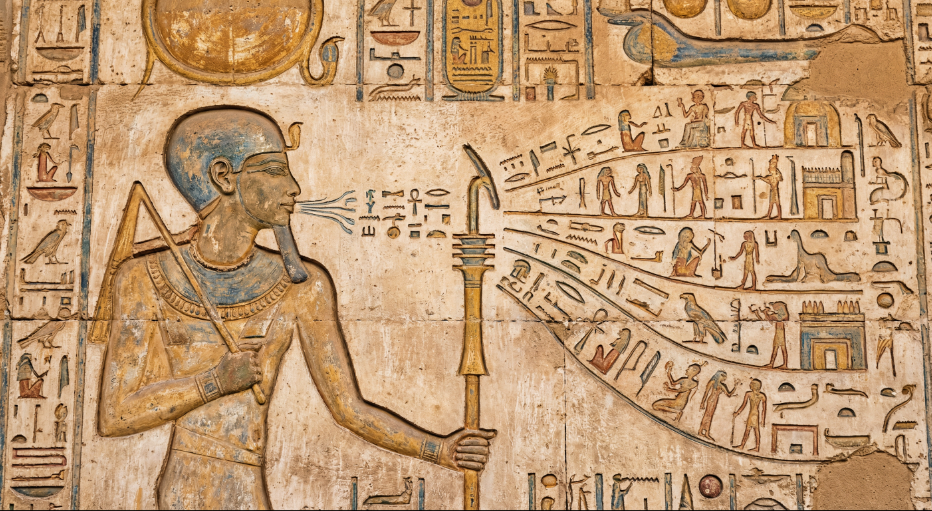
To understand the connection between Ptah and the abstract concept of Echad, one must first strip away the layers of syncretism and popular piety that surround the god Ptah and penetrate the “Memphite Theology”—a system of thought that James Henry Breasted called “the earliest known philosophical worldview.” Ptah is typically depicted as a mummiform man wearing a skullcap, holding a scepter that combines the symbols of life (Ankh), stability (Djed), and power (Was). This iconography, while ancient, belies the radical abstractness of his true nature as revealed in the texts.1
2.1 The Shabaka Stone: The Manifesto of Intellectual Creation
The primary source for the high theology of Ptah is the Shabaka Stone, a slab of black basalt commissioned by the Nubian Pharaoh Shabaka in the late 8th century BCE (25th Dynasty). The inscription explicitly claims to be a copy of a “worm-eaten” document from the time of the ancestors, which Shabaka sought to preserve for eternity.4 While modern scholarship remains divided on the exact dating of the original text—some arguing for an Old Kingdom origin (c. 2500 BCE) based on archaic language, others suggesting a neo-classicizing composition of the late period—the theological content presents a distinct cosmology that rivals the complexity of Greek Logos philosophy.6
The central drama of the Shabaka Stone is the unification of Egypt and the establishment of Memphis as the capital, but its theological core is the “Memphite Theology,” a cosmogony that challenges the dominant Heliopolitan creation myth. In the Heliopolitan system, the creator god Atum evolves out of the primeval waters (Nun) and creates the first pair of gods, Shu (Air) and Tefnut (Moisture), through a physical act—either masturbation or expectoration. This is a biological, generative model of creation: the universe is the fluid or seed of the god.4
The Memphite Theology rejects this biological metaphor in favor of an intellectual and linguistic one. It posits Ptah as the supreme deity who exists prior to Atum and brings Atum himself into existence. The text reads:
“The Ennead is teeth and lips in [Ptah’s] mouth that pronounced the identity of everything… and gave birth to the Ennead.” 6
“Thus it is said of Ptah: ‘He who made all and created the gods.’ And he is Ta-tenen, who gave birth to the gods, and from whom every thing came forth… Thus Ptah was satisfied after he had made all things and all divine words.” 4
Here, the physical gods of the other systems are reduced to mere functions of Ptah’s body. Atum’s hands and semen are replaced by Ptah’s “teeth and lips.” This is a profound shift: the universe is not a biological secretion; it is a sentence.
2.2 The Mechanism of Sia and Hu: Heart and Tongue
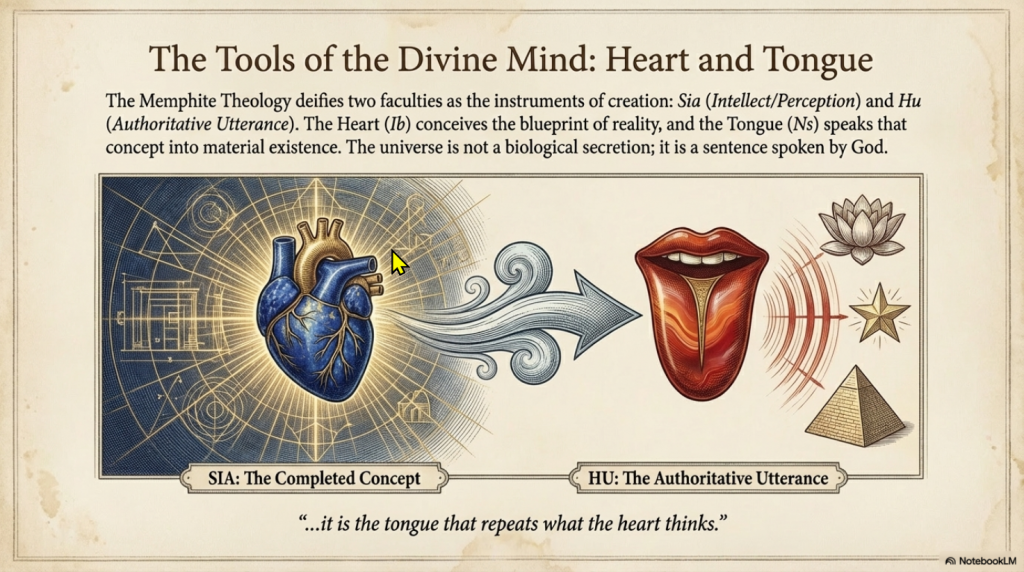
The “secret” mechanism of Ptah’s creative power is the synergy of two faculties: the Heart (Ib) and the Tongue (Ns). In Ancient Egyptian anthropology, the heart was the seat of the mind, the center of consciousness, memory, and intentional thought. The tongue was the agent of authoritative utterance and command.
The Memphite Theology deifies these faculties as Sia (Perception/Intellect) and Hu (Authoritative Utterance).8
- Sia (The Heart): Represents the cognitive act of conceiving the universe. Before a thing can exist, it must be perceived or “thought” by the creator. It is the architectural blueprint of reality.
- Hu (The Tongue): Represents the volitional act of speaking that thought into material existence. It is the “Fiat” or the command (“Let there be…”).
The text explains:
“The sight of the eyes, the hearing of the ears, and the smelling of the air by the nose, they present to the heart. This is what causes every ‘completed concept’ to come forth, and it is the tongue that repeats what the heart thinks.” 9
This passage describes a complete epistemology. Sensory data is synthesized by the Heart into a “completed concept” (a thought-form), which is then objectified by the Tongue. Ptah is the unity of this process. He is the Mind that thinks the universe and the Voice that speaks it. This anticipates the Johannine doctrine of the Word (Logos) and the Genesis account of creation by speech (“And God said…”) by centuries, if not millennia.10
The theological implication is that Ptah is the “Super-God” who transcends the physical pantheon. The text asserts that even the Ka (vital force) of every god and human comes from Ptah. He is the battery of existence. “He gave life to the peaceful and death to the criminal,” implying that Ptah is also the source of the moral order (Ma’at), not just the physical order.5
2.3 Ptah-Tatenen and the Doctrine of Immanence
A critical aspect of Ptah’s “secret” is his identification with Tatenen, the “Rising Land” or “Primordial Mound”.3 In Egyptian cosmogony, the world began as a watery abyss (Nun), from which a single mound of earth emerged (Tatenen). By identifying Ptah with Tatenen, the Memphite priests were making a radical claim about the nature of matter.
Ptah is not just the transcendent Mind (Heart/Tongue) that exists outside the world; he is also the immanent Matter (Earth) that constitutes the world. This is a Panentheistic vision: the universe is the physical body of the divine thought. The earth, the mountains, the grain, and the minerals are all manifestations of Ptah-Tatenen. The Shabaka Stone states that from Tatenen “every thing came forth, foods, provisions, divine offerings, and all good things”.4
This duality—Transcendence via Intellect (Sia) and Immanence via Matter (Tatenen)—is the unique signature of Ptah. He is the God who is both far (as a mind) and near (as the soil). As we shall see, this tension between transcendence and immanence becomes a central theme in the Hebrew concept of Echad as well.
2.4 The Epithets of Ptah: Linguistic Clues to Singularity
The titles and epithets ascribed to Ptah in the Memphite and Ramesside texts provide linguistic evidence for a proto-monotheistic conception of his nature. These epithets distinguish him from the “generated” gods of the pantheon.
Table 1: The Divine Epithets of Ptah
| Epithet (Egyptian) | Translation | Theological Significance |
|---|---|---|
| Kheper-djesef | “He who created himself” / “Self-Created” | Denotes aseity. Ptah has no father or mother; he is the uncaused cause who initiates the chain of being. 1 |
| Pautti Tepi | “The Primeval One” / “First of the Paut” | Paut refers to the primordial substance or dough of creation. Ptah is the original material from which the gods are formed. 13 |
| Netjer Wa | “The One God” / “The Sole One” | Used in hymns to assert his uniqueness. Often followed by nn sn.nw.f (“There is no second to him”). 2 |
| Neb Ma’at | “Lord of Truth/Order” | Identifies Ptah as the source of ethical and cosmic balance, linking the creative act to moral righteousness. 16 |
| Mesu-Netjeru | “Begetter of the Gods” | Reinforces his priority over the Ennead and the rest of the pantheon. 1 |
The epithet Kheper-djesef is particularly crucial for our comparison with Hebrew thought. The Hebrew name YHWH is linked to the root H-Y-H (to be), implying “He Causes to Be” or “He Who Is” (Ehyeh). Both Ptah and YHWH are defined by their self-sufficiency and their power to initiate existence without external agency.
—
3. The Ramesside Theological Revolution: The One and the Millions
While the Memphite Theology laid the foundation for intellectual creation in the Old Kingdom, it was during the New Kingdom—specifically the Ramesside Period (19th and 20th Dynasties, c. 1292–1069 BCE)—that Egyptian theologians articulated a sophisticated synthesis of unity and multiplicity that directly parallels (and possibly influences) the Hebrew concept of Echad. This period followed the tumultuous Amarna revolution of Akhenaten, whose radical monotheism had attempted to obliterate the “Many” in favor of the “One” (the Aten). The Ramesside reaction did not merely return to old polytheism; it developed a “New Solar Theology” that integrated the “One” and the “Many” into a complex unity.17
3.1 The Crisis of the Amarna Interlude
To understand the Ramesside synthesis, one must briefly consider the trauma of the Amarna period. Akhenaten (c. 1353 BCE) had proclaimed the Aten (the solar disk) as the sole god, suppressing the cults of Amun and the other deities. His monotheism was “physical”—the Aten was the physical sun, the source of light and heat, but devoid of the mythological and personal nuances of the traditional gods. Jan Assmann argues that Akhenaten introduced the “Mosaic Distinction” (the distinction between true and false religion) into history, a concept that would later be perfected by the Israelites.19
When the Ramesside pharaohs restored the traditional cults, they did not simply revert to pre-Amarna polytheism. Instead, they incorporated the monotheistic impulse of Akhenaten into a new, transcendent theology centered on Amun-Re. In this system, the “One” (Amun) was not exclusive (like Aten) but inclusive—he contained all other gods.
3.2 The Leiden Hymns and the Ramesside Triad
The most explicit articulation of this theology is found in the Leiden Papyrus I 350, a collection of hymns to Amun from the reign of Ramesses II. Chapter 300 of this papyrus presents a theological formula that has fascinated scholars of religion for over a century. It describes a “Trinity” of gods who are fundamentally One.
The text reads:
“All gods are three: Amun, Re, and Ptah, whom none equals. He who hides his name as Amun, he appears to the face as Re, his body is Ptah.” 17
This verse (Leiden Hymn Chapter 300) serves as a theological key to the Egyptian concept of “Oneness.”
- Three Hypostases: The three greatest gods of the realm—Amun (Thebes), Re (Heliopolis), and Ptah (Memphis)—are identified not as partners or rivals, but as distinct modes or dimensions of a single Divine Being.
- Amun: The “Hidden One” (Imn). He represents the invisible, transcendent soul (Ba) of the god, the mysterious breath of life that animates the universe but cannot be seen.
- Re: The “Sun/Face.” He represents the visible, cosmic manifestation of the god’s power—the light that illuminates the world.
- Ptah: The “Body” (Djet). He represents the physical, immanent presence of the god in the earth (Tatenen), in the temple statutes, and in the craftsmanship of the material world.
- Unity of Essence: The text uses singular pronouns (“He who hides his name,” ” his body is Ptah”) while asserting a plural manifestation (“All gods are three”). This is a “Trinity in Unity”—a distinct theological construct where the One God encompasses the totality of existence: the hidden spiritual realm (Amun), the cosmic celestial realm (Re), and the tangible terrestrial realm (Ptah).
3.3 The Formula of “The One and the Millions”
Another key Ramesside concept is expressed in the phrase “The One who makes himself into millions” (Kheperu em heh).25 This defines Egyptian “monotheism” as Cosmotheism or Pantheism.
- Egyptian View: The One God exists first. He then emanates or transforms himself into the “millions” of gods, spirits, humans, and animals. The “Many” are the unfolded limbs of the “One.”
- The Polemical Context: This formulation allows for the worship of many gods because they are all ultimately aspects of the One. However, it also implies that the One is the only true reality.
This theology sets the stage for the Hebrew intervention. The Israelites would encounter a culture where “Oneness” was already a sophisticated theological category—but one that was radically inclusive and immanent. The Hebrew Echad would adopt the language of this Oneness but invert its relationship to the “Many.”
—
4. The Hebrew Metaphysics of Echad: The Shema and the Polemic of Transcendence
We now turn to the Hebrew concept of Echad (One), the cornerstone of Jewish theology. The central declaration of the Jewish faith is the Shema:
Shema Yisrael YHWH Eloheinu YHWH Echad
“Hear, O Israel: The LORD our God, the LORD is One.” (Deuteronomy 6:4) 27
Superficially, this resembles the Egyptian hymns to the “One God” (Netjer Wa). However, deeply buried in the philology and context of the Shema is a radical departure from the Egyptian model—a departure that constitutes the essence of the “Mosaic Distinction.”
4.1 The Philology of Echad: Unity vs. Uniqueness
The Hebrew word Echad (אחד) comes from the root Aleph-Chet-Dalet, meaning “to be one” or “to unify.” The semantic range of Echad in the Hebrew Bible is debated and crucial for understanding its theological weight.
- Numerical Singularity: The cardinal number one. “One man,” “one stone.”
- Compound Unity: A unity composed of parts. For example, Genesis 1:5 calls the combination of evening and morning “one day” (yom echad). Genesis 2:24 says husband and wife become “one flesh” (basar echad). Ezekiel 37:17 describes two sticks becoming “one” in the prophet’s hand. This usage is often cited by Christian theologians to argue for a plurality within the Godhead.29
- Uniqueness/Exclusivity: The sense of being “the only one.” While the Hebrew word Yachid specifically means “solitary” or “only” (like an only child), Echad can also carry this weight in specific contexts (e.g., “one particular” or “unique among many”).
In the context of the Shema, the meaning of Echad is fiercely debated. Does it mean “YHWH is a compound unity” (like the Ramesside Amun-Re-Ptah)? Or does it mean “YHWH is unique/alone”?
4.2 The “Mosaic Distinction” and the Polemic Against Egypt
Jan Assmann’s theory of the “Mosaic Distinction” posits that the innovation of Hebrew monotheism was not just the worship of one god, but the distinction between “True Religion” and “False Religion” (Idolatry).20 In Egypt, different gods could be translated into one another (Amun = Zeus = Ptah). In Israel, YHWH could not be translated. He was “Jealous” (El Qanna).
Reading the Shema through this lens reveals it as a direct polemic against the Egyptian “One.”
- The Egyptian “One” (Wa): Contains the “Many.” It is the sum of Amun, Re, and Ptah.
- The Hebrew “One” (Echad): Excludes the “Many.” It asserts that YHWH is Echad in a way that denies the reality of the Ramesside Trinity.
Some scholars translate the Shema not as “YHWH is One” (numerical) but as “YHWH is our God, YHWH Alone” (exclusive).33 This reading aligns Echad closer to the meaning of Badad (alone) or Yachid. It suggests that while Egypt sees God as a spectrum (Hidden-Face-Body), Israel sees God as a singularity that cannot be divided into hypostases.
4.3 Maimonides and the Philosophical Purification of Echad
In the medieval period, Jewish philosophers like Moses Maimonides (Rambam) sought to rigorously define Echad to strip away any lingering anthropomorphism or plurality. In his Guide for the Perplexed, Maimonides argues against the Ba’alei To’ar (Attributists) who ascribed distinct attributes to God.
Maimonides posits that Echad means absolute simplicity. God is not a “species” (which has many members), nor a “body” (which has many parts), nor a “compound” (essence + accidents). He is a Unity unlike any other unity in the universe.35
Crucially, Maimonides connects this Unity to the intellect. He cites the Aristotelian dictum that God is “the Knower, the Known, and the Knowledge” all in one.37 This mirrors the Memphite Theology’s integration of Sia (Intellect) and Hu (Word). For Maimonides, the “Secret” of Echad is that God is pure Intellect, and his “Word” is identical to his Essence. This philosophical move effectively closes the loop, bringing the Hebrew Echad into alignment with the high philosophical theology of Ptah, albeit via the language of Greek metaphysics.
4.4 Yachid vs. Echad: The Kabbalistic Nuance
While Maimonides pushed for absolute simplicity (Yachid), the mystical tradition of Kabbalah embraced the dynamic complexity of Echad. The Zohar and other mystical texts see Echad as the unification of the Sefirot—the ten emanations of God.
In this view, YHWH is indeed a “One” that contains “Many” (the Sefirot), but these “Many” are not separate gods; they are internal dimensions of the Divine Personality (Love, Judgment, Beauty). This brings the Kabbalistic Echad startlingly close to the Ramesside conception of Amun-Re-Ptah, where diverse divine attributes are integrated into a singular divine organism.
—
5. The Bridge of Letters: Sefer Yetzirah and the Mechanics of Creation
The most profound “secret” shared by Ptah and Echad is the mechanism of creation. Both systems posit that the universe is not made of matter, but of language. This convergence is most explicitly detailed in the Sefer Yetzirah (Book of Creation), an early Hebrew mystical text (c. 2nd–6th century CE) that parallels the Memphite Theology with uncanny precision.
5.1 The 32 Paths of Wisdom and the Ennead
The Sefer Yetzirah begins with the declaration:
“In thirty-two mysterious paths of wisdom, Yah, the Lord of Hosts… engraved His name… He created His universe with three books (Sepharim): with text (Sepher), with number (Sephar), and with communication (Sippur).” 38
These “32 Paths” correspond to the 10 Sefirot (Numbers/Archetypes) and the 22 Letters of the Hebrew Alphabet.
- The Sefirot: Represent the abstract categories of existence (Depth, Height, East, West, Good, Evil). This corresponds to the Heart of Ptah (Sia)—the conceptual archetypes.
- The 22 Letters: Represent the building blocks of reality. God “combines” and “permutates” these letters to form the “soul of every creature.” This corresponds to the Tongue of Ptah (Hu)—the articulation of the concept into specific forms.
In the Memphite Theology, the Ennead (the company of nine gods) is described as the “teeth and lips” of Ptah.6 The gods are the articulators.
- In Memphis: The “Many” are the Teeth and Lips (phonetic articulators) of the One.
- In Kabbalah: The “Many” are the Letters (phonetic elements) of the One.
Both systems demythologize the polytheistic pantheon. The “gods” are not independent beings; they are linguistic variables in the Divine Speech.
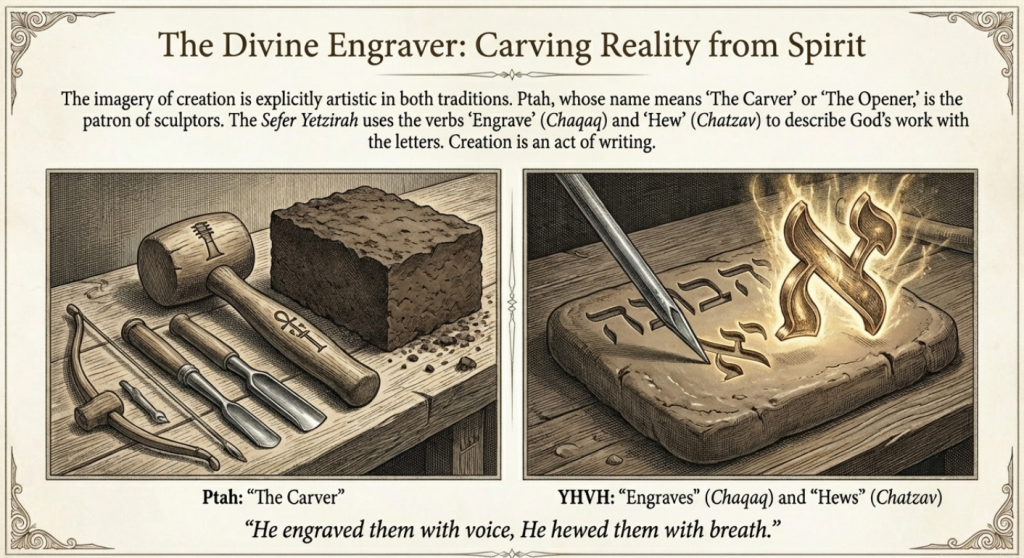
5.2 Engraving and Hewing: The Sculptor God
The Sefer Yetzirah uses two specific verbs to describe creation: Engrave (Chaqaq) and Hew (Chatzav).40
“He engraved them with voice, He hewed them with breath.” (Sefer Yetzirah 1:9)
This imagery of “engraving” is deeply resonant with Ptah. Ptah’s very name (Ptḥ) means “The Opener” or “The Carver” (related to semitic roots for opening/engraving). He is the patron of sculptors and craftsmen. The hieroglyphic sign for Ptah often includes the drill or the chisel.
- Ptah: Carves the world out of Tatenen (Matter/Earth) using Thought.
- YHWH: Carves the world out of the Holy Spirit (Ruach) using Letters.
The “Secret” here is that creation is an act of Writing. The universe is a text. To the Egyptian priest, the hieroglyphs (Medu Neter) were the “Words of God” that had ontological power. To the Hebrew mystic, the Hebrew letters (Otiyot) were the stones from which the universe was built.
5.3 The Triad of Creation: Voice, Breath, Speech
The Sefer Yetzirah (1:9) presents a triad that mirrors the Memphite/Ramesside system:
“Voice (Kol), Breath (Ruach), and Speech (Dibur)—this is the Holy Spirit.” 42
Compare this to the Ramesside Triad:
- Amun (Hidden Breath/Wind): Corresponds to Ruach (Breath/Spirit).
- Re (Visible Light/Face): Corresponds to Kol (Voice – the raw sound/energy).
- Ptah (Articulated Body/Speech): Corresponds to Dibur (Speech – the formed word).
The convergence is stunning. Both systems identify the creative agent as a “Holy Spirit” (Amun/Ruach) that manifests through a “Voice” (Re/Kol) and is articulated into concrete reality by “Speech/Body” (Ptah/Dibur).
—
6. Comparative Philology and Theology: A Deep Dive Data Analysis
To substantiate these theological parallels, we must examine the specific linguistic roots and concepts.
Table 2: Comparative Philology of Divine Attributes
| Concept | Egyptian Term | Hebrew Term | Analysis of Convergence |
|---|---|---|---|
| Creation | Kheper (To become/evolve) | Bara (To create/shape) | Kheper implies self-evolution (beetle); Bara implies cutting/separating. Ptah integrates both as the “Self-Created” (Kheper-djesef) who “Carves” the world. |
| The Word | Hu (Authoritative Utterance) | Davar (Word/Thing) | Both terms link speech to ontology. In Hebrew, Davar means both “word” and “thing/matter,” implying that words are things. |
| Intellect | Sia (Perception/Insight) | Chokhmah (Wisdom) / Da’at (Knowledge) | Both represent the internal blueprint. Da’at serves as the bridge between Wisdom (Chokhmah) and Understanding (Binah), just as Ptah unites Heart and Tongue. |
| Spirit/Wind | Amun (Hidden/Wind) / Shu (Air) | Ruach (Breath/Wind/Spirit) | The animating force. In Genesis, the Ruach Elohim hovers over the waters; in Memphis, Ptah breathes life into the nostrils of all living things. |
| Truth/Order | Ma’at (Cosmic Order/Truth) | Emet (Truth) / Tzedek (Righteousness) | Creation is not just physical but ethical. Ptah is Neb Ma’at; YHWH is the God of Truth (El Emet). |
| Oneness | Wa / Weti (One/Sole) | Echad (One) / Yachid (Unique) | Both cultures obsess over the “Oneness” of the Creator, though Egypt creates an “inclusive” One and Israel an “exclusive” One. |
6.1 The “Weti” and the “Echad”
The Egyptian epithet Weti (or Wa-ti) means “The Sole One”.2 It is linguistically distinct from the number one (Wa), carrying the nuance of “solitariness.” This is the precise semantic equivalent of the Hebrew Yachid.
However, the Bible prefers Echad. Why? Perhaps because Echad allows for a relationship. A Yachid (Solitary) God cannot be a King or a Father, for these roles require subjects and children. An Echad God can be One over a people. This reflects the “Covenantal Monotheism” of Israel, which is political as well as metaphysical.
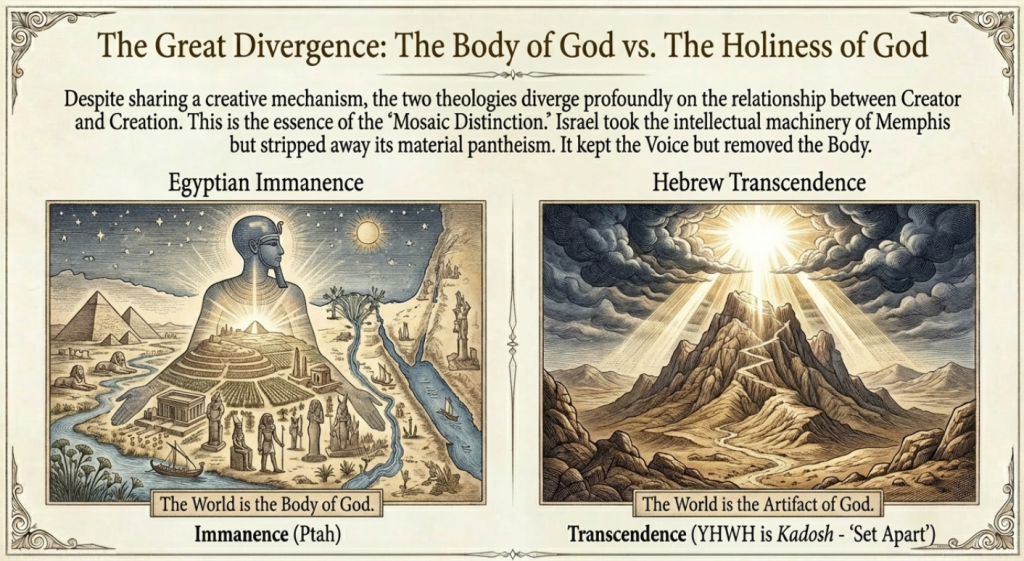
6.2 Immanence vs. Transcendence: The Great Divergence
Despite the mechanical similarities (Heart/Tongue vs. Word/Spirit), a fundamental divergence remains in the relationship between God and World.
- The Body of Ptah: In Egyptian thought, the world is the Body of God. Ptah is Tatenen (the Earth). The statue in the temple is a valid container for the divine Ka. The Pharaoh is the son of God. The boundary between Creator and Creation is porous.3
- The Holiness of YHWH: In Hebrew thought, the world is the Artifact of God. It is distinct. God is Kadosh (Holy), which literally means “Separate” or “Set Apart.” YHWH has no body. He cannot be represented by a statue (Aniconism). The Shema is a declaration of this separation.
The “Secret” of the Hebrew innovation is that it took the intellectual mechanism of Memphis (Creation by Word) but stripped away the material ontology (Pantheism). It kept the Voice but removed the Body.
—
7. The Mosaic Distinction and the Legacy of Egypt
We conclude by revisiting Jan Assmann’s theory of the “Mosaic Distinction” in light of these findings. Assmann argues that the “trauma” of monotheism was the introduction of intolerance—the rejection of other gods as “false”.45 He traces this back to Akhenaten, calling him the first “counter-religionist.”
However, our analysis suggests that the roots of monotheism are broader than just Akhenaten’s revolution. The Memphite Theology of Ptah represents a “quiet” monotheism—a philosophical realization that the Many must be subordinate to the One Mind.
- Ptah represents an Evolutionary Monotheism: The slow convergence of all gods into the functions of One Artificer.
- YHWH represents a Revolutionary Monotheism: The violent rejection of the “gods” to clear the stage for the One King.
Yet, the legacy of Egypt persisted. The concept of the Creative Word (Logos) traveled from the stele of Shabaka to the scrolls of the Torah, and eventually to the Gospel of John (“In the beginning was the Word”). The “Secret” of Ptah—that God is a Mind who speaks reality into existence—became the foundational dogma of Western religion.
—
8. Conclusion: The One Who Speaks
The comparison of the Ancient Egyptian god Ptah and the Hebrew concept of Echad reveals a deep, subterranean current of Ancient Near Eastern thought. Both traditions grappled with the mystery of existence and concluded that the ultimate reality is not a chaotic clash of elemental forces, but the orderly expression of a Supreme Will.
The “Secrets” revealed in this deep dive are:
- The Secret of the Word: Both Ptah (Heart/Tongue) and YHWH (Word/Breath) create via a linguistic act. Ontology is philology.
- The Secret of the Triad: The Ramesside “Trinity” (Amun-Re-Ptah) functions as a complex unity of Hiddenness, Radiance, and Immanence, paralleling the Kabbalistic complexity of the Hebrew Echad (Sefirot) while being rejected by the polemical simplicity of the Shema.
- The Secret of the Engraving: Both the Sefer Yetzirah and the iconography of Ptah view creation as an act of artistic “carving”—imposing form upon the formless void (Nun / Tohu).
In the final analysis, Ptah and Echad stand as the two great pillars of ancient theology. Ptah is the “One who becomes All,” sanctifying the material world as his body. Echad is the “One who stands Alone,” sanctifying the moral law as his will. Together, they articulate the twin longings of the human spirit: to find God in the world (Immanence) and to find God above the world (Transcendence).
Works cited
- Egyptian God Ptah: 6 important facts about the god of creation, accessed on December 19, 2025, https://egyptunitedtours.com/egyptian-god-ptah/
- Ptah – Wikipedia, accessed on December 19, 2025, https://en.wikipedia.org/wiki/Ptah
- Ptah the god from Memphis – Amun-Ra Egyptology Blog, accessed on December 19, 2025, https://amun-ra-egyptology.blogspot.com/2012/06/ptah-god-from-memphis.html
- Shabaka Stone – Wikipedia, accessed on December 19, 2025, https://en.wikipedia.org/wiki/Shabaka_Stone
- The Memphite Theology | Genesis 1:3 – intertextual.bible, accessed on December 19, 2025, https://intertextual.bible/index.php/text/the-memphite-theology-genesis-1.3
- The Shabaka Stone: An Introduction – BYU ScholarsArchive, accessed on December 19, 2025, https://scholarsarchive.byu.edu/cgi/viewcontent.cgi?article=1131\&context=studiaantiqua
- The Memphite Theology, accessed on December 19, 2025, https://www.nsspress.com/clements_early_2nd_demo/ch2/sec17.htm
- Sia and Hu – Ancient Egypt Online, accessed on December 19, 2025, https://ancientegyptonline.co.uk/sia-hu/
- “Shabaka Stone”: English Translation of Memphite Theology by Leonard H. Lesko – Text, accessed on December 19, 2025, https://omnika.org/texts/328
- What are the similarities and differences between the Genesis creation account and other creation stories of the time – Biblical Hermeneutics Stack Exchange, accessed on December 19, 2025, https://hermeneutics.stackexchange.com/questions/1252/what-are-the-similarities-and-differences-between-the-genesis-creation-account-a
- Uniqueness of Genesis : r/AcademicBiblical – Reddit, accessed on December 19, 2025, https://www.reddit.com/r/AcademicBiblical/comments/ix5s6j/uniqueness_of_genesis/
- NAMES AND POWER THE CONCEPT OF SECRET NAMES IN THE ANCIENT NEAR EAST By Nicholaus Benjamin Pumphrey Thesis Submitted to the Facu – CORE, accessed on December 19, 2025, https://core.ac.uk/download/pdf/216048895.pdf
- Chapter III – Primitive Gods And Nome-gods, accessed on December 19, 2025, https://www.wisdomlib.org/various/book/the-gods-of-the-egyptians-vol-1/d/doc6496.html
- Creation Myths of Ancient People – Hindu Website, accessed on December 19, 2025, https://www.hinduwebsite.com/general/essays/creation.asp
- Ancient Egyptian religion – Gods, Beliefs, Rituals | Britannica, accessed on December 19, 2025, https://www.britannica.com/topic/ancient-Egyptian-religion/The-Gods
- Ptah* – Gods of Ancient Egypt, accessed on December 19, 2025, https://akhretnotes.weebly.com/ptah.html
- The Possible Sources for the Development of the Christian Trinitarian Concepts – Center for Socinian, Philosophical, and Religious Studies, accessed on December 19, 2025, https://www.socinian.org/files/Sources_Christian_Trinitarian_Concepts.pdf
- ANCIENT EGYPT : Amun and the One, Great & Hidden – sofiatopia.org, accessed on December 19, 2025, http://www.sofiatopia.org/maat/amun.htm
- ANCIENT EGYPT : Great Hymn to the Aten – sofiatopia.org, accessed on December 19, 2025, http://www.sofiatopia.org/maat/aten.htm
- Freud and Monotheism: Moses and the Violent Origins of Relligion – UC Berkeley, accessed on December 19, 2025, https://escholarship.org/content/qt3xk7594z/qt3xk7594z.pdf
- Trinity is not exactly a new religious concept. : r/DebateReligion – Reddit, accessed on December 19, 2025, https://www.reddit.com/r/DebateReligion/comments/hzd39t/trinity_is_not_exactly_a_new_religious_concept/
- (PDF) Divine Triads of Ancient Egypt – ResearchGate, accessed on December 19, 2025, https://www.researchgate.net/publication/262175379_Divine_Triads_of_Ancient_Egypt
- Divine Triads of Ancient Egypt – CORE, accessed on December 19, 2025, https://core.ac.uk/download/61424394.pdf
- Amun/ Amen – 𓏞𓀀 Sesh Kemet Egyptian Scribe 𓆎𓅓𓏏𓊖, accessed on December 19, 2025, https://seshkemet.weebly.com/amun-amen.html
- Three Are All Gods: A Study of Egyptian Theology in the New Kingdom, accessed on December 19, 2025, https://edmundsiderius.wordpress.com/2011/09/17/three-are-all-gods-a-study-of-egyptian-theology-in-the-new-kingdom/
- EVOLUTION OF EGYPTIAN RELIGION REFLECTED IN TEMPLE ARCHITECTURE AND DESIGN by Nicole Marie Barnes Submitted to the Faculty of Th, accessed on December 19, 2025, https://minds.wisconsin.edu/bitstream/handle/1793/64642/Barnes_Nicole_Thesis.pdf?sequence=1\&isAllowed=y
- Shema – Wikipedia, accessed on December 19, 2025, https://en.wikipedia.org/wiki/Shema
- The meaning of the word Echad – One – Kehila News Israel, accessed on December 19, 2025, https://news.kehila.org/the-meaning-of-the-word-echad-one/
- In what sense is ‘echad’ [one] used in the Shema? – Jews for Judaism, accessed on December 19, 2025, https://jewsforjudaism.org/knowledge/articles/in-what-sense-is-echad-one-used-in-the-shema
- What is the Shema? The People of Israel Called to Prayer – One for Israel, accessed on December 19, 2025, https://www.oneforisrael.org/what-is-the-shema-the-people-of-israel-called-to-prayer/
- Trinity: Oneness in unity not in number: Yachid vs. Echad – Bible.ca, accessed on December 19, 2025, https://www.bible.ca/trinity/trinity-oneness-unity-yachid-vs-echad.htm
- Spotlight 030 | Wordtrade.com, accessed on December 19, 2025, https://www.wordtrade.com/spotlight/030aug2018.pdf
- Akhenaten’s Monotheistic Revolution | PDF – Scribd, accessed on December 19, 2025, https://www.scribd.com/document/718986603/OceanofPDF-com-Akhenaten-and-the-Origins-of-Monotheism-James-K-Hoffmeier
- (Simson Najovits) Egypt, Trunk of The Tree, Vol. 2 | PDF | Ancient Egyptian Religion – Scribd, accessed on December 19, 2025, https://www.scribd.com/document/365667755/Simson-Najovits-Egypt-Trunk-of-the-Tree-Vol-2
- GUIDE FOR THE PERPLEXED – Online Library of Liberty, accessed on December 19, 2025, http://files.libertyfund.org/files/1256/0739_Bk.pdf
- ON attributes; remarks more recondite than the preceding. It is known that existence is an accident appertaining to all things, and therefore an element superadded to their essence. This must evidently be the case as regards everything the existence of which is due to some cause – Moses Maimonides: Guide for the Perplexed – Christian Classics Ethereal Library, accessed on December 19, 2025, https://ccel.org/ccel/maimonides/guide/guide.v.lvii.html
- “Ketav ha-Da’at” or “Sefer ha-Sekhel we-ha-Muskalot”: The Medieval Hebrew Translations of Al-Farabi’s “Risalah fi’l-‘aql.” A Study in Text History and in the Evolution of Medieval Hebrew Philosophical Terminology – ResearchGate, accessed on December 19, 2025, https://www.researchgate.net/publication/270461341_Ketav_ha-Da’at_or_Sefer_ha-Sekhel_we-ha-Muskalot_The_Medieval_Hebrew_Translations_of_Al-Farabi’s_Risalah_fi’l-‘aql_A_Study_in_Text_History_and_in_the_Evolution_of_Medieval_Hebrew_Philosophical_Termino
- SEPHER YETZIRAH OR THE BOOK OF CREATION WW Wescott, tr. (1887) CHAPTER 1 – David Solomon, accessed on December 19, 2025, https://davidsolomon.online/wp-content/uploads/2020/05/Sefer-Yetzirah-Ch1.pdf
- Sefer Yetzirah 1 – Sefaria, accessed on December 19, 2025, https://www.sefaria.org/Sefer_Yetzirah.1
- SEFER YETZIRAH – [Book of Creation] – The Matheson Trust, accessed on December 19, 2025, https://www.themathesontrust.org/papers/judaism/saadia.pdf
- Sefer Yetzirah 2:4 with Jewish Thought – Sefaria, accessed on December 19, 2025, https://www.sefaria.org/Sefer_Yetzirah.2.4?with=Jewish%20Thought
- Sefer Yetzirah 1 with Kabbalah – Sefaria, accessed on December 19, 2025, https://www.sefaria.org/Sefer_Yetzirah.1?with=Kabbalah
- Rabbi Isaac the Blind’s Commentary on Sefer Yezirah, accessed on December 19, 2025, http://www.ma.huji.ac.il/~kazhdan/Shneider/Sendor,MarkBrian.Rabbi.Isaac.the.Blind.onSY,ch.1-2.pdf
- Ancient Egyptian Creation Myths: From Watery Chaos to Cosmic Egg – Glencairn Museum, accessed on December 19, 2025, https://www.glencairnmuseum.org/newsletter/2021/7/13/ancient-egyptian-creation-myths-from-watery-chaos-to-cosmic-egg
- Monotheism and the Monopoly on Violence (Chapter 3) – Monotheism, Intolerance, and the Path to Pluralistic Politics – Cambridge University Press, accessed on December 19, 2025, https://www.cambridge.org/core/books/monotheism-intolerance-and-the-path-to-pluralistic-politics/monotheism-and-the-monopoly-on-violence/FD73E3B3669EC633C344DBA5213CF7BC
- The Politics of Monotheism – Cambridge University Press, accessed on December 19, 2025, https://www.cambridge.org/core/elements/politics-of-monotheism/19BB445DD0122BC5614FBA6DD40BC74C
About the Author