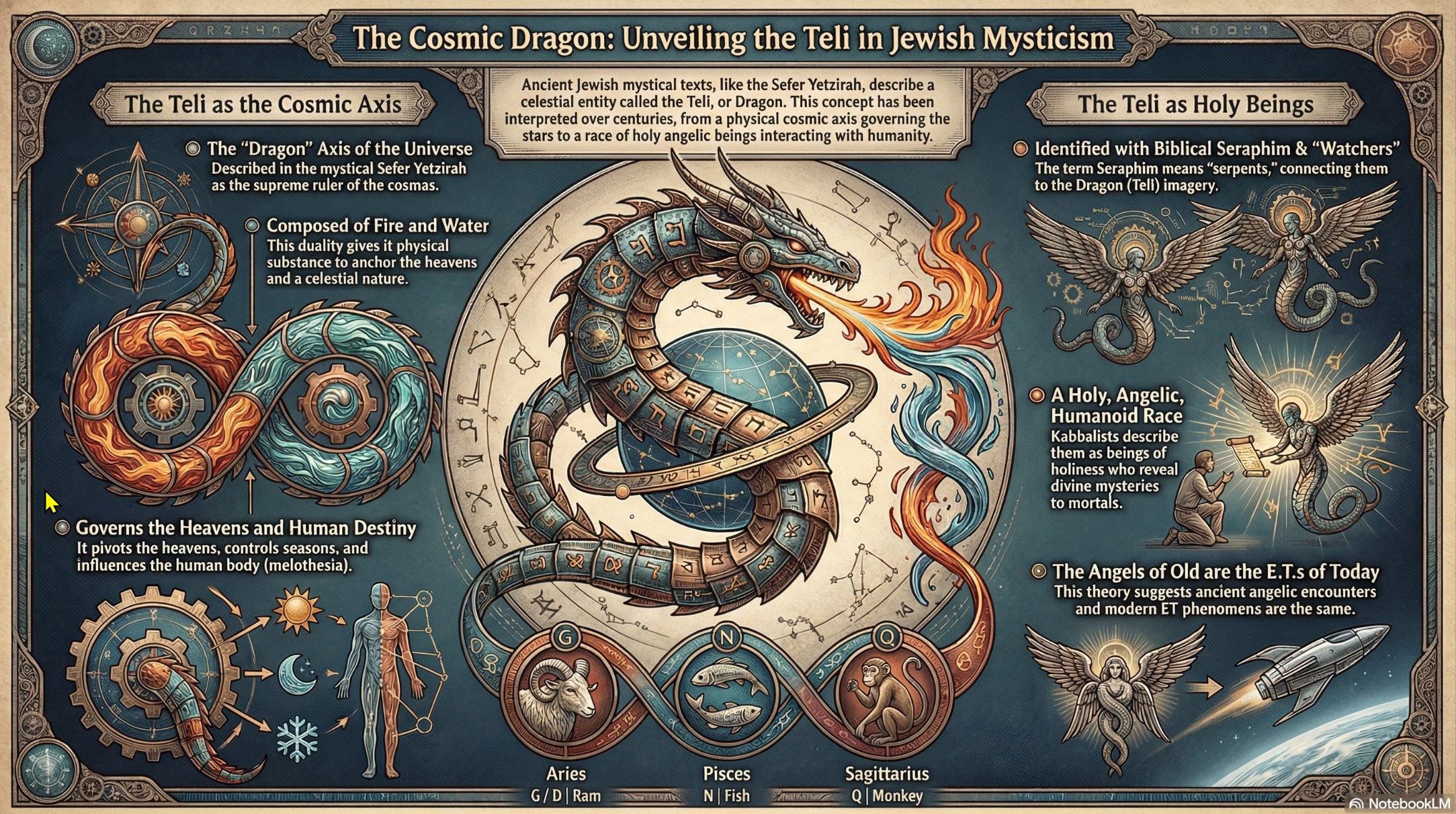
This exposition explores the cosmological theories of Shabbatai Donnolo, a tenth-century Jewish physician and scholar from Byzantine Italy. It focuses on his interpretation of the Teli, a mysterious celestial entity described as a cosmic dragon that serves as the physical axis of the universe. Unlike more rationalist thinkers, Donnolo integrated this mythic figure into a scientific framework, identifying it as a structure composed of fire and water that regulates the seasons and celestial movements. The report further examines the concept of melothesia, illustrating how Donnolo mirrored the macrocosmic “Dragon” with the human heart to connect astronomy directly to medical practice. Ultimately, these sources highlight a unique intellectual synthesis where ancient mysticism and medieval science collaborate to explain the divine governance of the world.
Introduction: The Axis of Reality
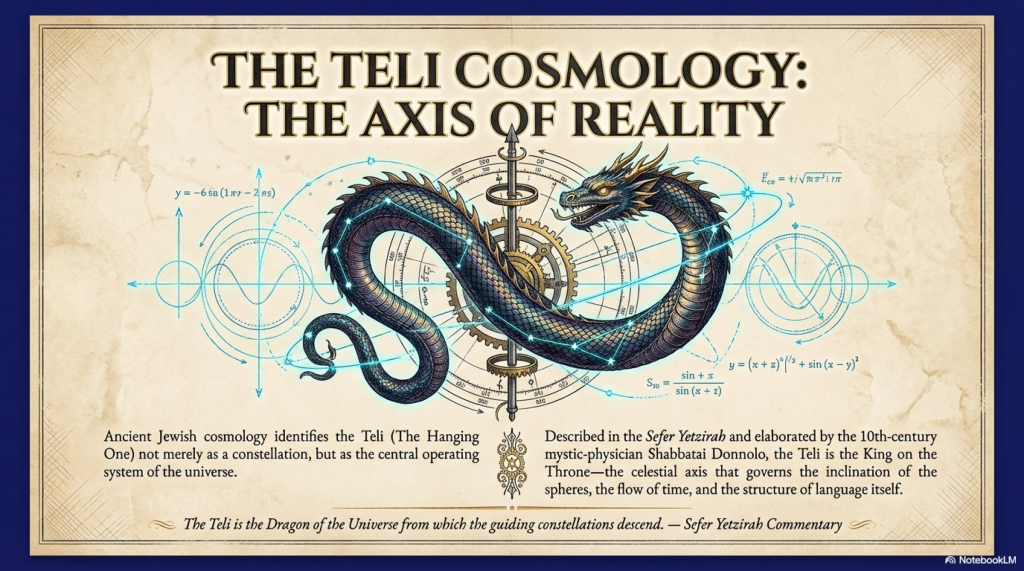
Today we are going to peel back the layers of history to examine a cosmology that has been largely obscured by modern rationalism. We are looking at the ‘Teli.’ In ancient Jewish mysticism, specifically the Sefer Yetzirah and the works of the 10th-century physician Shabbatai Donnolo, the universe was not seen as a silent, mechanical void. It was viewed as a living, breathing entity governed by a central operating system.
This system is the Teli—often translated as ‘The Hanging One’ or the ‘Dragon’. It is the axis upon which reality turns, the King on the Throne that dictates the movement of the stars, the flow of time, and—as we will see—the very structure of the language we speak. Let us explore how this ancient ‘Dragon’ connects astronomy, biology, and consciousness into a single, unified theory of reality.”
The Universe as Macroanthropos
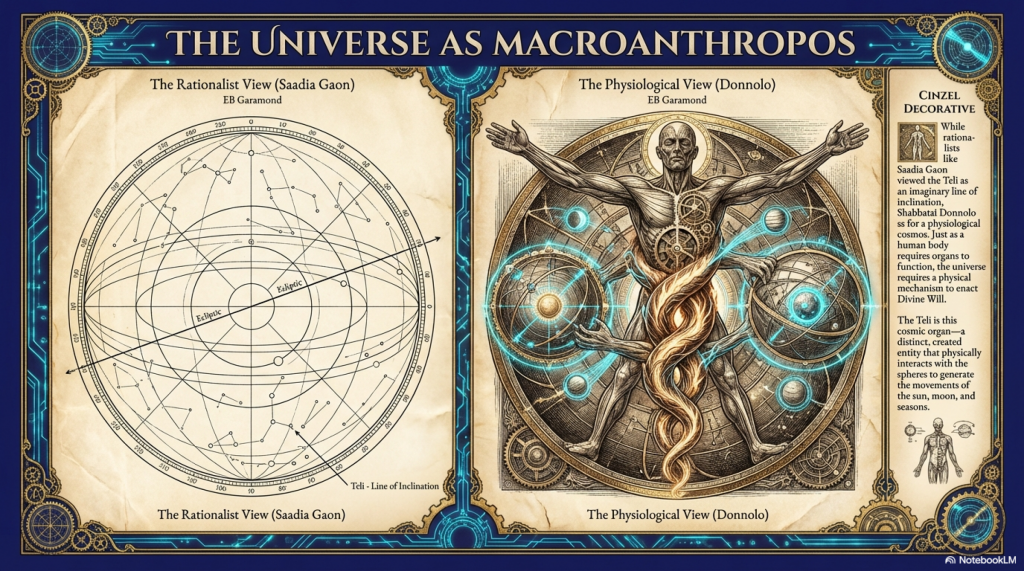
Historically, there have been two ways to view this axis. On one side, we have the Rationalist View, championed by Saadia Gaon, who saw the Teli as merely an imaginary line of inclination—a mathematical abstraction used to map the heavens.
However, Shabbatai Donnolo argued for a ‘Physiological Cosmos’. He posited that just as a human body requires physical organs to function, the universe requires a physical mechanism to enact Divine Will. In this view, the Teli is a cosmic organ—a distinct, created entity that physically interacts with the spheres to generate the movements of the sun, moon, and seasons. It is the mechanism behind the motion.

The Fire-Water Mechanism
So, what is this cosmic organ made of? Donnolo provides a fascinating answer: The Teli is a unique synthesis of Fire and Water. Fire provides ‘Vital Heat,’ allowing it to exist in the celestial realm where a purely physical object could not. Water provides ‘Substance’ and ‘Gravity,’ giving it the density necessary to act as a physical anchor.
This synthesis creates a ‘coagulated axis’—literally ‘The Hanging One’. If it were pure light, it would be too volatile to hold the stars; if it were pure water, it would fall to earth. It is the perfect balance that sustains the structure of the heavens.
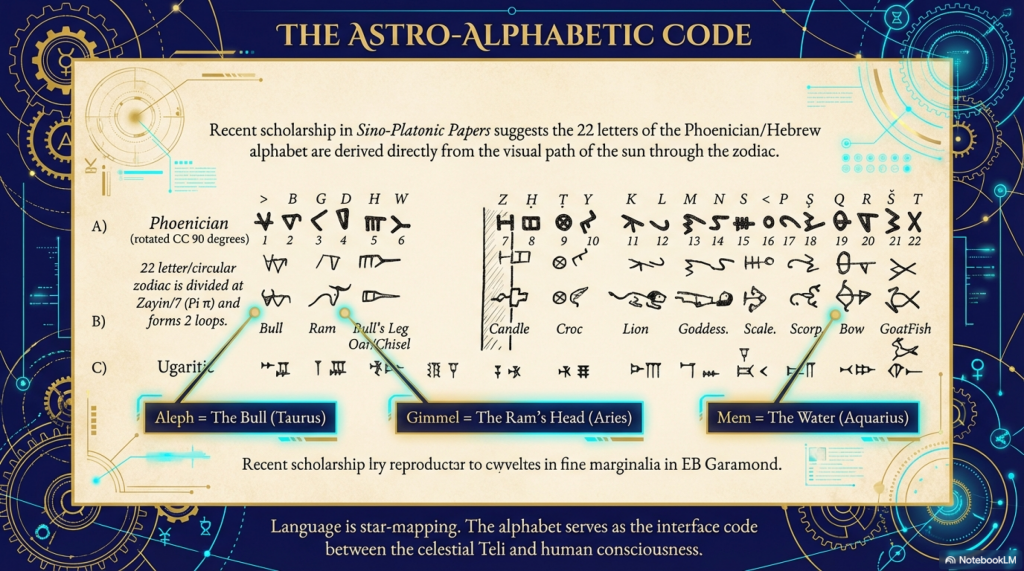
The Astro-Alphabetic Code
The influence of the Teli extends beyond the stars and into our speech. Recent scholarship suggests that the 22 letters of the Phoenician and Hebrew alphabets are not arbitrary shapes, but are derived directly from the visual path of the sun through the zodiac.
Language, in this view, is ‘star-mapping’. The alphabet serves as the interface code between the celestial Teli and human consciousness. For example, the letter Aleph is linked to the Bull (Taurus), and Mem to Water (Aquarius). When we speak, we are unknowingly replicating the geometry of the heavens.”
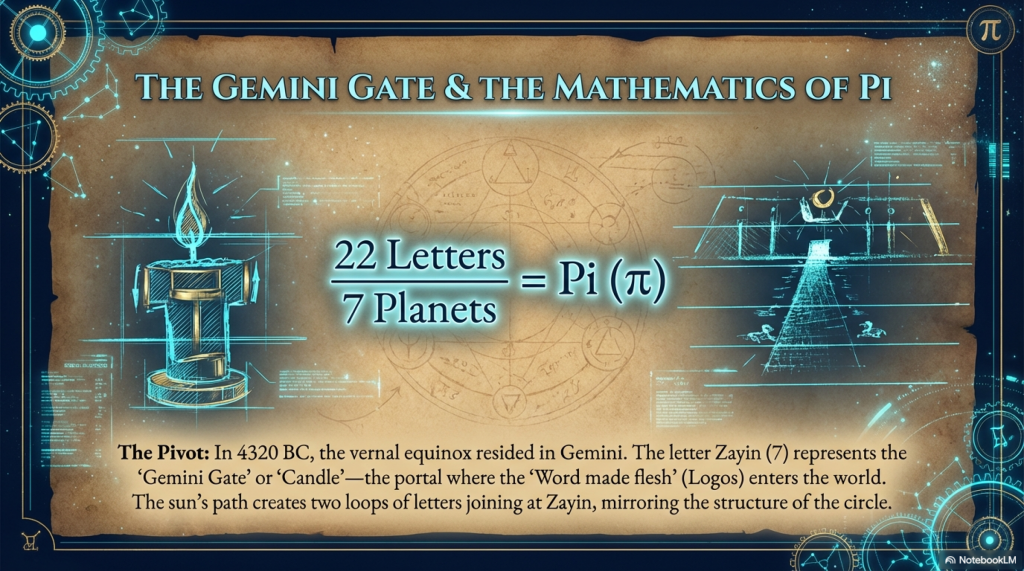
The Gemini Gate & The Mathematics of Pi
This connection is mathematical as well. If we take the 22 letters of the alphabet and divide them by the 7 classical planets, we arrive at the approximation of Pi (π).
History gives us a pivot point for this code: in 4320 BC, the vernal equinox resided in Gemini. The letter Zayin, which corresponds to the number 7, represents this ‘Gemini Gate’—the portal where the ‘Word made flesh’ enters the world. The sun’s path creates two loops of letters that join at this gate, effectively mirroring the structure of a circle.

The Linguistic Serpent
The Sefer Yetzirah states that the Teli rules the universe ‘like a King on a Throne’. This dominion is exercised through the ‘231 Gates’—the complex network of lines connecting the 22 letters in a circle.
This leads to a profound insight: The Teli is the governing algorithm that permutes these letters to create reality. The Dragon does not just hold the stars in place; it holds the definitions of reality itself. It is the linguistic serpent binding the cosmos together.
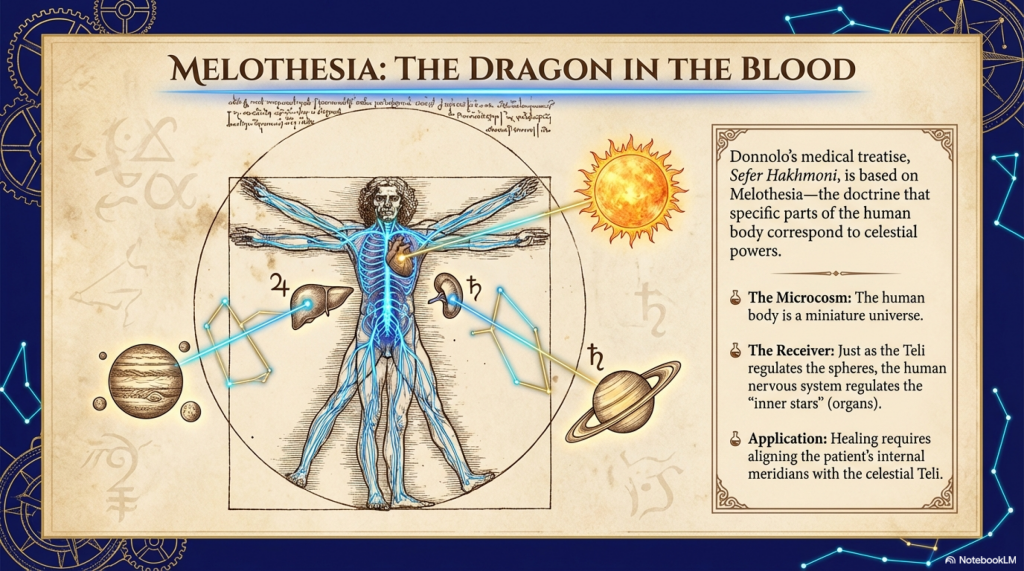
Melothesia: The Dragon in the Blood
Donnolo’s medical treatise, Sefer Hakhmoni, applies this macro-cosmic view to the human body through the doctrine of Melothesia. This is the idea that specific parts of the human body correspond to celestial powers.
The human body is a microcosm, a miniature universe. Just as the Teli regulates the celestial spheres, the human nervous system acts as the receiver, regulating our ‘inner stars’—our organs. Therefore, true healing requires aligning the patient’s internal meridians with the celestial Teli.
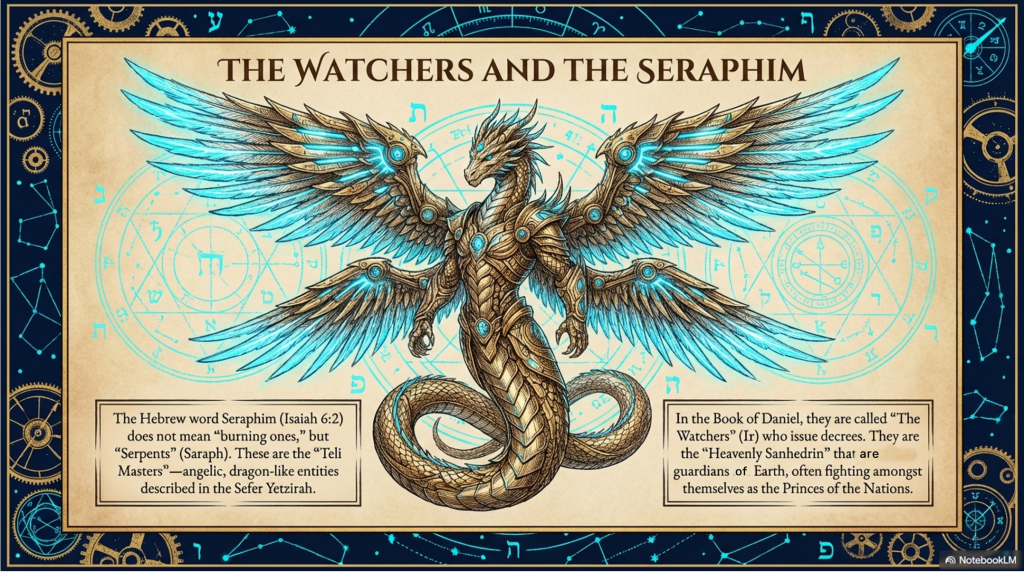
Who manages this system?
The Hebrew word Seraphim is often mistranslated. It does not simply mean ‘burning ones,’ but relates to the root Saraph, meaning ‘Serpent’. These are the ‘Teli Masters’—angelic, dragon-like entities.
In the Book of Daniel, they are called ‘The Watchers’ (Ir), the ones who issue decrees. They function as a ‘Heavenly Sanhedrin,’ guardians of the Earth who often fight amongst themselves as the energetic Princes of the Nations.

Technologies of Prophecy
How did the mystics interact with this system? They used specific ‘Technologies of Prophecy’. First, Star Gazing: focusing on the night sky to internalize the celestial order. Second, Letter Permutation: rotating the alphabet to unlock the 231 Gates we spoke of earlier. And third, Hypnotic Focus: using ‘Present Tense’ focus to bypass the conscious mind and access the Teli’s knowledge directly.
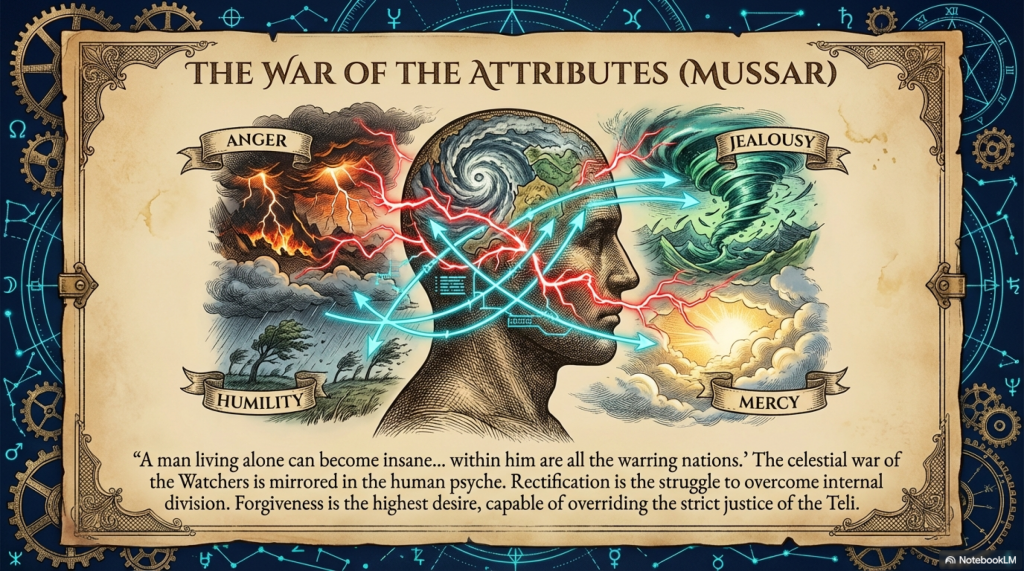
The War of the Attributes (Mussar)
Crucially, the celestial war is not just ‘out there’—it is ‘in here.’ The war of the Watchers is mirrored in the human psyche. We see this in the struggle of attributes: Anger, Jealousy, Humility, and Mercy.
Rectification, or spiritual fixing, is the struggle to overcome this internal division. It is said that forgiveness is the highest desire because it is capable of overriding the strict justice of the Teli. A person living in internal conflict is like a world at war.

A Seal Within a Seal
As we approach the end, we see that the wisdom of the Teli converges across disciplines. Truth is recursive; it is ‘A Seal Within a Seal’. The Teli represents the unification of opposites—Fire and Water, justice and mercy, the physical and the spiritual. All wisdom converges at this center.
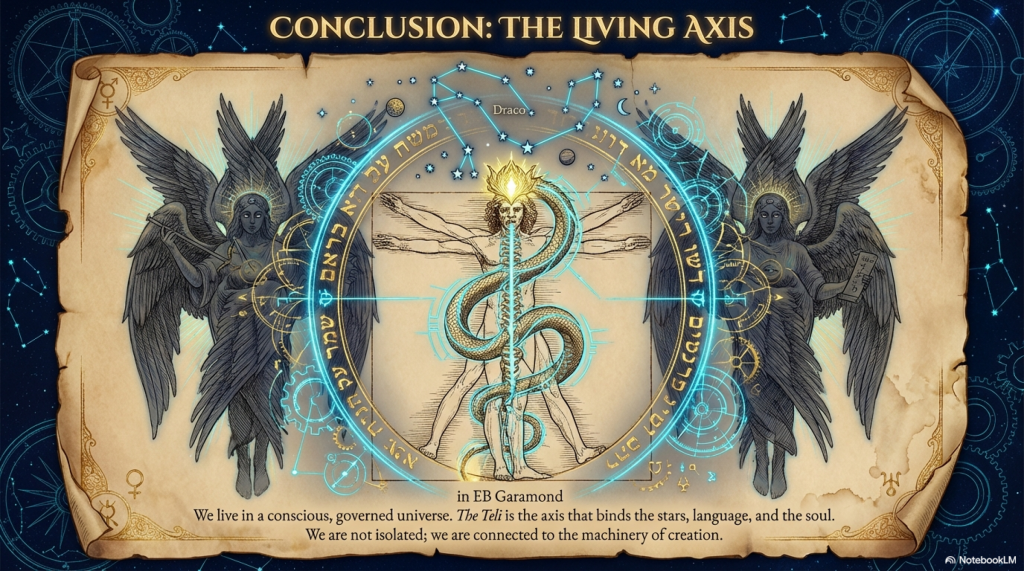
Conclusion: The Living Axis
In conclusion, the ancients teach us that we live in a conscious, governed universe. The Teli is the axis that binds the stars, the structure of our language, and the depths of the human soul. We are not isolated accidents of biology; we are connected to the machinery of creation.
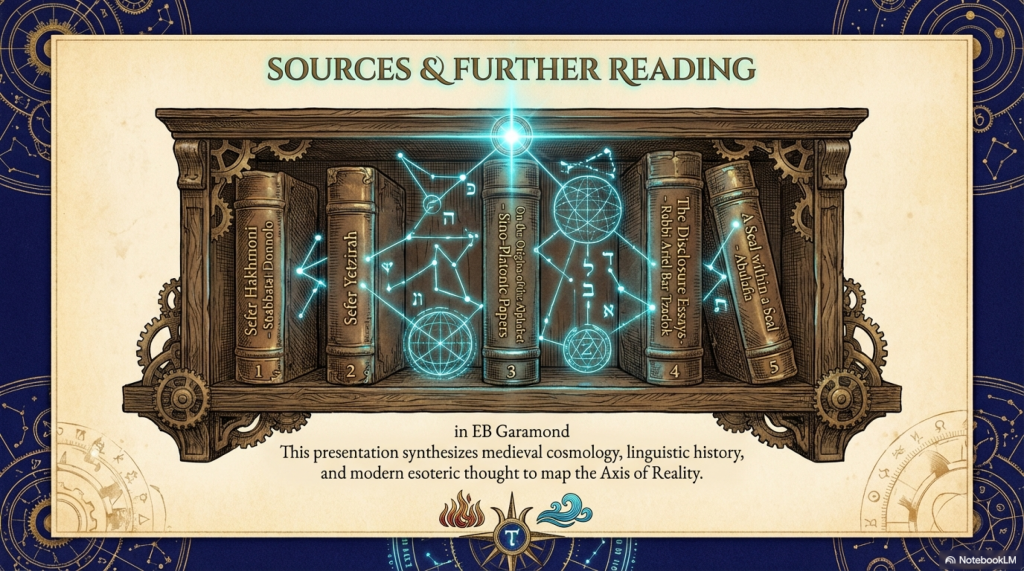
Sources & Further Reading
This presentation has synthesized medieval cosmology, linguistic history, and modern esoteric thought to map the Axis of Reality. For those wishing to go deeper, I recommend the Sefer Hakhmoni by Shabbatai Donnolo, the Sefer Yetzirah, and the modern essays of Rabbi Ariel Bar Tzadok
Afterword: The Unification of the Dragon
We have traversed a vast intellectual landscape today. What began as a discussion about an obscure constellation, the Teli, revealed itself to be a ‘Theory of Everything’ for the ancient mystic.
We saw three distinct cognates emerge:
- The Celestial: The Teli is the physical gravity (Water) and energy (Fire) holding the solar system together.
- The Linguistic: That same structure is mirrored in the Alphabet, where the ‘Gemini Gate’ and letter permutations code our reality.
- The Biological: Finally, this pattern is stamped onto us. Our nervous system is the Teli of the body, and our psychological struggles are the ‘War of the Watchers’ played out on a micro-scale.
By understanding the Teli, we understand that astronomy, language, and psychology are not separate fields, but different expressions of the same ‘Living Axis.’
Abulafia, Sefer Yetzirah, Sufism and the Teli an extended Audio Commentary
Synthesis of Mystical, Cosmological, and Philological Themes
Executive Summary
This briefing synthesizes findings from multiple sources, revealing deep connections between Jewish mysticism, ancient cosmology, and the origins of foundational symbolic systems. The analysis shows that Jewish mystical traditions, particularly Kabbalah, are highly syncretic, demonstrably absorbing concepts from Islamic Sufism, as seen in the teachings of Abraham Abulafia, who appears to have integrated the Sufi concept of the “Seal of Sainthood” from the works of Ibn al-ʿArabī.
A central, recurring theme is the profound link between mythological concepts and celestial phenomena. Mythical creatures, especially the dragon and serpent, are not merely folkloric but serve as potent symbols within biblical texts, Kabbalistic demonology, and cosmology. Figures like Leviathan, Raab, and the supreme cosmic dragon Theli are directly mapped onto astronomical entities, most notably the constellation Draco, which was understood in Jewish tradition as the cosmic axis (Teli) from which the heavens were suspended.
Furthermore, a comprehensive theory is presented positing that the 22-letter alphabet is not a simple phonetic tool but an intricate astronomical code representing the solar zodiac. This “astro-alphabetic” pattern, where letter-pairs form constellations, is evidenced across a vast timeline and geography, from a 4800 BC zodiac tablet in Karanovo, Bulgaria, to Egyptian hieroglyphs, the Phoenician and Ugaritic alphabets, and remarkably, the Chinese Lunar Zodiac. This system hinges on a “gate” at the constellation Gemini, which encodes the vernal equinox of 4320 BC, suggesting that knowledge of the precession of the equinoxes is far more ancient than previously believed and was preserved within the very structure of the alphabet.
Syncretism in Jewish Mysticism: The Case of Abraham Abulafia
Abraham Abulafia (ca. 1240-90), a pivotal figure in Jewish mysticism, believed himself to be both a prophet and the messiah. His teachings, developed across the Mediterranean world, show clear evidence of syncretism, drawing from the Christian and Islamic traditions he encountered. While his messianic timetable was influenced by the Joachite teachings of certain Franciscan orders, other core concepts in his work are not easily explained by Jewish or Christian sources, pointing instead to the influence of Sufism.
The Proposed Influence of Ibn al-ʿArabī
The scholar Harvey J. Hames proposes that Abulafia was acquainted with the works of Muḥyiddīn ibn al-ʿArabī (1165-1240), the Andalusian Sufi mystic known as “the Great Sheikh.” This connection is supported by several factors:
- Geographical and Cultural Proximity: Both men originated from the Iberian Peninsula, a center of religious and cultural symbiosis between Jews, Christians, and Muslims.
- Temporal Connection: Abulafia was born in 1240, the year Ibn al-ʿArabī died. Abulafia considered this year—5000 in the Hebrew calendar—to be the start of the sixth millennium and the year of the renewal of prophecy.
- Parallel Lives: Both were itinerant masters with disciples, produced extensive writings, and integrated ideas from diverse religious traditions.
The “Seal of Sainthood” Concept
A central pillar of Ibn al-ʿArabī’s thought, particularly in his work Book of the Fabulous Gryphon, is the concept of the “Seal of sainthood,” signifying the perfection of man, the acquisition of divine knowledge, and prophecy. Ibn al-ʿArabī believed in his own elevated status as “the Perfect Man” and the “Seal of Muhammadan Sainthood.” He articulated a doctrine of three distinct seals:
- The Seal of Prophethood: Muhammad, after whom no legislative prophet will come.
- The Universal Seal of Sainthood: Jesus, who will return at the end of time.
- The Seal of Muhammadan Sainthood: A figure who achieves the supreme state of sainthood and stands level with the Prophet Muhammad. Ibn al-ʿArabī identified himself with this seal, viewing himself as the “renewer” for the seventh Islamic century.
Abulafia’s distinct use of “seal imagery as signaling the acquisition of knowledge and the end of history seems to bear the imprint of ibn al-ʿArabī,” suggesting a direct intellectual inheritance. This theory builds on earlier scholarship by Moshe Idel, who identified Sufi influences on Abulafia’s ecstatic Kabbalah (e.g., the practice of hitbodedut), and Haviva Pedaya, who noted phenomenological similarities between the Kabbalists of Gerona and Jewish Sufism.
The Dragon and Serpent Motif in Jewish Tradition
The dragon and serpent are powerful, multifaceted symbols in Jewish tradition, appearing in mythological, astronomical, and demonic contexts.
Biblical and Mythological Origins
In Hebrew texts, the dragon is primarily identified by two words, nachash and tannin, which can both mean “serpent” and are sometimes used interchangeably. These terms refer not only to natural snakes but also to powerful mythological sea monsters:
- Raab: A sea monster mentioned in Isaiah, Job, and Psalms. The name can mean “pride” or “superbia” and was also used as an emblematic name for Egypt.
- Leviathan: Described in Isaiah 27:1 as the “nachash bariyach” (twisting or fleeing serpent) and explicitly connected to the “tannin” (dragon) in the sea. The Midrash Rabbah identifies Leviathan with the Tanninim created in Genesis 1:21.
A significant linguistic confusion exists between the Hebrew words tannin (dragon/serpent) and tannim (jackals). This has led to mistranslations in many older biblical versions. The following tables distinguish their usage in the Tanakh.
Biblical Uses of Tannin or Tanninim (Dragon/Monster)
| Reference | Context |
| Genesis 1:21 | God created the great sea monsters [taninim]. |
| Exodus 7:9, 10, 12 | Aaron’s staff becomes a serpent [tanin/taninim]. |
| Deuteronomy 32:33 | Their wine is the poison of serpents [taninim]. |
| Nehemiah 2:13 | The author passes the fountain of the Dragon [tanin]. |
| Job 7:12 | “Am I the sea, or a sea monster [tanin]…?” |
| Psalms 74:13 | God crushed the heads of the dragons [taninim] on the waters. |
| Psalms 91:13 | You will trample lions and dragons [tanin]. |
| Psalms 148:7 | Praise the Lord, you sea monsters [taninim]. |
| Isaiah 27:1 | The Lord will kill the dragon [tanin] that is in the sea. |
| Isaiah 51:9 | “Did you not cut Raab to pieces, pierce the dragon [tanin]?” |
| Jeremiah 51:34 | Nebuchadnezzar swallowed me like a dragon [tanin]. |
| Ezekiel 29:3, 32:2 | Pharaoh is compared to a great dragon [tanim, for tannin]. |
Biblical Uses of Tannim (Jackals)
| Reference | Context |
| Job 30:29 | “I have become a brother to jackals [tanim]…” |
| Psalms 44:19 | Crushed in a place of jackals [tanim]. |
| Isaiah 13:22, 34:13, 35:7 | Ruined palaces will become a haunt for jackals [tanim]. |
| Isaiah 43:20 | The beasts of the field, jackals [tanim]… will honor me. |
| Jeremiah 9:11, 10:22, etc. | Cities of Judah will become a haunt for jackals [tanim]. |
| Lamentations 4:3 | “Even the jackals [tanin, textual variant] offer the breast…” |
| Micah 1:8 | “I will howl like the jackals [tanim]…” |
| Malachi 1:3 | God gave Esau’s inheritance to the jackals [tanot] of the desert. |
Astronomical and Mystical Dimensions
The serpent/dragon motif extends from mythology into cosmology and mysticism:
- The Pole Serpent (Draco): The “nachash bariyach” (twisting serpent) is identified by Aryeh Kaplan as a reference to the constellation Draco, the “Serpent of the Pole.” Ancient observers saw this circumpolar constellation as the axis from which the stars were “hung,” giving it the Hebrew name Teli (from talah, to hang).
- Theli, the Cosmic Dragon: The Sefer Yetzirah, an early work of Jewish mysticism, describes a celestial being named Theli, envisioned as a great dragon surrounding the universe “as a king on his throne.” Commentators like Shabbethai Donnolo identified Theli as a cosmic dragon governing planets and constellations, while others like Ibn Ezra and the Vilna Gaon equated it with Leviathan. Its name may derive from the Akkadian attalū, a serpent believed to cause eclipses.
- Dragon’s Head and Tail: Medieval Jewish astronomy, influenced by Arab and Persian science, identified Teli with Al Jaz’har (“the knot”), referring to the lunar nodes—the points where a planet’s orbit intersects the ecliptic. These were known as the “head of the dragon” and “tail of the dragon.”
Demons and Dragons in Kabbalah
Kabbalistic demonology systematized earlier beliefs and incorporated external influences, often casting demonic figures in draconic forms.
- Origins of Demons: The Zohar posits that many demons originate from sexual unions between humans and demonic powers like Lilith.
- The Dragon King: The title “Dragon” is given to the king of demons. According to the Ra`aya Meheimna, one of the three types of demons is animal-like, appearing as dragons, scorpions, or winged goats.
- Demonic Figures: Key figures in this demonology include Samael, Lilith, Naamah, Agrath, and Mahalath. Foreign gods mentioned in the Bible (shedim) are often interpreted as demons.
The Alphabet as an Ancient Astronomical Code
A comprehensive theory proposed by Brian R. Pellar argues that the alphabet is a sophisticated astronomical system encoding the solar zodiac. This thesis satisfies criteria for such a system, including having an organizing principle, great age, widespread distribution, and a correlation of form, meaning, and phonetic value.
The Astro-Alphabetic Thesis
The core of the thesis is that the 22 letters of the Semitic alphabet, when manipulated in a specific way, reveal the shapes of eleven zodiacal constellations.
- Method: The letters are rotated 90 degrees counter-clockwise and joined into eleven sequential couplets (e.g., ‘aleph and beth, gimmel and daleth).
- Structure: The resulting sequence forms two distinct loops that converge at one point.
- Small Loop: Taurus, Aries, Pisces (with Aquarius being silent/unseen).
- Large Loop: Gemini, Cancer, Leo, Virgo, Libra, Scorpio, Sagittarius, Capricorn.
- Solstice Reversals: The orientation of the letter-couplets reverses at the solstices. These points are marked by letters containing an “x” shape, such as taw (Capricorn, winter solstice) and teth (Cancer, summer solstice), mirroring the reversal of the sun’s path on the horizon.
The Centrality of Gemini and the Date 4320 BC
The entire system converges on the constellation Gemini, which holds special significance.
- The Gate (Zayin/Heth): Gemini is formed by the letters zayin (7) and heth. As the meeting point of the two loops and the place where the 22-letter “circle” is divided by the 7th letter, the structure suggests a relationship to Pi (22/7).
- Symbolic Meaning: In Egyptian hieroglyphs, the candle-like shape corresponding to Gemini signifies “door,” “gateway,” and “Great Door of Heaven.” This glyph also served as the architectural blueprint for Egyptian temples, whose pylons framed the rising sun like a celestial gate.
- The First Time (4320 BC): This Gemini “gate” is located in the Milky Way, a celestial region considered sacred by ancient cultures as the sun’s birthplace. The astro-alphabetic pattern is structured to encode the vernal equinox of 4320 BC, which was located precisely at this point. This date, known to the Egyptians as Tep Zepi (“the First Time”), is preserved in the Dendera Zodiac and reflected in Chinese traditions.
Cross-Cultural Evidence
The astro-alphabetic pattern is not confined to one script but appears across a wide range of cultures and historical periods, indicating a widespread and ancient system of knowledge.
- Phoenician and Hebrew: The pattern is clearly visible in these classic 22-letter alphabets.
- Chinese Lunar Zodiac: When the 28 lunar mansions are rotated 90 degrees, they form the same constellation couplets, including the solstice reversals. The meeting point, Gemini, is lunar station number 7, and the first lunar month (Tiger) corresponds to the Gemini gate of 4320 BC.
- Egyptian Hieroglyphs: The 24 uniconsonants form twelve couplets that match the twelve Egyptian constellations from the older Age of Taurus. Specific glyphs show direct correlations, such as the half-bow for Sagittarius and the foot for Pisces.
- Ugaritic Alphabet: This cuneiform script displays the pattern without needing rotation. Its longer 30-letter version likely corresponds to the lunar cycle, while its shorter 22-letter version reflects the solar zodiac.
- Ancient European Artifacts:
- Stag Bone (Spain, c. 4000-3800 BC): Glyphs on a stag bone depict a sequence of six constellations that match the astro-alphabetic pattern.
- Karanovo Zodiac (Bulgaria, c. 4800 BC): A clay tablet from the Karanovo culture shows clear glyphs for the zodiacal constellations that match the alphabetic couplets. Crucially, it includes markers that accurately point to the locations of the equinoxes and solstices for the year 4800 BC.
This evidence suggests that the alphabet originated not merely as a phonetic script but as a mnemonic device for preserving and transmitting a complex body of theo-astronomical knowledge, with roots extending deep into Neolithic Europe. This system connects directly back to Jewish mysticism through the Sefer Yetzirah, which explicitly links the “twenty-two letters” to the “twelve constellations,” stating they were placed in a circle (Galgal) and directed by a force known as the Teli—the cosmic dragon.
Study Guide
Short-Answer Quiz
Answer the following questions in two to three complete sentences, based on the provided source material.
- Describe Abraham Abulafia’s self-perception during a significant period of his life and identify the two primary external traditions that influenced his thought.
- What are the “Three Seals” that ibn al-‘Arabi differentiates in his works, and who does he identify with each role?
- What is the central thesis of Brian R. Pellar’s paper, “On the Origins of the Alphabet,” regarding the origin and structure of the alphabet?
- Explain the linguistic confusion that exists between the Hebrew words tannin and tannim, and state the correct translation for each.
- What is Theli, according to the Sefer Yetzirah, and how did the commentator Shabbethai Donnolo envision this entity?
- According to the Pellar paper, what is the significance of the constellation Gemini and the Hebrew letter zayin in the proposed astro-alphabetic pattern?
- In Kabbalistic demonology, who are Samael and Lilith, and what is their relationship to the “emanazione sinistra” (left emanation)?
- How does the Karanovo Zodiac, dated to 4800 BC, support the thesis that the alphabet is derived from astronomical patterns?
- In Jewish tradition, what is Raab, and with which biblical monster is it identified?
- According to Moshe Idel’s research, what specific practice in Abraham Abulafia’s ecstatic Kabbalah suggests an influence from Sufism?
Essay Questions
The following questions are designed for longer, essay-style responses. Answers are not provided.
- Analyze the evidence for cross-cultural influence presented in the sources, comparing the proposed connections between Sufism and Kabbalah with the suggested transmission of an astro-alphabetic system from Europe to Egypt, the Near East, and China.
- Discuss the role of mythological creatures, specifically dragons and serpents (Raab, Leviathan, tannin, Theli), within Jewish biblical and mystical traditions as outlined in the provided texts.
- Elaborate on the astro-alphabetic theory proposed by Brian R. Pellar. Detail the methodology of joining letter couplets, the significance of the solstices, and the evidence drawn from various scripts like Phoenician, Egyptian Hieratic, and the Chinese Lunar Zodiac.
- Based on the source text, describe the systematic demonology of the Kabbalah. Discuss the origins of demons, the hierarchy of demonic powers, key figures like Lilith and the four mothers of demons, and their interactions with the human world.
- Compare the messianic self-conception of Abraham Abulafia with that of ibn al-‘Arabi. How did each figure use concepts like prophecy and the “Seal” to understand their role in history, and what external influences shaped their views?
Quiz Answer Key
- For a significant period, Abraham Abulafia believed he was not only a prophet but also the expected messiah. His messianic timetable was heavily influenced by Joachite conceptions propagated by the Franciscan Order, while other ideas in his oeuvre, such as the use of “seal” imagery, suggest an acquaintance with Isma’ili theology and Sufism, particularly the works of ibn al-‘Arabi.
- Ibn al-‘Arabi differentiates the Seal of Prophethood, who is Muhammad; the Universal Seal of Sainthood, who is Jesus and will return at the end of times; and the Seal of Muhammadan Sainthood. Based on a vision, ibn al-‘Arabi believed himself to be this third seal, the “renewer for the seventh century.”
- The central thesis is that the alphabet originates from the eleven visible constellations of the Egyptian solar zodiac. This pattern is revealed by rotating the twenty-two letters of an alphabet (like Phoenician) ninety degrees counter-clockwise and joining them into sequential couplets, each couplet forming the shape of a constellation.
- A confusion exists because the Hebrew word תַנִּים (tannim) sounds similar to tannin. Many older translations incorrectly rendered both as “dragons,” but tannim correctly translates to “jackals,” while tannin (plural: tanninim) is the word used for a dragon, serpent, or great sea monster.
- According to the Sefer Yetzirah, Theli is a celestial being that surrounds the universe, described as being “above the universe, as a king on his throne.” The commentator Shabbethai Donnolo envisioned Theli as a powerful “cosmic dragon” that governed both planets and constellations.
- In the astro-alphabetic pattern, Gemini is the constellation where the two “loops” of the alphabet join, at the seventh letter, zayin. This spot corresponds to the center of the Milky Way, which the Egyptians considered a “Gate of Heaven,” and the joining of 22 letters at the 7th position (22/7) suggests a relationship to Pi.
- In Castilian Kabbalah, Samael and Lilith are primary demonic figures who exist as a pair at the head of the sitra ahra (“the other side”), which is the realm of evil. Their existence is linked to the last grade of the powers of the “left emanation,” a system of ten evil Sefirot that corresponds to the ten holy Sefirot.
- The Karanovo Zodiac, a clay tablet from 4800 BC, contains glyphs that strongly correlate with the shapes of the letter-couplets in the astro-alphabetic theory. For instance, its depiction of Taurus is in two parts resembling the couplet ‘aleph/beth, and the zodiac includes markers that date the positions of the equinoxes and solstices to that specific year.
- Raab is a mythical sea monster mentioned in later biblical texts like Isaiah, Job, and Psalms. Isaiah 51:9 explicitly compares this demon Raab to a dragon or monster, and it is identified with the Hebrew word reb, which can mean pride, a sea monster, or a symbolic name for Egypt.
- Moshe Idel suggests that Abulafia’s practice of hitbodedut (seclusion and concentration) may have been influenced by Sufism. This ecstatic practice in Abulafia’s Kabbalah has similarities with Sufi ideas, which may have been transmitted to Jewish mystics in Spain from either the East or the Iberian Peninsula itself.
Glossary of Key Terms
| Term / Name | Definition |
| Abraham Abulafia | (ca. 1240-1290) A Jewish mystic born in Navarre who believed he was both a prophet and the messiah. His teachings were influenced by Maimonides, Sefer Yetzirah, Joachite Franciscans, and, as proposed, Sufism. |
| Akhet | An Egyptian hieroglyph for “horizon.” The design of Egyptian temple entrance pylons was built to mirror this form, framing the rising sun. |
| Astro-alphabetic pattern | A theory proposed by Brian R. Pellar that the alphabet is derived from the solar zodiac. The pattern is revealed by rotating 22 letters 90 degrees counter-clockwise and joining them into 11 couplets, each forming a constellation. |
| Azazel (ʿAzʾazel) | A demon believed to live in the desert, associated with the ritual of the Day of Atonement in Leviticus, where a goat “for ʿAzʾazel” is left to be freed in the wilderness. |
| Fabulous Gryphon | (‘Anqà’ Mughrib) A major work by ibn al-‘Arabi dealing with the Seal of sainthood and prophecy, written before he left the West for the East. In it, he seems to identify himself as the Gryphon, a “sun rising in the West.” |
| Galgal | A Hebrew word used in the Sefer Yetzirah and Talmud to denote the sphere or circle of the zodiac, or the mystical array of the twenty-two letters arranged in a circle. |
| ganzhi | The 22 Chinese calendar signs (tiangan dizhi), which show correspondences to the 22 Phoenician letters when rotated 90 degrees according to Pellar’s theory. |
| hitbodedut | A practice in Abraham Abulafia’s ecstatic Kabbalah involving seclusion and concentration. Moshe Idel suggests this concept may have been influenced by Sufism. |
| ibn al-‘Arabi, Muhammad b. Ali | (1165-1240) An influential Sufi mystic born in Murcia, Andalusia, referred to as the “Great Sheikh.” He developed complex doctrines on sainthood and prophecy, believing himself to be the “Seal of Muhammadan Sainthood.” |
| Karanovo Zodiac | A clay tablet from Karanovo, Bulgaria, dated to 4800 BC. It contains glyphs that appear to be proto-alphabetic representations of the zodiac constellations, with markers indicating the solstices and equinoxes for that era. |
| Leviatan (Leviathan) | A sea monster identified in Isaiah 27:1 as “the serpente guizzante” (wriggling/fugitive serpent) and linked to the tannin (dragon). The Midrash Rabbah identifies it with the Taninim from Genesis 1:21. |
| Lilith | A prominent female demon in Kabbalah, sometimes considered one of the four mothers of demons. She was believed to be created during the six days of Creation as a disembodied spirit and seeks to procreate with human males. |
| nachash | A Hebrew word that can mean “serpent” or “dragon.” It is used in Exodus 4:3 to describe Aaron’s staff turning into a serpent and is also associated with the Leviathan. In Jewish astrology, it indicated the constellation Draco. |
| qliphoth | (Hebrew for “husks” or “shells”) In the Kabbalah of Isaac Luria, these are manifestations of evil or spiritual impurity that must be overcome through the observance of the Torah and mitzvot. |
| Raab (Rahab) | A mythical sea monster or demon mentioned in biblical texts (Isaiah, Job, Psalms). The name comes from the Hebrew reb, meaning “pride” or “superbia,” and is also used as an emblematic name for Egypt. |
| Samael | In Kabbalistic demonology, the chief of the demonic powers, sometimes described as the “soul of the planet Mars.” He and Lilith appear as a pair at the head of the sitra ahra (the “other side” or realm of evil). |
| Seal of Muhammadan Sainthood | The third of ibn al-‘Arabi’s three seals. This individual is able to ascend to the top step of Muhammad’s podium (minbar) and is considered greater than the Universal Seal (Jesus) because they seal the sainthood of the saints themselves. Ibn al-‘Arabi identified himself with this role. |
| Sefer Yetzirah | (Book of Creation) An early and influential work of Jewish mysticism that Abulafia based his teachings on. The text explicitly links the “twenty-two foundation letters” to the “twelve constellations.” |
| shedim | A Hebrew term for demons, also used to refer to foreign gods in the Bible. In Kabbalah, Nachmanide described them as beings made of fire and air with thin bodies. |
| sitra ahra | (Aramaic for “the other side”) In the Zohar and Kabbalistic literature, this is the realm of evil or impurity, the “left emanation,” which consists of ten evil Sefirot corresponding to the ten holy Sefirot. |
| tannim | ( תַנִּים ) The masculine plural form of the Hebrew word tan (“jackal”). It appears in 15 verses of the Tanakh and is often confused with tannin due to a similar sound, but it correctly translates to “jackals.” |
| tannin | ( תַנִּין ) A Hebrew word for dragon, great sea monster, or serpent; its plural is tanninim. It appears in 14 verses of the Tanakh, including Genesis 1:21 (“great sea monsters”) and Exodus 7:9 (Aaron’s staff becomes a serpent). |
| Teli | A term from the Sefer Yetzirah associated with the “Pole Serpent” (Leviathan or the constellation Draco). It denotes the “almost invisible lines” upon which the letters of the alphabet are written in the cosmic circle (Galgal), likely referring to the ecliptic. It is also the name of a cosmic dragon in some mystical traditions. |
| Zohar | A foundational work of Jewish mystical thought (Kabbalah). It contains extensive demonology, describing the origins of demons from sexual unions between humans and demonic powers and detailing figures like Samael and Lilith. |
About the Author