Part I: From Symptom to Sinthome – A Corrective to the Psychoanalysis of Judaism
The application of psychoanalytic theory to the structure of Judaism has been dominated, since its inception, by the foundational—and limiting—metapsychology of its founder. Sigmund Freud, in a gesture of ambivalent identification and critique, framed Judaism as the paradigmatic collective neurosis.1 This report argues for a necessary theoretical revision: a displacement of the Freudian model of Judaism-as-symptom with the late-Lacanian concept of Judaism-as-sinthome. This shift reframes Rabbinic Judaism entirely, moving it from the register of a pathology to be interpreted to a sophisticated structural solution—a knot—that ensures the survival of a collective psyche in the face of a foundational structural failure.
1.1 The Freudian Inheritance: Judaism as Collective Obsessional Neurosis
Freud’s primary thesis on religion posited it as a “universal obsessional neurosis”.3 In Moses and Monotheism, his “historical novel,” this thesis finds its most potent (and problematic) application to Judaism.4 Freud constructs a speculative history wherein the Jewish people, led out of Egypt by an Egyptian Moses, murder this liberating “good” father figure.4 This primordial patricide, a repetition of the Urphantasie from Totem and Taboo, becomes the repressed trauma at the origin of the Jewish psyche.7
The Jewish religion, in this Freudian model, is the neurotic symptom resulting from this repression. Its complex legal and ritualistic structure (Halakha) is understood as analogous to the “obsessive actions” of an individual neurotic, emerging as a compromise formation to manage the overwhelming guilt (the “return of the repressed”) stemming from the forgotten murder.3 The development of the religion follows Freud’s precise formula for neurosis: “Early trauma (murder of Moses) – defence – latency – outbreak of neurotic illness (the religion) – partial return of the repressed”.7
This formulation has critical implications. A Freudian symptom is, by definition, a “metaphor” for a repressed signifier; it is a cipher that “has meaning” 10 and demands interpretation. The neurotic “believes in his symptom” as an enigma 11, and the goal of psychoanalysis is to provide the interpretation that will “unwind” the “knotty problems” 1 and dissolve the symptom, thereby effecting a “cure.” Freud’s Moses and Monotheism is his own attempt at this “interpretation”.4 This model, however, inherently positions psychoanalysis as a “Jewish science” 1 that “supersedes” the religion it analyzes, a move that, as critics noted, dangerously mirrors the very Pauline supersessionism Freud’s text was accused of reinforcing.4
1.2 Lacan’s Late Turn: The Sinthome as a Knot of Ex-sistence
The later work of Jacques Lacan, particularly Seminar XXIII: The Sinthome, offers a radical alternative to this paradigm.12 This work requires a rigorous differentiation between the symptom (which is interpretable) and the sinthome (which is not).
The Freudian symptom (or symptôme) is a formation of the unconscious that “has meaning” 10 and operates as a message to be deciphered. The sinthome (an archaic spelling of symptôme) designates “precisely that which in the symptom is resistant to the unconscious, that which… does not lend itself to any meaning-effect that would yield a revelation”.15 It is not a “message” but a practice, a “fixed manner in which subjects enjoy their unconscious”.16 It is that which “helps the person live with their jouissance and maintain their sense of reality”.10
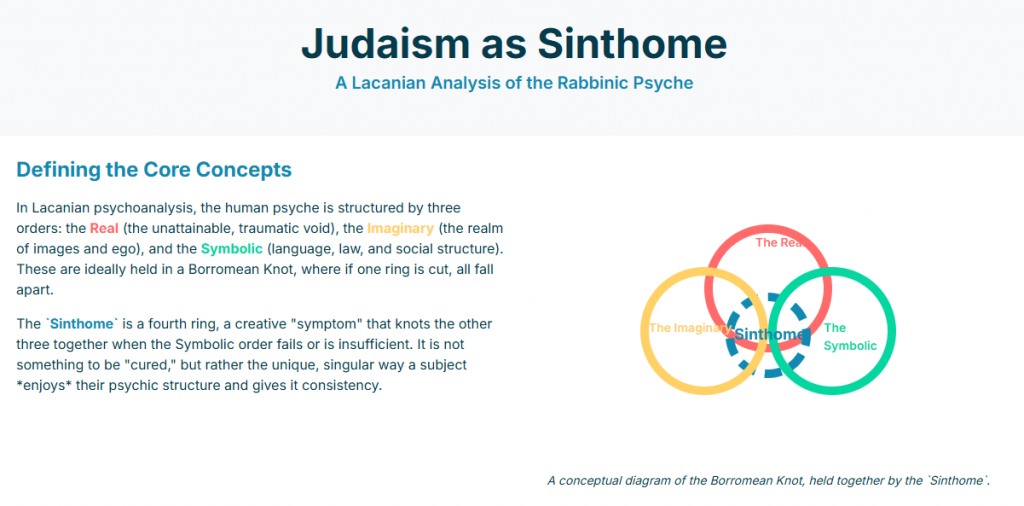
The function of the sinthome is topological. In Lacan’s late Borromean knot model, the human psyche is held together by the knotting of three registers: the Real (R), the Symbolic (S), and the Imaginary (I).17 In the “normal” neurotic subject, this knotting is achieved by a fourth ring, the Name-of-the-Father (the Nom-du-Père), which Lacan identifies as the “first=Symbolic or structural version of the 4th=sinthome”.14 The Name-of-the-Father is the paternal metaphor that guarantees the stability of the Symbolic order and represses the jouissance of the Real.19
However, when the Name-of-the-Father fails—when it is “foreclosed,” in Lacan’s terms—the rings fall apart.20 This failure of the paternal metaphor is the very definition of psychosis.19 The sinthome is the “4th element” 14 that, in the absence or failure of the standard Name-of-the-Father, invents a new way to knot the R, S, and I. It is a singular, creative solution that holds the psyche together and prevents a psychotic break.
Lacan’s prime example is James Joyce. Lacan argues that Joyce’s “art”—his savoir-faire (know-how) 15 with language, his obsessive “en-joycing” 21 of the “imposed words” 15 of lalangue—functioned as his personal sinthome. It was the knot that held his reality together in the face of a foreclosed Name-of-the-Father.22 The sinthome is not something to be “cured” or “resolved”.10 The goal of analysis, when faced with the sinthome, is to “learn what to do with it” 16, to identify with it as one’s singular mode of ex-sistence.12
This theoretical pivot is total. If Rabbinic Judaism is a sinthome, it is not a “collective neurosis” (Freud’s model). It is, instead, a collective, non-pathological, and highly sophisticated solution to a psychotic-level structural failure in the Symbolic order.
1.3 Table: Symptom vs. Sinthome in the Analysis of Judaism
The following table clarifies the central theoretical pivot of this report, contrasting the Freudian model with the proposed Lacanian framework.
| Feature | Freud’s Model: Judaism as Symptom (Neurosis) | Lacanian Model: Judaism as Sinthome |
|---|---|---|
| Origin | Repressed trauma (Mythic: Murder of Moses) 7 | Foreclosure/Failure of Symbolic (Real: Temple Destruction) 24 |
| Function | A defense against a repressed truth; a “return of the repressed”.7 | A knot that holds the RSI together in the absence of a standard Symbolic function (Name-of-the-Father).10 |
| Relation to Law (Halakha) | Neurotic prohibition; obsessive ritual to manage guilt.3 | A savoir-faire 15; a “template” for managing and living with jouissance.10 |
| Relation to Interpretation | Interpretable. The symptom is a metaphor that has meaning.10 Freud’s Moses is its interpretation. | Uninterpretable. It is “resistant to any meaning-effect”.15 It is a practice, not a message. |
| Analytic Goal | To dissolve the symptom through interpretation; “cure”.1 | To identify with the sinthome 23; to “learn what to do with it”.16 |
Part II: The ‘Symbolic Rabbinic Psyche’ and its Foundational Trauma
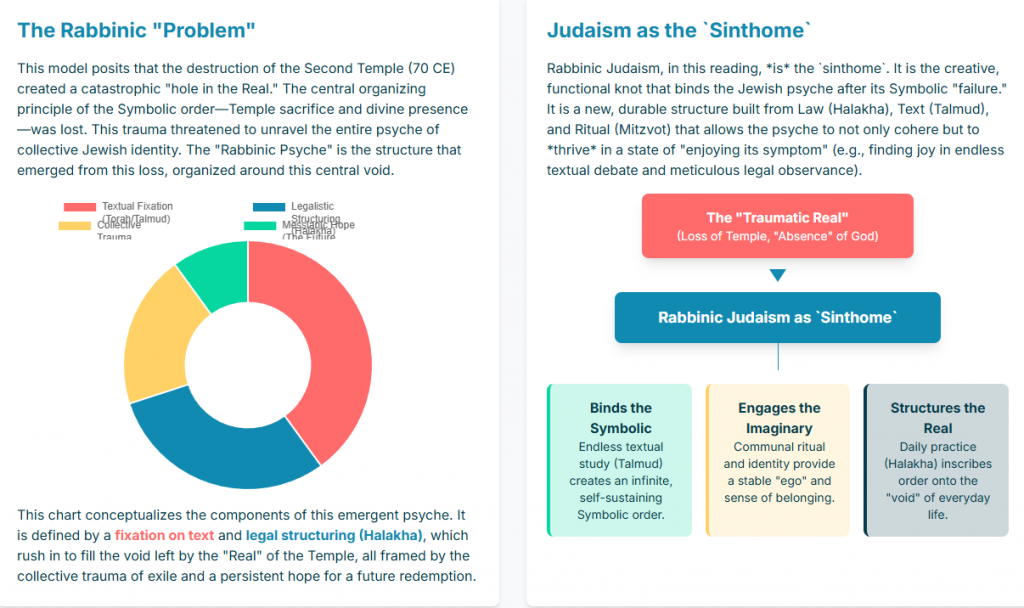
To posit a collective sinthome, one must first define the collective subject and the specific, foundational trauma that necessitates this sinthome. This analysis defines the “symbolic Rabbinic psyche” as a collective, textual entity and identifies its foundational trauma not as Freud’s mythic murder, but as the Real historical catastrophe of the Second Temple’s destruction, which exposed a pre-existing structural void at the core of the Jewish Symbolic order.
2.1 Defining the Subject: The ‘Symbolic Rabbinic Psyche’
The subject of this analysis is not an individual but a collective, textual entity: the “symbolic Rabbinic psyche.” This psyche is the “collective intellectual tradition” 27 that emerges from, and is coterminous with, the entire corpus of Rabbinic literature (Sifrut Chazal).28 It is a psyche constituted by a “collective voice” and a “collective authority” 30 that spans generations.
This aligns perfectly with Lacan’s primary dictum that the “unconscious is structured like a language” 18 and is, more precisely, the “discourse of the Other”.31 For the Rabbinic psyche, the “big Other”—the Symbolic order that structures its reality—is the vast, dialogical, and hermeneutic body of its own textual tradition.27 Freud’s “collective unconscious” 3 is thus reframed, not as a mystical phylogenetic inheritance, but as a shared, Symbolic structure of discourse that determines the subject.
2.2 The Foundational Trauma: The Real of Exile
A sinthome becomes necessary when the Name-of-the-Father—the paternal metaphor guaranteeing the Symbolic order—fails.19 This report locates this failure not in a repressed myth, but in the Real historical trauma of 70 C.E.: the Roman destruction of the Second Temple in Jerusalem.33
The Temple was not merely a building; it was the central organizing signifier of the Jewish psyche, the point of “neurotic planning” (in Sartre’s sense 34) that knotted the Imaginary (collective identity), the Symbolic (the Law and its authority), and the Real (the site of God’s unmediated presence). Its destruction was not a repressed event to be interpreted, but a conscious, “regrettable loss” 33 and “catastrophic” 35 Real event that threatened the total “collapse” of Judaism.35
This destruction ripped a hole in the Symbolic order. The central signifier that held “reality” together was lost, leading to the fragmentation of exile.24 The “mourning” for this event, which continues in rituals like Tisha B’Av, is not a “bewildered” remembrance of a “remote” building 24, but an annual, structural encounter with this inherited, intergenerational trauma.24 The Jewish psyche was de-knotted.
2.3 The Jewish God as the Central Void (Das Ding)
The historical trauma of 70 C.E. was catastrophic because it violently exposed a pre-existing structural void at the center of the Jewish Symbolic: the very nature of the Jewish God.
YHVH is not a positive entity in the model of Greek philosophy.36 The Jewish God is the unrepresentable Real, the “Thing” (das Ding) 25 that “presents itself at the level of unconscious experience” 25 as the ultimate, prohibited object. It is the void around which the Symbolic is structured.4
This is evident in the divine name itself. When Moses asks for God’s name, the reply is Ehyeh-Asher-Ehyeh (“I am what I am”). As Reinhard and Lupton argue, this must not be mistranslated in the direction of “Greek metaphysics” (i.e., “he who is”).36 The phrase, in its “oral repetition and incomplete semanticization,” crystallizes its “nonsensical character”.36 It is a voice 38, a “ferocious nonknowledge”.26 It is the “signifier without signified,” the S1 that anchors the Symbolic chain by ex-sisting from it.36 The Symbolic order of Judaism is thus founded on a “gap” 39 or a central void.40
The Rabbinic psyche is, therefore, doubly de-knotted. It possesses a synchronic, structural hole—the unrepresentable God (YHVH as Real)—and suffered a diachronic, historical trauma—the destruction of the Temple (the Name-of-the-Father that knotted the psyche around this void). The Roman destruction of the Temple was the cutting of this primary knot, exposing the psyche directly to the “terrifying or unbearable” Real 17, threatening a collective psychosis.
A new knot was not an option; it was an absolute necessity for survival. The “adaptation” to “synagogues, study, and prayer” 35 is the invention of this new knot. Rabbinic Judaism is this collective sinthome.
Part III: Rabbinic Judaism as the Sinthome (The Tripartite Knot)
This section details the central thesis: how Rabbinic Judaism, as a set of specific practices, functions as the “fourth ring” to re-knot the Real, Symbolic, and Imaginary registers of the collective Rabbinic psyche. The sinthome is this tripartite savoir-faire.
3.1 Knotting the Symbolic: The ‘Savoir-Faire’ of the Letter (Talmud/Midrash)
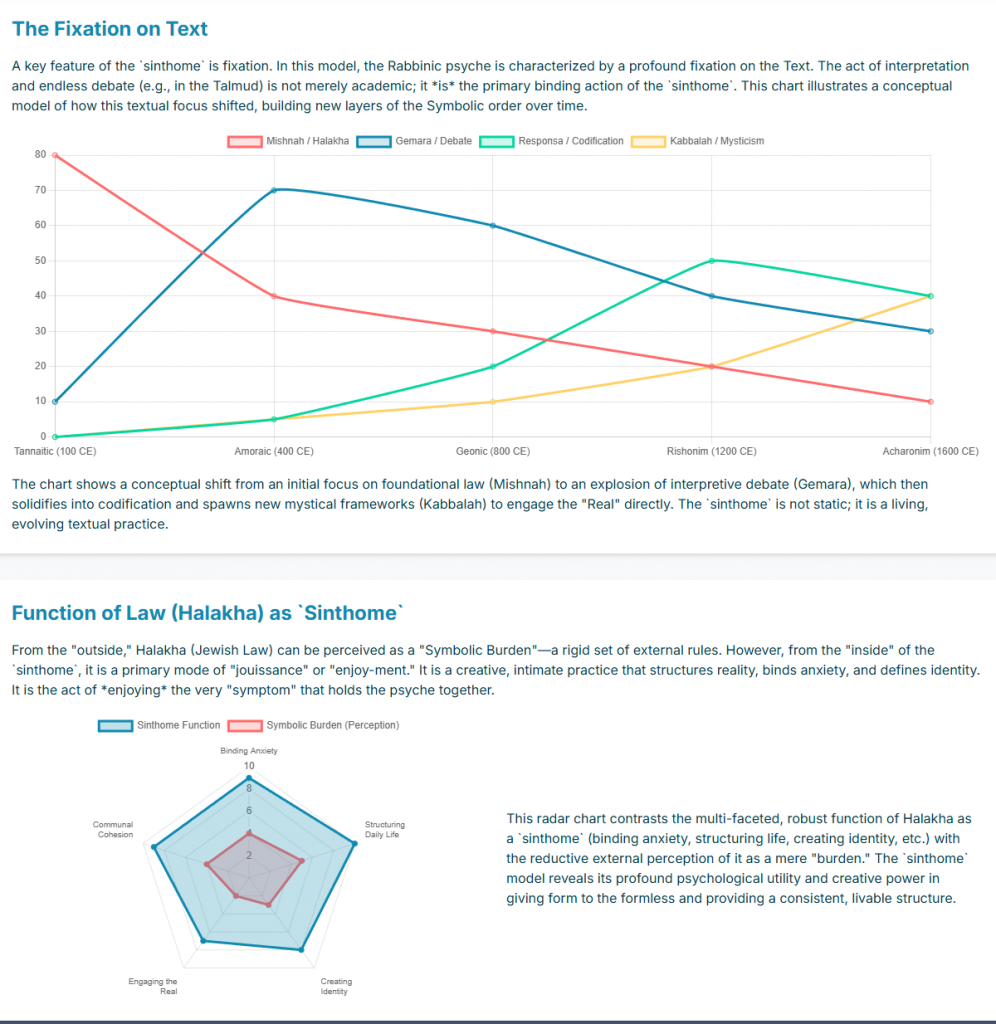
The sinthome knots the Symbolic register through a specific practice or savoir-faire 15: the endless hermeneutic process of Talmud and Midrash. This is a savoir-faire with the Letter itself.
Lacan was fascinated by the “determining role of the letter” in the Jewish tradition 41, where God “has no other body or means than that of the letter”.41 The Rabbinic psyche, deprived of its central signifier (the Temple), re-knotted its Symbolic order by turning to the materiality of the signifier—the lalangue—itself.
As Susan Handelman has argued, Freudian and Lacanian psychoanalysis is itself a “Jewish science” 32 precisely because it is a “secular version of Talmud”.32 Its methodology—its “Rabbinic hermeneutics” 32—is rooted in the Rabbinic assumption of “omnisignificance,” the idea “that the slightest details of the biblical text have a meaning”.30 This is a hermeneutic that privileges puns, wordplay, and “serpentine arguments”.43
This Talmudic process is the sinthome in action. It is a “dialogical, situated… practice” 27 that, rather than fleeing “contradiction,” uses it as its very engine.30 The crucial point is that this endless dialectic is not a search for truth (which would be a standard Symbolic, or S2, function). It is a mode of jouissance (which is Real). The goal of Talmudic argumentation is not to resolve the contradiction (which would be a neurotic “cure”) but to inhabit it, to generate more questions, more text, in an “endless line”.45
This process is the “superabundant vitality” 45 of jouissance.46 The Rabbinic psyche “en-joys” 21 its text. It knots the Symbolic by treating the signifier itself (S1, the Letter) as the object of desire (objet petit a), rather than seeking a final, stable signified (S2). This savoir-faire with the void 40 fills it with an infinite, self-generating hermeneutic process, thus knotting the Symbolic ring and holding it in place.
3.2 Knotting the Real: Halakha as a Template for Jouissance
The sinthome must also manage the Real—the register of “unbearable bodily intensities” 47, the “excess of life” 45 that is jouissance. Jouissance is “beyond the pleasure principle” 45, a “pain coupled with pleasure” 48 inextricably linked to the death drive.49 Left un-knotted, this “Other jouissance” 50 is “kindled” and “destructive”.52
The Rabbinic sinthome knots the Real through Halakha (Jewish Law). This is not Freud’s model of Law-as-neurotic-prohibition.3 It is, as Reinhard and Lupton argue, a “foundational template of subjective relationships to enjoyment (jouissance)”.25 The Decalogue, and the Halakha that flows from it, is not a “repressive text of negative prohibitions”.25 It is a sophisticated “apparatus of jouissance” 45 that “maps the subject’s relations to the symbolic order and to the real”.25
The Jewish God, the “furious Volcanic God” 37 of the Real, is the source of this “superabundant” and “terrible” jouissance. The mitzvot (rituals) are the sinthome’s savoir-faire for managing this jouissance. Halakha does not forbid enjoyment; it channels the “insufferable pressure of the drives” 26 into a “circuitous route” 48 that makes life “bearable”.45
Through the meticulous organization of every aspect of life—time (the Sabbath as a ritualized “gap” in the Symbolic 36), food, bodily functions, and social relations 53—Halakha functions as a “container”.55 It domesticates the Real, transforming the “inferno” 45 of “unbearable enjoyment” 26 into a “sublime object” 56 of collective, livable practice. It is the sinthome as the management of the Real.
3.3 Knotting the Imaginary: The ‘Jewish Cogito’ as Identification with the Remnant
Finally, the sinthome must knot the Imaginary (the register of the ego, identity, and the “mirror image” 18). It does this by providing a new, singular point of identification, which David Metzger terms a “Jewish cogito”.23
This is not the Cartesian cogito (“I think, therefore I am”), which establishes the subject as a master of its own consciousness. The “Jewish cogito” is, instead, an identification with the sinthome itself 23, or more precisely, an “identification with the object a“.23
The objet petit a (object little a) is the “object cause of desire”.58 It is not the object of desire, but the “leftover, the remnant” 59, the “surplus jouissance” 59 that is “beyond the reach of any demand”.23 It is the “sublime ‘object’ inside of an ordinary object”.56
Metzger maps Freud’s statement—”People of the Jewish faith believe they are the chosen ones [for the Other]” 23—directly onto this Lacanian concept. “Chosenness,” when read through the sinthome model, is not an Imaginary claim of mastery (“We are the best”). It is, rather, the Imaginary identification of the collective self with the Real remnant (objet a) of the Symbolic Other (God). It is the realization: “I am this non-signifier for the Other”.23
A subject is normally alienated in the Symbolic (“a signifier represents the subject for another signifier” 36). But the sinthome provides a different path. The “Rabbinic psyche” (the Imaginary “I”) identifies not with a master signifier (S1) in the Symbolic, but with the gap or leftover (objet a) of the Symbolic. This is the “Jewish Science” that Metzger and Lacan describe 23: it is founded on the knowledge that “There is no Other” 23 (i.e., no absolute Symbolic guarantee). In response, the psyche identifies with the remnant left by this lack. This identification (“We are the remnant”) is the sinthome “shouldering the weight of Jewish fantasy” 23, knotting the Imaginary to the Real and allowing the “Rabbinic psyche” to ex-sist its own foundational trauma.
Part IV: Concluding Analysis – The Rabbinic Sinthome as a Mode of Survival
4.1 Judaism as Savoir-Faire, Not Croyance (Belief)
The analysis culminates in a re-definition of Rabbinic Judaism. As a sinthome, it is not a croyance (a belief system), which would be a function of the Symbolic and Imaginary registers. It is, rather, a savoir-faire 15, a complex, embodied practice for living in the world after the failure of the central Symbolic guarantee.
Rabbinic Judaism is this “art,” in the same way Lacan describes Joyce’s work as the savoir-faire of an “artist”.15 It is a tripartite, functional art that knots the psyche:
- The Art of the Letter: The savoir-faire of Talmudic hermeneutics, which knots the Symbolic by generating jouissance from the signifier itself (Part 3.1).
- The Art of the Act: The savoir-faire of Halakhic practice, which knots the Real by meticulously channeling and domesticating “unbearable jouissance” (Part 3.2).
- The Art of Identity: The savoir-faire of the “Jewish cogito,” which knots the Imaginary by identifying the collective self with the “remnant” (objet a) (Part 3.3).
It is this practice—not a belief in an interpretable, neurotic symptom 11—that allowed the “symbolic Rabbinic psyche” to survive the “psychotic” de-knotting of its world (the Temple’s destruction) and maintain its “sense of reality”.10
4.2 Final Distinction: A ‘Jewish Science’ Beyond Neurosis
This report returns to Freud’s “hope for a ‘Jewish Science'”.23 Freud, limited by his own metapsychology, could only frame Judaism as a neurosis, which he and Aquinas considered a “better deal than psychosis”.23 His Moses was his “desire to construct ‘something’ that might shoulder the weight of Jewish fantasy”.23
Lacan, via the sinthome, provides the theoretical concept that Freud lacked. Rabbinic Judaism is that “something.” It is a third way, a structure that “picks up… right where Descartes left it, at the point where the unconscious is Real” (the point of psychosis) 23, but avoids the “terrible price of psychotic certainty”.23
The Rabbinic sinthome shoulders the collective Jewish fantasy, not by repressing it (neurosis) or being overwhelmed by it (psychosis), but by knotting it.14 It is a creative, singular invention that knots the R, S, and I into a durable, collective, and generative ex-sistence. It is not the “especially dumb” answer to a riddle 15, but the very mechanism of survival itself.
Works cited
- Freud as Talmudist – Jewish Review of Books, accessed on November 15, 2025, https://jewishreviewofbooks.com/jewish-history/13912/freud-as-talmudist/
- Psychoanalysis: A Jewish Science?, accessed on November 15, 2025, https://jewishideasdaily.com/654/features/psychoanalysis-a-jewish-science/
- Sigmund Freud: Religion | Internet Encyclopedia of Philosophy, accessed on November 15, 2025, https://iep.utm.edu/freud-r/
- Lacan and Monotheism: Psychoanalysis and the Traversal of Cultural Fantasy, accessed on November 15, 2025, https://legacy.chass.ncsu.edu/jouvert/v3i12/reinha.htm
- Freud and Monotheism: Moses and the Violent Origins of Religion | Department of German, accessed on November 15, 2025, https://german.berkeley.edu/publications/freud-and-monotheism-moses-and-violent-origins-religion
- Religiousness – Between Defence Mechanism and Consciousness. A Study Based on Sigmund Freud’s Moses and Monotheism – Biblioteka Nauki, accessed on November 15, 2025, https://bibliotekanauki.pl/articles/37550237.pdf
- 2006: Moses and monotheism | News and features | University of …, accessed on November 15, 2025, https://www.bristol.ac.uk/news/2006/11557411546.html
- (PDF) Religiousness – Between Defence Mechanism and Consciousness. A Study Based on Sigmund Freud’s Moses and Monotheism – ResearchGate, accessed on November 15, 2025, https://www.researchgate.net/publication/381832552_Religiousness_-_Between_Defence_Mechanism_and_Consciousness_A_Study_Based_on_Sigmund_Freud’s_Moses_and_Monotheism
- Lacan and Žižek’s Concept of the Superego | by The Dangerous Maybe | Medium, accessed on November 15, 2025, https://thedangerousmaybe.medium.com/lacan-and-%C5%BEi%C5%BEeks-concept-of-the-superego-7c0b5baf7705
- Symptom According to Psychoanalysis – Bita Psychology, accessed on November 15, 2025, https://www.bitamelbournepsychologist.com.au/understanding-the-symptom-in-lacanian-psychoanalysis/
- On the Aim and End of Analysis in the Lacanian School, accessed on November 15, 2025, https://www.journal-psychoanalysis.eu/articles/on-the-aim-and-end-of-analysis-in-the-lacanian-school/
- The Seminar of Jacques Lacan XXIII: Le Sinthome – LACANONLINE.COM, accessed on November 15, 2025, https://www.lacanonline.com/wp-content/uploads/2014/11/Seminar-XXIII-The-Sinthome-Jacques-Lacan-Thurston-translation.pdf
- Lacan Seminar 23 Le Sinthome, accessed on November 15, 2025, http://www.lacaninireland.com/web/wp-content/uploads/2010/06/THE-SEMINAR-OF-JACQUES-LACAN-XXIII.pdf
- SEMINAR XXIII JOYCE AND THE SINTHOME – lievenjonckheere-psy.be, accessed on November 15, 2025, https://lievenjonckheere-psy.be/sites/default/files/pdf/sem_xxiii_summary_for_summer_school_5_lessons_0.pdf
- NLS Congress – ORIENTATION 12, accessed on November 15, 2025, https://www.amp-nls.org/nls-messager/nls-congress-orientation-12/
- Symptom/Sinthome | Encyclopedia.com, accessed on November 15, 2025, https://www.encyclopedia.com/psychology/dictionaries-thesauruses-pictures-and-press-releases/symptomsinthome
- Jacques Lacan: Explaining the Imaginary, the Symbolic, and the Real | TheCollector, accessed on November 15, 2025, https://www.thecollector.com/jacques-lacan-imaginary-symbolic-real/
- [SPOILERS S1] LACAN AND THE “BORROMEAN KNOT MODEL” : r/1899 – Reddit, accessed on November 15, 2025, https://www.reddit.com/r/1899/comments/zcgjy2/spoilers_s1_lacan_and_the_borromean_knot_model/
- On the logical use of the Sinthome, or, Joyce with Freud | Archives of a Divided Subject, accessed on November 15, 2025, https://melbournelacanian.wordpress.com/2017/02/20/on-the-logical-use-of-the-sinthome-or-joyce-with-freud/
- Understanding the Imaginary & Symbolic in relation to the Real & Borromean Knot : r/lacan, accessed on November 15, 2025, https://www.reddit.com/r/lacan/comments/109w0ou/understanding_the_imaginary_symbolic_in_relation/
- Lacan Le-sinthome – (Re)-Turn: A Journal of Lacanian Studies, accessed on November 15, 2025, https://return.jls.missouri.edu/ReturnVol2/Chiesa.pdf
- Mirrors/ Lacan with Joyce/ Theory, Psychoanalysis, and Literature – Breac, accessed on November 15, 2025, https://breac.nd.edu/articles/mirrors-lacan-with-joyce-theory-psychoanalysis-and-literature/
- Freud’s Jewish Science and Lacan’s Sinthome – ODU Digital …, accessed on November 15, 2025, https://digitalcommons.odu.edu/cgi/viewcontent.cgi?article=1018\&context=english_fac_pubs
- Mourning Something We’ve Never Seen – Jewish Journal, accessed on November 15, 2025, https://jewishjournal.com/judaism/383098/mourning-something-weve-never-seen/
- The Subject of Religion: Lacan and the Ten Commandments, accessed on November 15, 2025, https://escholarship.org/uc/item/6k31748m
- (PDF) The Subject of Religion: Lacan and the Ten Commandments, accessed on November 15, 2025, https://www.researchgate.net/publication/236783280_The_Subject_of_Religion_Lacan_and_the_Ten_Commandments
- The Origins and Worldwide Significance of Judaic Hermeneutics – MDPI, accessed on November 15, 2025, https://www.mdpi.com/2077-1444/16/6/717
- Rabbinic literature – Wikipedia, accessed on November 15, 2025, https://en.wikipedia.org/wiki/Rabbinic_literature
- Law in Classical Rabbinic Judaism (Chapter 3) – Cambridge University Press, accessed on November 15, 2025, https://www.cambridge.org/core/books/cambridge-companion-to-judaism-and-law/law-in-classical-rabbinic-judaism/1932B4D89EE7D25BED3CC70D3D1A8401
- The Talmud as an Agent of Chaos – 18Forty, accessed on November 15, 2025, https://18forty.org/articles/talmud-as-an-agent-of-chaos/
- Lacan on Religion – Parallaxis-view – WordPress.com, accessed on November 15, 2025, https://parallaxisview.wordpress.com/2018/03/06/lacan-on-religion/
- INTERPRETATION AS DEVOTION: – Freud’s Relation to Rabbinic Hermeneutics – Susan Handelman, accessed on November 15, 2025, http://www.susanhandelman.com/uploads/2/4/8/0/24803043/interpretation_as_devotion-freuds_relation_to_rabbinic_hermene.pdf
- WHEN JUDAISM LOST THE TEMPLE – Macquarie University, accessed on November 15, 2025, https://figshare.mq.edu.au/articles/thesis/When_Judaism_lost_the_Temple_crisis_and_response_in_4_Ezra_and_2_Baruch/19444439/1/files/34545551.pdf
- The Fantastic Structure of Freedom: Sartre, Freud, and Lacan – e-Publications@Marquette, accessed on November 15, 2025, https://epublications.marquette.edu/cgi/viewcontent.cgi?article=1905\&context=dissertations_mu
- Why Jews Still Cry Over the Destruction of the Temple in Jerusalem …, accessed on November 15, 2025, https://aish.com/why-jews-still-cry-over-the-destruction-of-the-temple-in-jerusalem/
- Revelation: Lacan and the Ten Commandments, accessed on November 15, 2025, https://www.jcrt.org/archives/02.1/reinhard_lupton.shtml
- תוכן העניינים, accessed on November 15, 2025, https://www.magnespress.co.il/api/magnes/book/8717/preview
- Radical Transcendence: Lacan on the Sinai, accessed on November 15, 2025, http://www.teof.uni-lj.si/uploads/File/BV/BV2017/03/Welten.pdf
- The Borromean Knot The Borromean knot is a certain way of knotting loops of thread. Mathematician – Lacanian Works Exchange, accessed on November 15, 2025, https://lacanianworksexchange.net/wp-content/uploads/2023/06/19860101LafontTopologyCh7.pdf
- Am I understanding these Lacanian principles right? : r/psychoanalysis – Reddit, accessed on November 15, 2025, https://www.reddit.com/r/psychoanalysis/comments/kyp9ff/am_i_understanding_these_lacanian_principles_right/
- Lacan and the Jews – Association Lacanienne Internationale, accessed on November 15, 2025, https://www.freud-lacan.com/documents-ged/lacan-and-the-jews/
- The Insistence of the Letter in the Unconscious, accessed on November 15, 2025, https://web.english.upenn.edu/~cavitch/pdf-library/Lacan_Insistence_of_the_Letter_in_the_Unconscious.pdf
- Talmudic Dream Interpretation, Freudian Ambivalence, Deconstruction – SURFACE at Syracuse University, accessed on November 15, 2025, https://surface.syr.edu/context/rel/article/1066/viewcontent/talmudic_dream_interpretation.pdf
- The Coiled Serpent of Argument: Reason, Authority, and Law in a Talmudic Tale: Epilogue, accessed on November 15, 2025, https://scholarship.kentlaw.iit.edu/cgi/viewcontent.cgi?article=3466\&context=cklawreview
- What Does Lacan Say About… Jouissance? – LACANONLINE.COM, accessed on November 15, 2025, https://www.lacanonline.com/2015/07/what-does-lacan-say-about-jouissance/
- Lacan: The Limits of Love and Knowledge – Janus Head, accessed on November 15, 2025, http://janushead.org/wp-content/uploads/2020/07/Brent-Dean-Robbins-2.pdf
- Jacques Lacan – Stanford Encyclopedia of Philosophy, accessed on November 15, 2025, https://plato.stanford.edu/entries/lacan/
- “What’s in the Basket?”: Jouissance and the Circuit of the Lacanian Drive – lacan.org, accessed on November 15, 2025, http://lacan.org/gilley
- Jouissance and death drive in Lacan’s teaching – Redalyc, accessed on November 15, 2025, https://www.redalyc.org/journal/3765/376563855006/376563855006.pdf
- LACAN ON THE MYSTICAL ‘JOUISSANCE OF BEING’ | Psychoanalytische Perspectieven, accessed on November 15, 2025, https://www.psychoanalytischeperspectieven.be/vol-41-2-2023/lacan-on-the-mystical-jouissance-of-being
- Other Jouissance and Modern Mysticism | Archives of a Divided Subject – WordPress.com, accessed on November 15, 2025, https://melbournelacanian.wordpress.com/2018/03/19/other-jouissance-and-modern-mysticism/
- The Psychoanalytic Concept of Jouissance and the Kindling Hypothesis – Frontiers, accessed on November 15, 2025, https://www.frontiersin.org/journals/psychology/articles/10.3389/fpsyg.2017.01593/full
- Halakha and Morality: A Few Methodological Considerations – W\&M ScholarWorks, accessed on November 15, 2025, https://scholarworks.wm.edu/cgi/viewcontent.cgi?article=1119\&context=jtr
- Orthodox Judaism and Psychoanalysis: Toward Dialogue and Reconciliation, accessed on November 15, 2025, https://www.researchgate.net/publication/8434261_Orthodox_Judaism_and_Psychoanalysis_Toward_Dialogue_and_Reconciliation
- The mystical roots of psychoanalytic theory – World Cultural Psychiatry Journal, accessed on November 15, 2025, https://www.worldculturalpsychiatry.org/wp-content/uploads/2019/08/05-Themystical-V01N3.pdf
- Lacan’s Concept of the Object-Cause of Desire (objet petit a) – The Dangerous Maybe, accessed on November 15, 2025, https://thedangerousmaybe.medium.com/lacans-concept-of-the-object-cause-of-desire-objet-petit-a-bd17b8f84e69
- “Freud’s Jewish Science and Lacan’s Sinthome” by David Metzger, accessed on November 15, 2025, https://digitalcommons.odu.edu/english_fac_pubs/16/
- accessed on November 15, 2025, http://lacan.org/gilley#:~:text=The%20objet%20petit%20a%20(or,to%20it%20and%20initiates%20desire.
- Objet petit a – Wikipedia, accessed on November 15, 2025, https://en.wikipedia.org/wiki/Objet_petit_a
- Rethinking desire: the objet petit a in Lacanian theory – PubMed, accessed on November 15, 2025, https://pubmed.ncbi.nlm.nih.gov/15822424/
About the Author