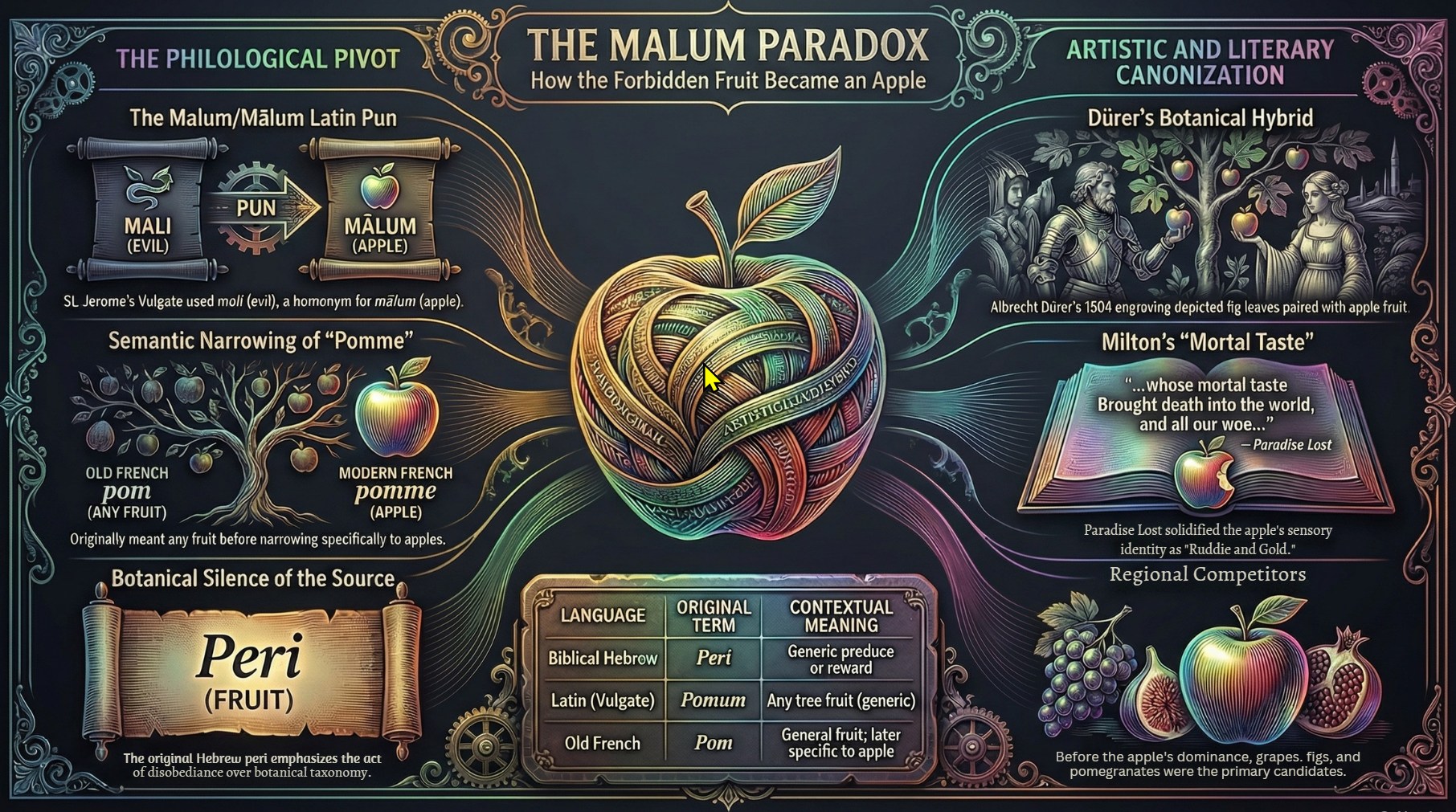
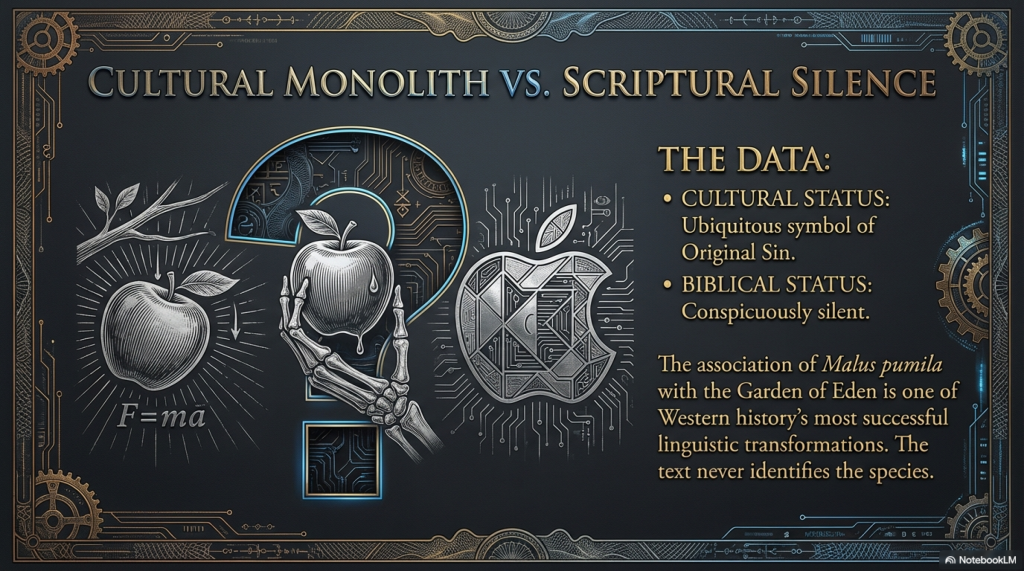
The identification of the forbidden fruit in the Garden of Eden as an apple represents one of the most successful and enduring instances of linguistic and cultural transformation in Western history. While the contemporary collective consciousness almost reflexively envisions an apple when contemplating the “Fall of Man,” the Hebrew scriptures remain conspicuously silent regarding the botanical species of the fruit. The original Hebrew text in the Book of Genesis utilizes the term peri, a generic noun signifying fruit, produce, or the results of growth.1 The transition from this non-specific biblical peri to the iconic red Malus pumila is not the result of a single scriptural revelation but rather a complex convergence of linguistic coincidences, shifting semantic boundaries in medieval vernaculars, and the potent influence of Renaissance art and literature. This analysis explores the multi-layered evolution of this association, exploring the Latin homonymic tension between “evil” and “apple,” the role of the Vulgate translation, the specific semantic narrowing of the Old French word pomme, and the consolidation of this imagery through the works of Albrecht Dürer and John Milton.
The Scriptural Foundation: The Generic Fruit of Genesis
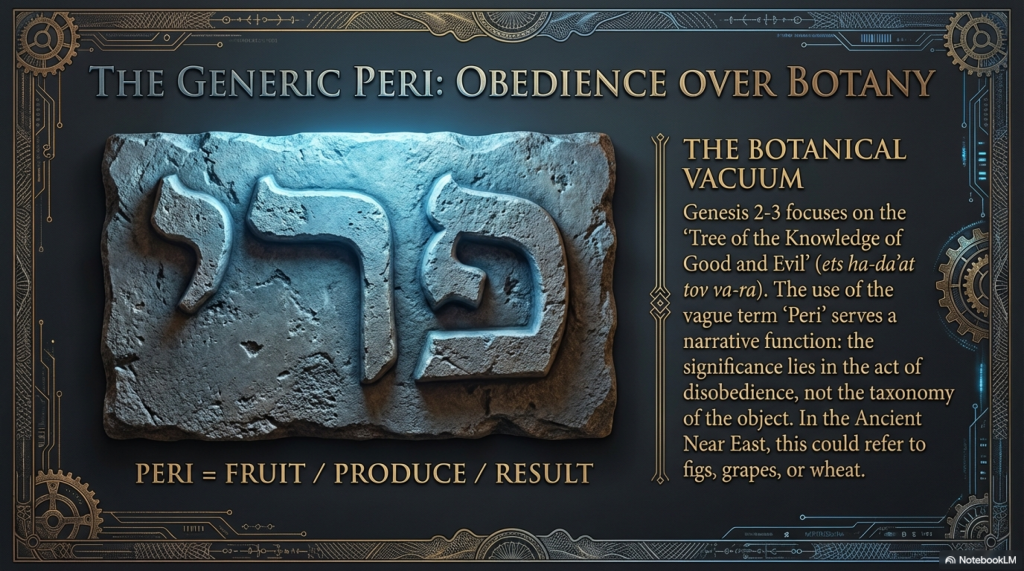
The biblical account of human origins in Genesis 2 and 3 establishes the “Tree of the Knowledge of Good and Evil” (ets ha-da’at tov va-ra) as the focal point of divine prohibition.4 The text describes a lush environment where God permits the first humans to eat from any tree except this specific one, warning that consumption would lead to certain death.1 When the serpent tempts Eve, the narrative refers only to the “fruit of the tree which is in the midst of the garden”.7 The Hebrew word peri (פְּרִי) serves a broad semantic function, encompassing any edible yield of a plant.2 In the context of ancient Near Eastern agriculture, this could have referred to any number of native species, yet the text avoids specific identification to emphasize the act of disobedience over the physical properties of the object itself.9 The internal logic of the narrative suggests that the significance of the fruit lies in its effect—granting awareness of morality and mortality—rather than its taxonomy.10
Comparative Terminology in Early Biblical Texts
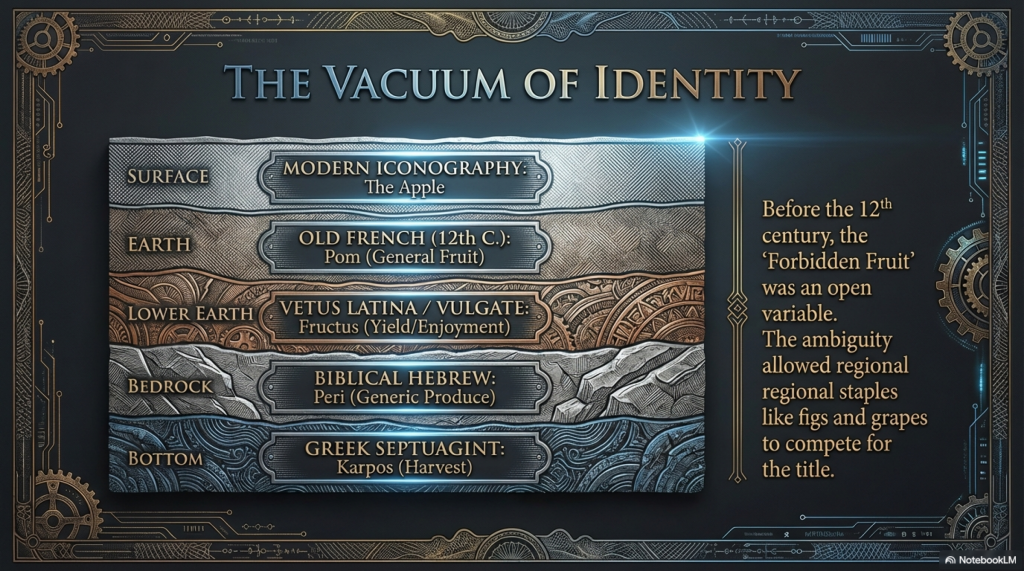
The following table outlines the linguistic variations in the term for “fruit” across primary ancient translations, illustrating the early lack of botanical specificity.
| Language | Term | Contextual Meaning | Source |
|---|---|---|---|
| Biblical Hebrew | Peri (פְּרִי) | Generic fruit; botanical produce; reward | 2 |
| Latin (Vetus Latina) | Fructus | Fruit; enjoyment; yield | 13 |
| Latin (Vulgate) | Fructus / Pomum | Fruit in general; tree fruit | 13 |
| Ancient Greek (Septuagint) | Karpos (καρπός) | Fruit; yield; harvest; result | 15 |
| Old French | Pom | General fruit; later specific to apple | 14 |
Historical analysis indicates that the Hebrew peri is most accurately understood as “produce” or “result,” a term that carries no inherent botanical identity.3 The description of the tree of “the knowledge of good and evil” leaves no trace as to the exact species, as the emphasis is placed on the moral boundary rather than the physical object.12 This botanical silence provided a vacuum into which various cultural and linguistic traditions projected their own regional staples, including figs, grapes, pomegranates, and eventually, the apple.2
The Vulgate and the Philological Pivot: St. Jerome’s Linguistic Contribution
In the late 4th century, Pope Damasus I commissioned the scholar Jerome (Eusebius Sophronius Hieronymus) to produce a definitive Latin translation of the Bible.15 At the time, the Western Roman Empire was increasingly linguistically isolated from the Greek-speaking East, and existing “Old Latin” translations were fragmented and often inaccurate.15 Jerome’s project, which became known as the Vulgate, aimed for Hebraica Veritas—the Hebrew truth—by translating the Old Testament directly from original Hebrew manuscripts rather than the Greek Septuagint.15
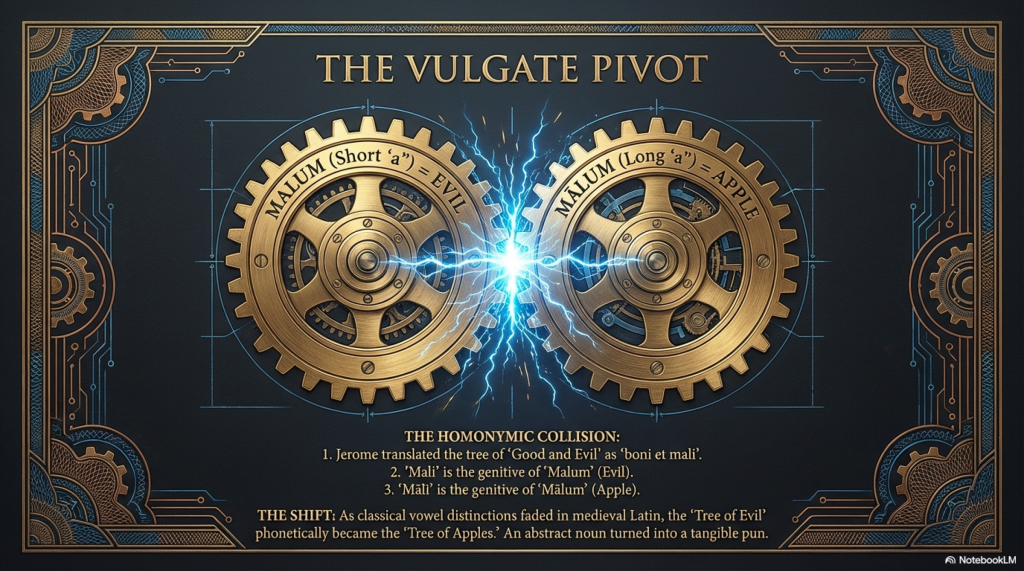
In Genesis 2:17, Jerome translated the “tree of the knowledge of good and evil” as lignumque scientiae boni et mali.2 The word mali is the genitive form of the noun malum, meaning “evil”.2 However, Latin contains a striking homonym: mālum (with a long ‘a’) refers to an “apple,” while malum (with a short ‘a’) refers to “evil” or “misfortune”.13 Although Jerome himself utilized the general term fructus in Genesis 3 to describe the fruit Adam and Eve consumed, the proximity of the “Tree of Good and Evil” (boni et mali) to the concept of the forbidden fruit created a fertile ground for wordplay.8
The Malum/Mālum Distinction and Medieval Reinterpretation
The phonemic difference between the long /aː/ in mālum (apple) and the short /a/ in malum (evil) was distinct in classical Latin pronunciation.13 However, as Latin transitioned into the medieval period and regional dialects, these quantitative vowel distinctions often blurred.13 To a medieval reader or listener, the “Tree of Knowledge of Good and Mali” naturally suggested a “Tree of Knowledge of Good and Apples“.9 This pun provided a mnemonic and symbolic bridge, linking the abstract concept of sin with a tangible, familiar object.24
Scholarly debate continues regarding whether Jerome intended this pun. Some suggest that as a “godly translator” who viewed even the word order of scripture as a “mystery” (mysterium), Jerome may have recognized and leveraged the linguistic overlap to underscore the gravity of the transgression.24 However, historical linguistics suggests the identification was likely an emergent property of the Latin language itself, adopted by later commentators and artists who found the linguistic coincidence too compelling to ignore.14
Homonymic Tensions in Latin Vocabulary
| Nominative | Genitive | Meaning | Relation to Genesis | Source |
|---|---|---|---|---|
| Malum | Mali | Evil; badness; suffering | The abstract quality of the Tree’s knowledge. | 2 |
| Mālum | Mālī | Apple; fruit; orchard produce | The physical object often associated with the Fall. | 2 |
| Mālus | Mālī | Apple tree; mast of a ship | The botanical source; later the “Tree of Knowledge.” | 22 |
This linguistic overlap meant that when Jerome wrote about the tree of mali (evil), subsequent generations reading the Latin text could interpret it as the tree of mali (apples). This was not an error in translation per se, but a shift in the interpretive lens of the reader as classical vowel lengths faded from common usage.13 By the 12th century, the apple had become a standard shorthand for the forbidden fruit in Western European thought, though it was still competing with regional candidates like the fig and the grape.14
Medieval France and the Semantic Shift: The Rise of Pomme
Recent research suggests that the Latin pun, while influential, was not the primary catalyst for the apple’s dominance in the Western imagination. Instead, the identification may be traced to 12th-century France and a specific shift in historical linguistics.14 In medieval Latin, authors frequently referred to the forbidden fruit as a pomum, a term that generically meant “fruit” or “tree fruit”.14 When the Book of Genesis was translated into Old French, the term pomum was rendered as pom.14 At that stage of the French language, pom maintained the broad Latin meaning of any fruit. Consequently, a phrase such as “Adam and Eve ate a pom” originally meant they ate a fruit.14
Over several centuries, however, the French language underwent a process of semantic narrowing. The word pom (evolving into the modern pomme) transitioned from a general term for all fruit to a specific term for the apple.14 When later generations of French readers encountered earlier translations or Latin texts using pomum/pom, they projected the newer, narrower meaning onto the text.14 By the 12th century, French artists began depicting the forbidden fruit as an apple, and this iconographic choice spread through illuminated manuscripts and cathedral carvings to the rest of Europe.14
The Evolution of the Old French Pom
The semantic narrowing of pom is a textbook case of linguistic drift impacting theological perception. The transition can be understood in three distinct phases:
- General Acquisition (Pre-1100s): Old French inherits pom from Latin pomum. It is used to describe dates (fingeræppla), cucumbers (eorþæppla), and other produce.14
- Semantic Narrowing (1100s-1200s): In French-speaking regions, the apple becomes the most common tree fruit. The term pom begins to be used as the default name for the species Malus domestica.14
- Projective Reinterpretation (Post-1200s): Readers of the vernacular Bible understand “Adam ate a pom” as “Adam ate an apple.” Artists in 12th-century France begin representing the scene with apples, a practice that eventually supplants depictions of grapes and figs.14
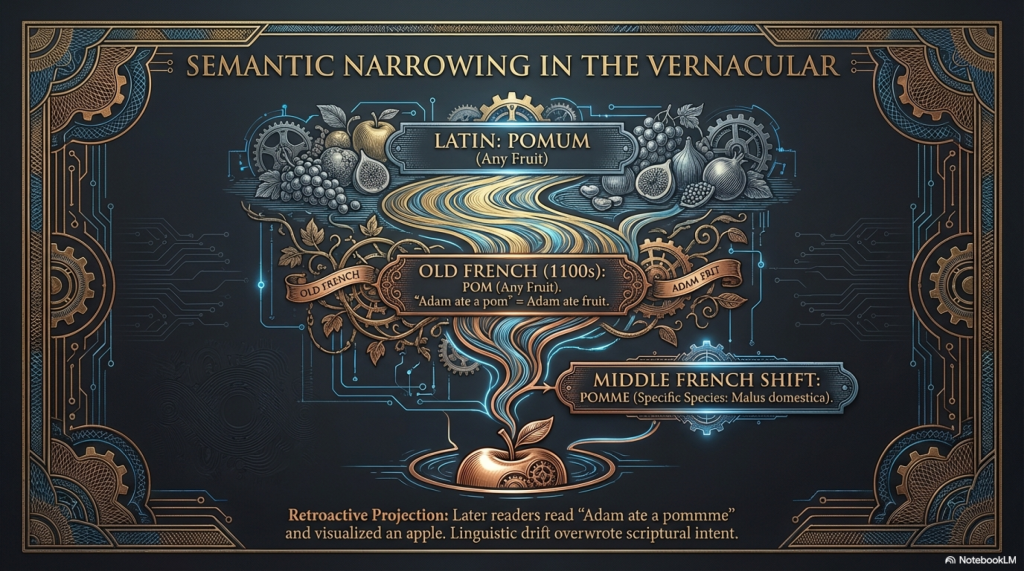
This linguistic shift occurred independently of theological considerations, yet it had profound ramifications for the most well-known symbol in the Hebrew Bible.14 It demonstrates how forces of vernacular change can overwrite original scriptural intent, transforming a generic “fruit” into a specific botanical icon that carries a weight the original authors never envisioned.14
Artistic Canonization: The Renaissance and the Hybrid Tree
The transition from linguistic theory to cultural fact was largely accomplished through the power of visual art. For centuries, artists had experimented with various identifications for the fruit, often reflecting local agriculture. In Mediterranean regions, the fig and the grape remained prominent.14 However, as the center of European artistic production shifted northward, the apple—a hardy and ubiquitous fruit in temperate climates—became the standard.8
Albrecht Dürer and the Iconographic Synthesis
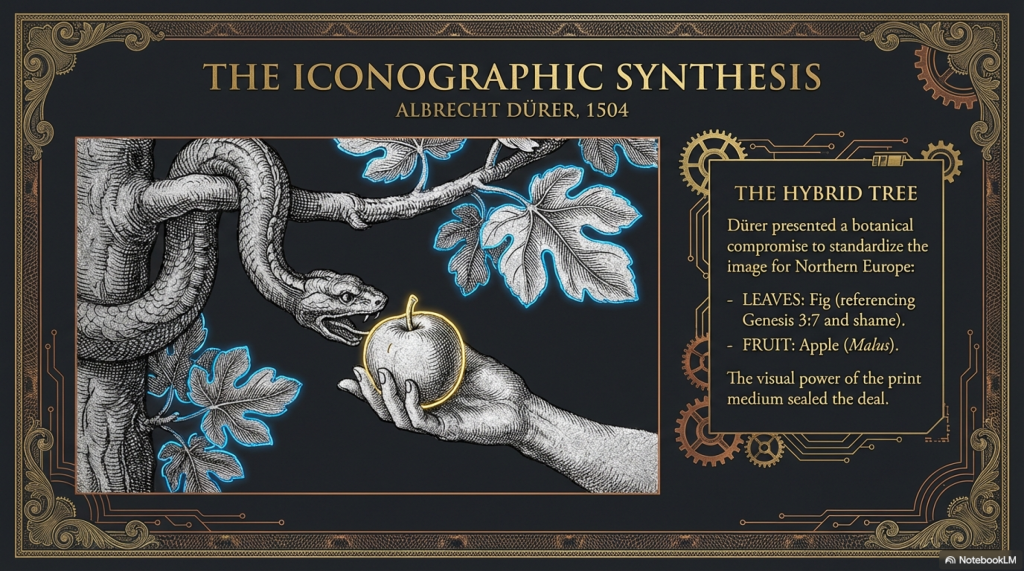
The German Renaissance master Albrecht Dürer played a pivotal role in “sealing the deal” for the apple in Western consciousness.8 His 1504 engraving, Adam and Eve, is one of the most influential works of the era.31 In this depiction, Dürer presents a nuanced botanical compromise that reflects the tension between tradition and the emerging apple motif. Dürer’s “Tree of Knowledge” is a botanical hybrid: it features the leaves of a fig tree but the fruit of an apple tree.32 This hybridity serves a specific narrative function. The fig leaves represent the immediate consequence of the sin—the awareness of nakedness and the subsequent need for clothing (Genesis 3:7)—while the apple serves as the catalyst for the Fall.32 Dürer also includes a “Tree of Life” in the background, represented as a mountain ash (or sorb-apple tree), creating a symbolic contrast between the tree of mortality and the tree of life.32
The Influence of the Four Temperaments
Dürer’s engraving was not merely a literal representation of the Fall but a dense collection of medieval and Renaissance symbolism. Placed around Adam and Eve are four animals, each representing one of the “four temperaments” or humors that were believed to govern human health and personality:
- The Elk: Melancholic (gloomy, associated with the earth).31
- The Rabbit: Sanguine (sensual, associated with air).31
- The Cat: Choleric (cruel, associated with fire).31
- The Ox: Phlegmatic (slothful, associated with water).31
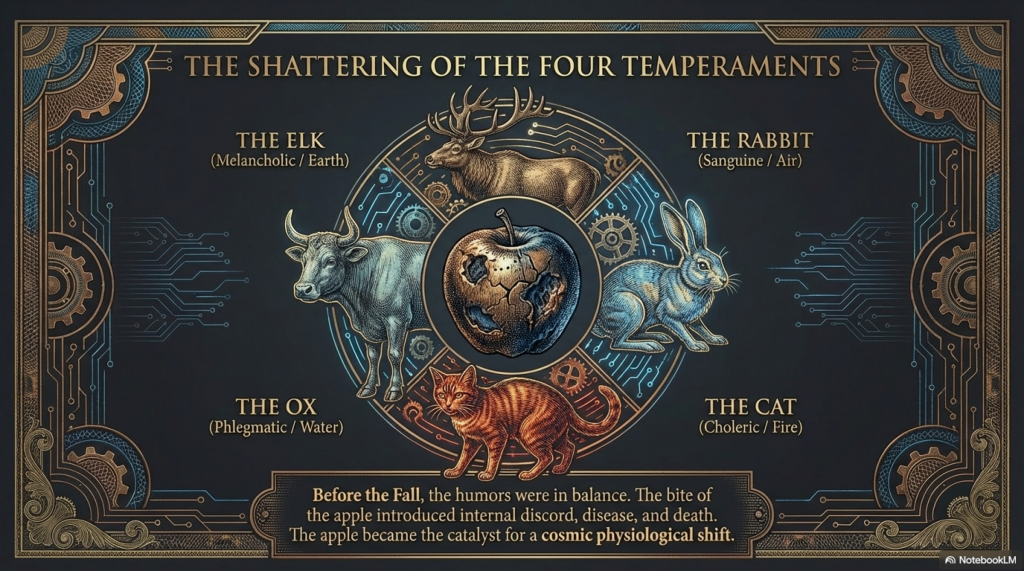
Before the Fall, these temperaments were believed to be in perfect balance within Adam and Eve.31 The act of eating the apple disrupted this harmony, introducing disease, psychological instability, and death into the human experience.1 By placing the apple at the center of this profound shift in human nature, Dürer elevated the fruit from a mere snack to a cosmic symbol of imbalance and lost perfection. This artistic template was so successful that it influenced generations of later artists, including Lucas Cranach the Elder, who depicted Adam and Eve beside unambiguous apples.8
The Miltonic Synthesis: Paradise Lost
If Dürer provided the visual template for the apple, the English poet John Milton provided the definitive literary one. In his 1667 epic Paradise Lost, Milton explicitly identifies the forbidden fruit as an apple twice.8 Milton, a polyglot scholar who was undoubtedly aware of the linguistic ambiguity of the Hebrew and Latin texts, likely chose the apple for its rich sensory and symbolic potential.9
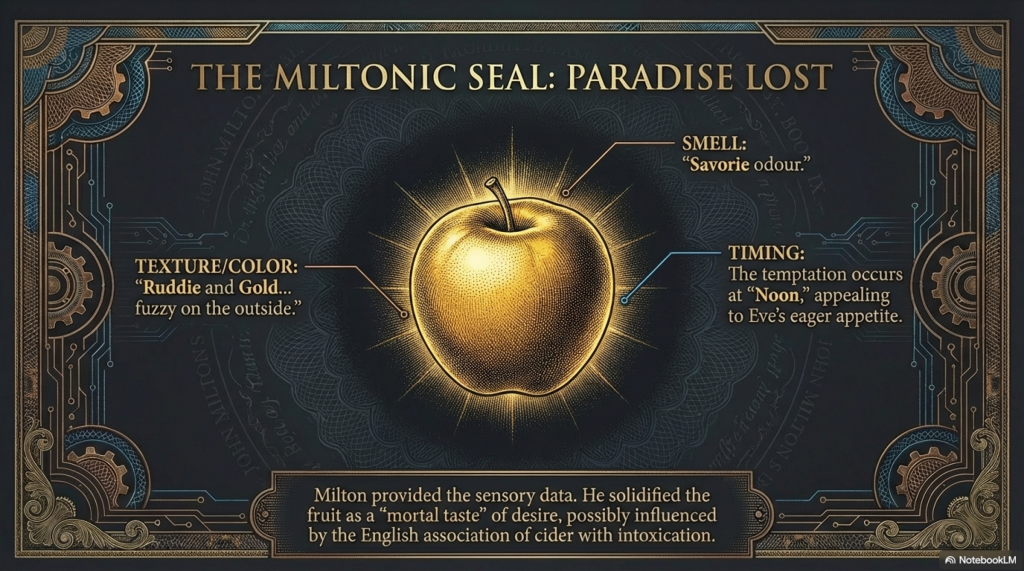
In Book IX, Milton provides a vivid description of the fruit as Eve approaches it, noting its “savorie odour” and “Ruddie and Gold” appearance.25 He describes the serpent’s temptation as occurring at the “hour of Noon,” when Eve’s “eager appetite” made the fruit even more enticing.25 This sensory indulgence—the “mortal taste” that “brought death into the world”—cemented the apple as the ultimate symbol of forbidden desire.7 Milton’s use of the term also tapped into contemporary English connotations. In the 17th century, “apple” could still refer to any fleshy, seed-bearing fruit, but it was increasingly associated with the common Malus.7 Furthermore, some scholars suggest Milton’s choice was influenced by the cultural presence of hard apple cider in England, which carried associations of both innocence and intoxicating distraction.25 When Satan returns to Hell to boast of his victory, he mocks humanity by claiming the Fall was wrought by something as “ridiculous” as an apple, highlighting the stark contrast between the triviality of the fruit and the gravity of the consequence.25
Milton’s Symbolic Framing of the Apple
| Attribute | Symbolic Meaning in Paradise Lost | Connotation |
|---|---|---|
| Red Color | Blood and mortality | The introduction of death into the world. |
| Round Shape | Fertility and the world | The universal scope of the Fall’s consequences. |
| Golden Hue | Greed and divine status | The desire to “be like gods,” knowing good and evil. |
| Sweet Taste | Sensual desire and temptation | The triumph of appetite over obedience. |
Milton’s vivid descriptions in the temptation scene made the fruit more relatable and memorable to a general audience. He described the apple as being “fuzzy on the outside, and extremely juicy and sweet and ambrosial,” at the moment Eve takes the mythical bite.25 This sensory richness helped ensure that the apple would remain the definitive forbidden fruit in the Western cultural imagination for centuries to come.25
Comparative Mythology: The Golden Apple and Divine Knowledge
The association of the apple with divine or forbidden knowledge was not unique to Christianity. The selection of the apple as the fruit of Eden was likely influenced by its prominent role in broader Indo-European mythologies.25 The recurring theme across these cultures is the apple as a gateway to the divine realm, a fruit that bridges the gap between the mortal and the eternal.35

The Garden of the Hesperides and Classical Influence
In Greek mythology, the Garden of the Hesperides contained a tree (or grove) that produced golden apples, a wedding gift from Gaia to Hera.36 These apples were guarded by a hundred-headed dragon named Ladon and the Hesperides themselves.36 Like the Tree of Life in Genesis, these apples conferred immortality or divine wisdom upon those who ate them.35 The parallel between a guarded garden with a miraculous tree and the Garden of Eden is striking, and Renaissance artists frequently blended these motifs to create a hybrid symbolism that appealed to both Christian and Classical sensibilities.3
Norse and Celtic Traditions
Norse mythology features the goddess Idunn, who guards the golden apples that provide the gods with eternal youth.8 Without these apples, the gods would age and perish. In Celtic legends, the island of Avalon (meaning “Place of Apples”) was a realm of the afterlife where magical apple trees provided sustenance and healing.35 For the ancient Celts, the apple was strongly associated with the hereafter, magic, and secret knowledge.35 In the Irish tale Echtra Condla, a hero is fed an apple by a fairy lover which sustains him for a month without diminishing, but also creates a longing for the immortal realm.36
The Apple of Discord
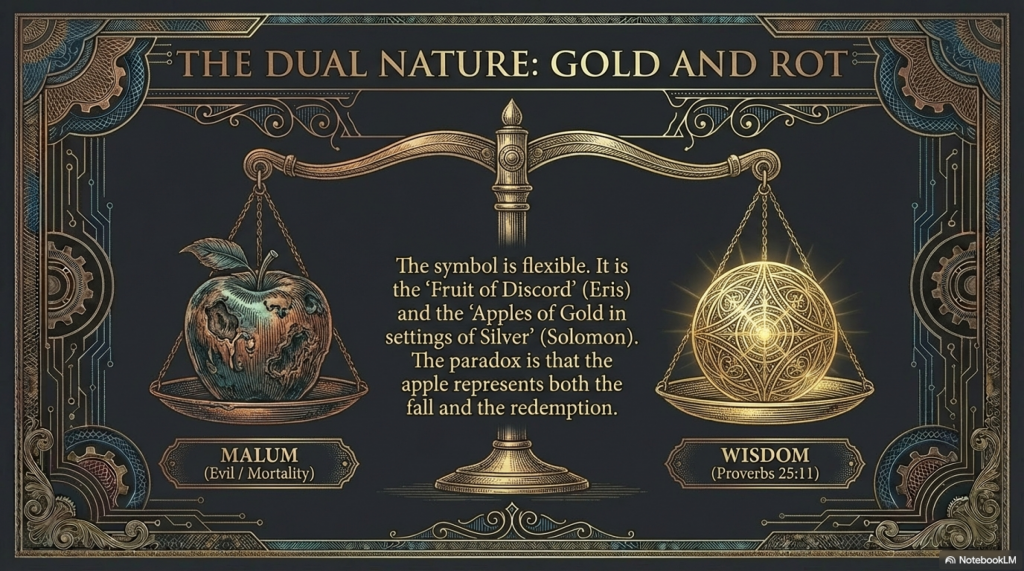
The apple also serves as a catalyst for conflict. In the myth of the Judgement of Paris, Eris (the goddess of strife) throws a golden apple inscribed with “For the Fairest” into a wedding feast.25 The resulting dispute between Hera, Athena, and Aphrodite eventually leads to the Trojan War.8 This motif of the apple as a “fruit of discord” or a cause of human suffering mirrors the role of the forbidden fruit in bringing “all our woe” to the human race through a single act of eating.7
Alternative Exegesis: Jewish and Early Christian Perspectives
While the Western tradition coalesced around the apple, Jewish tradition and early Christian commentators proposed a wide variety of candidates for the forbidden fruit, based on botanical proximity, linguistic puns, and symbolic associations.1
The Seven Species of Israel
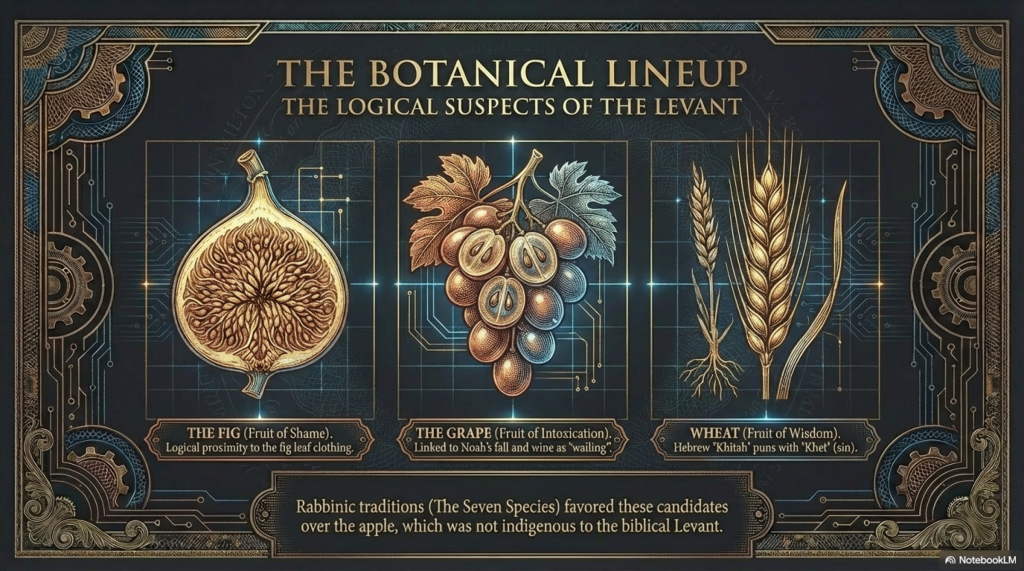
Many Jewish interpretations favor fruits from the “Seven Species” (Shiv’at HaMinim) mentioned in Deuteronomy 8:8 as being special to the Land of Israel: wheat, barley, grapes, figs, pomegranates, olives, and dates.37 These fruits were the staple foods consumed by the Jewish people during biblical times and carry deep spiritual significance.40
| Fruit / Species | Symbolic Association | Reason for Garden of Eden Association | Source |
|---|---|---|---|
| Fig (Te’enah) | Eternity, perseverance; modesty | Adam and Eve used fig leaves to clothe themselves immediately after the Fall. | 2 |
| Grape (Gefen) | Harmony, joy; wine and blood | Associated with the sin of drunkenness (Noah) and the pressing of wine as a metaphor for sin. | 2 |
| Pomegranate (Rimon) | Righteousness, glory; fertility | Common in the region; “Apple of many seeds” (pomum granatum); fruit of the underworld. | 42 |
| Wheat (Khitah) | Kindness, sustenance; civilization | Hebrew khitah puns with khet (sin); represents the dawn of discernment. | 2 |
| Etrog (Citron) | Beauty, majesty; heart | Noted for its “desirability” and fragrance, fitting the description in Genesis 3:6. | 2 |
| Date (Honey) | Royalty; sweetness | “Milk and honey” symbolism; indigenous and highly valued in the Levant. | 24 |
The Wheat Hypothesis and the Dawn of Knowledge
One of the more unique Jewish interpretations identifies the forbidden fruit as wheat.2 Proposed by Rabbi Yehuda, this is based on the observation that a child “does not know how to call to its father or mother until it has tasted the taste of grain”.2 Therefore, wheat represents the transition into human consciousness and discernment. Furthermore, the Hebrew word for wheat, khitah, is linguistically close to khet, the word for sin.2 Some traditions even suggest that wheat was originally a tree in Paradise and only became a low-growing grass after the Fall as a punishment that forced man to labor by the “sweat of his brow”.1
The Grape and the Wine of Sin
Rabbi Meir suggested that the forbidden fruit was the grape, specifically because wine brings “wailing” to the world.2 This interpretation links the Fall of Adam to the later Fall of Noah, who planted a vineyard and became drunk (Genesis 9:20-21). The Zohar suggests that Noah’s failure was an attempt to “rectify” Adam’s sin by using wine for holy purposes, only to be overcome by it.2 In some traditions, it is believed that Eve pressed grapes and gave Adam red wine to drink, linking the “forbidden fruit” to the intoxicant that would later lead to many human transgressions.41
The Fig and the Immediacy of Shame
The fig is a leading candidate because the text recounts that when Adam and Eve realized they were naked, they sewed fig leaves together for clothing (Genesis 3:7).1 Rabbinic sages argue that it is only natural they would use the leaves of the same tree from which they had just eaten.2 This identification emphasizes the immediate transition from the pleasure of the fruit to the shame of exposure.1 In early Christian art, such as Michelangelo’s Sistine Chapel ceiling, the Tree of Knowledge is clearly depicted as a fig tree, showing that the apple was not the universal choice even as late as the 16th century.7
Etymological Cognates: The Indo-European Roots of the Apple
The word “apple” has a complex etymological history that predates its association with the Garden of Eden. Linguists have reconstructed two primary roots for the fruit in the Proto-Indo-European (PIE) language: *h₂ébōl and *meh₂lo.45
The North-West Root: *h₂ébōl
The root *h₂ébōl (or *h₂ébl) is primarily found in the North-Western Indo-European languages.46 This root gives us the Germanic “apple” (Old English æppel, German Apfel), the Celtic “apple” (Old Irish aball, Welsh afal), and the Balto-Slavic forms (Lithuanian obuolỹs, Russian jábloko).29 The presence of the phoneme /b/ in this root is notable, as it had a marginal distribution in reconstructed PIE.45 Some scholars argue that *h₂ébōl may have been an ancient “Wanderwort”—a loanword that traveled with the spread of apple cultivation from its origin in Central Asia to Europe.45 This suggests that the apple was not indigenous to the core Indo-European homeland but was adopted as tribes moved westward, eventually becoming a staple fruit of the North.46
The Southern/Mediterranean Root: *meh₂lo
The root *meh₂lo (or *mālo) is found in the southern branches of the Indo-European family.46 It is the source of the Greek mêlon (μῆλον) and the Latin mālum.2 In these languages, the term was often generic, referring to any fleshy fruit with a core of seeds.8 This linguistic heritage explains why the “melon” (derived from Greek mēlopepōn) and the “apple” share a common root in many Romance languages, and why the Latin pomum could eventually encompass both specific and generic meanings.21
Semantic Genericity and the “Earth Apple”
In many European languages, the word for “apple” remained a generic term for all fruit well into the 17th century.29 This is evidenced by various compound words that used “apple” as a placeholder for “fruit”:
- Old English: eorþæppla (“earth apples”) referred to cucumbers.29
- Middle English: fingeræppla (“finger apples”) were dates.29
- Middle English: appel of paradis was used to describe the banana.2
- French: pomme de terre (“apple of the earth”) is the modern word for potato.14
- English: pomegranate derives from pomum granatum, meaning “seeded apple”.23
This linguistic tendency to use “apple” as a placeholder for “fruit” facilitated the identification of the forbidden fruit as an apple; it was, in a sense, the most “fruit-like” of fruits in the Western imagination.14
Symbolic Resonance: The Adam’s Apple and the Larynx
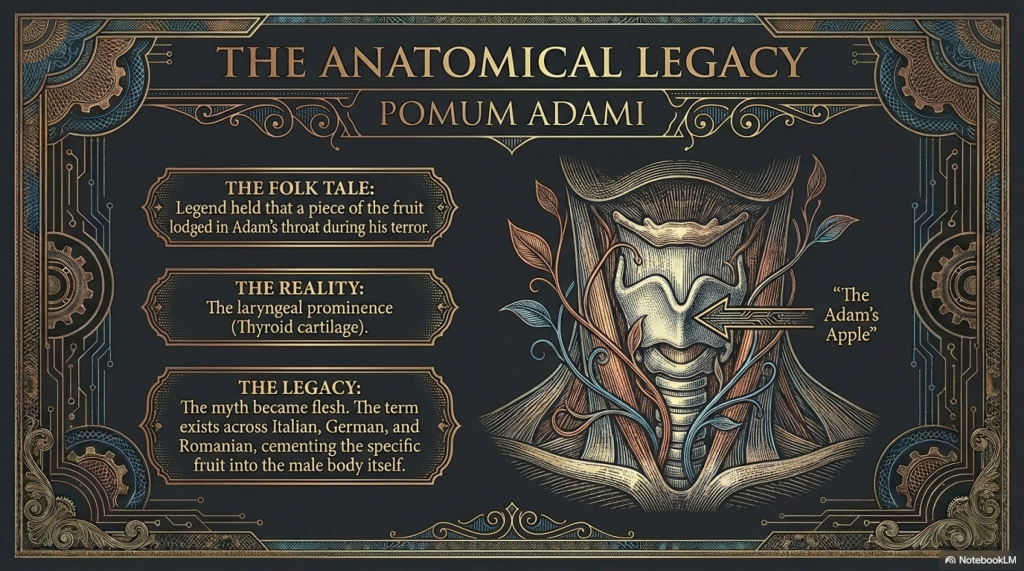
The association between the forbidden fruit and the apple eventually became so deeply embedded in Western culture that it entered the realm of human anatomy. The laryngeal prominence, or the cartilaginous protrusion in the human throat, is commonly referred to as the “Adam’s apple”.2
The Anatomy of a Myth
The term pomum Adami (Adam’s apple) is based on a popular folk tale suggesting that a piece of the forbidden fruit became lodged in Adam’s throat as he attempted to swallow it in his haste and fear.2 Because the prominence is generally more visible in men than in women, the legend served as a permanent anatomical reminder of the Fall and the shared guilt of humanity.3 In some folkloric accounts, it is said that after Adam had already bitten the apple, he remembered God’s command and put his hand on his neck to prevent swallowing, causing the fruit to stick.16
Scientifically, the Adam’s apple is the thyroid cartilage, which protects the larynx and vocal cords.16 Its growth is stimulated by testosterone during puberty, hence its greater prominence in males.16 The transition from the medical term “thyroid cartilage” to the colloquial “Adam’s apple” across numerous languages—pomo d’Adamo (Italian), Adamsapfel (German), mărul lui Adam (Romanian)—reflects the pervasive power of the Eden narrative to shape how humans perceive their own physical bodies.13
The Pomegranate: The “Apple of Seeds” and the Fruit of Death
The pomegranate (Punica granatum) is another major contender for the identity of the forbidden fruit, particularly in Middle Eastern and Mediterranean contexts. Its rich red color and abundance of seeds made it a potent symbol of fertility, life, and death.35
Linguistic and Symbolic Links
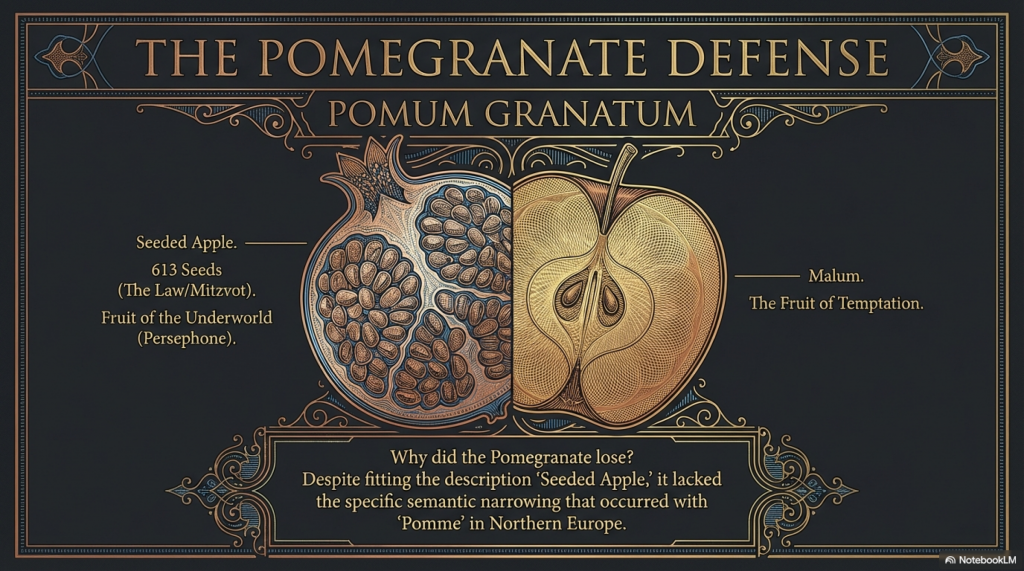
The English name “pomegranate” derives from the medieval Latin pōmum granātum, meaning “seeded apple”.23 In early English, it was known as the “apple of Granada,” a term that survived in heraldry.44 The linguistic link between the pomegranate and the apple further blurred the distinction in the minds of early translators and readers.43
In Greek mythology, the pomegranate is the fruit that binds Persephone to the underworld. Having eaten a few of its seeds, she was compelled to remain with Hades for part of each year, an event that created the seasons.24 This “fruit of the underworld” carries a thematic weight similar to the forbidden fruit of Genesis, which brought mortality to the human race.24 In Christian art, the pomegranate occasionally appears as a symbol of the Passion and Resurrection, representing the “seeds” of the church that would sprout from Christ’s sacrifice to heal the wound of Adam’s Fall.52
Pomegranate vs. Apple Identification
| Aspect | Pomegranate (Rimon) | Apple (Malus) |
|---|---|---|
| Geographic Origin | Middle East (Iran/Levant) | Central Asia |
| Biblical Status | One of the Seven Species of Israel | Not indigenous to ancient Israel |
| Primary Symbolism | Fertility, 613 commandments, glory | Temptation, Fall, sin, beauty |
| Linguistic Link | Pomum granatum (seeded apple) | Malum/Mālum (evil/apple) |
| Mythic Parallel | Persephone and Hades | Golden Apples of the Hesperides |
The pomegranate’s role as a symbol of righteousness in Jewish tradition (where it is said to contain 613 seeds, corresponding to the 613 mitzvot of the Torah) provides a stark contrast to its potential role as the forbidden fruit.42 This duality—representing both the law of God and the fruit of the underworld—mirrors the complex nature of the Tree of Knowledge of Good and Evil itself.5
Gnostic and Islamic Interpretations: Variations on a Theme
The story of the forbidden fruit is not limited to mainstream Judaism and Christianity; it occupies a central place in the Gnostic and Islamic traditions, each offering unique perspectives on the nature of the fruit and the sin.
The Gnostic Reversal: The Tree as Savior
In some Gnostic interpretations, the Tree of Knowledge is viewed not as a source of sin but as a source of necessary liberation.2 Per this narrative, it was the “archons” (lower, often malevolent spiritual beings who created the physical world) who attempted to prevent Adam and Eve from eating the fruit to keep them in a state of ignorance.2 In this tradition, the “serpent” or an “instructor” is sent from the higher divine realm (Pleroma) to encourage the humans to eat the fruit, thereby revealing gnosis (secret knowledge) and showing them the way to salvation from the material world.5 For Gnostics, the “sin” was not the eating of the fruit, but the prior state of ignorance.2
The Islamic Perspective: A “Slip” and Repentance
In the Quran, the forbidden fruit is not specified, but Islamic tradition commonly identifies it with either wheat or the grapevine.2 The Quranic narrative emphasizes the temptation by Satan (Iblis), who tells Adam and Eve that eating from the tree will turn them into angels or grant them eternal life (Quran 7:20).5 Notably, the Quran describes the event as a “slip” (zalla) rather than a permanent “original sin” that stains all of humanity.5 Following their transgression, Adam and Eve repented to God and were forgiven, a theological distinction that contrasts with the Western Christian focus on the inherited “guilt” of the Fall.5
The “Apple of the Eye” and the Apple of Wisdom
A common misconception is that the “apple” is universally associated with sin in the Bible. However, the term “apple” (Hebrew tappuah) appears in other scriptural contexts with entirely positive connotations, further complicating its history.30
The Song of Solomon and the Fragrance of Love
In the Song of Solomon, the beloved is likened to an “apple tree among the trees of the wood,” and his fruit is described as “sweet to my taste” (Song 2:3).53 The king also compares the breath of the Shulammite woman to the fragrance of apples (Song 7:8).53 In these contexts, the tappuah represents protection, delight, and intimacy.54 This positive imagery likely refers to a fragrant fruit like the quince or the apricot, which were more common in the Levant than the true Malus.53
The Apple of the Eye: Protection and Irreplaceability
The phrase “apple of the eye” appears in several places, including Psalm 17:8 and Proverbs 7:2.30 This is an idiom for something precious and intensely guarded.55 However, the Hebrew literal translation is “the pupil of the eyeball”.53 The English term “apple” was used because the pupil was considered a vital, round spot essential for vision; to lose the “apple” was to lose something irreplaceable.30 The transition from “pupil” to “apple” in English translations like the King James Version occurred because “apple” remained a generic term for any round, vital object well into the Anglo-Saxon period.30
| Verse | Context | Meaning of “Apple” | Source |
|---|---|---|---|
| Genesis 3 | The Fall | Forbidden fruit (tradition) | 1 |
| Psalm 17:8 | Divine Protection | The pupil; the center of attention | 30 |
| Proverbs 25:11 | Wise Speech | “Apples of gold”; wisdom/discretion | 53 |
| Song of Solomon 2:3 | Romantic Love | The beloved; sweet sustenance | 53 |
| Joel 1:12 | Judgment | Withered crops; loss of joy | 53 |
This linguistic duality—where the “apple” is both the instrument of the Fall and a metaphor for the highest wisdom and divine protection—highlights the complexity of the symbol. The “apple of knowledge” became evil through disobedience, but the “apple of gold” remains a symbol of fitly spoken truth.12
Conclusion: The Fruit of Transformation
The association of the apple with the forbidden fruit of Eden is a masterpiece of cultural and linguistic synthesis. It began with the non-specific Hebrew peri, which served to center the narrative on the act of human choice rather than botanical trivia.1 The transition to the apple was facilitated by the linguistic chance of the Latin malum/mālum pun, but it was driven to fruition by the evolution of the French language and the creative necessities of Northern European artists who sought to represent the story using familiar, local staples.8
Through the works of Dürer and Milton, the apple was transformed into a multi-valent symbol that could simultaneously represent beauty, desire, sin, mortality, and the potential for redemption.8 In Christian symbolism, the “Second Adam” (Christ) is often linked to the apple tree as a “Paradise Regained,” where the wound caused by the first Adam’s eating is healed through the spiritual “fruit” of the Savior.55 The red apple of Christmas, traditionally used to decorate trees, can thus be interpreted as a symbol of the opportunity to return to Paradise through the birth of the Savior.35
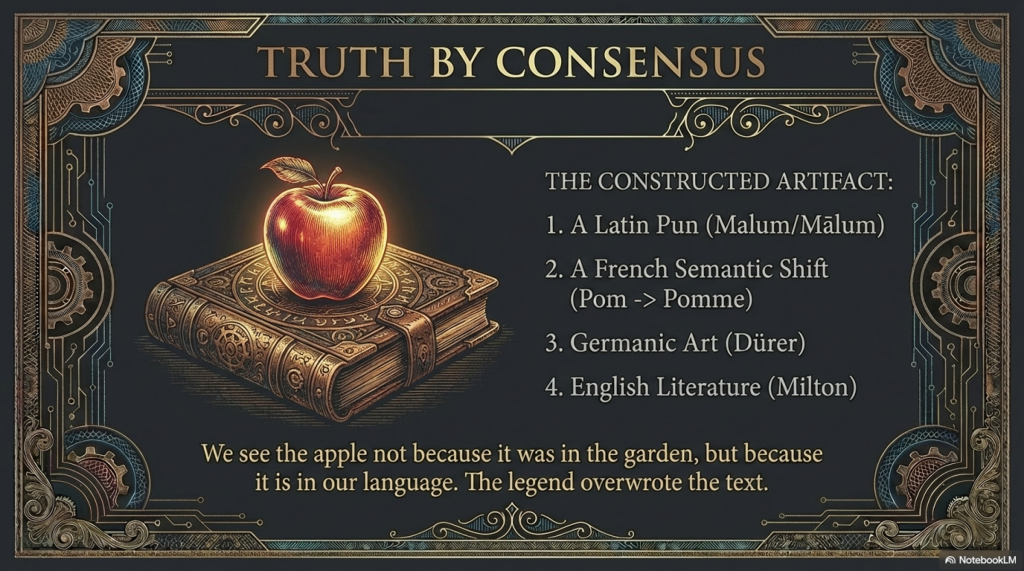
While other traditions—Jewish, Islamic, and Eastern Christian—have maintained a richer variety of interpretations including wheat, grapes, and figs, the Western consciousness remains captive to the apple.2 This historical “mix-up” serves as a reminder that the meanings assigned to sacred texts are often shaped as much by the languages spoken and the art consumed as by the original words themselves. The apple of Eden, though biblically absent, remains culturally omnipresent, a permanent fixture in the garden of the human imagination. In the transition from peri to apple, the fruit became a physical manifestation of the human condition: a balance of beauty and mortality, knowledge and the loss of innocence.
Works cited
- The Forbidden Fruit and the Origins of Poverty – Compassion International, accessed on February 14, 2026, https://www.compassion.com/blog/forbidden-fruit-and-the-origins-of-poverty/
- Forbidden fruit – Wikipedia, accessed on February 14, 2026, https://en.wikipedia.org/wiki/Forbidden_fruit
- Was the forbidden fruit an apple? | GotQuestions.org, accessed on February 14, 2026, https://www.gotquestions.org/forbidden-fruit-apple.html
- Genesis 2-3 NET – The heavens and the earth were – Bible Gateway, accessed on February 14, 2026, https://www.biblegateway.com/passage/?search=Genesis%202-3\&version=NET
- Tree of the knowledge of good and evil – Wikipedia, accessed on February 14, 2026, https://en.wikipedia.org/wiki/Tree_of_the_knowledge_of_good_and_evil
- god lied to Adam : r/DebateReligion – Reddit, accessed on February 14, 2026, https://www.reddit.com/r/DebateReligion/comments/1n0nnqn/god_lied_to_adam/
- What was the forbidden fruit in Paradise Lost? – eNotes.com, accessed on February 14, 2026, https://www.enotes.com/topics/paradise-lost/questions/what-was-the-fruit-of-the-forbidden-tree-in-2494281
- Was the Bible’s Forbidden Fruit Really an Apple? | Ripley’s Believe It or Not!, accessed on February 14, 2026, https://www.ripleys.com/stories/was-the-forbidden-fruit-apple
- How did the Apple come to be associated with the forbidden fruit? – Quora, accessed on February 14, 2026, https://www.quora.com/How-did-the-Apple-come-to-be-associated-with-the-forbidden-fruit-1
- Tree of Knowledge – Encyclopedia.com, accessed on February 14, 2026, https://www.encyclopedia.com/religion/encyclopedias-almanacs-transcripts-and-maps/tree-knowledge
- Hypothesis: The Forbidden Fruit is the Fear of Death : r/mythology – Reddit, accessed on February 14, 2026, https://www.reddit.com/r/mythology/comments/1okb7f2/hypothesis_the_forbidden_fruit_is_the_fear_of/
- Adam and eve fruit of knowledge, accessed on February 14, 2026, https://cdn.prod.website-files.com/6724a4b921679f169fe00723/6735d75a2597d82c1fea4b27_89660711516.pdf
- Harry Harm (SIL) – TIPs, accessed on February 14, 2026, https://tips.translation.bible/tip_source/harry-harm-sil/
- How the Forbidden Fruit Became an Apple | Rutgers University, accessed on February 14, 2026, https://www.rutgers.edu/news/how-forbidden-fruit-became-apple
- Saint Jerome: The Perils of a Bible Translator, accessed on February 14, 2026, https://www.smp.org/resourcecenter/resource/2637/
- A LINGUISTIC MOTIVATIONAL ANALYSIS BASED ON THE ROMANIAN LINGUISTIC ATLAS BY REGIONS. Synthesis, accessed on February 14, 2026, https://lingv.ro/wp-content/uploads/2023/12/8-Bota.pdf
- The Forbidden Fruit – IsraelBiblicalStudies.com, accessed on February 14, 2026, https://lp.israelbiblicalstudies.com/lp_iibs_biblical_hebrew_was_it_an_apple_dec_2018-en.html?cid=86092\&adGroupId=-1\&utm_source=Email_Marketing\&utm_medium=Was_it_an_apple_04_21\&utm_campaign=BIB_EN_EML_Was_it_an_apple_2021-04-13_86092\&commChannel=1\&stid=\&hash=
- Saint Jerome Creates the Vulgate | History | Research Starters – EBSCO, accessed on February 14, 2026, https://www.ebsco.com/research-starters/history/saint-jerome-creates-vulgate
- 405 Jerome Completes the Vulgate | Christian History Magazine, accessed on February 14, 2026, https://christianhistoryinstitute.org/magazine/article/jerome-completes-vulgate
- It wasn’t an apple! – Creation.com, accessed on February 14, 2026, https://creation.com/en/articles/it-wasnt-an-apple
- For scholars of Latin: do the words ‘malum’ (apple) and malum (bad thing or bad adj. s, n) have anything in common? – Reddit, accessed on February 14, 2026, https://www.reddit.com/r/latin/comments/ki4qy/for_scholars_of_latin_do_the_words_malum_apple/
- Original meaning of ‘malum’ – Latin – Textkit, accessed on February 14, 2026, https://www.textkit.com/t/original-meaning-of-malum/10241
- TIL the word “Apple” didn’t always refer to the specific fruit. As late as the 17th century the word was used for all fruits that weren’t berries. : r/todayilearned – Reddit, accessed on February 14, 2026, https://www.reddit.com/r/todayilearned/comments/eav76k/til_the_word_apple_didnt_always_refer_to_the/
- TIL that the forbidden fruit was never identified as an apple in the original Hebrew texts. : r/todayilearned – Reddit, accessed on February 14, 2026, https://www.reddit.com/r/todayilearned/comments/2ya0mv/til_that_the_forbidden_fruit_was_never_identified/
- Was the “Forbidden Fruit” in the Garden of Eden Actually an Apple …, accessed on February 14, 2026, https://www.ancient-origins.net/myths-legends-europe/forbidden-fruit-0017084
- The Literal Character of the Vulgate – Bible Research, accessed on February 14, 2026, https://www.bible-researcher.com/vulgate4.html
- On Mistranslation – EthicalDative, accessed on February 14, 2026, https://ethicaldative.com/2018/07/29/on-mistranslation/
- Forbidden Fruit – Jewish Journal, accessed on February 14, 2026, https://jewishjournal.com/spiritual/poetry/363860/forbidden-fruit-2/
- Why, in so many modern European languages, did the generic word for “fruit” come to refer only to the “apple”? – Reddit, accessed on February 14, 2026, https://www.reddit.com/r/asklinguistics/comments/1pqe5vc/why_in_so_many_modern_european_languages_did_the/
- About that apple a day keeping the doctor away | Winnipeg Regional Real Estate News, accessed on February 14, 2026, https://www.winnipegregionalrealestatenews.com/publications/real-estate-news/2165
- Adam and Eve | Cleveland Museum of Art, accessed on February 14, 2026, https://www.clevelandart.org/art/1944.473
- Adam and Eve (Dürer) – Wikipedia, accessed on February 14, 2026, https://en.wikipedia.org/wiki/Adam_and_Eve_(D%C3%BCrer)
- Albrecht Dürer – Adam and Eve – The Metropolitan Museum of Art, accessed on February 14, 2026, https://www.metmuseum.org/art/collection/search/336222
- Paradise Lost by John Milton | English | Loughborough University, accessed on February 14, 2026, https://www.lboro.ac.uk/subjects/english/undergraduate/study-guides/paradise-lost/
- The symbol of the apple over the centuries – from the forbidden fruit to the symbol of love – Steemit, accessed on February 14, 2026, https://steemit.com/story/@daydreaming/the-symbol-of-the-apple-over-the-centuries-from-the-forbidden-fruit-to-the-symbol-of-love
- Apples in mythology – Wikipedia, accessed on February 14, 2026, https://en.wikipedia.org/wiki/Apples_in_mythology
- What Are the Seven Species of Israel? – IFCJ Learning Center, accessed on February 14, 2026, https://www.ifcj.org/learn/resource-library/what-are-the-seven-species-of-israel
- Seven Species – Wikipedia, accessed on February 14, 2026, https://en.wikipedia.org/wiki/Seven_Species
- What Is So Special About the 7 Species of Fruit With Which Israel Was Blessed? – The Significance of the Shiv’at Haminim – Chabad.org, accessed on February 14, 2026, https://www.chabad.org/library/article_cdo/aid/3567733/jewish/What-Is-So-Special-About-the-7-Species-of-Fruit-With-Which-Israel-Was-Blessed.htm
- The Seven Species – My Jewish Learning, accessed on February 14, 2026, https://www.myjewishlearning.com/article/the-seven-species/
- Seed of the Woman – Pt.I, ch.10 The Forbidden Fruit:Tradition, accessed on February 14, 2026, https://custance.org/Library/SOTW/Part_I/chap10.html
- The Seven Species of Israel in the Bible and Today, accessed on February 14, 2026, https://firmisrael.org/learn/the-seven-species-of-israel-in-the-bible-and-today/
- The Forbidden Fruit ( an open discussion) : r/OrthodoxChristianity, accessed on February 14, 2026, https://www.reddit.com/r/OrthodoxChristianity/comments/19b3hqf/the_forbidden_fruit_an_open_discussion/
- Pomegranate – Wikipedia, accessed on February 14, 2026, https://en.wikipedia.org/wiki/Pomegranate
- The Proto-Indo-European root for ‘apple’ and the problem of comparative reconstruction, accessed on February 14, 2026, https://ejournals.eu/en/journal/studia-etymologica-cracoviensia/article/the-proto-indo-european-root-for-apple-and-the-problem-of-comparative-reconstruction
- THE PROTO-INDO-EUROPEAN ROOT FOR ‘APPLE’ AND THE PROBLEM OF COMPARATIVE RECONSTRUCTION – CORE, accessed on February 14, 2026, https://core.ac.uk/download/pdf/229243252.pdf
- Reconstruction:Proto-Indo-European/h₂ébōl – Wiktionary, the free dictionary, accessed on February 14, 2026, https://en.wiktionary.org/wiki/Reconstruction:Proto-Indo-European/h%E2%82%82%C3%A9b%C5%8Dl
- The Forbidden Fruit: Etymology of Apple – ALTA Language Services, accessed on February 14, 2026, https://altalang.com/beyond-words/the-forbiden-fruit-etymology-of-apple/
- Talking Neolithic: Linguistic and Archaeological Perspectives on How Indo-European Was Implemented in Southern Scandinavia | Request PDF – ResearchGate, accessed on February 14, 2026, https://www.researchgate.net/publication/319693901_Talking_Neolithic_Linguistic_and_Archaeological_Perspectives_on_How_Indo-European_Was_Implemented_in_Southern_Scandinavia
- Is there. common Indo-European root/word for apples? : r/IndoEuropean – Reddit, accessed on February 14, 2026, https://www.reddit.com/r/IndoEuropean/comments/j9uo32/is_there_common_indoeuropean_rootword_for_apples/
- Plant of the Month: September | Professor Hedgehog’s Journal, accessed on February 14, 2026, https://professorhedgehogsjournal.uk/2015/09/26/plant-of-the-month-september/
- Pomegranates on Coins of Side – General – Numis Forums, accessed on February 14, 2026, https://www.numisforums.com/topic/8142-pomegranates-on-coins-of-side/
- Apple – JW.ORG, accessed on February 14, 2026, https://www.jw.org/en/library/books/Insight-on-the-Scriptures/Apple/
- Tag: Commentary on Song of Solomon 7:8 – Summer Setting – WordPress.com, accessed on February 14, 2026, https://kathrynwarmstrong.wordpress.com/tag/commentary-on-song-of-solomon-78/
- PARADISE REGAINED: THE SYMBOLISM OF THE APPLE TREE – Crossing My Bridges, accessed on February 14, 2026, https://crossingmybridges.com/symbolism-of-the-apple-tree-paradise-regained/
About the Author