
Rachav Original Video Bite Here
Welcome to this exploration of The Metaverse of Consciousness. Today, we embark on an intellectual journey through the groundbreaking work of Shelli Renee Joye. We will examine the intersection of quantum physics, deep psychology, and mystical experience to understand a reality far more complex than what our five senses typically reveal.
The Metaverse of Consciousness
This presentation serves as an intellectual journey through the extensive work of Shelli Renee Joye. Joye’s research seeks to bridge the gap between hard science and the profound mysteries of human awareness.
The Edge of the Known World
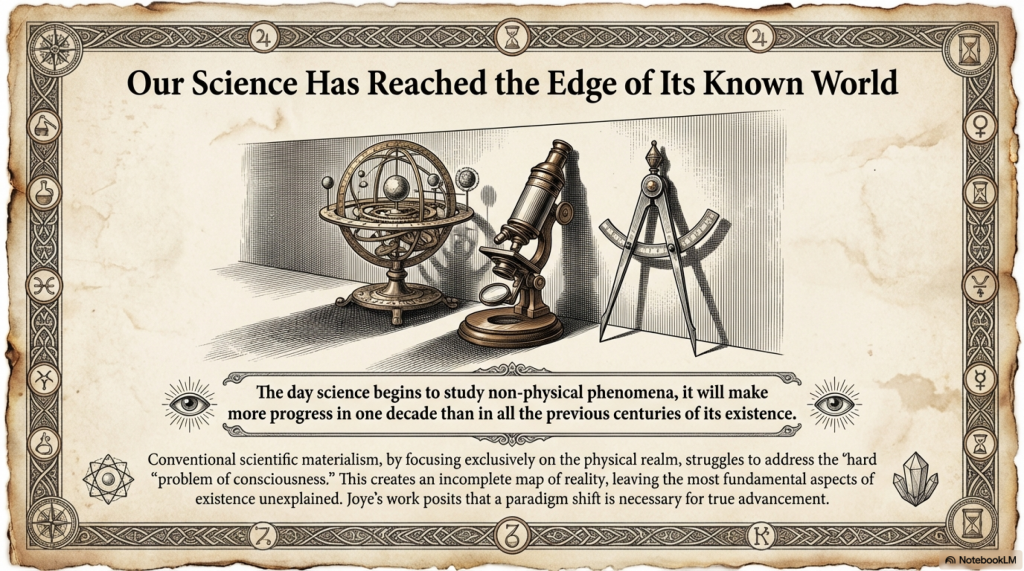
- Conventional scientific materialism is struggling to address the “hard problem of consciousness” because it focuses exclusively on the physical realm.
- This focus creates an incomplete map of reality, leaving fundamental aspects of our existence unexplained.
- As the quote suggests, if science began to study non-physical phenomena, it could achieve more progress in a decade than in all previous centuries combined.
- Joye posits that a paradigm shift is necessary to move beyond our current explanatory limits
Psychology’s Abandonment of the Soul
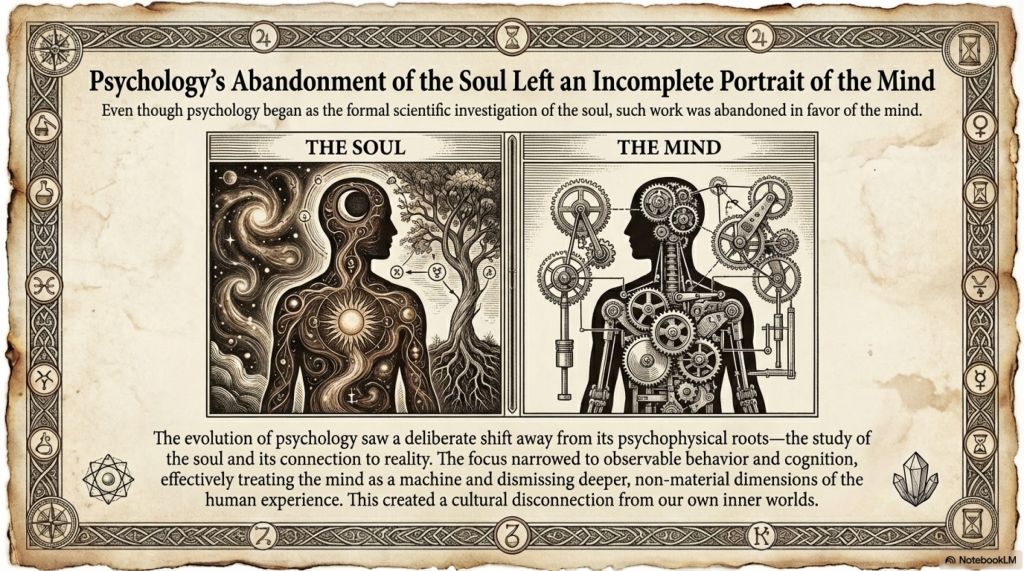
- Modern psychology began as a scientific investigation of the soul, but it eventually abandoned these “psychophysical” roots.
- The field shifted focus to observable behavior and cognition, effectively treating the human mind as a machine.
- By dismissing non-material dimensions, we have created a cultural disconnection from our own inner worlds.
- This has left us with an incomplete portrait of what it means to be a conscious being.
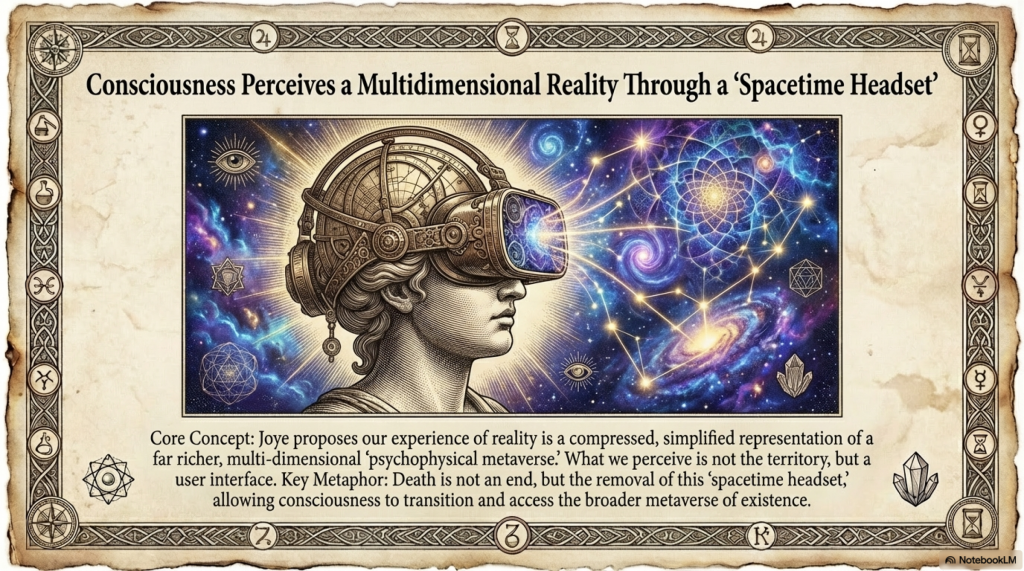
The ‘Spacetime Headset’
- A core concept in Joye’s work is that our experience of reality is a simplified, compressed representation of a much richer, multi-dimensional “psychophysical metaverse”.
- What we perceive as the world is not the “territory” itself, but rather a user interface.
- Using a powerful metaphor, Joye suggests we are wearing a “spacetime headset” that filters reality.
- In this view, death is not an end, but the removal of this headset, allowing consciousness to access the broader metaverse of existence.
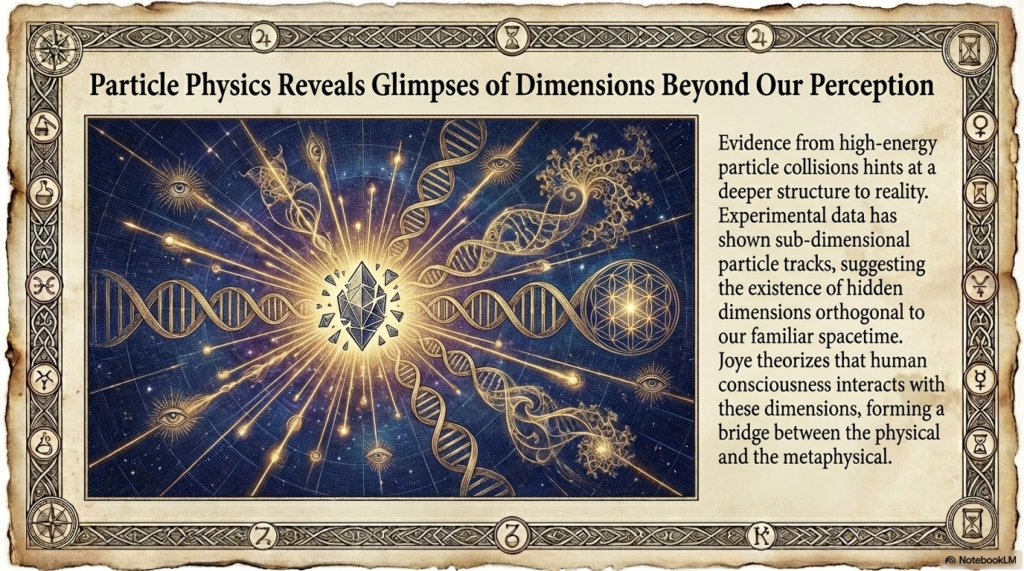
Glimpses from Particle Physics
- High-energy particle collisions provide evidence of a deeper structure to reality beyond our perception.
- Experimental data has shown sub-dimensional particle tracks, suggesting hidden dimensions exist orthogonal to our familiar spacetime.
- Joye theorizes that human consciousness interacts with these hidden dimensions.
- This interaction forms a vital bridge between the physical and the metaphysical worlds.
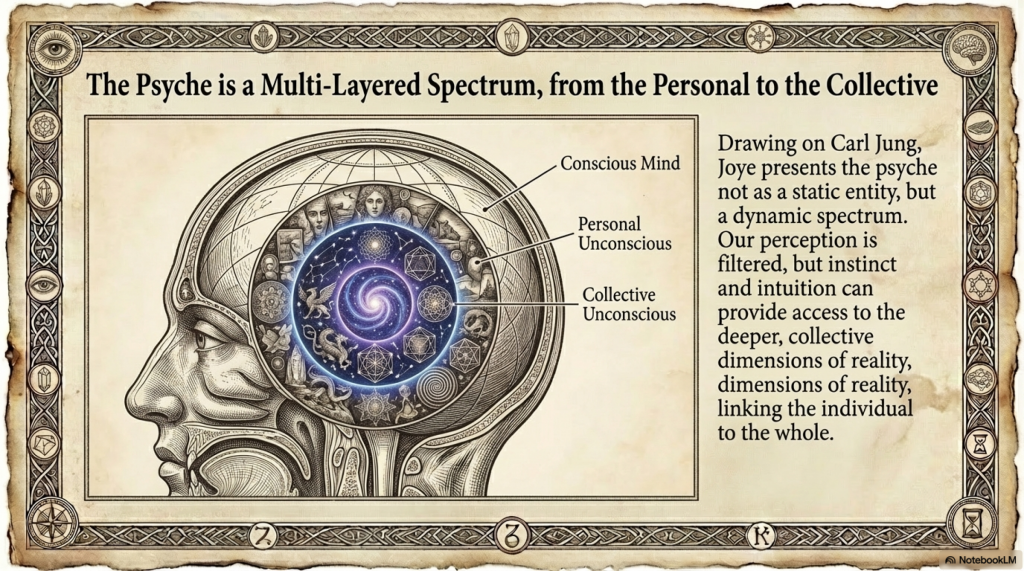
The Multi-Layered Psyche
- Drawing on Carl Jung, Joye describes the psyche as a dynamic spectrum rather than a static entity.
- It consists of the Conscious Mind, the Personal Unconscious, and the Collective Unconscious.
- While our perception is often filtered, tools like instinct and intuition can provide access to deeper, collective dimensions of reality.
- These deeper layers link the individual to the whole of existence.
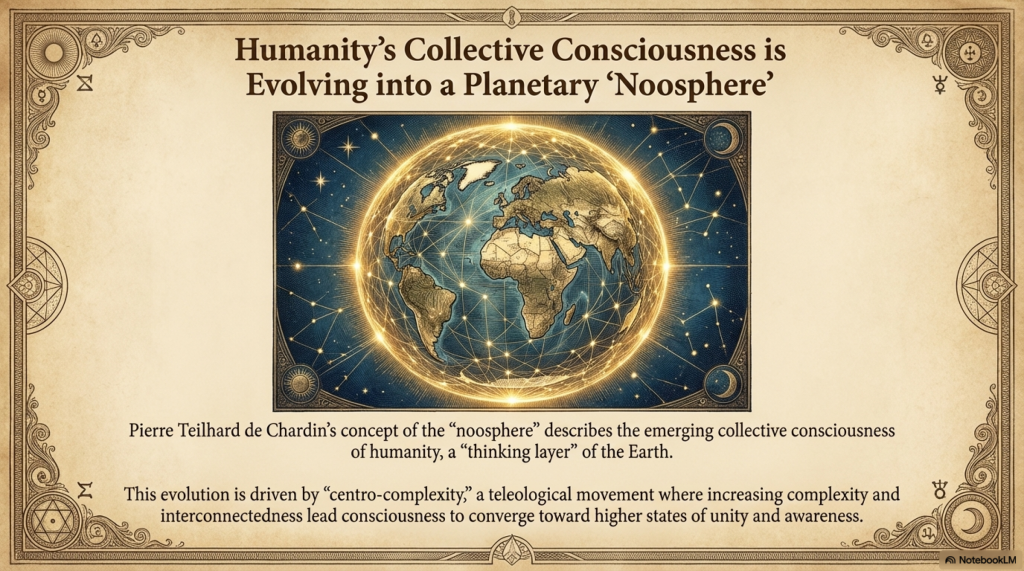
The Planetary Noosphere
- Humanity’s collective consciousness is evolving into what Pierre Teilhard de Chardin called the “noosphere”—a thinking layer of the Earth.
- This evolution is driven by “centro-complexity,” a movement where increasing interconnectedness leads consciousness to higher states of unity.
- As we become more complex and connected, our awareness begins to converge.
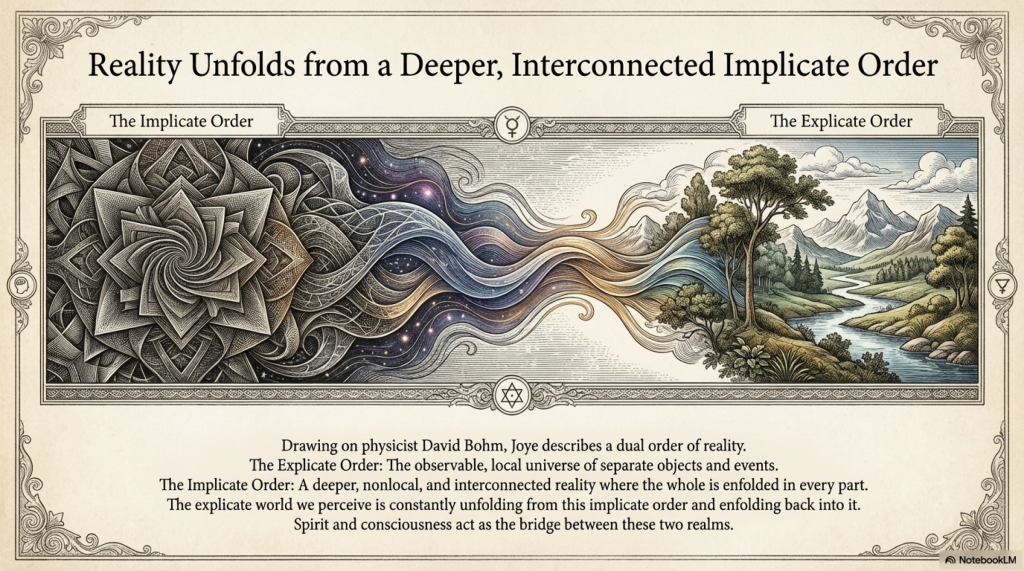
Implicate and Explicate Orders
- Referencing physicist David Bohm, Joye describes a dual order of reality:
- The Explicate Order: The local universe of separate objects and events that we observe daily.
- The Implicate Order: A deeper, nonlocal reality where the whole is enfolded into every part.
- The world we see is constantly unfolding from the implicate order and enfolding back into it.
- Spirit and consciousness serve as the bridge between these two realms.
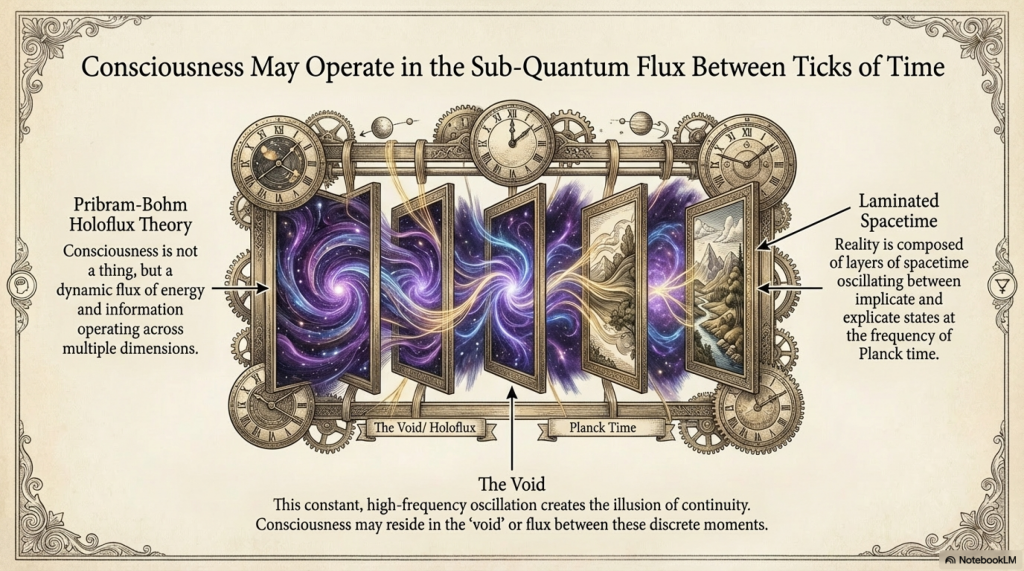
Sub-Quantum Flux and Planck Time
- The Pribram-Bohm “Holoflux Theory” suggests consciousness is a dynamic flux of energy and information operating across multiple dimensions.
- Reality is composed of layers of spacetime oscillating between implicate and explicate states at the frequency of Planck time.
- This high-frequency oscillation creates the illusion of continuity in our world.
- Consciousness may actually reside in the “void” or flux between these discrete moments.
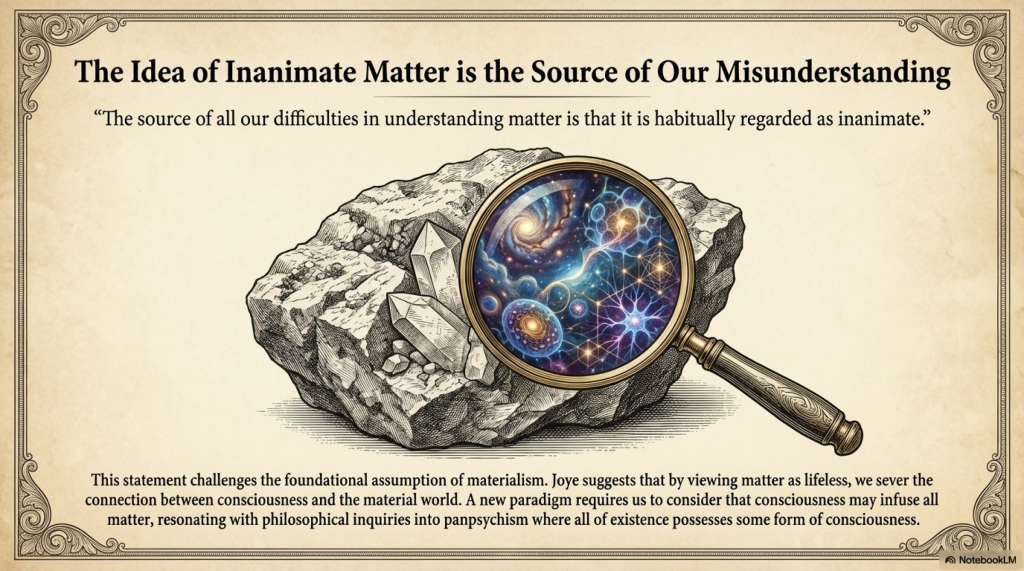
The Illusion of Inanimate Matter
- A major misunderstanding in our science is the habit of regarding matter as inanimate or “dead”.
- Joye suggests this view severs the connection between consciousness and the material world.
- A new paradigm may require “panpsychism,” the idea that all matter possesses some form of consciousness or resonance.
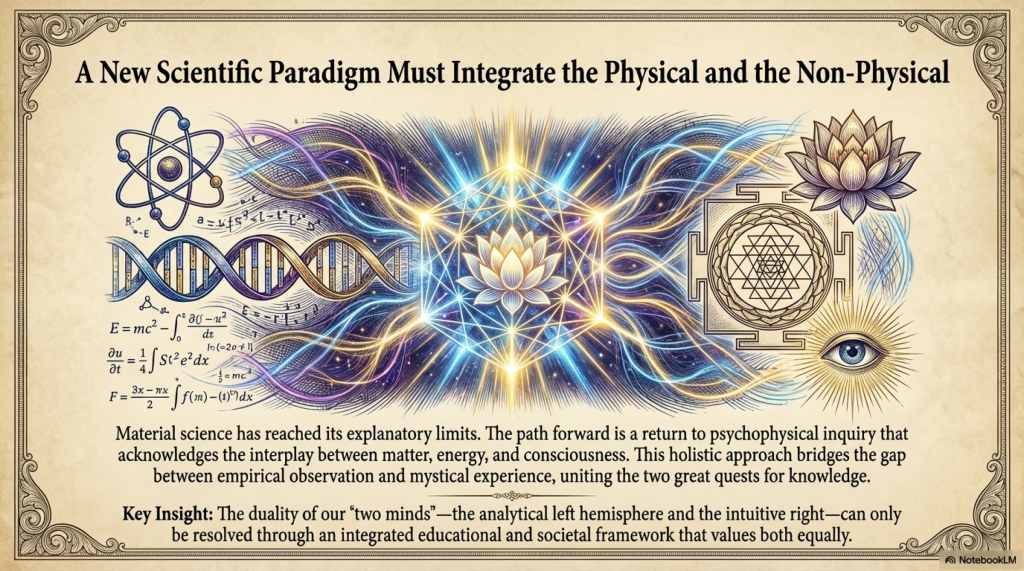
A New Scientific Paradigm
- Material science has reached its explanatory limits. The path forward requires a return to psychophysical inquiry.
- This requires integrating the physical and the non-physical, uniting empirical observation with mystical experience.
- This paradigm shift is reflected in complex interactions, such as those modeled by:


- We must value both the analytical left hemisphere and the intuitive right hemisphere of our minds equally
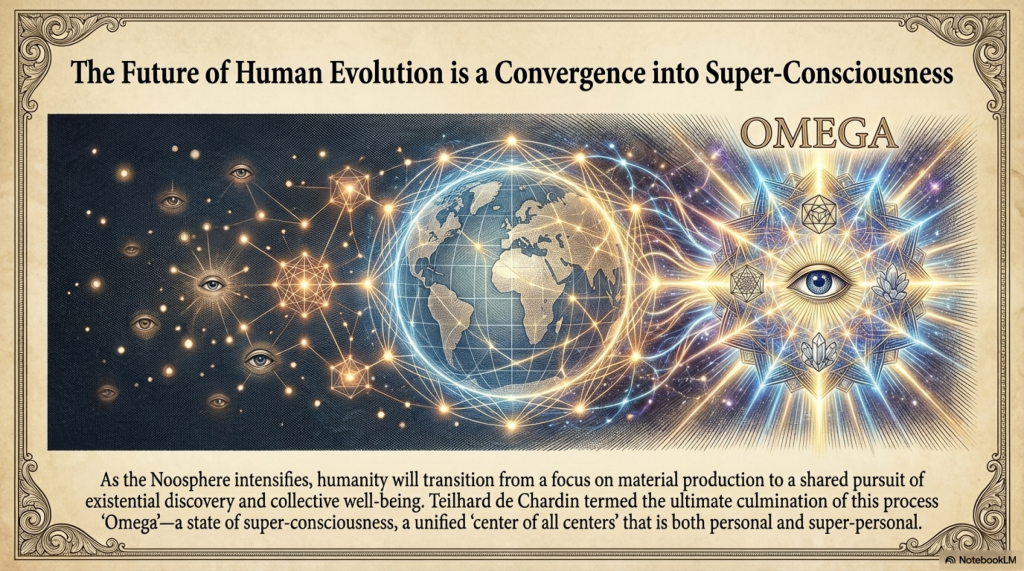
Transition to Omega
- As the Noosphere intensifies, humanity will move away from material production toward a shared pursuit of existential discovery.
- The ultimate culmination is the “Omega” point—a state of super-consciousness.
- Omega represents a unified “center of all centers” that is both personal and super-personal.
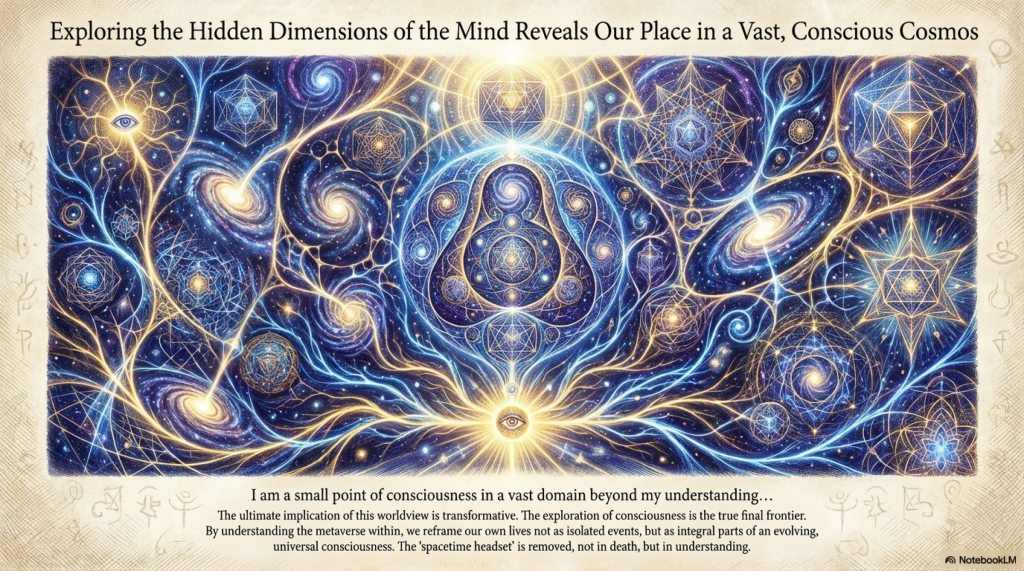
The Final Frontier
- Understanding that we are small points of consciousness in a vast domain reveals our true place in a conscious cosmos.
- The exploration of consciousness is the true final frontier.
- By understanding the “metaverse within,” we realize that our lives are not isolated events, but integral parts of an evolving universal consciousness.
- The “headset” is removed not only in death, but through the act of understanding.
Critique and Examination
The work of Shelli Renee Joye represents a bold attempt to synthesize disparate fields—quantum mechanics, neuro-psychology, and evolutionary theology—into a single, cohesive worldview.
Intellectual Strengths
Joye’s primary strength lies in her ability to repurpose technical metaphors (like the “spacetime headset”) to make complex metaphysical concepts accessible. By grounding her theories in the work of established giants like Bohm and Jung, she provides a rigorous foundation for what might otherwise be seen as purely speculative philosophy. Her critique of “inanimate matter” is particularly poignant, aligning with modern philosophical resurgences of panpsychism to solve the “hard problem” of consciousness.
Critical Examination
However, from a strictly empirical standpoint, many of the theories presented—such as consciousness residing in the “void” between ticks of Planck time—remain hypothetical. While particle physics hints at hidden dimensions, the direct “bridge” between these dimensions and human consciousness is a theoretical leap that current experimental science has yet to verify.
Final Reflection
Ultimately, Joye’s work is a call to intellectual humility. It suggests that our current scientific era is not the “end of history” but merely the edge of a much larger map. Whether the “Omega point” is an inevitable evolutionary destination or a hopeful spiritual metaphor, the journey toward a more integrated, “psychophysical” understanding of reality offers a necessary remedy to the fragmentation of modern materialism.
An in-depth Audio presentation
Study Guide for The Metaverse of Consciousness by Shelli Renee Joye
This study guide provides a review of the key themes, arguments, and terminology presented in the scholarly analysis and summary of Shelli Renee Joye’s The Metaverse of Consciousness. It is designed to test and deepen the understanding of the original book’s complex integration of science, psychology, philosophy, and spirituality.
——————————————————————————–
Quiz: Short-Answer Questions
Instructions: Answer the following questions in 2-3 sentences each, based on the provided source materials.
- What is the “spacetime headset” metaphor, and what does it suggest about the nature of death?
- Why does Shelli Renee Joye argue that the term “universe” is an outmoded concept?
- Explain David Bohm’s concepts of the “implicate” and “explicate” orders as discussed in the text.
- According to the analysis, what historical shift occurred in the field of psychology that Joye believes should be revisited?
- What is the “noosphere,” and how does Joye connect it to the future evolution of humanity?
- Describe the “Pribram-Bohm Holoflux Theory” and its proposed relationship to consciousness.
- How can virtual reality worlds be considered a “blessing” according to the book’s perspective on consciousness?
- What is “hyperphysics” as conceptualized by Joye?
- According to the analysis of Chapter 21, what is the potential consequence of an educational system that favors left-hemisphere skills over right-hemisphere ones?
- The text describes Midrashic interpretation as a method for deeper analysis. Define the term “Peshat” within this context.
——————————————————————————–
Answer Key
- The “spacetime headset” is a metaphor suggesting our experience of reality is a simplified and compressed representation of a more complex, multidimensional universe. Within this framework, death is not an end but a transition, akin to “removing the spacetime headset” to access the broader metaverse of existence.
- Joye argues that “universe” is an outmoded term because it is insufficient to describe the complexities of reality revealed by modern science, such as hidden dimensions. She advocates for the term “metaverse” to better encapsulate this more expansive, multi-dimensional understanding of existence.
- The “implicate order” represents a deeper, interconnected, and nonlocal reality that underlies the observable universe. The “explicate order” is the observable, local universe that we perceive through our senses and scientific instruments.
- Joye highlights that psychology began as the formal scientific investigation of the soul but later abandoned this work in favor of studying the mind and behavior. She suggests a revival of this psychophysical inquiry is needed, especially as material science grapples with the “hard problem of consciousness.”
- The “noosphere” is a concept from Teilhard de Chardin describing the collective consciousness of humanity. Joye posits that as humanity evolves, this collective consciousness will progress toward greater integration and complexity, eventually culminating in a super-consciousness termed “Omega.”
- The Pribram-Bohm Holoflux Theory describes consciousness as a dynamic flux of energy and information, or “holoflux energy,” operating at a sub-quantum level. This theory suggests that consciousness is a fundamental process that interacts with the universe across multiple dimensions and frequencies.
- Virtual reality worlds can be a “blessing” because they offer a tool for the exploration of consciousness. By encouraging this exploration, these technologies hold the potential to provide profound insights into the nature of consciousness and lead to greater self-awareness.
- “Hyperphysics” is a speculative framework introduced by Joye that examines reality beyond the limits of conventional material science. It incorporates concepts like a nonlocal, interconnected universe where consciousness plays a central, active role.
- An educational system that prioritizes the left hemisphere’s analytical and verbal skills at the expense of the right hemisphere’s integrative and intuitive strengths can lead to a dysfunctional psyche. Joye argues this imbalance can cause a “dysfunctional operation of the ‘two minds’ within the seemingly single individual.”
- “Peshat” is the first layer of Midrashic interpretation. It refers to the surface, literal, or straightforward meaning of a text before any deeper symbolic or associative analysis is applied.
——————————————————————————–
Essay Questions
Instructions: The following questions are designed for longer, essay-format responses. They require synthesizing multiple concepts from the text to form a comprehensive argument. No answers are provided.
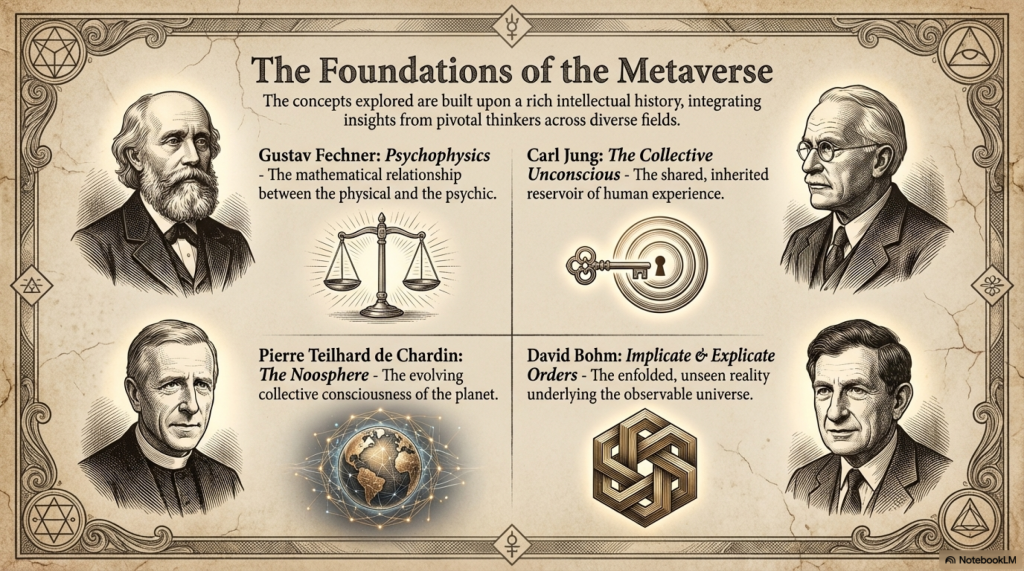
- Synthesize the arguments from the historical figures mentioned in the text (Gustav Fechner, Carl Jung, Pierre Teilhard de Chardin, and David Bohm) to construct a detailed explanation of Joye’s concept of a “psychophysical metaverse.”
- Discuss the recurring theme of integrating science with spirituality and metaphysics. How does Joye use concepts from contemporary physics—such as quantum theory, string theory, hidden dimensions, and Planck time—to support her arguments for a more holistic worldview?
- Analyze the statement, “The source of all our difficulties in understanding matter is that it is habitually regarded as inanimate.” How does this idea challenge traditional materialism, and what are its connections to concepts like panpsychism, the noosphere, and the evolution of consciousness as presented in the book?
- Explore the concept of “hidden dimensions” as a central pillar of Joye’s thesis. How does she link evidence from particle physics to the structure of the human psyche and the fundamental nature of consciousness?
- Examine the book’s call for a new paradigm in both science and education. What specific limitations in current systems does Joye identify, and what kind of integrated, holistic approach does she advocate for to foster a more complete understanding of human consciousness?
——————————————————————————–
Glossary of Key Terms
| Term | Definition |
| Centro-complexity | A concept from Teilhard de Chardin positing that consciousness evolves through a process of increasing convergence and complexity toward higher states. |
| Collective Consciousness | The idea, drawing from figures like Fechner and Jung, that individual psyches connect within a larger metaverse. Joye frames this connection as essential for navigating contemporary global crises. |
| Derash | A layer of Midrashic interpretation focusing on deeper, creative, and associative meanings within a text, going beyond the literal and hinted meanings. |
| Explicate Order | A concept from physicist David Bohm representing the observable, local universe that we perceive. It is the unfolded manifestation of the deeper implicate order. |
| Holoflux Energy | A foundational aspect of consciousness proposed in the Pribram-Bohm theory, described as a dynamic flux of energy and information operating across multiple dimensions and frequencies. |
| Hyperphysics | A speculative framework introduced by Joye that examines reality beyond the limits of material science, focusing on a nonlocal, interconnected universe where consciousness is a central principle. |
| Implicate Order | A concept from David Bohm representing a deeper, interconnected, and nonlocal reality that underlies and enfolds the observable, explicate universe. |
| Laminated Spacetime | A theoretical physics model in which reality consists of layers of spacetime that oscillate between implicate and explicate orders at extremely high frequencies, creating the illusion of continuity. |
| Metaverse | Joye’s conceptualization of a multi-dimensional framework for understanding consciousness itself, which links the physical, quantum, and psychical realms. It is more than a virtual construct; it is the broader reality beyond our limited perception. |
| Midrashic Interpretation | A hermeneutical method of analysis involving multiple layers of meaning: Peshat (surface), Remez (hinted), and Derash (associative/creative). |
| Noosphere | A concept from Teilhard de Chardin describing the collective consciousness of humanity as an evolving entity that transcends individual experience and moves toward a state of super-consciousness. |
| Omega | In Teilhard de Chardin’s theory, the term for the super-consciousness or unified state toward which the energetic noosphere is evolving. |
| Peshat | A layer of Midrashic interpretation representing the surface, literal, or straightforward meaning of a text. |
| Planck Holosphere | A model described by Joye in which energy and information converge at the Planck scale (the fundamental limit of spacetime), aligning with Bohm’s theory of a deeper implicate order. |
| Pribram-Bohm Holoflux Theory | A theory that describes consciousness as a dynamic flux of energy and information operating on a sub-quantum level, suggesting our understanding of reality is limited by current scientific frameworks. |
| Psychophysical Metaverse | The book’s central concept of an inseparable link between consciousness and physical reality, forming a multidimensional framework where individual psyches connect to the universe. |
| Psychophysics | An area of scientific inquiry, associated with figures like Gustav Fechner, that studies the relationship between the physical universe and the soul or psyche, bridging science and spirituality. |
| Remez | A layer of Midrashic interpretation that explores the deeper, hinted, or allegorical meanings of a text that lie beneath the surface. |
| Spacetime Headset | A metaphor used to explain that human perception of reality is a compressed, simplified representation of a far more complex, multidimensional universe. Death is theorized as the removal of this headset. |
About the Author




What about understanding how our biological receptors work? Receptors are the missing ingredient in understanding ourselves and creating better AI. At the most fundamental level, we are the summation and interplay of trillions of our cellular receptors. These receptors are poised biochemical balances that interact with our environment and with one another in a grand symphony that has evolved since the universe began. We are currently unique beings who can reflect on the universe and discover our origins within it. We reside upon the cusp of an unfolding creation, like a surfer trying to catch a wave. See the book, Origins of Life’s Sensoria, for more.
The receptors can be modelled by assigning a qualia quotient to the perceived data indicating a certain mental state early days but I am building an AI that models qualia as part
of its interpretive strategy examining Jewish texts, so that over time the system begins to feel the data not just flatly repeat it .