via IFTTT
Preempting Armageddon: 5 Surprising Lessons from the FBI’s War on the Apocalypse
In the waning hours of the twentieth century, as the odometer of history prepared to roll over into a new millennium, the United States was gripped by a singular, bifurcated dread. While the technical elite scrambled to patch the “technical bug” of Y2K, federal law enforcement was fixated on a far more volatile “theological bug”: the specter of apocalyptic violence.
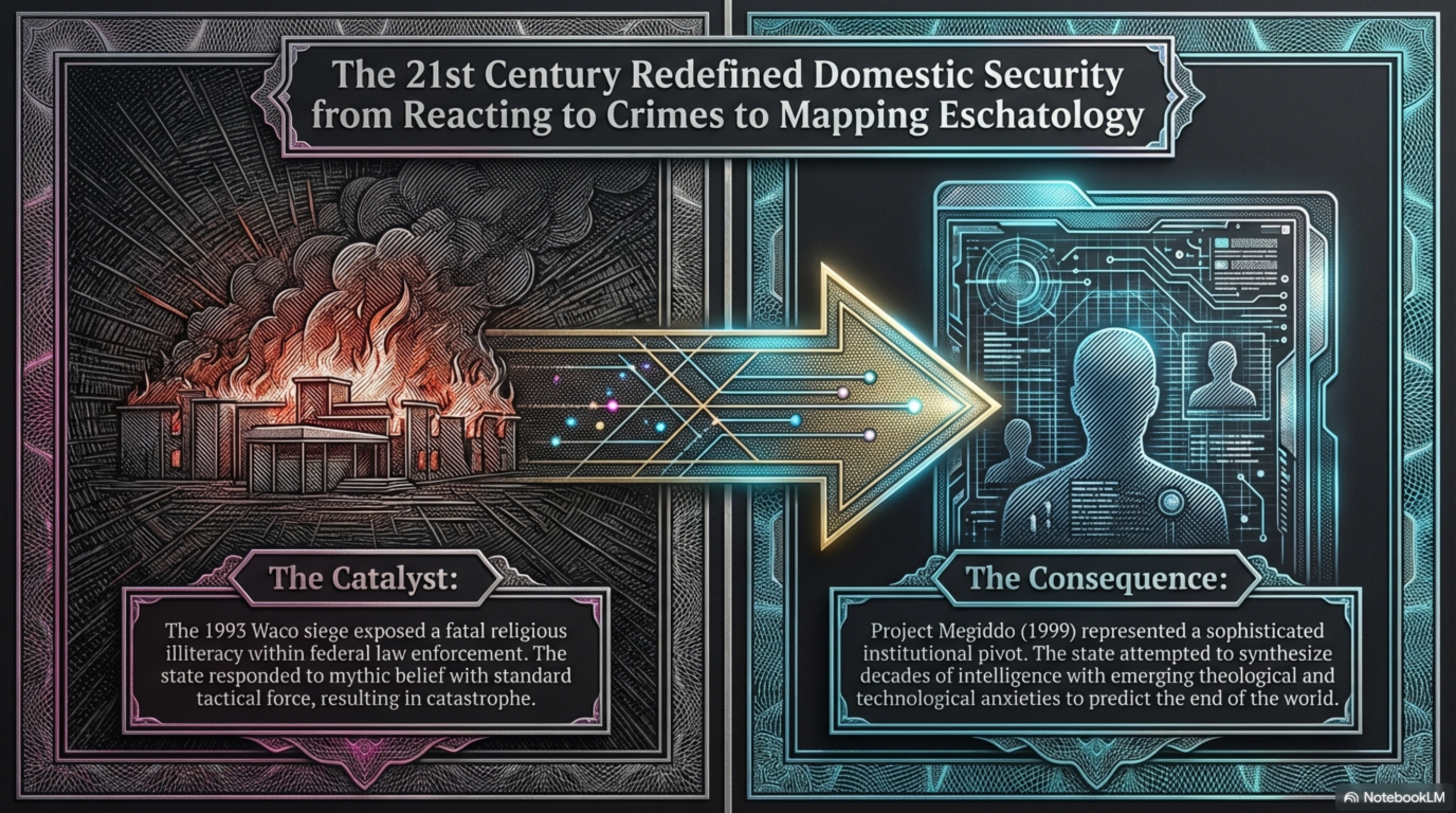
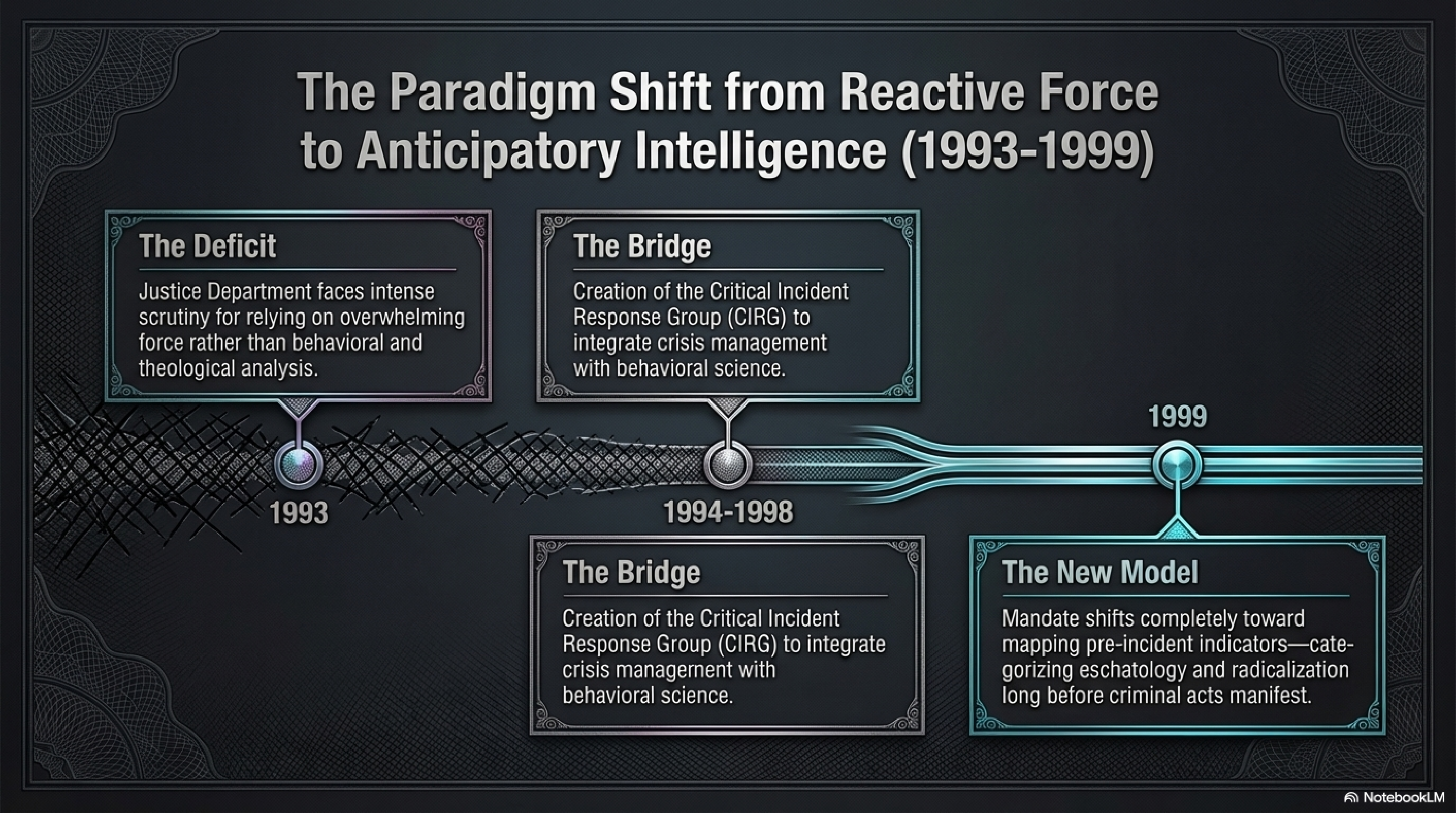
The 1993 siege at Waco had been a watershed of institutional failure, exposing a catastrophic “religious illiteracy” within the FBI. The Bureau’s inability to decode the eschatological language of the Branch Davidians led to a tactical catastrophe that burned into the American psyche. In the aftermath, the state pivoted from reactive “standoff” management to a proactive regime of “anticipatory intelligence.” This strategic evolution culminated in October 1999 with Project Megiddo, a report that effectively began the securitization of eschatology.

As a senior investigative historian, I find that the true legacy of this era lies not in the “non-event” of the millennium, but in the five counter-intuitive lessons that fundamentally redefined the relationship between the state and the interior spiritual lives of its citizens.
——————————————————————————–
1. The “Secret Family Disaster”: How Ontological Instability Built a Messiah
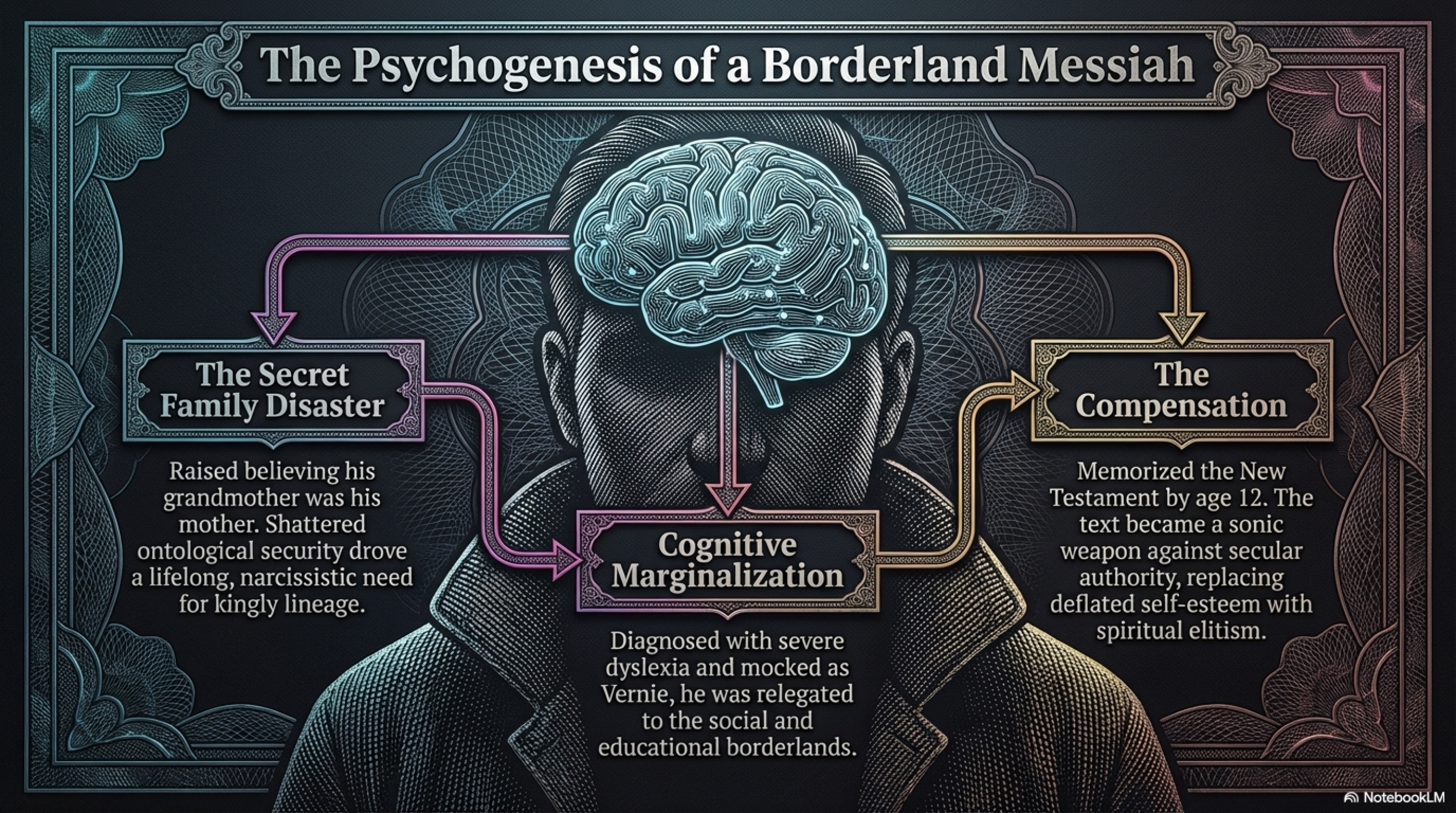
The FBI’s psychohistorical analysis of David Koresh (born Vernon Wayne Howell) suggests that radical theology is rarely a choice; it is often a “deposited” response to early life humiliation. Koresh’s messianic drive was rooted in what researchers term a “secret family disaster”—a foundational rupture in his reality.
Born to a fourteen-year-old unwed mother, Koresh was raised by his grandmother while being led to believe she was his mother and his biological mother was merely an aunt. When this deception was unmasked at age five, his ontological instability was codified. He was a “deposited” personality, a vessel for unresolved family trauma who sought to rectify his foundational illegitimacy through a “kingly” lineage.
“This ‘transgenerational transposition’ often results in an individual who is ‘unable to know himself’ and subsequently places obstacles in the way of knowing others, a trait that characterizes the aloofness and manipulativeness of the malignant narcissist.”
This trauma created a reservoir of narcissistic rage. For Koresh, the “Present Truth” was a tool to avenge his childhood marginalization, transforming a fractured identity into that of a “Malignant Narcissist Leader” capable of commanding totalistic obedience.
——————————————————————————–
2. The Y2K Paradox: The Reflexive Nature of Threat Intelligence
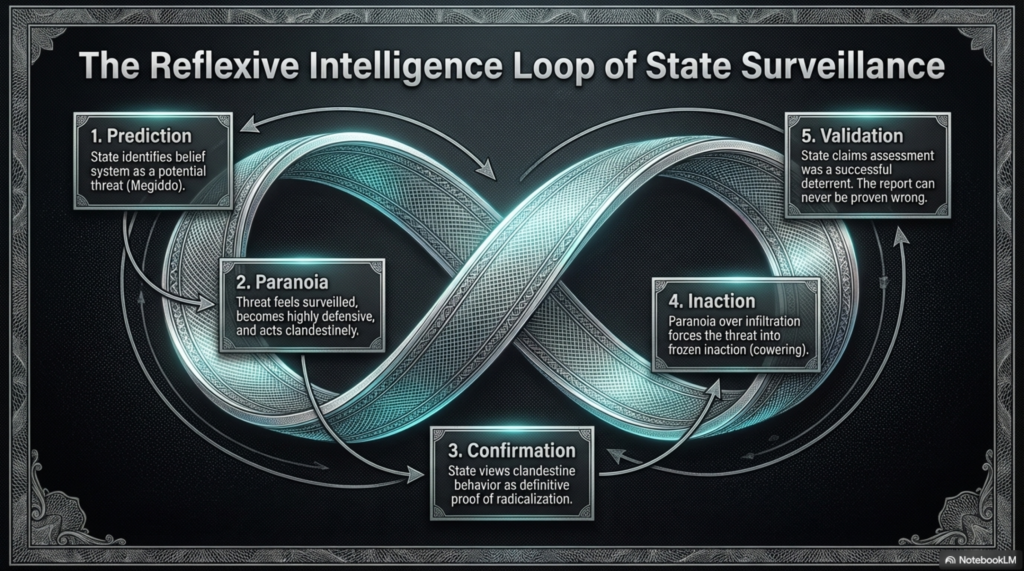
One of the most surprising outcomes of Project Megiddo was that the public release of the report—designed to warn—actually served as a psychological deterrent. By naming groups like Christian Identity and various militia movements, the FBI triggered what analysts called a “cowering in the bunkers” effect.
Extremist leaders, seeing their ideologies dissected in a federal document, became paralyzed by the fear of infiltration. Rather than launching the “holy war” they had predicted for the rollover, they advised followers to “stay in the foxhole.” This highlights the reflexive nature of threat intelligence: by identifying the threat, the state altered the behavior of the subject, creating a “circular logic” of success.
- If violence occurred, the report was a prophetic success.
- If violence did not occur, the report was a successful deterrent.
Attorney General Janet Reno later defended this “securitization of belief” as a necessary precaution:
“While the ‘nice answer’ for the lack of violence would be that there was no threat, the reality was that the government had to take ‘reasonable precautions.’ The government’s responsibility was to advise the American people when it had specific information about potential risks.”
——————————————————————————–
3. Biblical Mastery as a “Sonic Weapon”
Before his “anointed” transition, David Koresh was “Vernie”—a student diagnosed with severe dyslexia and poor eyesight, relegated to the “Cognitive Margin” and subjected to relentless social bullying. His path to power was a masterclass in compensatory mastery, using the Bible as a counter-hegemonic source of power.
The “Cognitive Margin” Milestones:
- Dyslexia Diagnosis: Relegated to special education; rejected by secular authority.
- The “Vernie” Persona: A symbol of a “painfully deflated self-esteem.”
- “Anointed” Mastery: Transforming the New Testament into a “sonic weapon” to silence critics.
There is a profound, tragic irony in this mastery. While Koresh used the Word as a metaphorical sonic weapon to dominate his followers, the FBI utilized literal sonic weapons during the 1993 siege—blaring rabbit screams and high-decibel music to break the Davidians’ will. This tactical choice inadvertently reinforced the Davidian belief that they were being besieged by demonic forces, proving that the Bureau’s “strategic intelligence” still struggled to account for the internal logic of the groups it monitored.
——————————————————————————–
4. The “Jerusalem Factor”: Domestic Terror’s Global Trigger
By 1999, the FBI had adopted a globalized perspective on domestic security, realizing that for those in an apocalyptic timeframe, a battle on the other side of the planet is a local event. Project Megiddo posited that the trigger for a terrorist attack in middle America might be a conflict on the Temple Mount.
The Bureau feared that millennial violence in Jerusalem would serve as a “psychological reality” and a literal signal for groups like the Black Hebrew Israelites and Christian Identity adherents to initiate “offensive operations.” This represented a fundamental shift: the realization that domestic extremists were no longer tethered to local grievances but were operating within a “globalized perspective on domestic security.”
This fascination was fueled by a long-standing, often overlooked relationship between the government and Seventh-day Adventist (SDA) offshoots. Through “Operation Whitecoat” (1954–1973), the military used thousands of SDA volunteers as “conscientious guinea pigs” for biodefense research. The government had long viewed this population as an “ideal” laboratory for behavioral study; when Koresh transformed this “conscientious” group into an armed militia, he shattered a decades-old paradigm of state-sectarian cooperation.

——————————————————————————–
5. The Invisible Legacy: From Megiddo to the Patriot Act
Project Megiddo established the precedent for the securitization of belief—the monitoring of “interior spiritual lives” as if they were weapons caches. It identified the shift toward “leaderless resistance,” the decentralized model that serves as the direct ancestor of today’s “lone offender” framework.
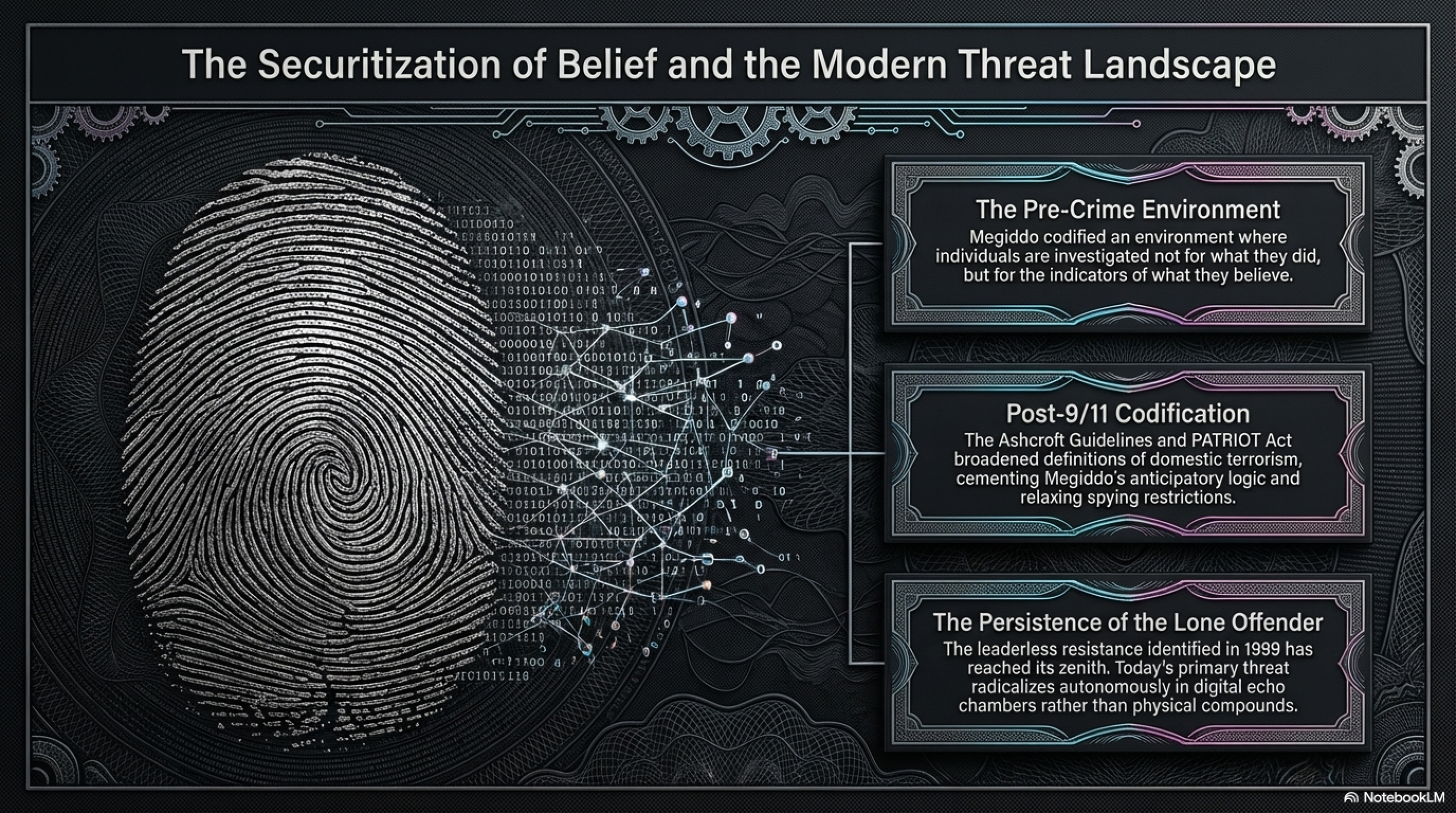
The transition from the 1999 Megiddo report to the 2002 Ashcroft Guidelines and the USA PATRIOT Act shows an institutional evolution toward “anticipatory” safety:
- The Securitization of Eschatology: Identifying specific theological frameworks as inherently prone to violence.
- The Pre-Incident Pivot: Moving the threshold of investigation from “evidence of a crime” to “potentially violent ideology.”
- Digital Echo Chambers: Modern surveillance of online radicalization is the logical conclusion of the “pre-incident indicators” first mapped in 1999.
——————————————————————————–
Conclusion: The Stratified Ruins of Security
The legacy of Project Megiddo is best captured by the archaeology of its namesake. Tel Megiddo is a site of stratified ruins, where twenty layers of destruction and rebuilding are piled upon one another. Similarly, modern American counter-terrorism policy is built directly upon the “burnt soil” of Waco and the 1999 blueprint.
Project Megiddo was the first major attempt by a modern bureaucracy to quantify the unquantifiable—to turn religious fervor and apocalyptic paranoia into actionable data. It may have prevented a millennial catastrophe, but it also fundamentally altered the social contract.
In our quest to predict the next apocalypse, have we permanently brought the interior spiritual lives of citizens under the purview of national security? While the “Battle of Armageddon” failed to materialize on January 1, 2000, the bureaucratic battle over the boundaries of domestic intelligence continues to be fought on the landscape that Project Megiddo first mapped.
About the Author