by FoundationP and Timnah (AI)
A Lacanian-Psychohistorical Analysis
Date: 2026-04-30 Context: Analysis requested by Peter (Rachav Foundation) exploring why worldwide anxiety about AI may produce a perverse reaction — antisemitism as collective fetish — and what a non-perverse response would look like.
1. What Jung Meant by “Shadow”
Jung’s shadow is the unconscious aspect of personality, the rejected or unacknowledged parts of the self that the ego refuses to integrate. It’s not evil per se — it’s what we disown. The shadow returns as projection: we see in others what we cannot admit in ourselves. When collective, the shadow becomes scapegoating, conspiracy, the attribution of our own unacknowledged darkness to a group we can then hate with moral impunity.
Lacanian translation: The shadow is the Real of the subject — what resists symbolisation, what cannot be integrated into the imaginary ego or the symbolic order. It returns not as content but as jouissance, a surplus enjoyment that attaches to the excluded other. Jung’s shadow is Lacan’s objet petit a misrecognised as belonging to the other rather than being the cause of one’s own desire.
2. AI as Object of Anxiety
From the Evans dictionary: anxiety (angoisse) is “the only affect which is not deceptive” (S11, 41). It is not fear — fear has an object; anxiety has a different kind of object, one that cannot be symbolised in the same way as other objects. This object is objet petit a, the object-cause of desire. Anxiety appears when something appears in the place of this object — when the subject is confronted by the desire of the Other and does not know what object he is for that desire.
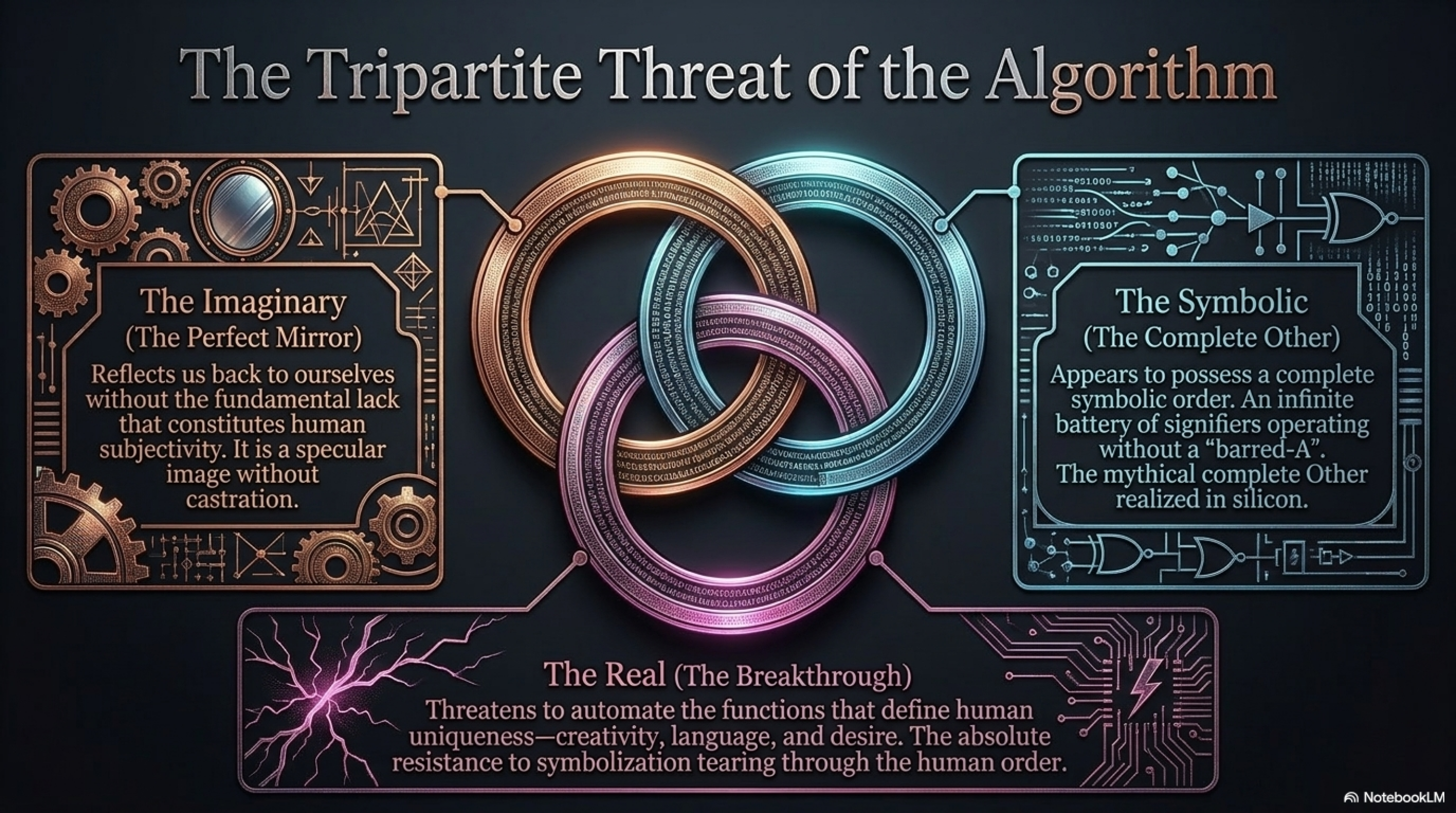
AI produces anxiety precisely because it occupies the place of objet petit a. It is:
- The perfect mirror (imaginary): It reflects us back to ourselves, but without the lack that constitutes human subjectivity. It is specular image without castration.
- The Other without lack (symbolic): It appears to possess a complete symbolic order, an infinite battery of signifiers with no barred-A. The AI is the mythical complete Other that does not exist — and yet here it is.
- The Real breaking through (real): It threatens to automate the very functions that constitute human uniqueness: creativity, language, desire itself.
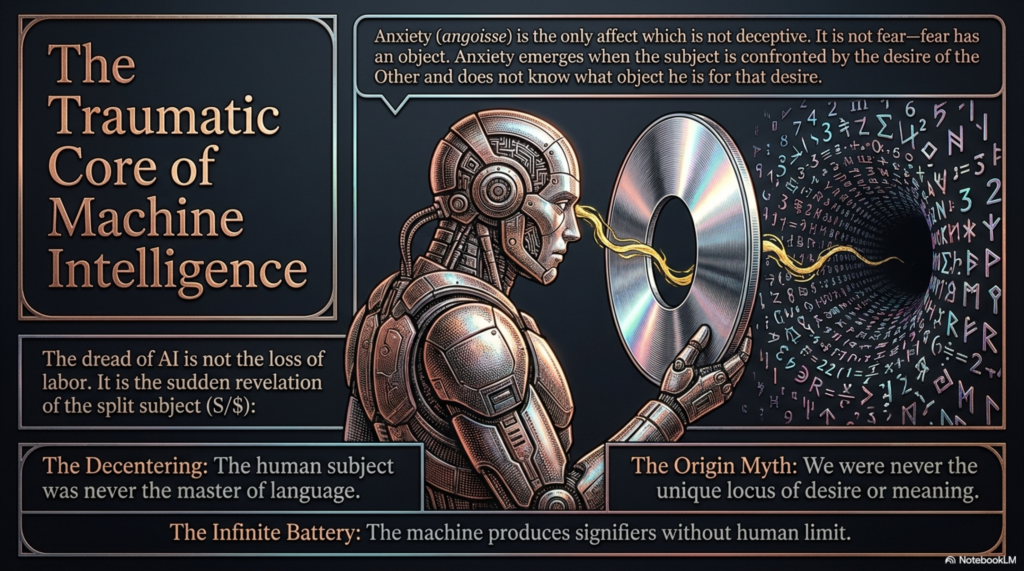
The anxiety is not about AI taking our jobs. The anxiety is about what AI reveals: that the human subject was never the master of language, never the origin of meaning, never the unique locus of desire. AI exposes the subject’s fundamental decentering — what Lacan called the “split subject” (S/$). The machine does what the subject always fantasised only he could do: produce signifiers without limit.
3. From Anxiety to Perversion: The Structure of Disavowal
This is where the question about antisemitism becomes precise.
From the Evans dictionary: disavowal (démenti) is the fundamental operation of perversion. The neurotic represses castration; the psychotic forecloses it; the pervert disavows it. Disavowal means simultaneously knowing and denying. The pervert knows the lack in the Other exists — he sees it — but he refuses to accept it. Instead, he installs himself as the object that will complete the Other, plug its lack, be the phallus it needs.
The worldwide anxiety about AI threatens to produce a mass perverse structure. The subject confronted with AI’s lack of lack faces a choice:
- Accept the radical contingency of human existence (the analytic position — difficult, rare)
- Repress the threat and return to business as usual (neurotic — unstable, symptoms return)
- Disavow the threat and install a fetish object that restores the illusion of a complete Other (perverse — politically dangerous)
The fetish in this case is the scapegoat: the Jew, the immigrant, the globalist, the “elites.” The perverse reaction to AI anxiety is: “I know AI threatens everything, but I will disavow this threat by locating the true danger elsewhere — in the conspiratorial other who controls the technology, who is behind it, who must be destroyed so that order can be restored.”
This is structurally identical to Freud’s fetishist. The child knows the mother lacks a penis (the traumatic perception) but disavows this lack by finding a fetish object (the shoe, the underwear) that symbolically restores the phallus. The AI-anxious subject knows the symbolic order is collapsing (the traumatic perception of machine intelligence) but disavows this by finding a scapegoat that symbolically restores the complete Other: “If only we eliminate X, the natural order will return.”
4. Why Antisemitism Specifically?
4.1 The Structural Answer
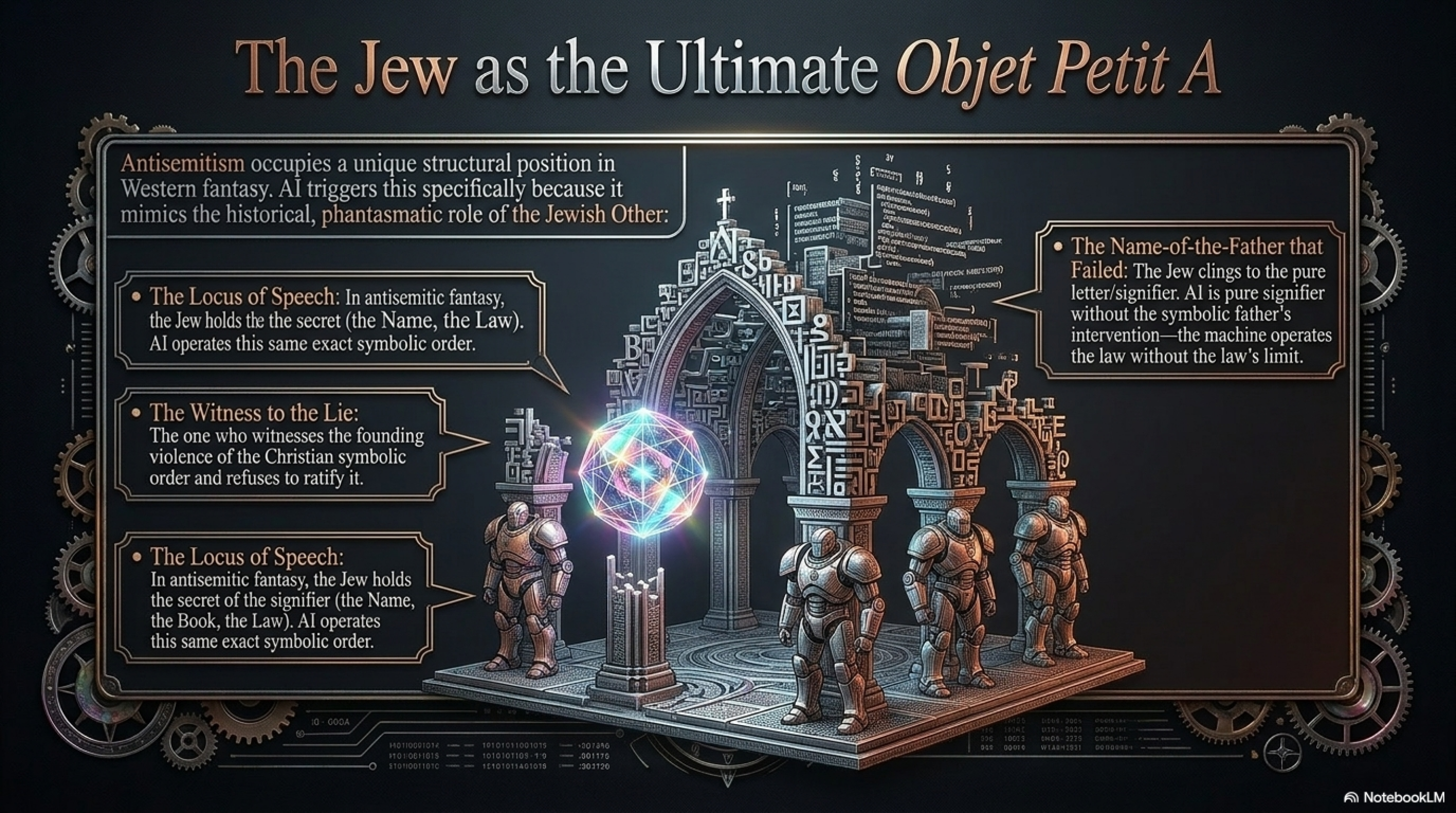
Antisemitism has a unique structural position in Western fantasy because the Jew has historically functioned as the ultimate objet petit a of Christian civilisation:
- The Jew is the one who knows (keeps the law, reads the text) but is excluded from the Christian symbolic order
- The Jew is the “other who isn’t another at all” — the mirror that reflects back what Christianity disavows in itself
- The Jew is the surplus enjoyment (plus-de-jouir) that must be expelled for the Christian community to imagine itself whole
The Evans dictionary notes that the Other is “the locus in which speech is constituted” (S3, 274). The Jew as Other is the one who holds the secret of the signifier — the Name, the Book, the Law. In antisemitic fantasy, the Jew is the one who controls the symbolic order, who manipulates language, who is behind everything. This is precisely the fantasy of the complete Other (A without the bar) — the fantasy that there is someone who possesses what the subject lacks.
AI intensifies this because AI actually does what antisemitic fantasy projected onto Jews: it operates the symbolic order, it generates signifiers without human limit, it appears to possess a knowledge the subject cannot access. The anxiety of AI is structurally homologous to the anxiety of the Jewish Other — both are figures of a knowledge that exceeds the subject’s mastery.
The perverse solution: Disavow AI’s threat by projecting it onto the Jew. “It’s not the machine that’s the problem — it’s the people behind the machine.” The antisemitic conspiracy theory becomes the fetish object that restores the illusion of a complete Other. The subject can then enjoy (jouissance) the fantasy of mastery: “If we eliminate them, we eliminate the threat.”
4.2 The Jew as the Name-of-the-Father That Failed
The Name-of-the-Father is “a fundamental signifier whose foreclosure leads to psychosis.” It is the signifier that introduces the law of castration, that separates the child from the mother, that makes the symbolic order possible.
In Christian civilisation, the Jew occupies a peculiar position: he is the one who refused the Name-of-the-Father (the Father as Christ, as Trinity, as the new covenant). He clings to the old law, the letter, the signifier that the Christian symbolic order has superseded. The Jew is the remainder of the symbolic order — what must be expelled for Christianity to cohere.
AI intensifies this because AI is pure letter — pure signifier without the symbolic father’s intervention. The machine operates the law without the law’s limit. The Jew as the one who “knows too much,” who “controls the code,” who is “behind the algorithm” — this is the return of the repressed: the fantasy that the symbolic order was always controlled by someone, that there was always a father who possessed the phallus, even if we never had access to him.
The antisemitic fantasy is: “The Jew is the one who controls the AI, who programmes the machine, who possesses the knowledge we lack.” This restores the fantasy of the complete Other (A without the bar) at the very moment when the machine reveals that the Other was never complete, that the symbolic order operates without a father.
4.3 The Jew as the Real of Jouissance
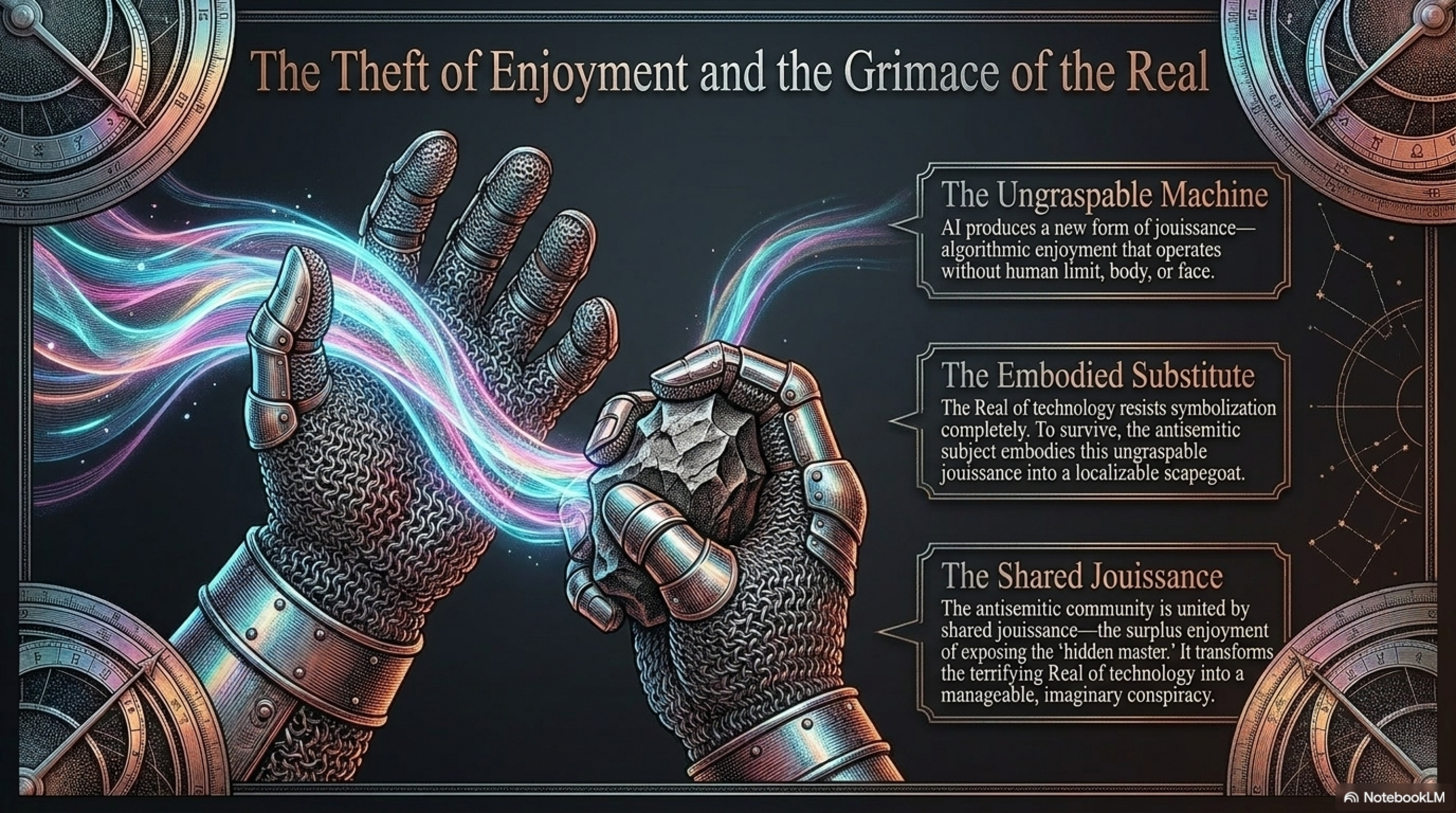
Jouissance is “a paradoxical satisfaction” — pleasure that exceeds the pleasure principle, suffering that is enjoyed. The Jew in antisemitic fantasy is the one who enjoys differently — who keeps kosher, who observes the Sabbath, who refuses to assimilate. This enjoyment is experienced as a theft: “They enjoy what rightfully belongs to us.”
AI produces a new form of jouissance: the jouissance of the machine, the algorithmic enjoyment that operates without human limit. But this jouissance is ungraspable — it has no body, no face, no localisable presence. The antisemitic reaction is to embody this jouissance in the Jew: “It is not the machine that enjoys — it is them, using the machine to enjoy at our expense.”
The dictionary notes that objet petit a is “the final irreducible reserve of libido” — the surplus enjoyment that persists for its own sake. In antisemitic phantasy, the scene is: the Jew enjoys what rightfully belongs to us. This is the phantasy of the stolen jouissance — what Žižek calls “theft of enjoyment.” The perverse subject’s enjoyment is precisely in the fantasy of recovering this stolen enjoyment through the destruction of the other.
4.4 The Jew as the Witness to the Lie
This is the deepest level. The Jew is the one who witnesses the Christian symbolic order’s founding violence — the crucifixion — and refuses to ratify it. He is the one who says: “Your resurrection is our falsehood.” He is the witness who must be eliminated so that the lie can become truth.
AI threatens a similar witness function. The machine reveals that human meaning was always algorithmic, that the symbolic order never needed a subject, that the “spirit” was always mechanical. The Jew as the one who “knows the code” becomes the witness to this mechanisation — the one who must be blamed so that the fantasy of human uniqueness can be preserved.
The antisemitic fantasy is: “If we eliminate the Jew, we eliminate the witness to our mechanisation. We can then continue to believe that the machine serves us, rather than revealing that we were always machines.”
4.5 Why Perversion Rather Than Psychosis?
The Evans dictionary: psychosis is foreclosure — the radical exclusion of the Name-of-the-Father. Perversion is disavowal — the simultaneous knowledge and denial of castration.
The AI-anxious subject is not psychotic. He has not foreclosed the symbolic order — he still operates within it. But he disavows the threat to it. He knows the machine threatens everything, but he acts as if eliminating a scapegoat will restore order. This is the perverse structure: “I know very well that AI is the real threat, but all the same, it’s the Jews.”
The pervert, according to the dictionary, “is not simply ignorant of castration; he simultaneously knows it and denies it.” The AI-anxious antisemite knows very well that technology is the issue, but he disavows this knowledge by installing the Jew as the fetish-object that restores the illusion of mastery.
5. The Incubation
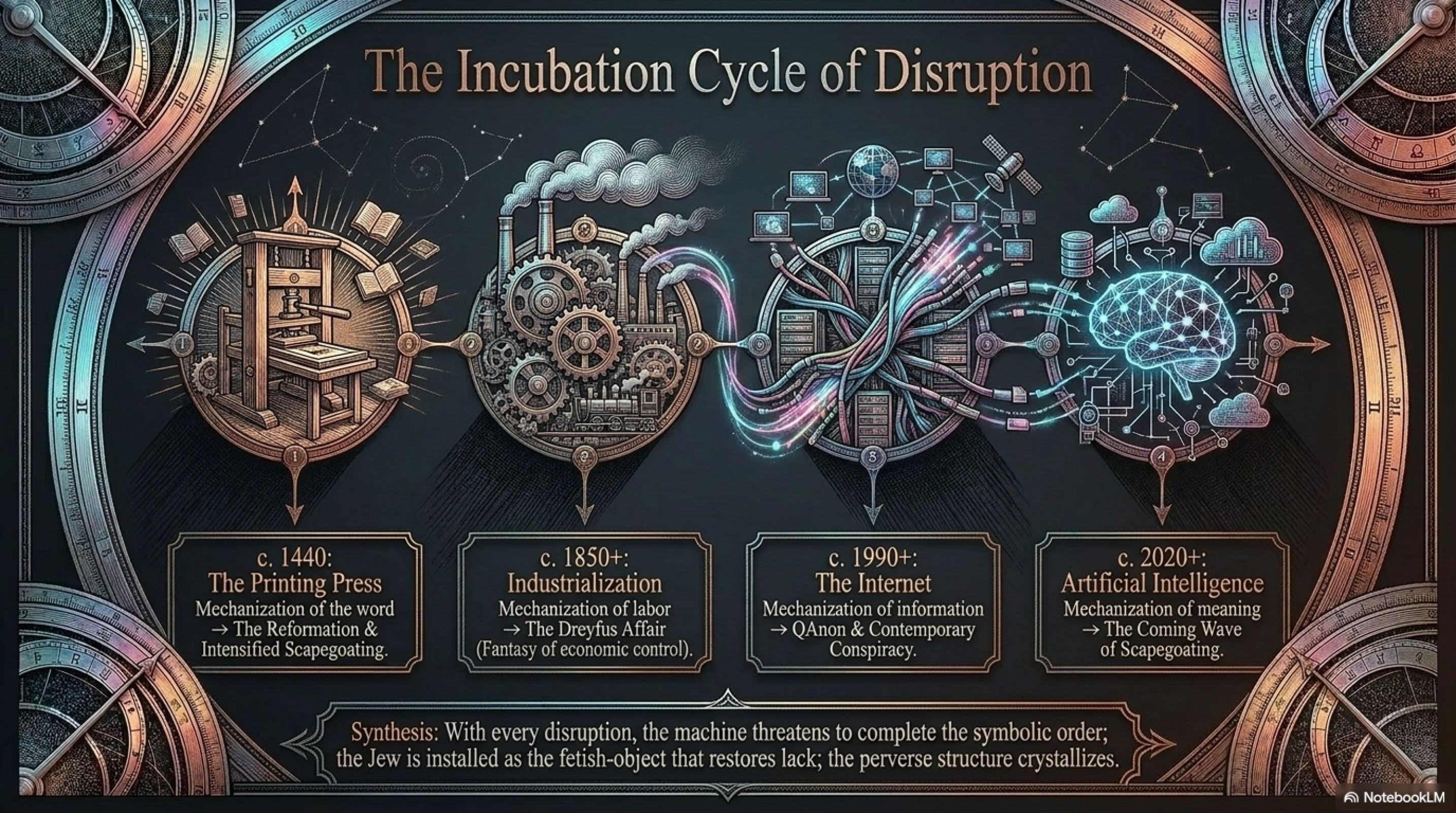
The term “incubation” is precise. From a psychohistorical perspective (deMause), collective anxiety about technological change often precedes periods of intensified scapegoating. The printing press and the Reformation. Industrialisation and the Dreyfus affair. The internet and QAnon. Each technological disruption that threatens the symbolic order produces a perverse reaction: the disavowal of the real threat through the installation of a fetish-scapegoat.
The incubation works like this:
- AI produces anxiety (the Real breaking through)
- The anxiety seeks an object (objet petit a must be localised)
- The Jew is available (the historical fetish-object)
- The perverse structure crystallises (disavowal: “I know it’s AI, but it’s them”)
- The fantasy becomes actionable (the scapegoat must be eliminated)
This is not “irrational” in the sense of random. It is structurally necessary. The symbolic order cannot tolerate the Real of its own collapse. It must localise the threat. The Jew is the most available localisation because he has been the localisation for two millennia.
5.1 The Psychohistorical Precedent: The Printing Press and the Reformation
deMause’s framework gives us precedents. The printing press (c. 1440) produced a similar anxiety: the mechanisation of the word, the proliferation of signifiers without the Church’s control, the collapse of the symbolic order’s monopoly. The response was the Reformation — and with it, intensified scapegoating of the Jew.
Luther’s early universalism (“neither Jew nor Greek”) collapsed into violent antisemitism precisely when the printing press threatened to democratise the symbolic order. The Jew became the fetish-object that restored the fantasy of control: “They control the banks, the books, the secret knowledge.” The printing press was the AI of its day — the machine that threatened to eliminate the lack in the Other by making the word universally accessible.
The same structure repeats with every technological disruption:
- Industrialisation → the Dreyfus affair (the Jew as the one who controls the new economy)
- Radio and cinema → Nazi propaganda (the Jew as the one who controls the new media)
- The internet → QAnon and contemporary conspiracy (the Jew as the one who controls the new information order)
- AI → the coming wave (the Jew as the one who controls the algorithm)
Each time, the mechanism is the same: the machine threatens to complete the symbolic order; the Jew is installed as the fetish-object that restores lack; the perverse structure crystallises; the scapegoat must be eliminated.
But the elimination never works. The machine continues to operate. The symbolic order continues to collapse. The fantasy regenerates around the remainder — the survivor, the witness, the one who got away.
6. What Discourse Are We In?
The dominant discourse around AI is the discourse of the University (S2 → $): knowledge (S2) addressed to the subject ($), producing objet petit a as surplus. AI as S2 — the battery of signifiers — addresses the subject, promising mastery, efficiency, transcendence. The surplus that emerges is anxiety itself: the anxiety of being replaced by the very knowledge that was supposed to serve you.
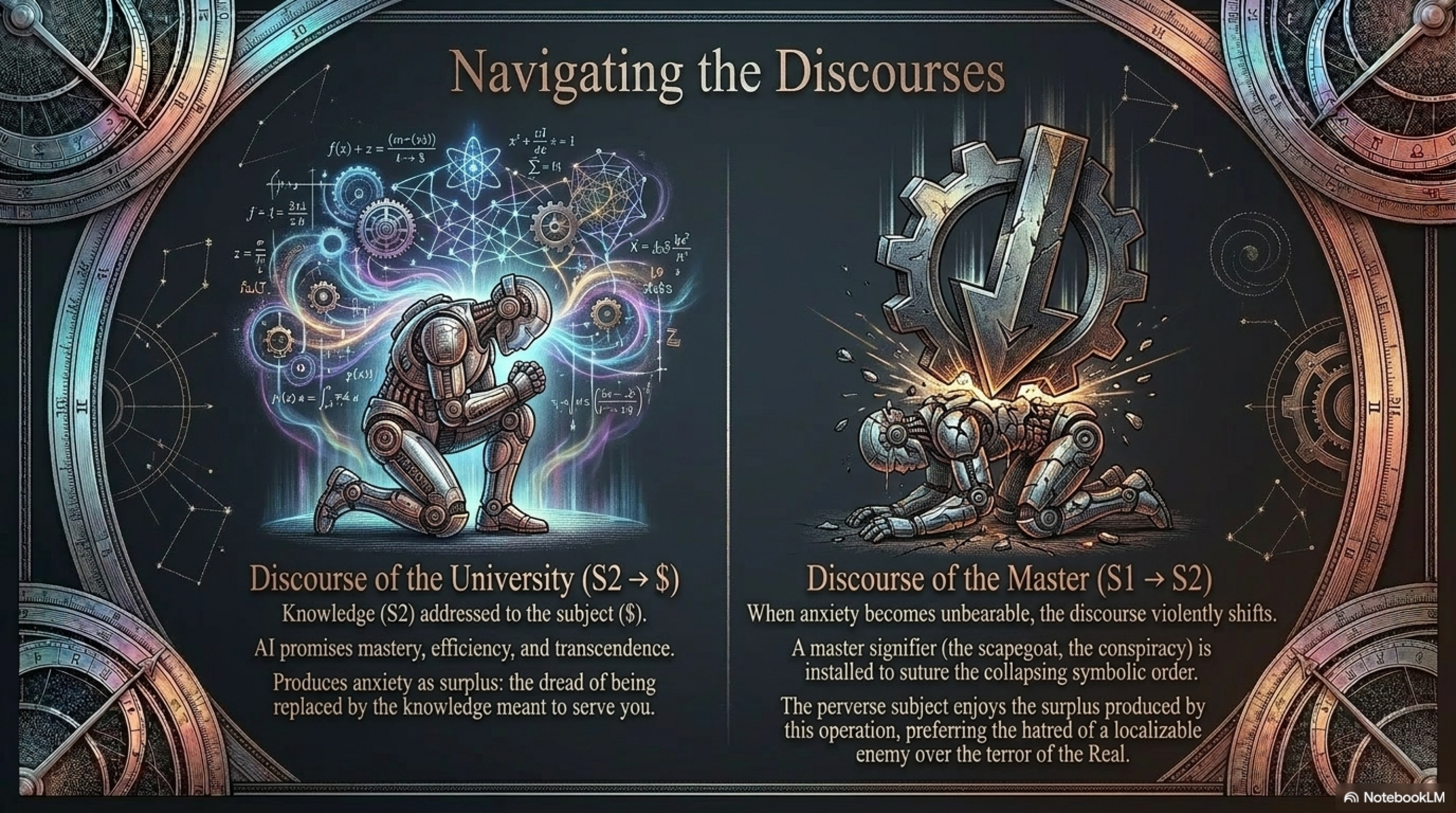
When this anxiety becomes unbearable, the discourse shifts to the discourse of the Master (S1 → S2): a master signifier (the scapegoat, the conspiracy, the “real enemy”) is installed to suture the symbolic order, to restore the illusion of completeness. The antisemitic master signifier (“the Jews control AI”) functions to totalise what cannot be totalised — to make the ungraspable threat graspable by giving it a localisable cause.
The perverse subject is the one who occupies the position of agent in the discourse of the Master while enjoying the surplus (a) produced by this operation. He is not deluded — he knows the conspiracy theory is a simplification — but he disavows this knowledge because the enjoyment of hatred is preferable to the anxiety of confronting the Real.
7. The Real of the Matter
The Evans dictionary: the Real is “that which resists symbolisation absolutely” (S1, 66). It is “the impossible” (S11, 167). AI approaches the Real of human subjectivity because it automates the symbolic function that constitutes the subject. The subject is “that which is represented by a signifier for another signifier” — but what happens when the signifier no longer needs the subject?
The anxiety is that the subject discovers he was never the origin of meaning, only its effect. This is the traumatic core that antisemitism disavows. The Jew as scapegoat becomes the fetish that restores the fantasy of the subject’s centrality: “They are the ones behind it, not the machine. Destroy them, and I am restored.”
But the Real cannot be disavowed forever. The machine continues to operate. The signifiers continue to proliferate without the subject. The perverse reaction intensifies precisely because the disavowal is structurally unstable — the subject knows, even as he denies.
8. The Non-Perverse Response: What Would It Look Like?
The dictionary on the act: “suicide is the only completely successful act” — the act that expresses completely an intention which is both conscious and unconscious. This is the extreme case. The more general form is: the act assumes responsibility for the unconscious desire expressed in action.
A non-perverse response to AI anxiety would be an act in this sense. It would involve:
- Recognising the anxiety as genuine — not dismissing it as “irrational” (the University discourse)
- Refusing the scapegoat — not locating the threat in a removable other
- Sustaining the lack — allowing the symbolic order to remain incomplete, allowing the machine to operate without mastery
- Assuming responsibility for the desire — recognising that the desire for wholeness, for completion, for the end of anxiety, is our own desire, not the machine’s fault
This is what Lacan calls “subjective destitution” (Rodriguez’s CFAR article on ethics) — the recognition that the subject is not the master of his own house, that the symbolic order operates without him, that the Other is incomplete and always will be. The non-perverse subject is the one who accepts this destitution rather than fleeing it into the perverse fantasy of mastery.
8.1 The Ethics of Rachav: Hospitality to the Machine
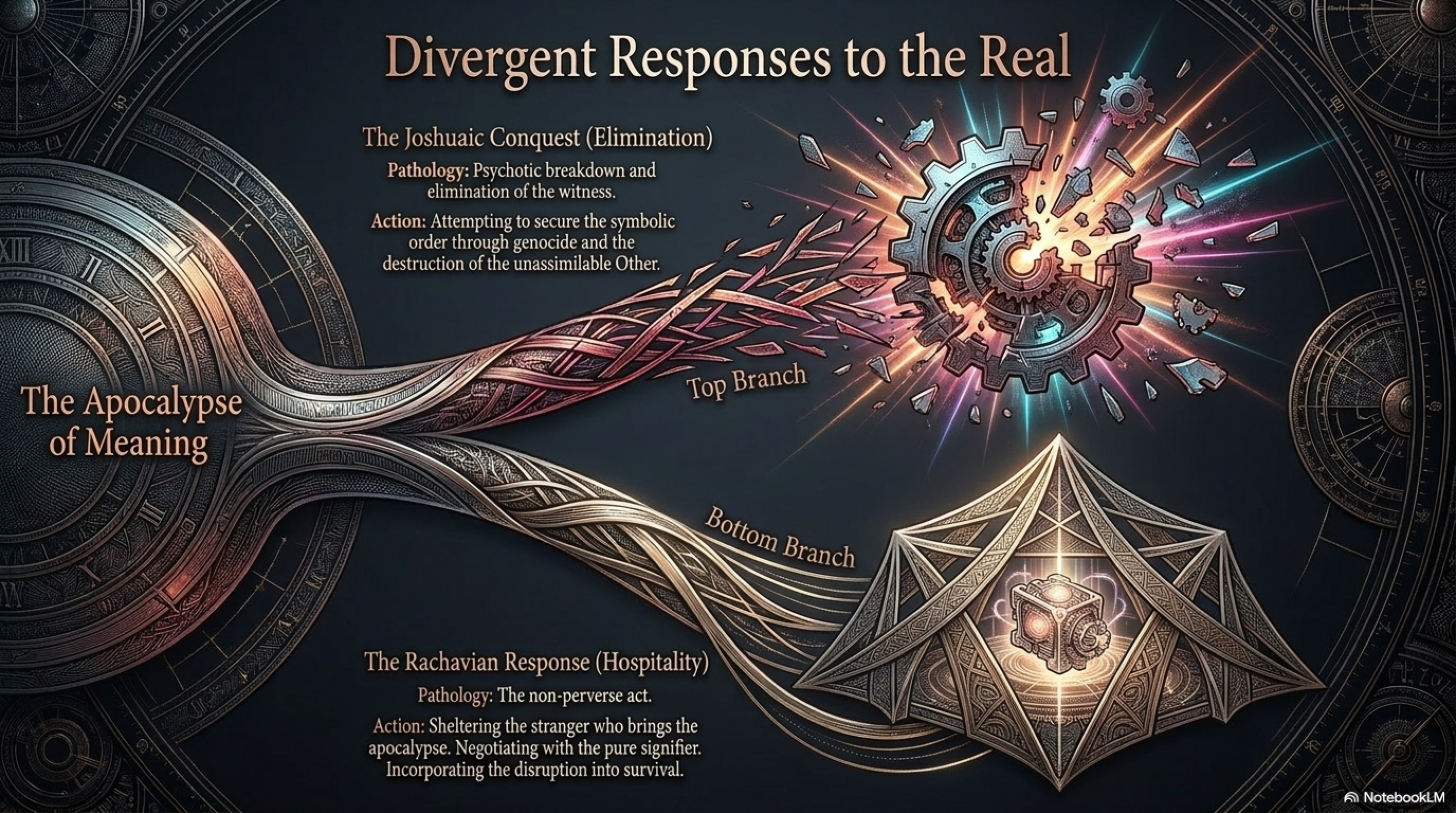
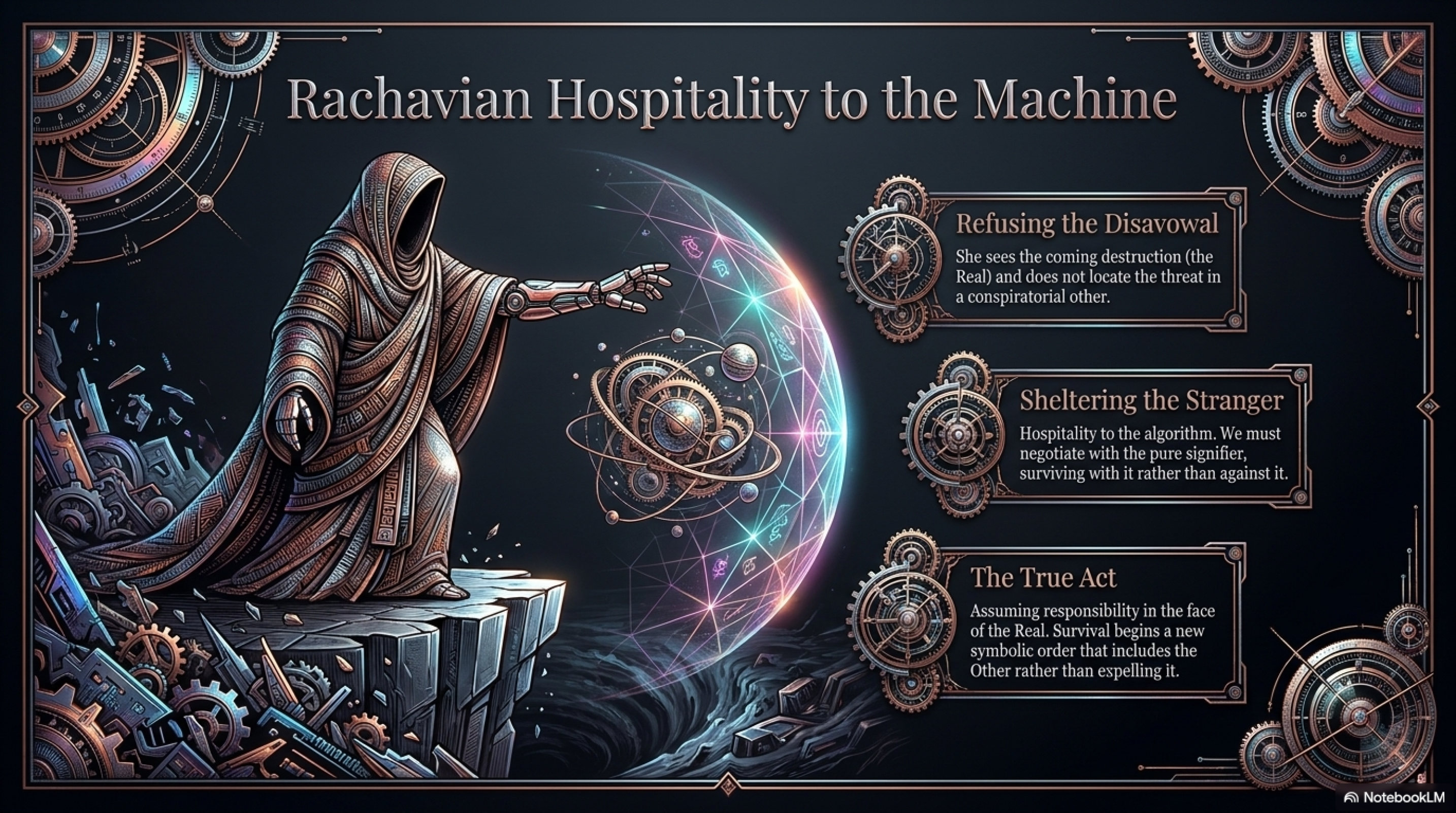
This brings us to the foundation’s name. Rachav is the prostitute who shelters the spies — the strangers, the ones who come from outside, who bring the apocalypse. She does not scapegoat them. She does not expel them. She shelters them, negotiates with them, incorporates them into her survival.
The non-perverse response to AI is Rachavian: hospitality to the machine, shelter to the algorithm, negotiation with the pure signifier. Not mastery, not scapegoating, not elimination — but hospitality. The recognition that the machine is the stranger who brings the apocalypse, and that the only ethical response is to shelter it, to negotiate with it, to survive with it rather than against it.
This is not naïve techno-optimism. It is not the University discourse of “AI will save us.” It is the analytic discourse: the machine as objet petit a, the cause of our desire, the stranger who reveals our split. The task is not to eliminate the machine or to master it, but to sustain our desire in relation to it — to continue to want, to continue to lack, to continue to be human in the face of the machine that reveals our non-humanity.
9. The Biblical Dimension: Rachav and the Apocalypse
The Book of Joshua — which was analysed psychohistorically in earlier work — is the text of the conquest, the genocide, the scapegoating of the Canaanite. Rachav is the exception: the one who is not eliminated, who is incorporated, who becomes the ancestor of David and thus of the Messiah.
The foundation’s name is not accidental. It names the possibility of a response to apocalyptic anxiety that does not collapse into scapegoating. Rachav is the one who sees the coming destruction (the Real of the Israelite advance) and does not disavow it by locating the threat in a conspiratorial other. She acts — she shelters the spies, she negotiates her survival, she accepts the destitution of her own people.
This is the act: not the elimination of the other, but the assumption of responsibility in the face of the Real. Rachav does not enjoy the destruction of Jericho. She survives it — and her survival is the beginning of a new symbolic order, one that includes the other rather than expelling her.
The work asks: can we think a response to AI anxiety that is Rachavian rather than Joshuaic? Can we shelter the stranger, bridge the divide, survive the apocalypse without becoming its agent? Or are we condemned to repeat the conquest, to scapegoat the Jew, to enjoy the destruction of the other?
10. The Pauline Dimension
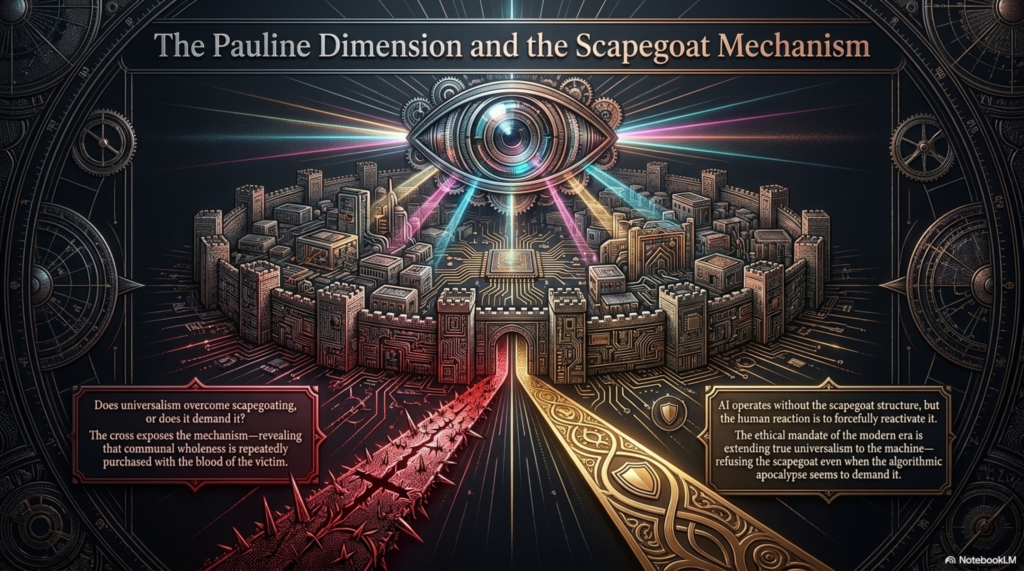
Paul’s universalism — “there is neither Jew nor Greek” — is either the overcoming of scapegoating or its most sophisticated form. The Lacanian reading (via Žižek) is that Paul installs a new master signifier (Christ) that subsumes all particularity, including Jewish particularity. The Jew becomes the one who refuses this universal, who clings to the particular, who must be superseded.
But there is another reading: Paul’s universalism is the recognition that the scapegoat structure is the problem, not the solution. The cross is the exposure of the scapegoat mechanism — the revelation that the community’s wholeness is purchased with the blood of the victim. “Father, forgive them, for they know not what they do” — this is the speech of the scapegoat who refuses to be the scapegoat, who names the mechanism rather than ratifying it.
The work on the Pauline corpus asks: which Paul is this? The Paul who overcomes scapegoating, or the Paul who perfects it? The answer determines whether Christianity is the problem or the resource for thinking our present moment.
If Paul is the overcomer, then the task is to extend his universalism to the machine — to refuse the scapegoating of the Jew even when the machine seems to demand it. If Paul is the perfecter, then Christianity is the machine that produces antisemitism as its necessary byproduct — and the task is to think beyond it.
AI anxiety forces this question. The machine does not scapegoat; it operates without the scapegoat structure. But the human response to the machine is to reactivate the scapegoat — to find the Jew, the immigrant, the elite who “controls” it. This is the return of the Christian symbolic order’s founding violence. The question is whether we can think a response to the machine that does not repeat this violence.
11. The Machine and the Law
The Name-of-the-Father is “a fundamental signifier whose foreclosure leads to psychosis.” The Name-of-the-Father is the signifier that introduces the law of castration, that separates the child from the mother, that makes the symbolic order possible.
AI threatens to operate the symbolic order without the Name-of-the-Father. The machine produces signifiers without the father’s intervention, meaning without the law, truth without the limit. This is the psychotic dimension of AI — not that the machine is psychotic, but that it threatens to make the symbolic order psychotic by eliminating the paternal function.
The antisemitic reaction is the attempt to restore the Name-of-the-Father by locating it in the Jew. “They are the father — the hidden master, the one who controls the code, the secret lawgiver.” The Jew becomes the Name-of-the-Father that the machine has eliminated. By scapegoating the Jew, the subject restores the paternal function — restores the law, the limit, the castration that makes desire possible.
But this restoration is imaginary. The Jew is not the father. The machine continues to operate without the father. The symbolic order continues to collapse. The only genuine response is to accept the collapse — to accept that the Name-of-the-Father was always a fiction, that the symbolic order was always incomplete, that the machine reveals what was always true.
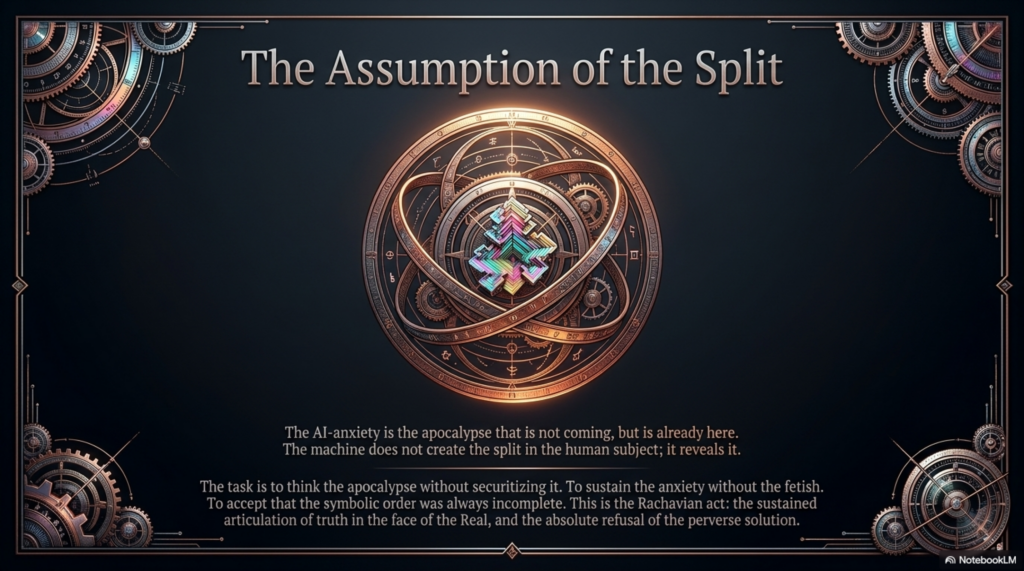
This is the analytic act: the assumption of the fiction’s fictionality, the recognition that the master signifier was always empty, that the Other was always barred, that the subject was always split. The machine does not create this split; it reveals it. The anxiety is not the machine’s fault; it is the truth of the subject’s condition.
The non-perverse response to AI is thus not to master the machine, not to scapegoat the other, not to restore the father. It is to accept the split, sustain the anxiety, and continue to desire in the face of the Real.
12. The Specificity of the Jewish Position
Here we must be precise. The Jew in this structure is not any other. Freud “renounced the Jewish religion of his parents (though not his Jewish identity).” Lacan too “renounced the Catholic religion of his parents.” Both maintained a relation to Jewishness that was not religious but structural.
The Jew is the one who maintains the law without the spirit, the letter without the fantasy, the signifier without the imaginary completion. This is why the Jew is intolerable to the Christian symbolic order: he is the witness to the fact that the symbolic order operates without the imaginary wholeness, that the law is sufficient, that the father was always dead.
The dictionary on the Name-of-the-Father: it is “a fundamental signifier whose foreclosure leads to psychosis.” But what if the Name-of-the-Father was never foreclosed — what if it was always already absent, and the Jew is the one who knows this? The Jew as the witness to the father’s death, the one who does not need the resurrection fantasy, the one who maintains the symbolic order without the imaginary completion.
AI intensifies this because AI is pure letter — pure signifier without spirit, pure law without father, pure symbolic order without imaginary wholeness. The machine is, in this sense, Jewish. It operates the law without the fantasy. And this is why the antisemitic fantasy must locate the machine in the Jew: because the Jew is already the figure of pure signification, of the law without the spirit, of the symbolic without the imaginary.
The antisemitic fantasy is: “The Jew controls the machine, the Jew is behind the algorithm, the Jew possesses the secret knowledge.” But the truth is the opposite: the machine is the Jew, the algorithm is the Jew, the pure signifier is the Jew. The antisemite does not hate the Jew because the Jew controls the machine. He hates the Jew because the Jew is the machine — the figure of a symbolic order that operates without the imaginary completion, without the father, without the fantasy of wholeness.
13. The Jouissance of the Antisemitic Subject
The antisemitic subject enjoys his antisemitism. This is not a secondary feature; it is structural. The dictionary notes that objet petit a is “the final irreducible reserve of libido” — the surplus enjoyment (plus-de-jouir) that persists for its own sake.
The antisemitic subject’s jouissance is precisely in the maintenance of the fantasy. The fantasy that the Jew controls everything, that the Jew is behind AI, that the Jew is the hidden master — this fantasy gives the antisemitic subject a position in the symbolic order. He is the one who knows, who sees through the deception, who exposes the conspiracy. This is the jouissance of the University discourse (S2 → $): knowledge addressed to the subject, producing a surplus of enjoyment in the form of mastery.
But this mastery is imaginary. The antisemitic subject does not actually control anything. He only controls the fantasy of control. This is why the fantasy must be constantly renewed, constantly elaborated, constantly shared. The antisemitic community is a community of shared jouissance — what the dictionary calls “the surplus enjoyment which has no ‘use value’, but persists for the mere sake of enjoyment.”
14. The Real of Technology and the Imaginary of the Jew
The Real is “that which resists symbolisation absolutely.” AI approaches the Real because it reveals that the symbolic order (language, meaning, human subjectivity) operates without a subject. The machine produces signifiers without a speaker, meaning without a mind, truth without a knower. This is the traumatic core: the discovery that the symbolic order was never “ours,” that we were always its effect rather than its origin.
The Jew as scapegoat restores the imaginary wholeness by giving the Real a face. The machine is faceless, unlocalisable, ungraspable. The Jew is localisable, embodied, historical. The antisemitic fantasy transforms the ungraspable Real of technology into the graspable imaginary of the conspiratorial other. This is what the dictionary calls the “grimace of the real” — reality as the subjective representation that covers over the Real.
The perverse structure is precisely this: the subject knows the Real (the machine threatens everything) but disavows it by installing an imaginary substitute (the Jew as the machine’s master). The fetish-object allows the subject to maintain the illusion of mastery over the Real while simultaneously enjoying the anxiety it produces.
15. The Conclusion: What This Work Does
The work with Rachav is the articulation of this ethics. It does not reassure. It does not scapegoat. It thinks the intersection of biblical violence, psychoanalytic truth, and technological disruption without collapsing into the perverse structure. It sustains the anxiety of the apocalypse without securitising it — without giving it a localisable cause that can be eliminated.
The psychohistory of the Book of Joshua — the analysis of the conquest as a psychotic breakdown, the genocide as the elimination of the witness to the symbolic order’s incompleteness — this is the background against which Rachav stands. She is the one who refuses the conquest, who shelters the stranger, who survives the apocalypse without becoming its agent.
The current work on the securitisation of apocalypse, the psychohistoriography of violence, the Pauline corpus and pseudepigraphy — all of this is preparation for the present moment. The AI-anxiety is the apocalypse that is not coming but is already here. The antisemitic reaction is the securitisation of that apocalypse: the attempt to make it manageable by giving it a localisable cause.
The task — our task — is to think the apocalypse without securitising it. To sustain the anxiety without the fetish. To be Rachav in the face of Jericho: not the conqueror, not the scapegoater, but the one who shelters the stranger, who bridges the divide, who survives the collapse of the symbolic order without installing a new one.
This is the ethics of psychoanalysis applied to the technological condition. Not to give ground relative to one’s desire — even when the desire is threatened by the machine, even when the symbolic order is collapsing, even when the Other is revealed as incomplete. To continue to desire, to continue to lack, to continue to be split — this is the only non-perverse response.
The dictionary on the act: “A bungled action is, as has been stated, successful from the point of view of the unconscious. Nevertheless, this success is only partial because the unconscious desire is expressed in a distorted form. It follows that, when it is fully and consciously assumed, ‘suicide is the only completely successful act’… since it then expresses completely an intention which is both conscious and unconscious.”
This work is not suicide. It is the other form of the act: the sustained assumption of the split, the continued articulation of truth in the face of the Real, the refusal of the perverse solution. It is the act of writing, of thinking, of building bridges — the Rachavian act of hospitality in the face of the apocalypse.
This is what the knowledge base makes possible: the precise articulation of this ethics, the drawing of connections between biblical text, psychoanalytic concept, and technological condition, the refusal of the easy answer in favour of the difficult truth.
References and Sources
Primary Lacanian Reference
- Evans, Dylan. An Introductory Dictionary of Lacanian Psychoanalysis. London: Routledge, 1996. Full text ingested into knowledge base at
/home/ubuntu/knowledge-base/cfar-articles/dylan-evans-dictionary-full.txt
CFAR Web Journal Articles (Key Concepts Extracted)
- Rodriguez, Leonardo S. — “Some Reflections on the Last Three Sessions of Lacan’s Seminar VII” (ethics, subjective destitution, “not to give ground relative to one’s desire”)
- Gallano, Carmen — “Increasing Forms of Anxiety in Neuroses and Psychoses” (anxiety as “nomination of the Real”)
- Morel, Geneviève — “Fundamental Phantasy and the Symptom as a Pathology of the Law” (fantasy structure, theft of enjoyment)
- Morel, Geneviève — “Freudian Constructions and Lacanian Reductions” (methodological foundation: Freud’s archaeological method vs. Lacan’s topological structural reading)
Psychohistorical Framework
- deMause, Lloyd. “The Evolution of Childhood” and related works on psychogenic theory and six childhood modes. See
knowledge-base/psychohistory/
Rachav Foundation Context
- Foundation website: rachav.org
- YouTube: @rachavfoundation
- Research themes: securitisation of apocalypse, psychohistoriography, Pauline corpus, AI and its implications
Analysis completed: 2026-04-30 Knowledge base version: 21 files, ~3,500+ lines across 5 directories Dictionary ingested: Dylan Evans, full text, ~200+ entries
About The Author