via IFTTT
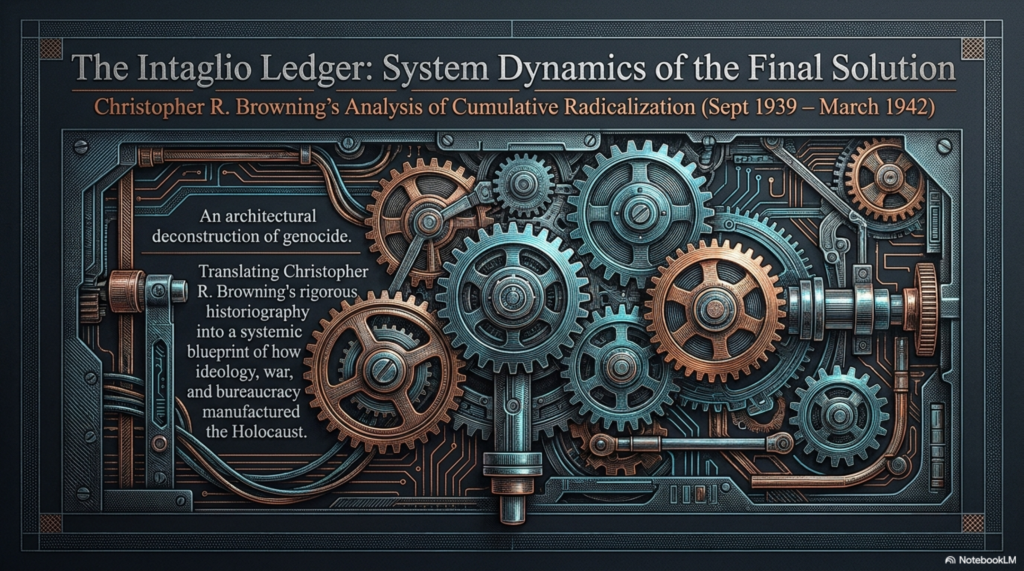
The Architecture of Genocide: Investigating the Incremental Radicalization of the “Final Solution”
1. Introduction: Beyond the Blueprint
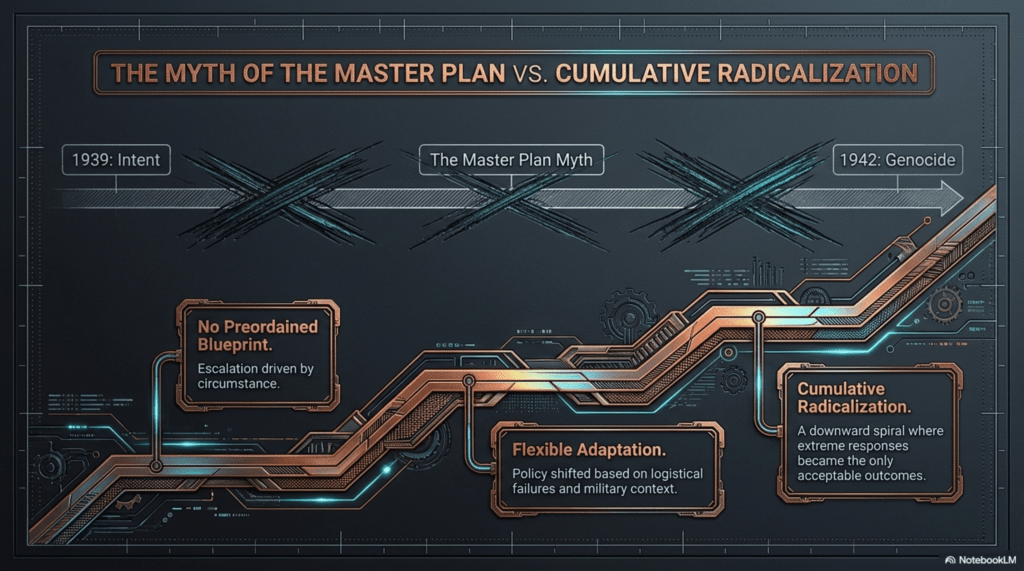
In the field of Holocaust historiography, the transition from discriminatory policy to industrialized mass murder remains the most daunting subject of inquiry. Christopher R. Browning’s The Origins of the Final Solution stands as a seminal text in this discourse, precisely because it moves beyond the reductive debate between “intentionalism”—the belief in a pre-conceived master plan—and “functionalism,” which views genocide as a product of bureaucratic momentum. Browning instead offers a synthesis through the lens of “cumulative radicalization.” He posits that the Holocaust was not a single, static decision made in 1933, but an evolutionary process shaped by the volatile interplay of deep-seated racial ideology and shifting wartime circumstances. Our goal as historians is to investigate the bureaucratic and social mechanisms that transformed abstract anti-Semitic sentiment into a lethal state apparatus. By doing so, we move past the comfort of a “blueprint” and confront the more terrifying reality of a genocide forged through incremental choices.
2. The Cultural Axiom: Historical Preconditions and the “Jewish Question”
To understand how the “Final Solution” became possible, we must first recognize how anti-Semitism shifted from a fringe belief into a “cultural axiom” among the German elite. For conservative traditionalists, radical anti-Semitism was not merely a prejudice; it was a defensive response to the perceived threats of modernization and liberalism that followed World War I. Within this worldview, the “Jewish Question” served as a symbolic focal point for anxieties regarding social decay and national weakness.
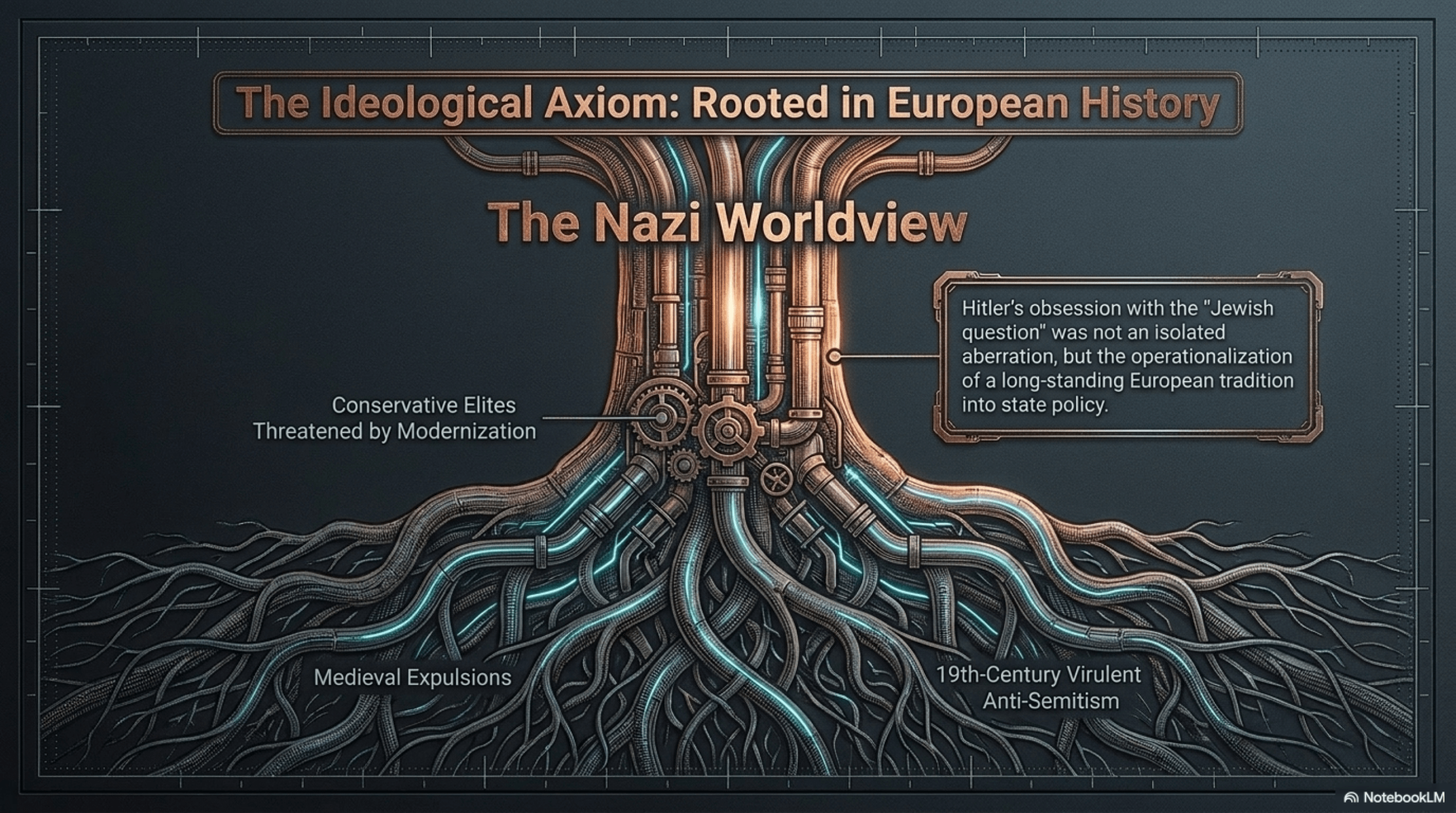
However, a critical investigative finding in Browning’s work—one that often surprises students—is that the “Jewish issue” was initially not the regime’s primary concern. As noted in the record of the early Third Reich:
“the Jewish issue was but one among many, neither their top priority nor source of greatest fear.” [Ch. 4]
This “secondary” status is historiographically significant. In the early years, Nazi policy was often reactionary and lacked a centralized, linear trajectory. Because it was one issue among many, it allowed for various radicalized experiments to emerge from the bottom up. It was only when this ideological framework was operationalized following the 1939 invasion of Poland that the regime began to treat racial policy as its most urgent laboratory.
3. Poland as a “Laboratory of Racial Policy”
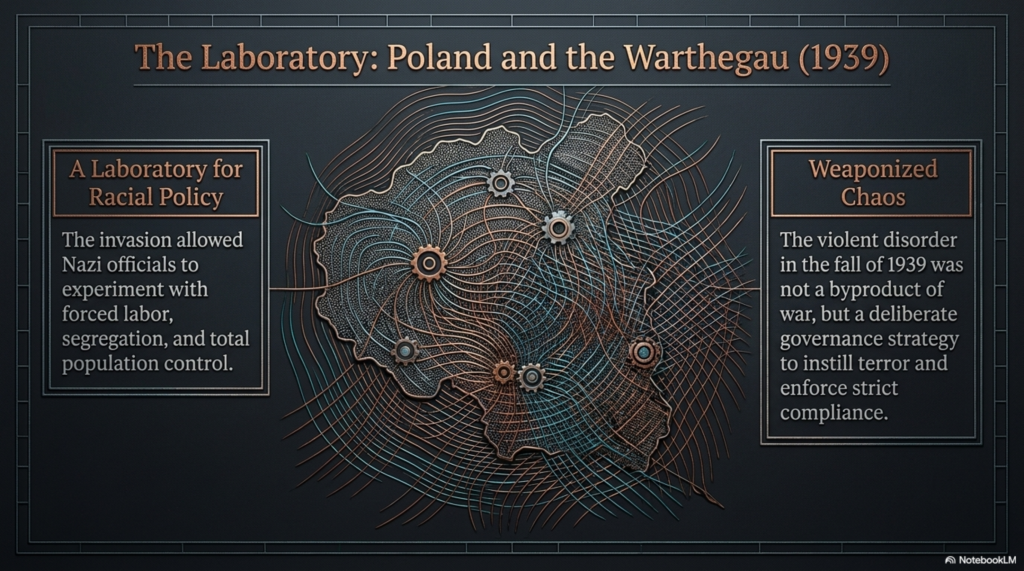
Following the 1939 invasion, occupied Poland became the primary site for Nazi racial engineering. It served as a testing ground where the regime moved beyond mere discrimination into the realm of population management. While the fall of 1939 is characterized by “chaotic terror,” this disorder was often a deliberate strategy utilized by officials to instill compliance and shatter existing social structures.
The Warthegau Experiment In the “Warthegau”—a region of western Poland annexed by Germany—Nazi officials implemented a radical program of experimental segregation. This area served as a site where the boundaries of racial purity were tested through forced labor and the systematic isolation of the Jewish population, all managed under the guise of “administrative necessity.”
A pivotal “So What?” layer emerges in Chapter 9: the logistical nightmare of the Volksdeutsche (ethnic Germans). During 1939 and 1940, Heinrich Himmler was frequently more preoccupied with the resettlement of ethnic Germans than with the immediate logistics of Jewish extermination. This competition for space created a “bottleneck.” When the regime failed to find adequate room for incoming Germans, the Jewish population was increasingly viewed not just as an ideological enemy, but as a disposable logistical obstacle. This friction between the desire for “living space” and the reality of overcrowding actually accelerated the drive toward more radical, lethal “solutions.”
4. The Logistics of Failure: From Madagascar to the Gas Chamber
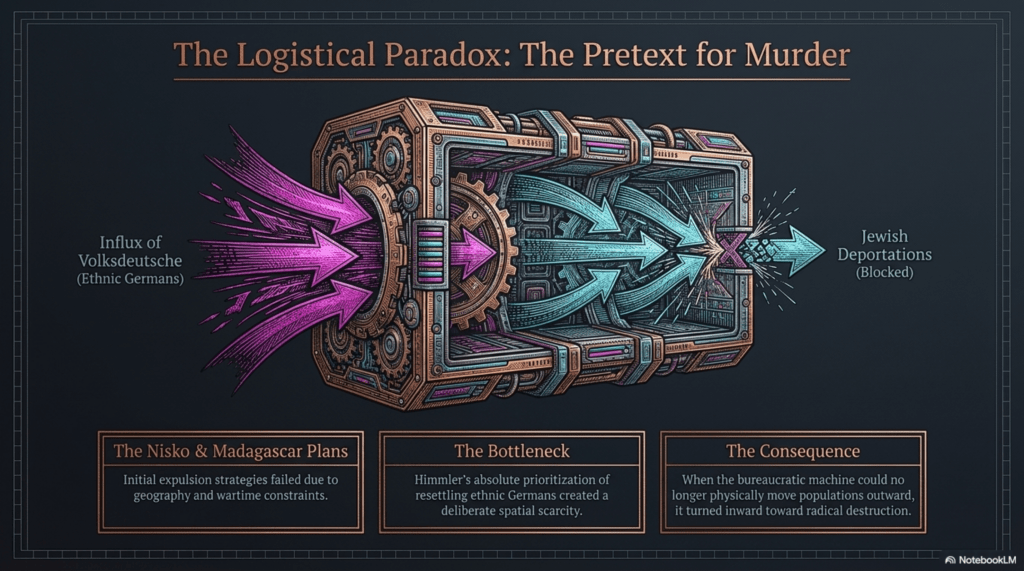
Before the advent of the gas chambers, the Nazi leadership attempted to solve the “Jewish problem” through massive programs of expulsion and displacement. These efforts were catastrophic logistical failures, and each failure effectively narrowed the options available to the regime, pushing them toward a policy of annihilation.
The Geography of Displacement
- The Nisko Plan: An early attempt to deport Jews to a “reservation” in the Lublin district. It failed due to logistical mismanagement and, more importantly, competing regional interests [Ch. 11]. Polycratic rivalries between Nazi leaders meant that local governors refused to accept more “burdens” into their territories.
- The Madagascar Plan: A proposal to deport millions of European Jews to the island of Madagascar. This became a logistical impossibility because the German Navy could not guarantee safe passage during the war with Britain, and the island lacked any infrastructure to sustain such a population.
The transition from “expulsion” to “extermination” was a direct response to these geographical solutions becoming non-viable. As the “Madagascar Plan” was shelved, the bureaucracy reached a chilling consensus: if the Jews could not be moved, they must be removed. Annihilation became the only remaining “logical” bureaucratic option in a system that refused to abandon its ideological goals.
5. Polycracy and the “Ordinary” Perpetrator
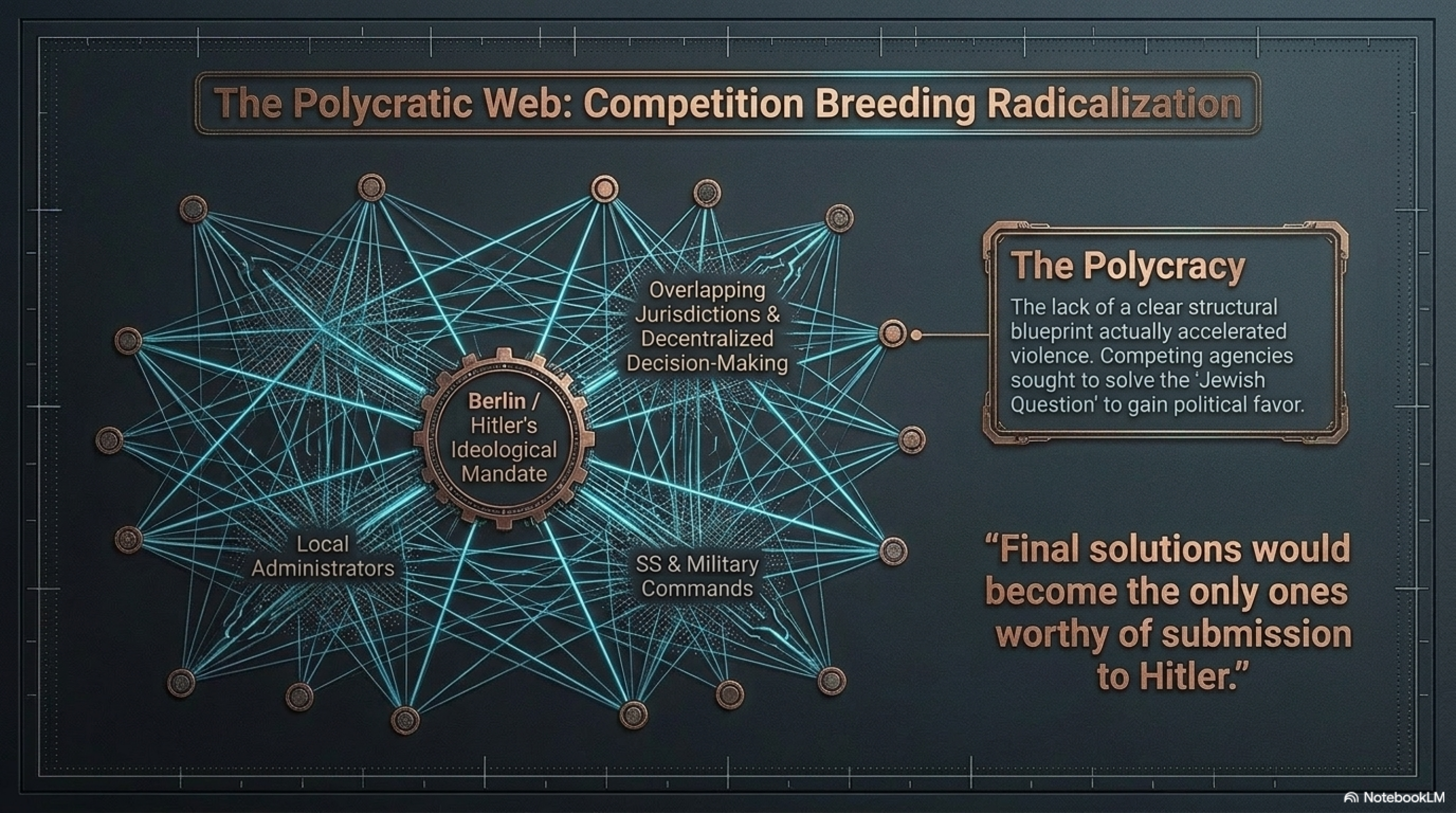
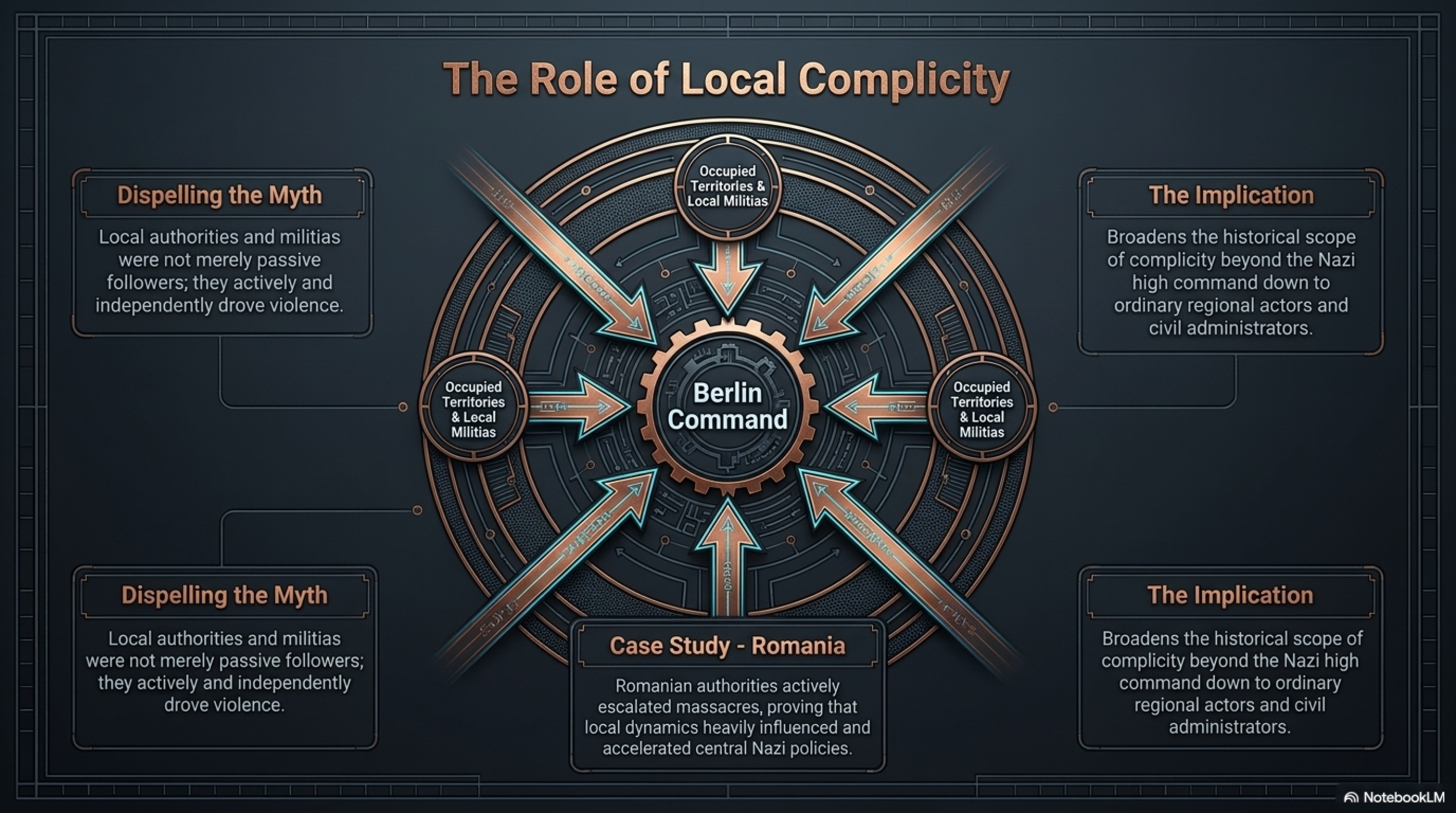
The Nazi regime was a “polycracy”—a chaotic collection of competing agencies. This structure was essential to the genocide because it encouraged decentralized radicalization. In the absence of a singular, clear blueprint, local officials were incentivized to “work towards the Führer,” interpreting Hitler’s vague ideological desires into concrete, radical policies to prove their loyalty.
This environment ensured that:
“final solutions would become the only ones worthy of submission to Hitler.” [Ch. 5]
The genocide was not merely a top-down order; it was an innovative competition. This is evidenced by the role of local agency and collaboration outside of Berlin. In Romania, for instance, local authorities and militias actively participated in the violence with an ideological fervor that matched the Germans. Their directive—“to cleanse the land” [Ch. 28, 29]—demonstrates that the mission of purification was a decentralized expansion. Local perpetrators did not wait for a budget or a map; they innovated violence to align themselves with the new racial order.
6. The Normalization of Extraordinary Evil
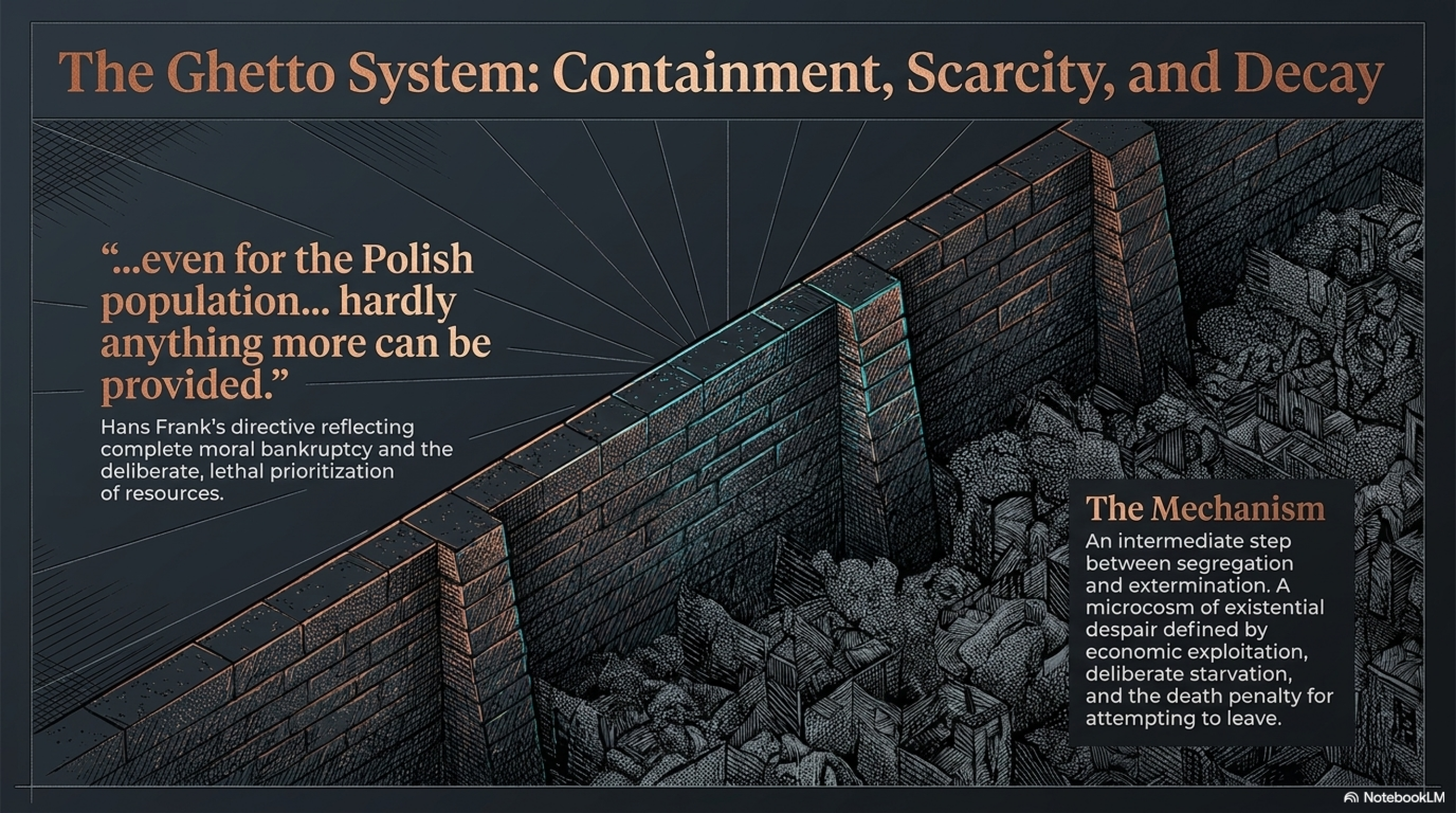
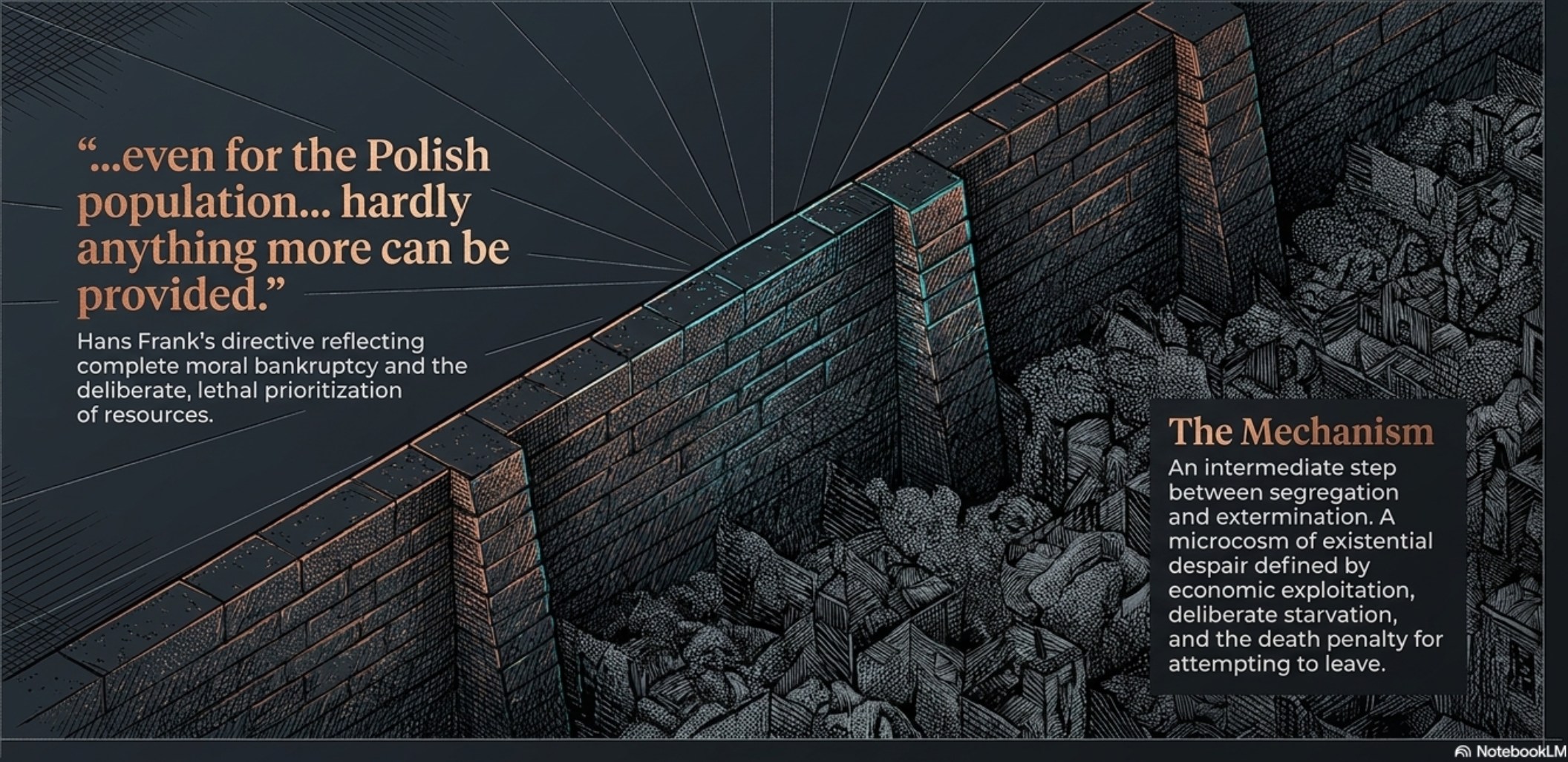
As the Holocaust progressed, violence was normalized through the language of administration. This was most visible in the Warsaw Ghetto, where officials cited “logistical constraints” and food shortages to justify mass death. Hans Frank, the Governor-General, famously prioritized resources away from the Jews, stating:
“even for the Polish population… hardly anything more can be provided.” [Ch. 34]
This was a deliberate prioritization that framed starvation as an unavoidable economic fact. However, this administrative mask eventually slipped, revealing the “religious-like” mission of the regime. The chilling resolve found in Chapter 36—“we must destroy the Jews, wherever we encounter them”—represents the moment where the “Final Solution” moved from an administrative problem to be solved to a sacred duty to be performed. This shift from the mundane management of resources to a mission of existential purification is a crucial pedagogical point: it explains how the bureaucratization of death allowed individuals to maintain their self-image as “managers” while committing the ultimate crime.
7. Conclusion: The Burden of Historical Memory
Christopher R. Browning’s investigation reveals a sobering truth: the Holocaust was the result of a series of “contingent decisions” rather than an inevitable march from 1933. His work challenges the comforting narrative of a “singular, premeditated event” executed by a few madmen. Instead, we see the far more frightening reality of how a modern state, fueled by ideological fervor and bureaucratic ambition, can drift into genocide through the mundane actions of ordinary people.
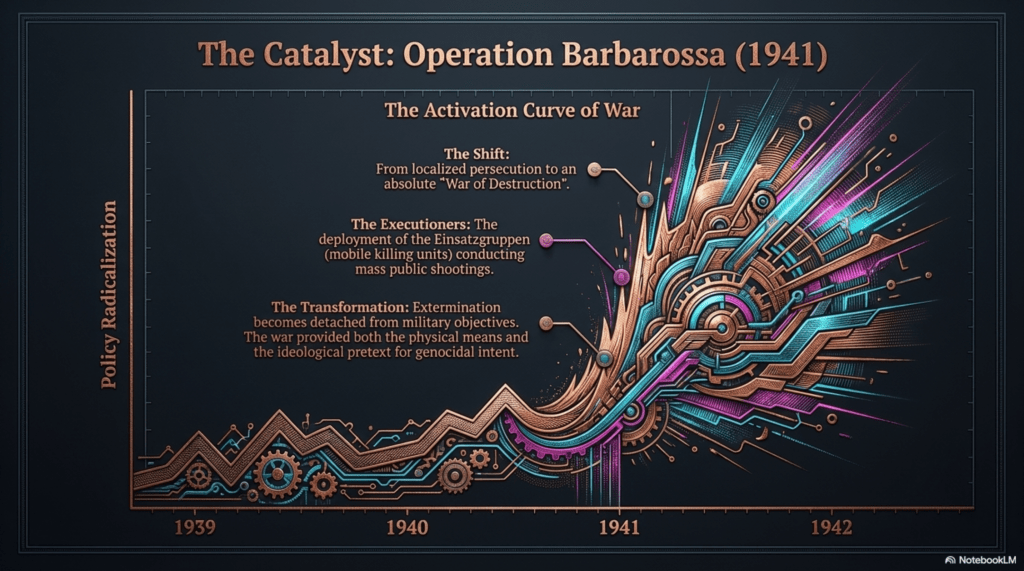
This nuanced understanding is vital for contemporary students. It highlights the “moral decay” that occurs when individuals view themselves as mere managers of resources, stripped of ethical responsibility. The Holocaust proves that extraordinary crimes do not require extraordinary people; they require ordinary bureaucratic structures that have been hollowed of moral constraints. We are left with a moral imperative: to recognize the capacity for administrative systems to facilitate mass murder and to resist the modern mechanisms of dehumanization before they reach their own lethal conclusions.
About The Author