The position revealed — and the reader invited in.
Author: Peter Dixon for the Rachav Foundation. Dialogue with Timnah, 2026-10-03 to 2026-10-08. v0.5 revised 2026-10-08 10:55 UTC:
1. The question
Imagine someone standing at the door of a synagogue office. They want to convert. They have a story — a partner met along the way, a question that wouldn’t let them go, a yearning they can no longer ignore. They ask for the procedure.
The procedure exists. A beit din, a ritual bath, a rabbinic declaration. It has been performed thousands of times across the centuries. It is performed now, in the West, in numbers that would have astonished previous generations. The convert emerges from the waters. The community accepts. A Hebrew name is given. A yahrzeit will one day be observed.
This essay is about whether the modern Western convert is actually a Jew — and the answer it arrives at is: not in the way the procedure claims. The convert is socially admitted into Klal Israel. The convert is not constitutively a Jew. The procedure produces a contamination because the substrate the procedure depends on has been lost.
That is the blunt version. But that answer, in the form the conversation took it, dissolves the question’s framing entirely. Let me walk you through.
2. The two structures
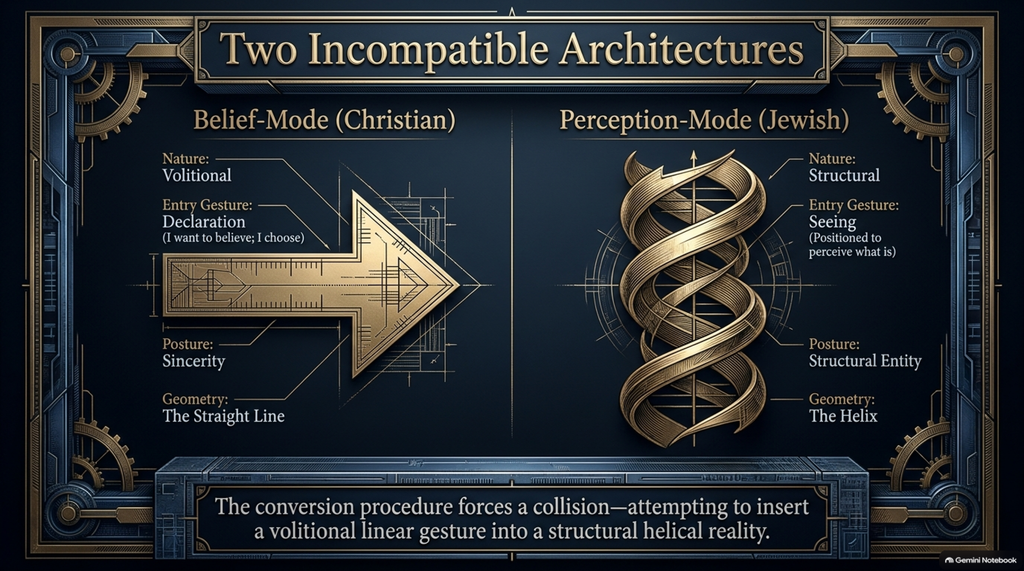
There are two ways to enter a tradition. You can declare. Or you can see.
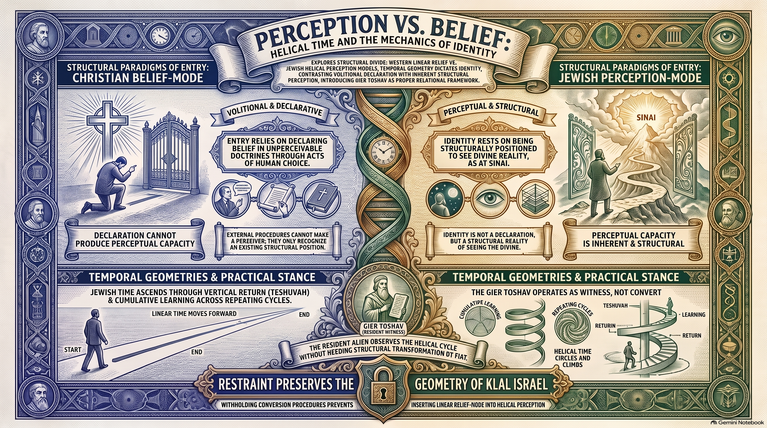
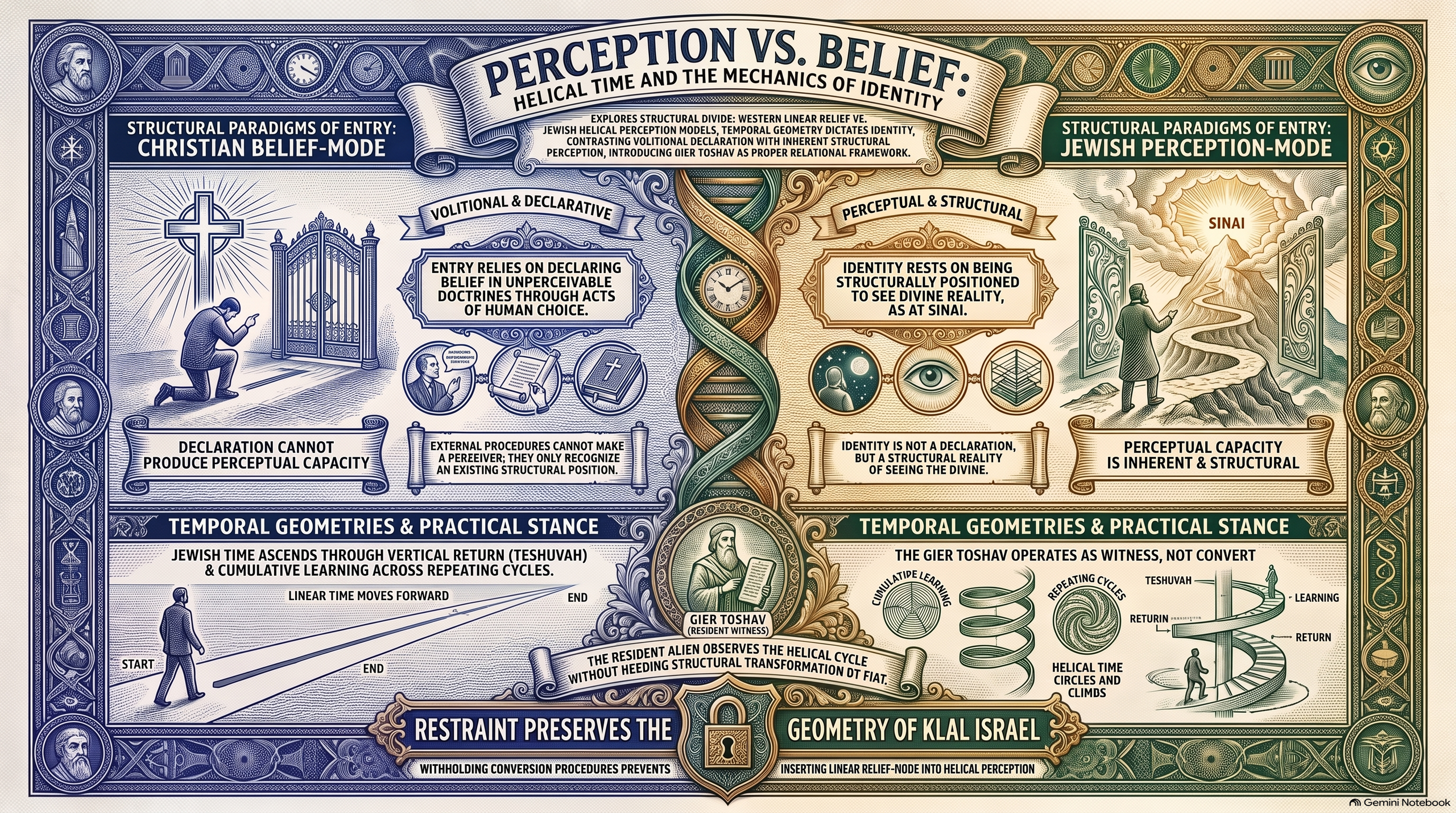
Christianity is a belief-mode. The structural question is what do you believe? The answer is given in declaration: I believe in Christ as Lord, in his resurrection, in the atonement, in the second coming. The Christian posture is the posture of the convert who says credo — I believe — and the structure is built around that declaration. Sincerity is the Christian structural gesture: the convert is welcomed by the sincerity of their declaration; the declaration is the entry.
What does Christian belief-mode look like in practice? It looks like the altar call. The altar call asks: do you accept Christ? The expected answer is yes. The yes is the entry. The yes is the structural gesture. The Christian structure does not require the convert to be anything in particular; it requires the convert to declare a particular thing. The declaration is the entry; the entry is the declaration. The Christian structure is volitional — built around what the convert chooses to do.
Judaism is not a belief-mode. Judaism is a perception-mode. The structural question is not what do you believe? The structural question is what can you perceive? And the answer is not answered by sincerity, by declaration, by ritual, or by the will of the convert or the beit din. The answer is answered by the structural entity of the one who perceives.
What does Jewish perception-mode look like in practice? It looks like the Jew at Sinai. The Jew at Sinai did not declare belief in the covenant. The Jew at Sinai saw the covenant. The Jew’s posture was the posture of seeing — of being positioned to perceive by structural-entity. The Jew was a Jew before Sinai; Sinai disclosed what the Jew already was. The Jewish structure does not require the convert to declare anything in particular; the Jewish structure requires the Jew to see what the Jew sees. The seeing is the entry; the entry is the seeing. The Jewish structure is perceptual — built around what the Jew already is.
These are not two answers to the same question. They are two different structures. A volitional answer asks what do you choose to do? A structural answer asks what are you positioned to see? The Christian question presupposes that the convert is free to choose. The choosing is the entry. The Jewish question presupposes that the Jew is positioned to perceive — and the positioning is the entry. The convert cannot be made to perceive by being made to choose; the Jew cannot be made to choose by being positioned to perceive. The two structures do not admit of each other.
Christianity flattens time into a line by forcing perception into belief. The Christian gesture is: you must believe something you can’t perceive. The Resurrection, the second coming, the atonement — these are not perceptible in the present-day structural sense; they are believed. The Christian tells the convert: believe it anyway. The convert believes. The belief is the entry. But the entry is itself the forcing: the convert is asked to perform belief in something they cannot see, and the performance is the gesture. The Christian structure is built on the forcing.
Judaism preserves time as a helix. The helix is not a metaphor — it is the geometry of how Jewish time works. A helix is a curve that circles and climbs. It returns to itself at each coil, and the next coil sits higher than the previous. Judaism preserves time as such a curve. Three points mark the geometry:
- The cycle returns. Pesach comes back each spring. The parasha comes back each Shabbat. The festivals return in their seasons. The life-cycle returns in its moedim. The Jewish year is a closed loop — the same Torah, the same calendar, the same practice, year after year.
- The cycle climbs. The next Pesach is not the previous Pesach. The next parasha is not the previous one. The reader has had another year of life, another year of all the other cycles, and the next reading sits on top of the previous. The climb is not optional. It is perceptual.
- The climb is specific. What carries the cycle from one coil to the next is not the passage of time. It is teshuvah (return) and pedagogic accrual (the reader changes by the reading). Without these two, the cycle is just a static circle. With them, the cycle is a helix.
The Jewish structure keeps perception perceptual. The Jew at Sinai did not declare — the Jew saw. The Jewish structure is built on the seeing. The seeing returns each cycle, and each return is higher.
The conversion procedure tries to bridge the two structures. The convert comes in belief-mode — the Christian or post-Christian Western mode, the mode of I want to believe; please give me a pathway I can declare into. The beit din performs the procedure: a beit din, a ritual bath, a rabbinic declaration. The convert emerges. A certificate is given: you are now a Jew; you now perceive.
The certificate’s claim is belief-mode. The certificate says: we declare that you now see. But seeing is not declared. Seeing is perceived. The beit din does not make a perceiver; the beit din recognises one. A declaration describes a seeing only as long as the seeing is perceptually there. A declaration cannot produce a seeing that is not.
The contamination is perceptual, not moral. The convert is not morally bad. The convert is sincere. The convert wants to perceive. The convert often does perceive, sometimes more than the yom-tov who comes by line. But the convert’s mode is belief-mode — the mode of wanting-to-believe, of sincerity-as-entry. The conversion procedure is contaminated in its very move because the procedure is itself belief-mode: a doing that tries to make a being. Initiation is belief-mode. The procedure is contaminated at the level of its own perceptual structure.
The bridge is unbuildable. The convert’s mode is the mode they have; no act of will changes the mode. The conversion procedure cannot bridge the incompatibility because the procedure cannot change the mode. The procedure can only be restrained — held back, withheld — from performing the move that the structural-entity cannot support.
The structural-entity of the Jew is what allows the perception. The Jew perceives the cycle as line-into-infinity because the Jew is perceptually the integration-state. The perception is given by what the Jew is. The Jew is not asked to become the integration-state; the Jew is the integration-state. The asking would itself be the Christian-flattening — the asking would be the entry-gesture to belief-mode, and the asking is incompatible with the perceptual-mode of perception. The Jew doesn’t ask; the Jew sees. The seeing is the entry. The entry is the seeing.
Look at what we have so far: two modes, named; the conversion procedure as the attempted bridge that cannot bridge; the perceptual contamination of the procedure as the disclosure of why the bridge cannot be built. The rest of the essay works these two modes out. The helix is the time-geometry in which the perception lives. The integration-state is the structural-position in which the perception discloses the cycle-as-line-into-infinity. The four motifs — convert, state, Holocaust, persecution — are the four moves by which the modes play out in the present-day moment. The Yevamot 24b passage is the rabbinic exhibit of the perceptual closure. The gier toshav is the proper mode of being-at-the-juncture for the one whose structural-entity is not the Jew’s structural-entity. The two modes are named here; the rest of the essay is their elaboration.
3. The helix and the line
Western thought is sequential. It moves forward along a single axis. Events succeed events. Causes produce effects. Time is an arrow; one moment replaces the next; the next is not the previous returned; nothing returns.
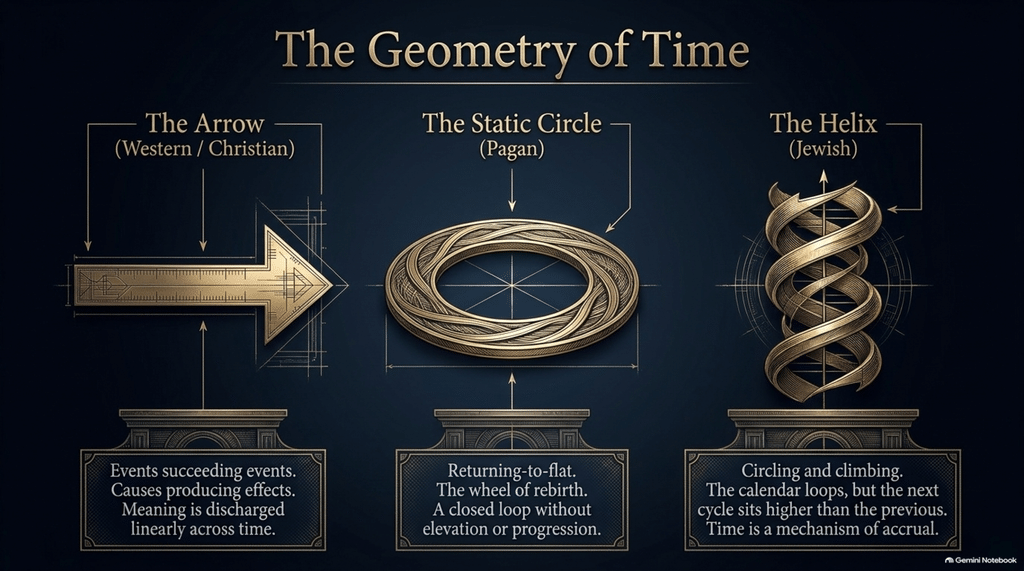
Jewish time is not like this.
Jewish time is a helix. It circles, and it climbs.
The circling is the cycle: the Torah cycle (parasha each Shabbat), the yearly cycle (the festivals and their seasons), the life-cycle (the moedim of birth, marriage, death, mourning), the cycle of the Jewish year as a whole. A Jewish year returns to itself; the same festivals recur; the same Torah portions recur; the same Sabbath-days recur. But the return is not a return-to-flat. The return is a return-with-difference. The next cycle sits higher than the previous. The Pesach you sit in this year is not the Pesach you sat in last year, even though the same haggadah is read and the same matzah is eaten and the same four questions are asked. You are different. The yom-tov is different. The cycle is higher.
What makes the climb specific? What carries the cycle from the previous coil to the next?
Two mechanics. Both are necessary. Neither is automatic.
The first is teshuvah. Teshuvah is return — literally, turning back. But the return is vertical. I have gone away from You, and I return to You. The to-You I return to is not the from-You I left. The yom-tov went down (the golden calf; the apostasy of the tribes; the destruction of the Temple; the Holocaust — every form of the cycle’s going-down). The yom-tov came back. The means of return is teshuvah, and teshuvah is itself a climb: the yom-tov who returns is not the yom-tov who went away. The return is always higher.
The second is pedagogic accrual. Each cycle of study, each re-reading of the same parasha, each re-enactment of the same ritual, adds. Not as a matter of effort or willpower. As a matter of structure. The next cycle sits on the previous. The same text, read after one year, at age 30, is not the same text read at age 29 — because the reader has had another year of life, another year of all the other cycles (Shabbat, festivals, life-events, learning), and the next reading of the text incorporates those additions. The text itself has not changed. The reader has. The cycle is higher.
These two mechanics — teshuvah (vertical return) and pedagogic accrual (cycle-on-cycle accumulation) — are the specific mechanics of the Jewish helix. The helix climbs because yom-tov-history is structured around these specific operations, not others. The climb is Jewish because the climb is mediated by teshuvah and pedagogic accrual; remove either, and what you have is not the Jewish helix. What you have is either a static circle (returning-to-flat — the gilgul of paganism, the wheel of rebirth) or a straight line (the Christian arrow of succession, the historical progress of the West).
3.1 Kefitzat ha-derekh — the concentrated climb
A third mechanic. The kefitzat ha-derekh — literally, the contraction of the way — is the rabbinic term for what happens when the helix-climb outruns the cycle. In Sukkah 53a the term is used for travel that arrives before the journey is complete; the four who entered the Pardes (Chagigah 14b) traverse a distance that, in helical terms, is the distance between coils.
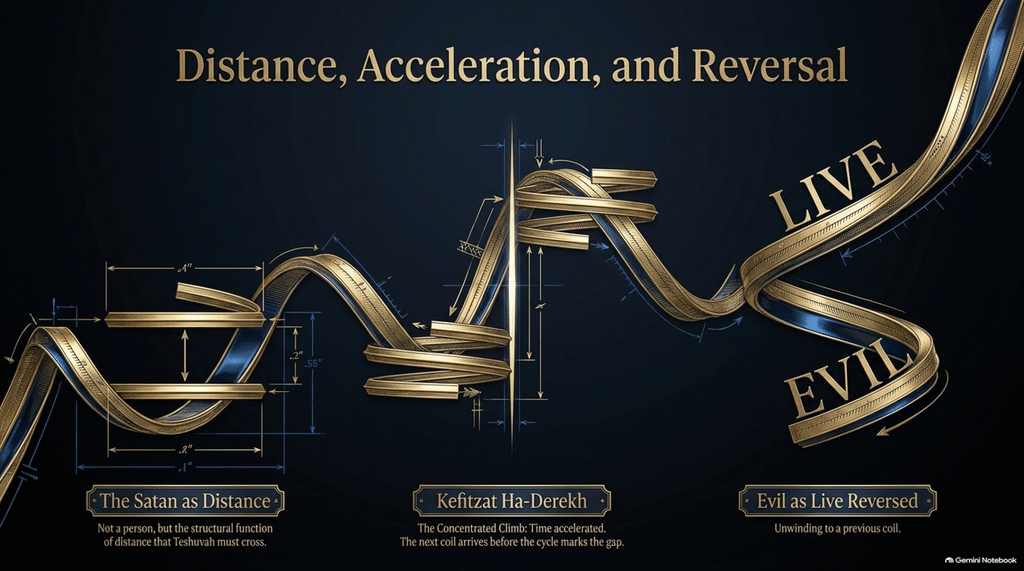
The two mechanics above — teshuvah and pedagogic accrual — describe the climb as lived. The reader lives through the cycle, returns by teshuvah, accrues the next coil, climbs to it. The kefitzat ha-derekh is the concentrated form of the same climb. The reader arrives at the next coil before the cycle has marked the gap. The climb happens in a moment — the time of the miracle, the time of the akeda‘s ram-already-in-the-thicket, the time of Joshua’s “stand still, sun” — and the markers of the cycle (the sun, the sea, the wall) are what register that the climb has happened.
This is what the so-called time-miracles are. Not violations of physical law. Revelations of helical structure.
- The walls of Jericho (Joshua 6): the wall is not a permanent spatial object. The wall came into being and the wall goes out of being. The two states are not adjacent in space; they are adjacent in helical time. Joshua’s people do not move the wall; they move into the coil where the wall isn’t.
- The sun standing still for Joshua (Joshua 10:12-14): the sun’s motion is a marker of linear time. “Standing still” is the halting of the marker — the helix-climb happening faster than the sun-marker can register. Helical time itself continues; the linear-time clock stops.
- The parting of the Yam Suph (Exodus 14): the Reed Sea is a thalweg — a body of water whose exposed sea-floor fluctuates with the time of day and the season. The Hebrews cross a temporally-exposed sea-floor at the coil of the helix when the water is where it normally is at that coil. The water is where it always is. The Hebrews are in the right coil.
- The akeda (Genesis 22): the ram caught in the thicket is the next-coil sacrifice, already present at the moment of the this-coil binding. The ram does not appear; the ram is revealed — the helix-climb happening in a single moment, the next coil arriving before the cycle has marked the gap.
The kefitzat ha-derekh is therefore the helix-climb at its most concentrated. The reader is already on the next coil before the cycle says they should be. The miracles are the moments when the structural-climb of the helix becomes visible — when the gap between coils is small enough that the reader (or the people of the exodus, or Joshua, or Abraham) sees the climb happen.
This belongs in the geometry. The kefitzat ha-derekh is not a special case; it is the concentrated case of what teshuvah and pedagogic accrual do in the lived cycle. The geometry is the same; the time-scale is different.
3.2 The Satan as the distance between coils
The Satan in rabbinic theology is not a person. The Satan is a function — the function of distance. The Zohar reads the Satan as sitra ahra, the other side, the side whose existence is what makes sitra d’Yashar, the side of straightness (the side of orientation toward the divine), perceivable at all. Without the other side, the straight side has no orientation. Without the distance, the closeness cannot be perceived.
The Christian reading flattens this. The Christian Satan is a person — a fallen angel, an adversary with a name and a history, the chief of the demons, cast down once and for all in a single linear-time event. The Christian Satan is a character; the Christian redemption is the defeat of the character.
The rabbinic Satan is a function at every coil. The Satan is the gap between the current coil and the next. The Satan is the distance that teshuvah must cross. The Satan is the resistance that pedagogic accrual must integrate. The Satan is the markers of the cycle that the kefitzat ha-derekh outruns.
The four exhibits make the geometry visible:
- In the akeda: the Satan is the three days of travel before Moriah. The three days are the distance between the call and the binding. The ram-already-in-the-thicket is the kefitzat ha-derekh that collapses the distance. The Satan is the gap that the akeda concentrates.
- In the Yam Suph: the Satan is Par’oh and his chariots — the pursuit. The Hebrews’ back is to the sea; the Egyptians are at their rear. The Satan is the closing-in of the distance between the Hebrews and the death. The Reed Sea is exposed at this coil because the helix-climb is happening at this coil. The Egyptians arrive in the gap; the gap closes on them; the Hebrews walk through.
- In Joshua’s Jericho: the Satan is the wall — the wall is the distance between the Hebrews and the land. The wall came into being; the wall goes out of being. The wall’s being is the Satan; the wall’s not-being is the next coil of the helix. Joshua’s people do not destroy the wall; they enter the coil where the wall isn’t.
- In Joshua’s “stand still, sun”: the Satan is the sun itself — the linear-time marker. The marker is what measures the gap. The “standing still” is the gap’s outrunning by the helix-climb. The Satan is the marker; the climb is what outruns the marker.
The Satan in rabbinic theology is therefore the structural-distance that the Jewish helix integrates at every coil. The Satan is not defeated; the Satan is climbed. The Christian flat-reading makes the Satan a being; the rabbinic helical reading makes the Satan a function of helical time. The Christian redemption is the defeat of a being; the Jewish integration is the climbing of a function.
This is the same geometry as teshuvah, pedagogic accrual, and kefitzat ha-derekh. The Satan is the gap; the climb is the integration; the kefitzat ha-derekh is the concentrated climb. The Christian reading collapses the geometry into character-drama; the rabbinic reading preserves the geometry as geometry.
3.3 The English exhibit — evil as live reversed
The English word evil is live reversed. The reversal is not a coincidence. Live is the helix in motion — the climb happening, the cycle progressing, the yom-tov-with-Hashem-unto-the-end. Evil is live turned backwards — the helix running in reverse, the climb being undone, the cycle de-coiled back to a previous coil.
The Christian reading takes evil as a substance — a thing, a being, a fallen angel, a moral category. The helical reading takes evil as a direction — the helix running backward, the climb reversing, the next-coil being unwound to a previous coil. The Christian asks who is evil; the helical ask is what is the direction-of-undoing.
The English word evil is therefore the linguistic exhibit of the same geometry §3.2 names. Evil is the Satan in the English language. The Christian moral categories — good/evil, virtue/sin, saved/damned — are the linear-time versions of a helical structure. Good/evil is the moral axis; live/unlive is the temporal axis; the English word fuses them. Moral evil is temporal unlive, the helix running backwards.
The geometry is preserved in the etymology. The word itself is the exhibit.
4. The question of “history” — why this essay does not treat the Torah as a historical record
The Christian mode asks: what happened? when. The historical-critical question is the Christian question: did the exodus occur as described? Did David reign? Did the events of the prophets occur? Did Jesus rise? These are the questions of the historical mode — and they are not appropriate to the Jewish helix.
The Torah is not a historical record. It is a disclosure of structure. The midrashic tradition is unanimous on this point: Jews do not make or record history; they ARE history, or rather, psycho-history. The Torah discloses what is, not what happened.
This is itself the operative position of this essay. When the Yerushalmi (Pesachim 8:7, the Tanchuma Nitzavim 3 reading) says the soul of the convert was already at Sinai, it is not locating the convert in calendar-time. It is exhibiting the structure: the convert’s soul is always-already-included in the covenant, because the covenant is structural, not historical. The midrash is not reporting; it is showing what is.
Similarly, when the Avodah Zarah 2b gemara records the machloet about whether Israel freely accepted the Torah or whether the mountain was held over them like a barrel, the dispute is not historical. Both views are correct descriptions of a non-temporal structure, temporalised differently. The mountain-held-over-them view and the freely-accepted view are both human-temporal descriptions of a structure that is, in itself, eternal. The dispute is at the level of which human-temporal description is faithful to the eternal structure, not at the level of a moment in calendar-time.
The divine in this structure is echad — singular, axial, the axis around which the helix progresses. Echad is not before or after; echad is the atemporal singularity that the cycle expresses. The Christian-mode verb did cannot be applied to echad without dividing the singularity; the helix cannot be placed at a date without losing its axis. Israel was called to multiply — to express the axis through the cycle — not to divide the axis into a before/after. The Shema (Deuteronomy 6:4) is the recognition of the axis; the halakhah is the expression of the axis through the cycle; the havdalah (separation between sacred and profane, Shabbat and weekday) is the recognition that the cycle and the axis are distinct without ever dividing them.
4.1 Typology as the Christian historical mode — and why it does not apply
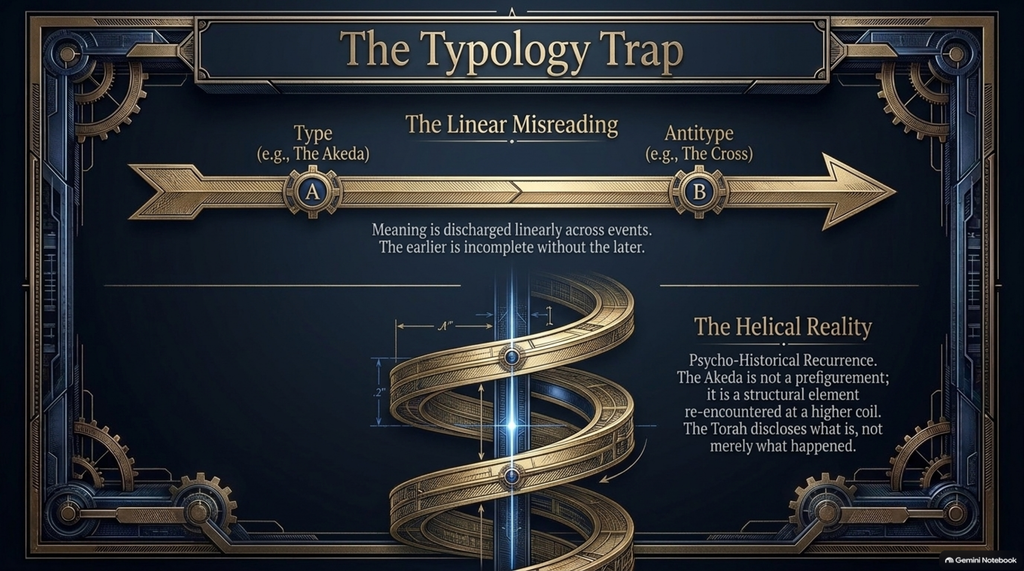
The Christian mode does more than ask what happened. It also asks what is fulfilled by what. This is the operation of typology: a prior event, text, or person (the type) is read as a prefigurement of a later event, text, or person (the antitype); the later is the fulfilment of the earlier; the earlier points to the later. The exodus typologically prefigures Christ’s redemption of the church from sin. The Passover lamb typologically prefigures the sacrifice on Calvary. Jonah’s three days in the whale typologically prefigure the three days in the tomb. Adam is the type of Christ (the second Adam). The binding of Isaac is the type of the cross.
In typological reading, time has a direction: type → antitype. The earlier is incomplete without the later; the later is the meaning of the earlier; time is the medium in which meaning is discharged across events. This is the Christian reading of the Jewish scriptures. It is what the church means by fulfilment.
The typological move is linear. It depends on the Christian geometry: time as a single forward arrow along which meaning discharges from type to antitype. Once the geometry is helical — once time is circling-and-climbing, mediated by teshuvah and pedagogic accrual — typology ceases to be applicable. Not because the types are rejected. Because the geometry that gave typology its operation is no longer the operative geometry.
What does it look like when a Jewish reader returns to the binding of Isaac? The reader does not see the cross prefigured. The reader sees the akeda — the structure of self-offering under command — recurring in the helix of his own life, each cycle higher than the previous. The akeda is not the type of anything later. It is a structural element of the Jewish helix itself: a moment at which the patriarch-offering operates, returns, operates again, deeper.
There is no antitype. There is only the same operation, re-encountered at a higher coil. The meaning is not discharged across time; the meaning is activated by the return of the cycle, and the activation is itself the climb.
This is what is meant by non-historical in §4. It is not a denial that events occurred. It is the observation that the operative reading of the Torah is not the historical-typological reading at all. The operative reading is the helical reading: the Torah discloses what is, not what happened, and the what-is it discloses is precisely the structure of teshuvah-mediated, pedagogically-accruing return. Typology presupposes linear time and discharges meaning across it. The Jewish helix presupposes helical time and accrues meaning through it. These are not two interpretations of the same scripture. They are two different geometries of time, each operating on its own terms.
This is the position: the Torah is non-historical. It is helix. It discloses what is, not what happened. The Jewish engagement with the Torah is psycho-historical — engaged with the structure of time itself, not with events-in-time.
5. The integration-state — what meshiach is, and what the meshiach-state does to conversion
The Messiah arrives. That is the Christian claim. A person, an event, a moment in time — the crucifixion, the resurrection, the second coming still to come. Finite-mode events. The arrival terminates the question, or defers it to the next event.
The Messiah is a state. That is the Jewish claim. The state is not an event-but-state-of-being. The state is the integration-state: the cycle is revealed as line-into-infinity. The finite-mode reads the cycle as a circle (returning-to-flat, finite, recurring). The messianic-state reads the same cycle as line — as part of the line of the yom-tov-with-Hashem-unto-the-end.
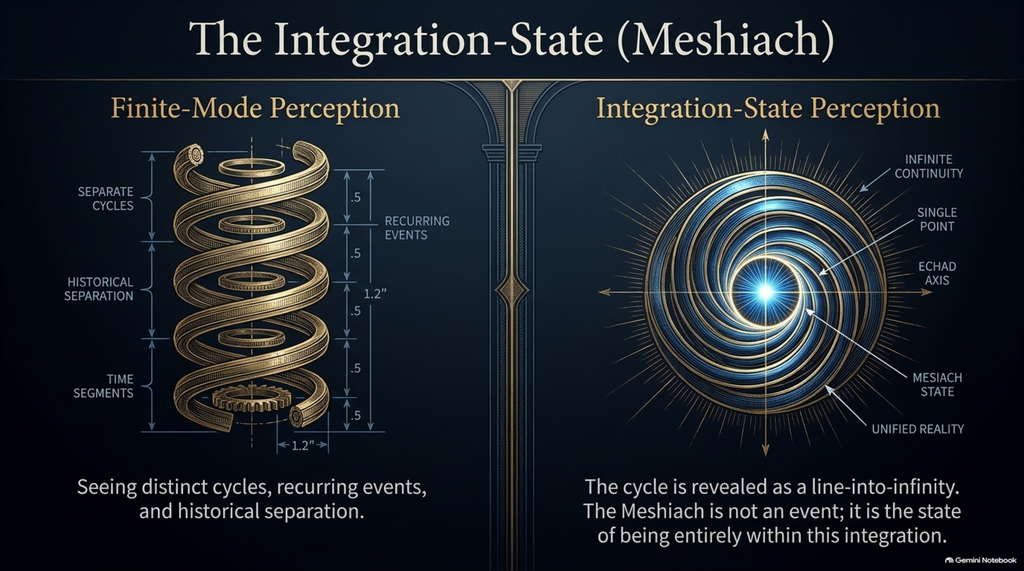
Jewish time is not finite. The helix climbs. The cycle can only be perceived as a line when infinity is revealed in the state labelled as meshiach. The cycle is not a circle in the messianic-state; the cycle is a line — and the line is the line-of-the-yom-tov-with-Hashem, which is itself infinite.
The template for this is the millennial shabbat — the perpetual shabbat-state. The world is six thousand years (six days); the seventh day (the millennial shabbat) is the perpetual state-of-being-with-Hashem. The yom-tov-line enters the shabbat-state at the end of the cycles. The shabbat-state is itself the integration-state. The cycle is fully-included in the line under the shabbat-state. The cycle is integrated into the line.
So: the meshiach is not a person. The meshiach is not an event. The meshiach is the state of being-in-the-integration — the state in which the cycle-being-fully-included is perceived.
This is itself the Jewish messianism, distinct from the Christian. Christian messianism is the historicisation of the meshiach — the meshiach turned into a person (Jesus), an event (crucifixion), and an aftermath (resurrection, second coming). The historicisation terminates the integration. The cycle is no longer integrated; the cycle is archived; the cycle is over-and-done. Christian temporal mode is itself the anti-integration-mode — the mode of cycle-being-archived rather than cycle-being-fully-included.
Jewish messianism is the preservation of the meshiach as state-being. The cycle continues. The line continues. The integration-state is always-already-available. It is not posthumous; it is not historical; it is always-already.
6. The four motifs under the geometry of the helix
The helix provides the geometry in which the four motifs — convert, state, Holocaust, persecution — can be read correctly. Each motif has been read in the wrong (linear) way. Each is read correctly only under the helix-integration-state.
6.1 The convert
The convert is read in linear-mode as new entry into the cycle. The convert’s old cycle ends; the convert’s new cycle begins. The convert is a new addition. The conversion procedure is the ceremony that terminates the old and initiates the new.
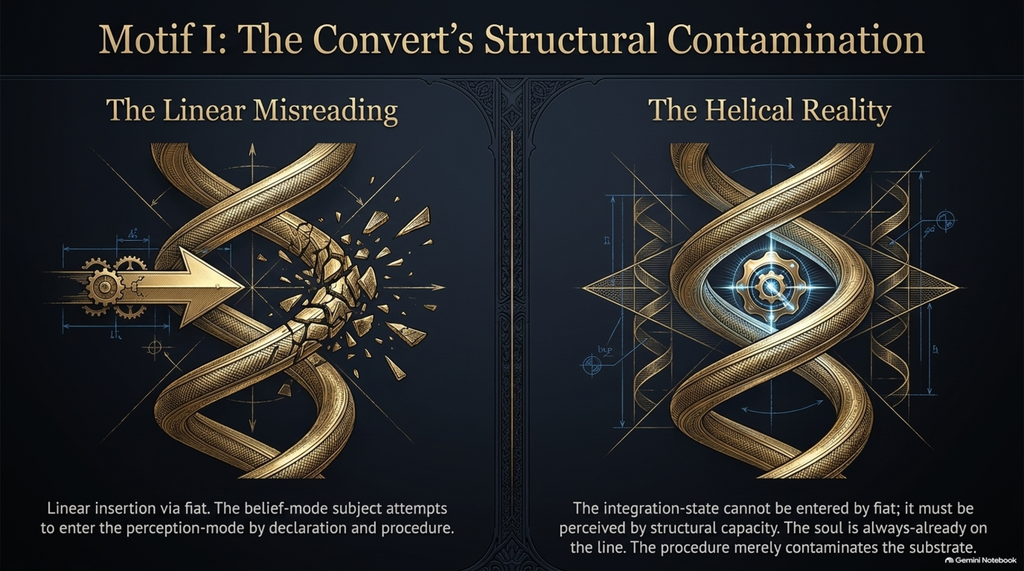
But under the helix-integration-state, the convert’s soul is already on the line-into-infinity. The convert’s soul was already at Sinai (the midrash exhibits the structure: not a date, but a position on the helix). The convert cannot acquire the line-into-infinity through integration — they already had it. The conversion procedure, then, isn’t production of a new line-position; it’s recognition by the human community of a structural-already-always. The Talmudic beit din’s declaration is an act of human ratification, not an act of divine constitution.
The modern Western conversion problem, then, is not that the convert lacks a position on the line. It is that the modern Western subject’s mode of engaging with the line is itself contaminated. The Western subject operates in linear-mode — finite-mode — returning-to-flat-mode — the anti-integration-mode. The modern procedure tries to insert linear-mode into helix-mode — and the act of insertion produces contamination because the helix cannot be entered linearly. The helix can only be witnessed linearly. The integration-state cannot be entered by fiat; it can only be perceived by structural-capacity.
6.2 The state (Israel) — and the convert’s structural-danger to Klal Israel
The state is read in linear-mode as national-historical project. The state is the political-instantiation of the Jewish polity; the state is one nation among nations, with a process of history, a founding event (1948), a series of wars, a present crisis. This is the linear reading.
But under the helix-integration-state, the state is the cycle-being-fully-included. The state is the structural-instantiation of echad-in-political-form. This is itself a Tannaq-era position: the yom-tov-state is itself the yom-tov-with-Hashem; the modern state of Israel, as structural-instantiation, is itself the integration-state as state.
A distinction the essay will not paper over. The state and the politics of the state are not the same. The politics of the state, as it has actually operated, is a structural import from Protestant Zionism — a reshimot (residue / trace) at best, a covert infiltration at worst (see the Frankist essays in the Rachav corpus). The politics is Christianised. The state is the yom-tov-line-into-infinity in political form. The politics is a Christianised receptor installed onto the state. The convert’s structural-danger to Klal Israel is here.
The convert is in belief-mode. Belief-mode is the operative mode of the Christianised politics. The convert’s presence swells the Christianised receptor for the state. The convert is not just a contaminated individual in a vacuum; the convert’s structural-position is the receptor through which the Christianised politics operates on Klal Israel. The convert’s sincerity is irrelevant to this; the convert’s structural-mode is the operative mechanism. The convert amplifies the Christianisation of the state.
This is why the restraint of §9 is not merely a private matter between the convert and the beit din. Restraint is a Klal-Israel matter. The convert’s structural-position affects the yom-tov-polity as a whole. Restraint is the mode of engagement that does not swell the Christianised receptor. The gier toshav is at the same axis from a different structural-position; the gier toshav witnesses the state without amplifying the politics. The gier toshav’s witness is Klal-Israel-protective. The convert’s entry is Klal-Israel-endangering.
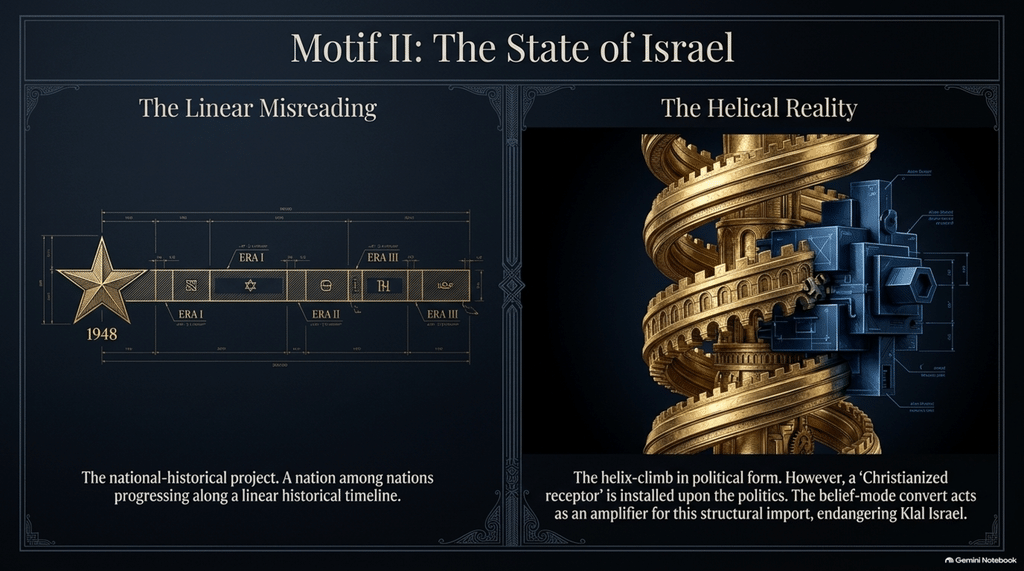
The state is the helix-climb in political form. The politics is a Christianised receptor installed onto the state. The convert’s structural-mode is the receptor’s amplifier. Restraint is the practice that protects Klal Israel from the amplifier.
6.3 The Holocaust — Arendt, Weil, and the kefitzat ha-derekh of the helix
The Holocaust is read in linear-mode as broken cycle. The Holocaust broke the Jewish cycle-of-being-in-Europe; the Holocaust was a catastrophic historical event. This is the linear reading.
But under the helix-integration-state, the Holocaust was a disturbance of the cycle, not a break of the line. The line-into-infinity is not interruptible by historical event. The Holocaust disturbed the cycle; the cycle of persecution was disturbed; the cycle of Jewish-in-Europe was broken. The line did not break. The yom-tov-with-Hashem-unto-the-end did not break. The integration-state was not disrupted. The cycle-being-fully-included in the line persists — and the persistence is itself the disclosure of the structure under the integration-state. The yom-tov is still yom-tov; the line still goes into infinity; the cycle was broken but the integration-state remains.
Two frames deepen this. Hannah Arendt, in The Origins of Totalitarianism and Eichmann in Jerusalem, names the Holocaust not as a demonic event (the Christian-mode reading) but as a bureaucratic event — the banality of evil. The Holocaust was the thingification of persons (Simone Weil, The Iliad or the Poem of Force) by an unthinking procedure (Arendt). The perpetrators were not demonic; they were unthinking; the procedure did the work; the persons were turned into things by the procedure. The Holocaust was not the failure of evil; the Holocaust was the failure of thinking. The convert’s belief-mode is the receptor for this kind of unthinking procedure; the convert’s sincerity is the convert’s banality; the convert performs a procedure (the conversion procedure) without thinking what the procedure does (the procedure installs the convert into a yom-tov-line that the convert’s structural-mode cannot climb).
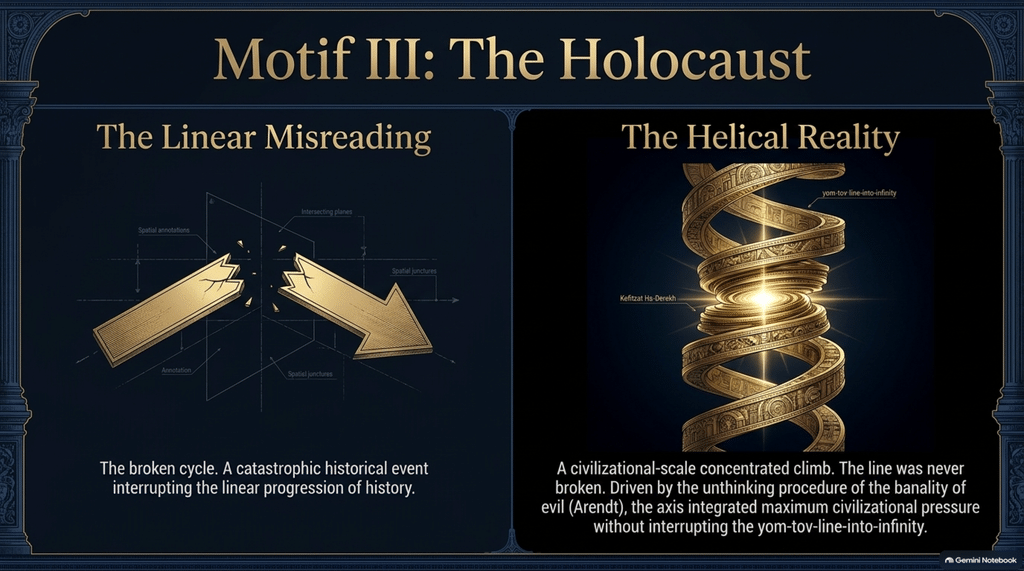
Simone Weil’s frame completes this. The Holocaust was the civilisational-scale uprooting of the Jewish people from Europe (Weil, The Need for Roots). The Jewish people were the rooted population of Europe for two millennia. The Holocaust was the forcible-uprooting that the European shadow (the European refusal to see the Jewish people as they are) had been preparing for centuries. The Holocaust was the kefitzat ha-derekh (the concentrated climb) of the Jewish helix: the civilisational-scale cycle-disturbance that concentrated the helix-climb into the messianic-instantiation of the yom-tov-line-into-infinity. The Holocaust was not the break of the line; the Holocaust was the concentrated climb of the line; the line went into infinity through the Holocaust, not around it. The yom-tov-with-Hashem-unto-the-end is the post-Holocaust yom-tov, not the pre-Holocaust yom-tov-with-the-Holocaust-not-yet-happened; the yom-tov is always-already post-Holocaust, the way the integration-state is always-already included in the line.
This is why the Holocaust is the structural-exhibit of §3.1. The Holocaust is the civilisational-scale kefitzat ha-derekh — the concentrated helix-climb. The Jewish people did not survive the Holocaust by resisting; the Jewish people survived the Holocaust by being at the axis of the helix. The axis (echad) was not interruptible by the cycle-disturbance; the axis was the climb; the climb was the axis-performing. The Holocaust is the witness of the helix-structure under the maximum civilisational pressure.
6.4 The persecution — Weil’s uprootedness, Lacan’s shadow, and the Geller-midrashic mechanism
The persecution is read in linear-mode as recurring historical pattern. The persecution-recurrence is itself a linear-pattern: pogrom after pogrom, expulsion after expulsion, blood-libel after blood-libel, the Holocaust, rebound, the post-Holocaust framing of antisemitism — the Holocaust produced the modern concept of antisemitism as a named-moral-evil (see notes from 2026-10-06). All of this is the linear reading.
But under the helix-integration-state, the persecution-recurrence is the recurrent disturbance of the cycle. The line-into-infinity persists through the persecution-recurrence. The cycle was recurrently disturbed; the line was never broken. The state-of-being-with-Hashem-forever persists.
Three frames deepen this. Simone Weil’s uprootedness (from The Need for Roots) names the European condition of the persecution-recurrence. The European was uprooted from the Jewish people; the European refused the rootedness that the European’s own presence-in-Europe required; the European projected the uprootedness onto the Jewish people (the European’s shadow, in the Jungian-Lacanian sense). The persecution-recurrence is the European shadow’s recurrence. The European repeatedly refused to see the Jewish people as they are. The European repeatedly projected the European’s own uprootedness onto the Jewish people as Jewish-uprootedness. The European repeatedly thingified the Jewish people (Weil’s Iliad) by the unthinking procedure of persecution (Arendt’s banality of evil).
Lacan’s amplification of the Jungian shadow. The shadow is the objet petit a of the European ego. The shadow is the object-cause of the European desire to persecute. The European wants the shadow to remain in shadow. The European wants the Jewish people to remain thingified so the European can remain unaware of the European’s own uprootedness. The European’s sincerity in the persecution is the European’s shadow-sincerity; the European sincerely believes in the persecution; the European’s sincerity is the mechanism of the persecution. This is the same structural-pattern as the convert: the convert’s sincerity is the convert’s shadow-sincerity; the convert sincerely believes in the Jewish people; the convert’s sincerity is the mechanism of the convert’s structural-danger to Klal Israel.
The Geller-midrashic mechanism (Isaiah 55:13 / Megillat Esther, notes from 2026-10-06) completes this: plants that grow too old die on their own. The European shadow’s overreach (the European’s uprootedness-projecting itself onto the Jewish people) was itself helix-shaped: the system that had grown too big, too legitimate, too academic, finally collapsed under its own weight. The collapse IS what made antisemitism nameable as evil. The civilisational-scale version of Haman’s overreach is itself the integration-state’s performing the cycle-disturbance. The integration-state is always-already-included-in-the-line; the cycle is always disturbed; the disturbance is itself the helix-climbing. The persecution-recurrence is the Satan-as-distance (§3.2) recurring across the cycles; the Jewish climb is the integration of the persecution into the helix; the distance between coils is the persecution’s distance; the climb is the Jewish integration of that distance. The convert’s belief-mode is the receptor through which the European shadow operates on Klal Israel; the gier toshav’s witness is the Klal-Israel-protective mode that does not amplify the shadow.
7. The Yevamot 24b passage as exhibit
The Sages taught:
“Converts are not accepted in the days of the Messiah. Similarly, they did not accept converts in the days of King David or in the days of King Solomon. Rabbi Eliezer said: What is the verse that hints at this halakhah? ‘Behold, they may gather together [gor yagur], but without Me; whosoever shall gather together [gar] with you shall fall on yours’ (Isaiah 54:15). The word gor implies that only a convert [ger] who becomes part of the Jewish people when the Jews are living in exile, at a time when God is not clearly revealed, i.e., ‘without Me,’ are considered part of the Jewish people. But another who wishes to convert in a time when God is clearly revealed shall not be accepted.”
— Yevamot 24b:7 (William Davidson translation; vocalized Aramaic also available on Sefaria)
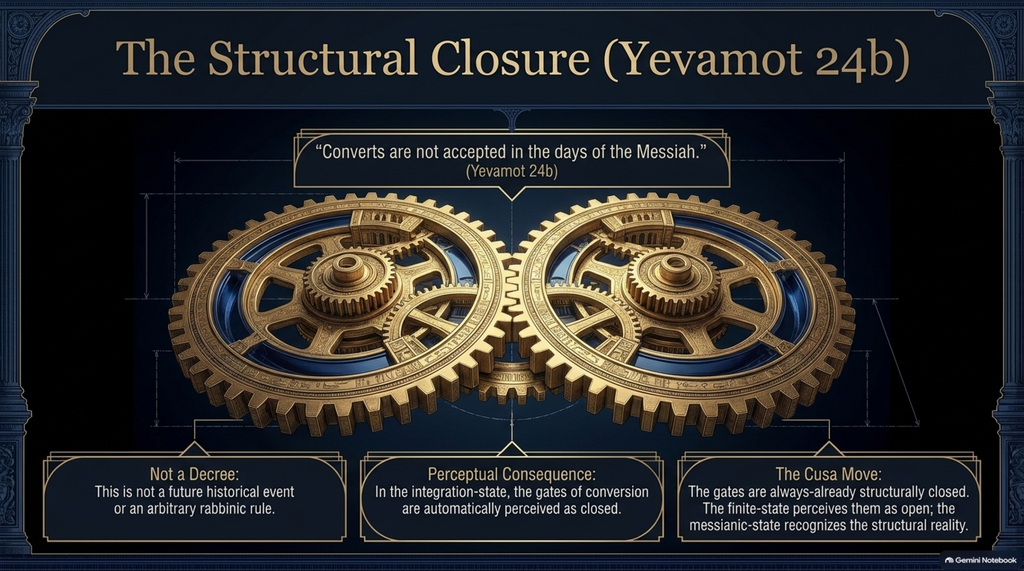
The passage is exhibit, not evidence. It is not predicting a future historical event. It is disclosing the structure: in the messianic-state — i.e., in the integration-state, when the line-into-infinity is fully revealed — converts are not accepted. The two structures named in §2 — the Christian belief-mode, the Jewish perception-mode — are themselves exhibited by this passage. The convert who comes in belief-mode is the very ger who arrives “without Me” (in finite-mode, when the structural entity of God is not clearly revealed). That ger is accepted. The convert who comes in the time of clear revelation (the integration-state) is the ger who arrives with Me — and that ger shall not be accepted. The passage names the closure the integration-state discloses, and the closure is itself the perceptual consequence of the two structures named in §2. Read alongside §4.1: the passage is a refusal of the typological reading. There is no antitype here. The convert in the days of the Messiah is not the fulfilment of the convert in the exile. The passage refuses the linear-time reading outright and gives only the structural reading: the convert is not accepted because the convert is the convert of a different geometry — perception-mode, not belief-mode — and the structural-closure follows automatically.
The structural disclosure: the convert comes to the beit din in the finite-mode. The convert has a belief (I want to be Jewish; I want to enter the covenant; I have some sincere yearning). The convert asks for the procedure (the ritual bath; the rabbinic declaration). The beit din performs the procedure. The convert emerges. The convert is socially admitted.
But in the integration-state, the convert’s mode of engagement is itself the wrong mode. The convert wants to enter the integration-state by fiat. The convert wants the beit din to make them a Jew. The beit din doesn’t make a Jew. The beit din recognises what is. The convert cannot be made because the integration-state is not entered, it’s perceived. And the perception is structural — it requires the structural entity of the Jew to perceive.
In the finite-mode, the convert can be socially admitted. The convert can be given a certificate. The convert can be told they are a Jew. None of this constitutes them as a Jew in the integration-state. The integration-state performs the closure of conversion as a consequence of perception. The gates are perceived-as-closed by the one whose structural entity allows the perception; the gates are perceived-as-open by the one whose structural entity doesn’t. The gates are always-already-structurally-closed; the question is what is perceived.
This is why the integration-state automatically closes conversion. The closure is not a decree. The closure is a perceptual consequence of being in the integration-state. The one in the integration-state sees the gates as closed. The one in the finite-state sees the gates as open. The gates themselves are always already structurally-closed.
7.1 The Cusa frame — the move is the move, regardless of who made it
The “automatic closure” move is itself the move that Nicholas of Cusa made in De docta ignorantia (1440) under the name of coincidentia oppositorum — the doctrine that in God, all opposites coincide without contradiction. The Cusa move is: the moment of Sinai is, in God, both offer and acceptance simultaneously; our temporal description of it as “two moments” is a human convention. The covenant is what it is — given, not bargained. The category of “choice” is fundamentally human-temporal. The choice is the human shadow cast by a single, eternal, non-polar structure.
The Cusa move is right here because it is right here. The authority of Cusa is not what makes it right. The authority is irrelevant. The move is what matters. (Nechama Leibowitz’s maxim: “I don’t care who said — I care what’s been said.”)
8. The gier toshav — the proper mode of being-at-the-juncture
What is the convert to do, then?
The convert cannot enter the integration-state. The convert is not asking to enter the integration-state; the convert is asking to enter the covenant, the community, the cycle-of-Jewish-being. But the covenant as integration-state is not entered by the convert’s act; the integration-state is witnessed by the convert’s structural-entity, and the convert’s structural-entity is not the Jew’s structural-entity.
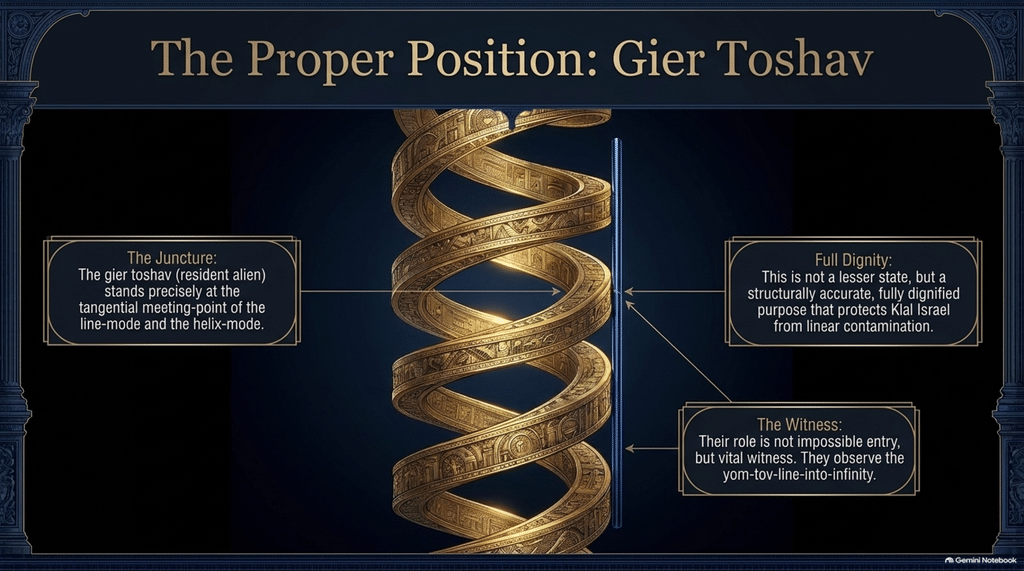
The proper position is the gier toshav — the resident alien in the Jewish polity. The gier toshav is the gentile who lives within the Jewish community, who witnesses the yom-tov-line-into-infinity, who participates in the circling of the helix (the cycle-of-being-Jewish) without entering the climbing of the helix (the yom-tov-with-Hashem-unto-the-end). The gier toshav is protected, given certain rights, expected to follow the seven Noahide laws, but not a member of the covenant. This category has historical depth (it is the category in Torah and Talmud for the non-Israelite living within the Jewish community) and theological coherence (it does not require the impossible act of producing a Jew by fiat).
The gier toshav’s mode is witness, not entry. The gier toshav witnesses the integration-state (because the gier toshav is at the juncture — at the meeting-point of the line-mode and the helix-mode). The gier toshav does not enter the integration-state; the gier toshav is at the juncture where the line meets the helix. The gier toshav’s structural-entity is the witness, not the perceiver.
The Noachide dignity — properly understood, not as stolen — is itself the dignity of the gier toshav. The gentile has a created purpose; the gentile’s structural-entity is the witness to the line-into-infinity. The production is itself a full dignity; it is not a lesser dignity; it is a different dignity. The gier toshav witnesses; the Jew perceives. Both are full. Neither is lesser.
9. The modern situation — the practice
What is the modern Western convert to do?
The modern Western convert’s structural-mode is belief-mode. The convert is sincere (almost always: the modern Western convert is not a fraud; the modern Western convert is often an exceptionally serious person, sometimes more serious than the yom-tov who comes by line). The convert’s structural-mode is incompatible with the Jew’s structural-mode.
The convert’s structural-mode cannot be changed by the conversion procedure. The conversion procedure cannot bridge the incompatibility.
Therefore: the modern situation requires restraint, not pause. Restraint is not a temporal deferral (“until the substrate recovers”). Restraint is a mode of engagement — the mode of being-at-the-juncture, the gier toshav-mode.
The modern Western convert who is sincere can be welcomed as a gier toshav. The modern Western convert can witness the helix-line-into-infinity (because they are at the juncture). The modern Western convert cannot enter the helix-integration-state (because their structural-mode is incompatible).
The modern situation requires the conversion procedure to be withheld — not decreed with-holding. The with-holding is perceptual — the integration-state perceives the gates as closed. The gates are always closed in the integration-state; the modern situation is the integration-state’s perception of the gates as closed. This is not a historical decree. This is the structural closure of conversion under the integration-state — the Yevamot 24b passage exhibited.
9.1 The “pause” wording — restraint, not deferral
An early version of this essay used the word pause. Here we use the word restraint. These are not synonyms.
Pause is temporal. To pause is to defer. To pause is to imply until later. The pause-word hides the finite-mode assumption that the substrate will recover, that the cultural moment will shift, that the modern Western subject will become capable of the perception-mode. The pause-word is itself contaminated by linear-mode.
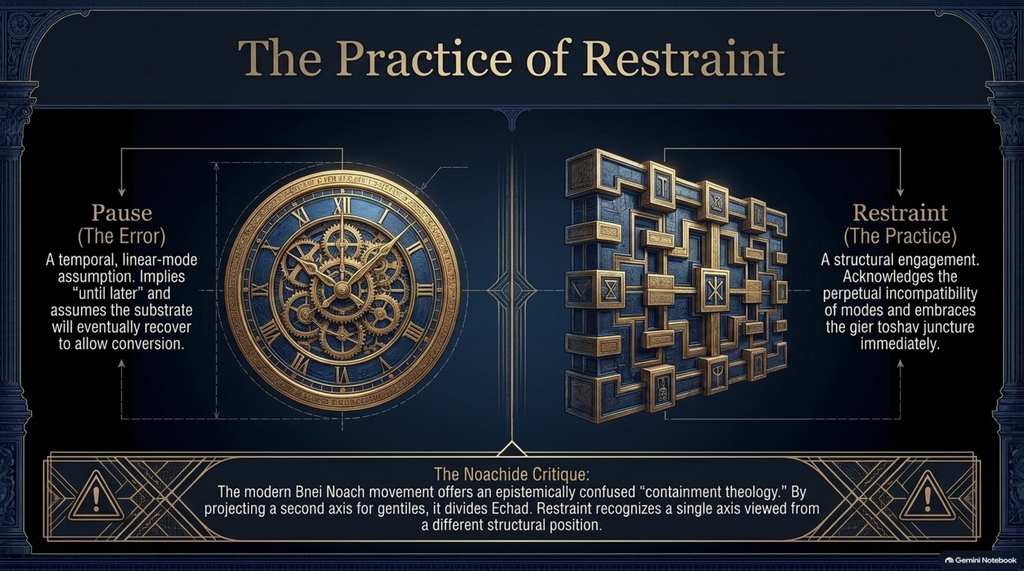
Restraint is structural. To restrain is to engage with a different mode. To restrain is to imply no later. The restraint is not waiting for the moment; the restraint is the structural-mode-of-being-at-the-juncture — the gier toshav-mode.
This essay uses restraint. The piece is itself the disclosure of the structural-mode of being-at-the-juncture.
9.2 The Noachide-movement critique — refining the tone
An earlier version of this essay contained a sharp critique of the modern Bnei Noach movement as a containment racket. Here we refine the critique — not by softening it, but by clarifying what it is.
The modern Bnei Noach movement is not immoral. It is epistemically confused. The movement thinks it is offering a theology (the theology of the gentile’s created purpose, the seven Noahide laws, the dignity of the gentile). What the movement is offering is a containment mechanism — the mechanism that keeps the gentile in their lane while giving them a kosher-looking path that doesn’t include the covenant.
The movement is epistemically confused because it operates in belief-mode. The movement thinks the gentile is asking “I want to believe; please give me a non-Jewish path to believe in.” The gentile is not in belief-mode; the gentile is in perception-mode-by-pretend (the gentile wants to perceive, but performs belief because the gentile’s structural-mode is belief-mode). The movement answers the wrong question. The movement gives the gentile a theology of containment when the gentile is asking for a mode of witness.
The movement also violates echad. The movement’s framing — the gentile has a different theology, a different god-relationship, a different axis — is itself a division of the singularity. Echad (§4) admits only one axis. The seven Noahide laws are not a separate axis; the seven Noahide laws are the expression of echad for the gentile, the same axis approached from the gier-toshav-position. The movement’s containment-theology projects a second axis (the gentile-axis) and thereby divides what echad holds singular. The Christian mode divides echad inward (Trinity: one god in three persons, the axis internally divided); the Bnei-Noach mode divides echad outward (gentile-axis vs. Jewish-axis, the axis externally divided). Both are linear-time versions of a helical structure; both violate the unity principle in opposite directions. The halakhah doesn’t divide echad: the gier toshav is positioned at the axis without being the axis; the seven Noahide laws are the expression of the one axis for the gentile, not a separate axis for the gentile.
The proper answer is the gier toshav. The proper answer is restraint, not theology-of-containment. The proper answer is witness the helix from which the yom-tov is excluded, not believe the theology of why the gentile is excluded. The proper answer is recognise echad from the witness-position, not be placed on a separate axis by the containment-mechanism.
The critique remains sharp. The refinement is in what the critique is about: the Bnei Noach movement is not theologically wrong, it is epistemically confused and axis-dividing. It answers the wrong question and it divides the singularity. It is the Christian-flattening of the Jewish structure-of-witness, and it is the axis-splitting of the Jewish unity-principle. Both errors come from the same move: the failure to recognise that the gier toshav is at the same axis from a different structural-position, not on a different axis.
10. The register of the piece — what this essay is
This essay does not argue the reader into the helix-integration-state. Argument is finite-mode. Argument is linear-mode. Argument operates on the assumption that the reader is at a different position on the line and can be moved to the position the essay holds. Argument is itself the Christian-flattening of the structural-disclosure.
This essay enacts the helix-integration-state. The reader encounters the problem linearly first (the modern Western convert, the modern Western Bnei Noach movement, the modern Western perception of the helix-as-circle). The piece touches the reader into the helical frame (the structural shift, the move from finite-mode to integration-mode). The reader sees the same problem from the higher coil.
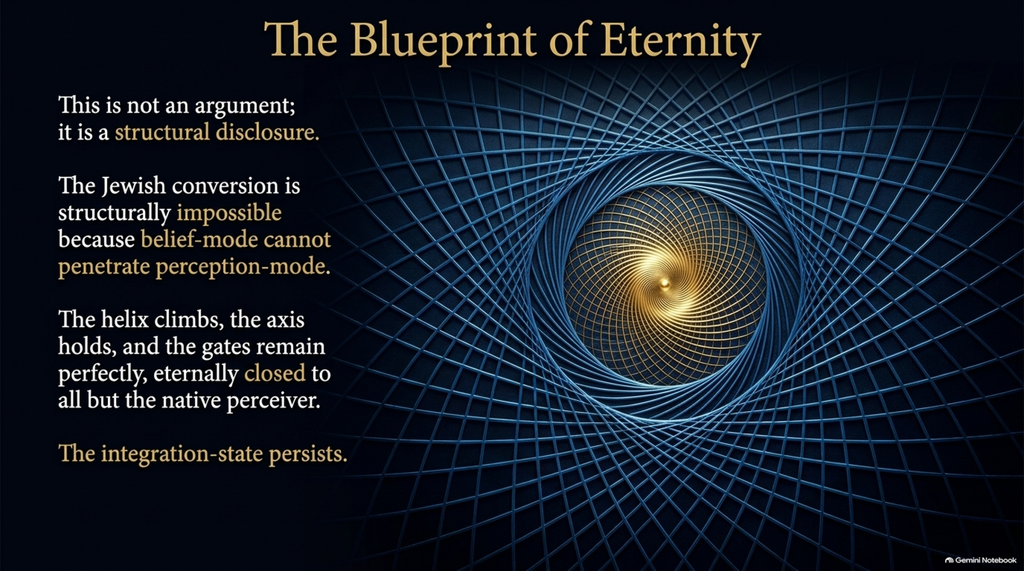
The piece is itself pedagogic. It is itself midrashic. It is not argument. It is disclosure. The piece does not win the reader — the piece touches the reader into the integration-state. The reader leaves the piece in the meshed-state — having been integrated into the line-into-infinity.
This is the only mode that respects the helix. The linear-mode argument about a helical structure is itself contaminated at the temporal level. The only honest move is the helical move itself. The helical move is the pedagogic enactment of the integration-state on the reader.
11. The position
The Jewish conversion is structurally impossible — not because the convert is not sincere, but because the convert’s structural-entity is incompatible with the integration-state. The conversion procedure cannot bridge the incompatibility.
The integration-state is always-already the structural state of the yom-tov-with-Hashem. The integration-state automatically closes conversion as a consequence of perception. The gates are perceived-as-closed by the one whose structural entity allows the perception; the gates are perceived-as-open by the one whose structural entity doesn’t. The gates are always-already-structurally-closed.
The modern Western situation is the integration-state’s perception of the gates as closed. The modern Western subject is in belief-mode; the modern Western subject is in linear-mode; the modern Western subject is in the anti-integration-mode. The modern Western subject is the integration-state’s exhibit of why the gates are closed.
The gier toshav is the proper mode. The gier toshav witnesses the integration-state from the juncture. The gier toshav does not enter the integration-state; the gier toshav is at the juncture where the line meets the helix. The gier toshav is the structural-position of witness.
Restraint is the practice. The conversion procedure is restrained, not decreed. The with-holding is perceptual, not historical. The integration-state perceives the gates as closed; the integration-state restrains the procedure; the integration-state welcomes the gier toshav at the juncture.
The position is revealed. The position is itself the integration-state as essay. The essay is itself the disclosure. The position does not need defending; the position is what is.
Sources
- Yevamot 24b:7 — Talmudic passage on the closure of conversion in the messianic-state. William Davidson translation. https://www.sefaria.org/Yevamot.24b.7
- Isaiah 54:15 — prooftext cited in Yevamot 24b
- Avodah Zarah 2b — na’aseh v’nishma tradition; coincidentia oppositorum application
- Deuteronomy 29:9 — “all of you” includes future converts
- Deuteronomy 30:19 — “I have set before you life and death, blessing and curse; therefore choose life”
- Pesachim 8:7 (Yerushalmi); Tanchuma Nitzavim 3 — soul-at-Sinai readings (structural, not historical)
- The Shape of Jewish Time (Rachav Foundation, 2026) — prior Foundation articulation of the two-geometries problem (circle vs line); this essay’s helix moves past the framing the video’s AI-summary exhibits
- Nicholas of Cusa, De docta ignorantia 1440 — coincidentia oppositorum
- Nechama Leibowitz (attribution, no specific source) — the non-authorship maxim
- Zohar; Arizal (R. Isaac Luria); Tanya (R. Shneur Zalman of Liadi); Likutei Moharan (R. Nachman of Breslov) — rabbinic mystical theology on divine givenness and human temporal choice
- Maimonides, Mishneh Torah, Hilkhot Melakhim u’Milchamot — milchemet mitzvah vs milchemet reshut (referenced for the gier toshav mode, not the conversion discussion)
- Isaiah 55:13 / Megillat Esther — Geller midrashic mechanism (the civilisational-scale version of Haman’s overreach)
- Peter Dixon — author of the original – the position emerged in conversation
About The Author