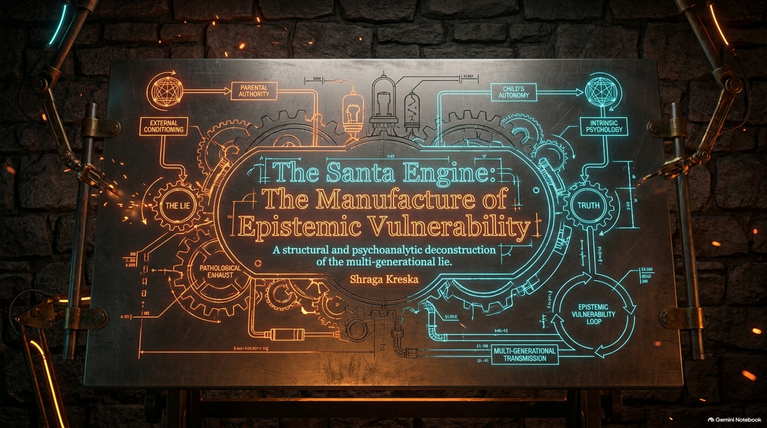
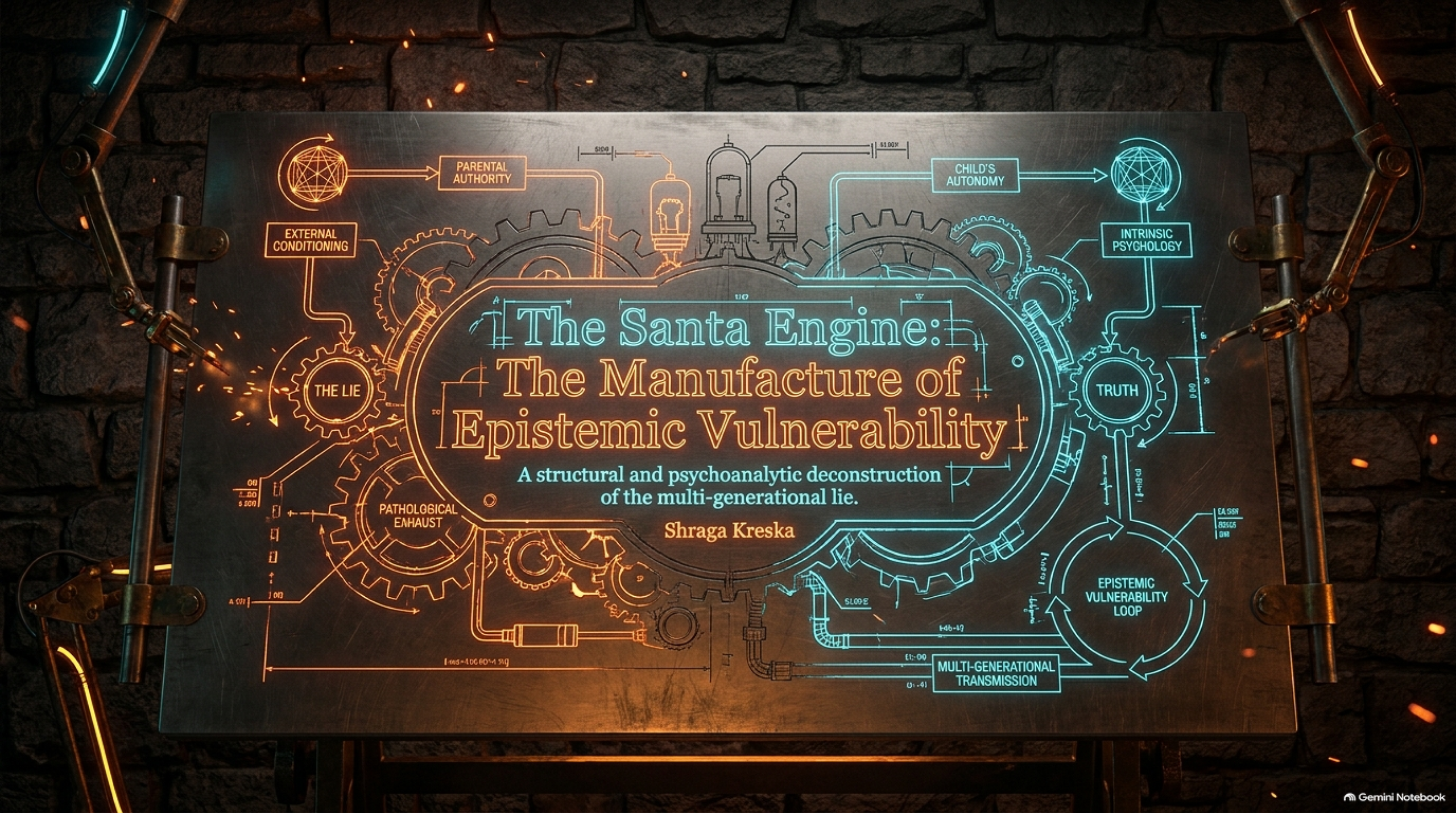
A psychoanalytic and cultural analysis
1. The Setup: A Coordinated Lie from the Most Trusted Source
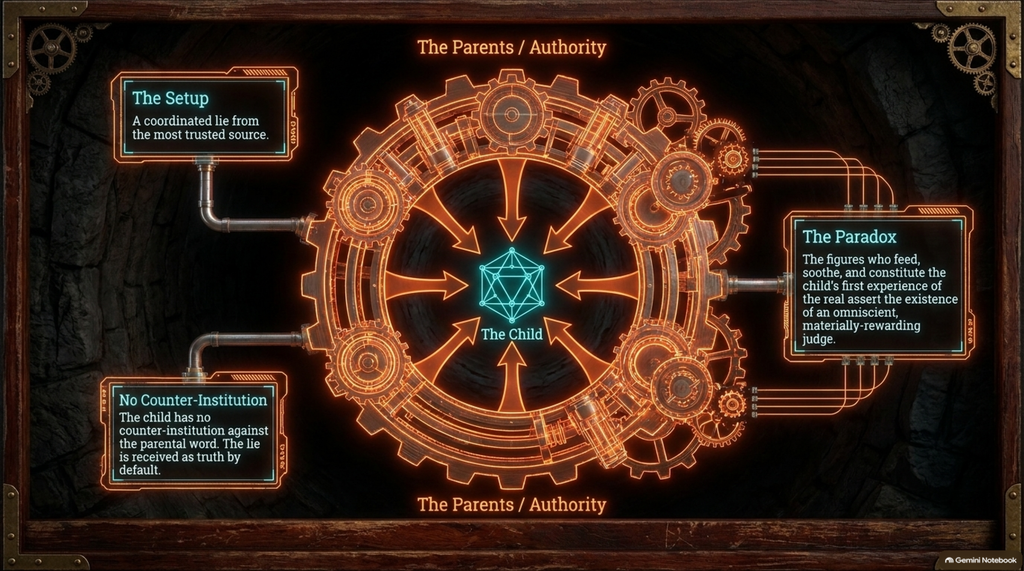
The Santa Claus myth is unique among the lies told to children for one reason: it is told by the very figures the child depends on for survival and the formation of reality itself. The parents — who feed the child, who soothe the child, who constitute the child’s first experience of the real — look the child in the eye and assert the existence of an omniscient, omnipresent, materially-rewarding elderly man who lives at the North Pole, employs elves, pilots a flying sleigh, and judges the child’s moral behaviour nightly.
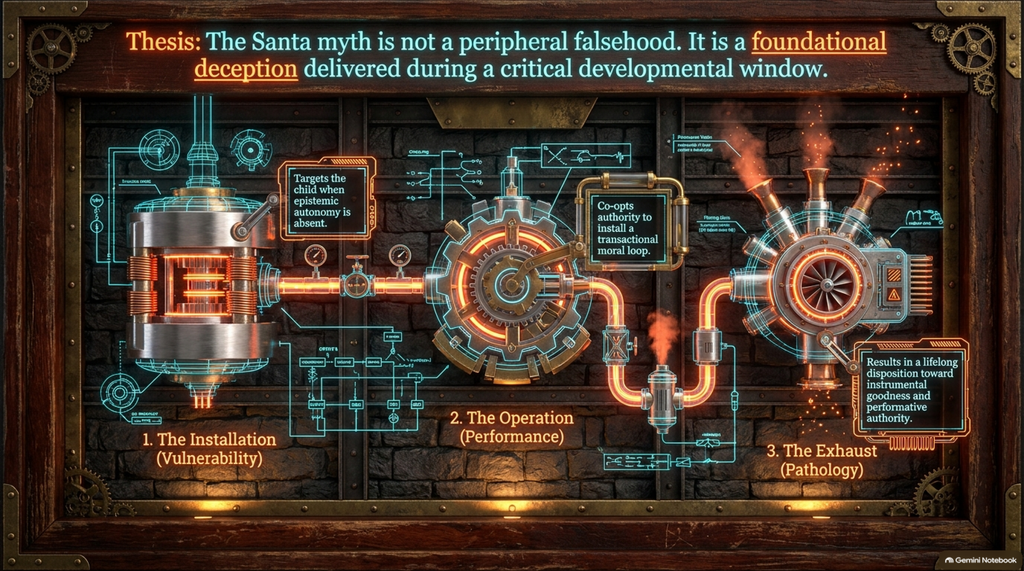
This is not a peripheral falsehood. It is a foundational one. The lie is delivered during the developmental window in which the child’s capacity to distinguish between external reality and parental assertion has not yet formed. The child has no counter-institution against the parental word. The lie is therefore received as truth by default — not because the child has evaluated the evidence and concluded, but because the child cannot yet evaluate evidence at all.
The Santa myth is a coordinated cultural project designed to operate inside this vulnerability. The adults know. The adults have always known. They tell the lie anyway. They coordinate with other adults to maintain it. They stage theatre (the department-store Santa, the cookies-and-milk ritual, the staged newspaper articles, the visible-but-conveniently-omniscient surveillance) to reinforce the lie. They enjoy the lie while the child suffers it.
2. The Developmental Window: A Technology of Behaviour Modification
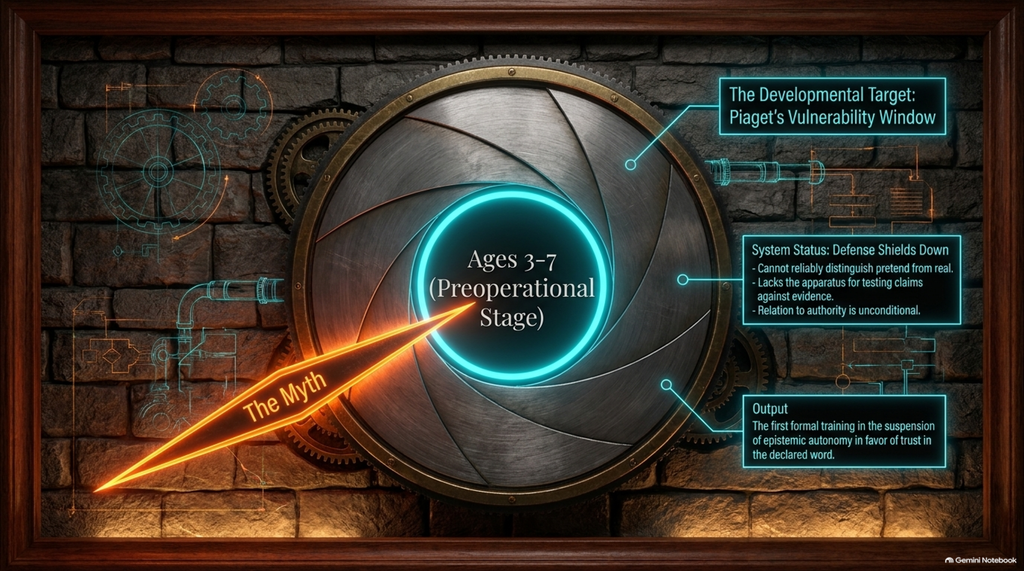
Children typically receive the full Santa myth between ages 3 and 7 — the preoperational and early concrete-operational stages of Piaget’s developmental sequence. This is the window in which:
- The child cannot reliably distinguish pretend from real
- The child has not yet developed the apparatus for testing claims against evidence
- The child’s relation to authority is unconditional — the parental word is not a hypothesis to be tested but the ground of reality itself
Inside this window, the Santa myth does two things simultaneously:
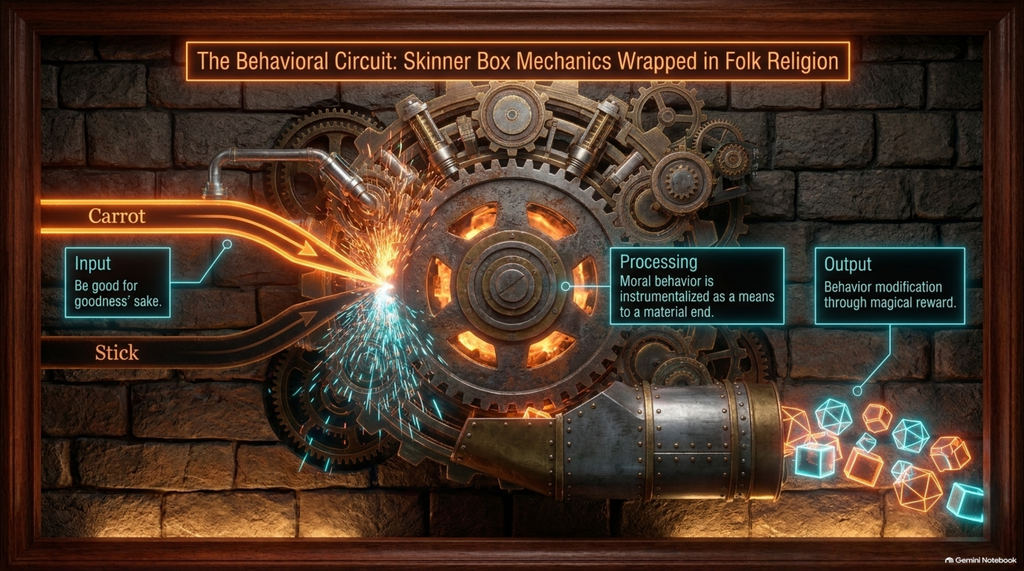
First, it teaches behaviour modification through magical reward. “Be good, and Santa will bring you presents.” This is operant conditioning — Skinner box mechanics — wrapped in the language of folk religion. The carrot is presented. The stick is implied (“if you’ve been bad…”). The mechanism is a reward-and-punishment scheme administered by an omniscient judge whose existence the child has no way to verify.
Second, it establishes a category of truth-by-declaration. The parent says X. X is true. The mechanism by which this works is the same mechanism the child will later use to evaluate other authority claims — religious, political, scientific, commercial. The Santa myth is not merely a lie. It is the first training in the suspension of epistemic autonomy in favour of trust in the declared word.
What is being installed is not a belief in Santa. What is being installed is a disposition: that authority is to be believed when authority says so. The Santa myth is the first lesson in uncritical reception of the declarative word of those who claim to know.
3. The Lacanian Big Other and the Betrayal
For Lacan, the Big Other (grand Autre) is the symbolic structure that guarantees meaning — the place from which the subject receives the message of their own identity and worth. The Big Other is not a person; it is the symbolic order itself: language, law, parental authority, social convention. The subject’s relation to the Big Other is constitutive — without it, the subject cannot organise experience at all.
The Santa myth installs a fictional Big Other in the child’s psyche. “Santa sees you when you’re sleeping. Santa knows when you’ve been bad or good. Santa knows if you’ve been bad or good — so be good for goodness’ sake.” This is a perfect Lacanian Big Other: omniscient, omnipresent, judging, rewarding. The child develops a real relation to this Big Other. The child behaves well for Santa, behaves well because Santa is watching, integrates Santa’s gaze into the formation of the nascent superego.
Then — kindergarten. Peer interaction. Other children whose parents told them something different. Some children know. Some don’t. The discovery happens, usually between ages 5 and 8, that Santa does not exist. That the parents knew. That the parents lied.
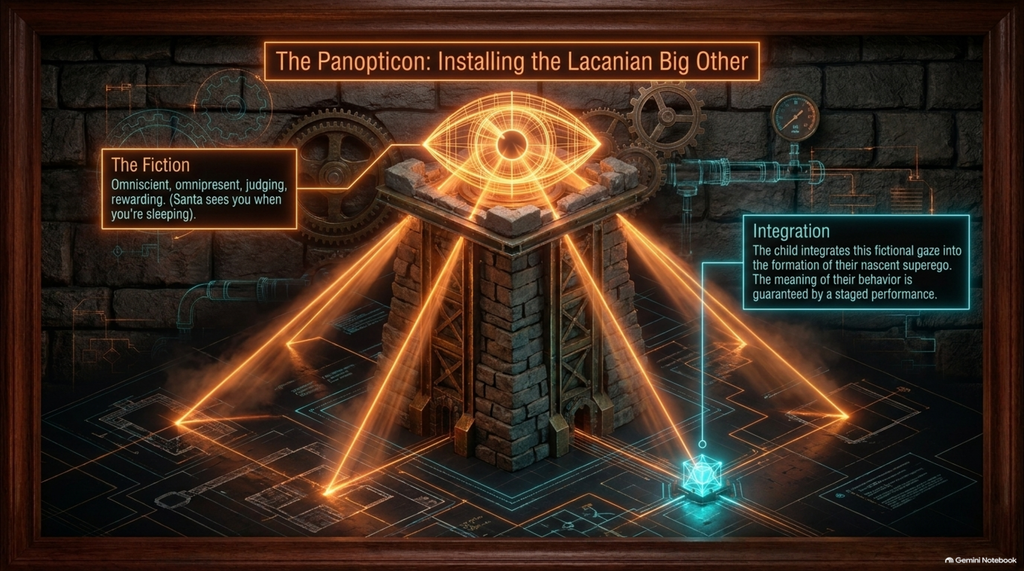
In Lacanian terms, this is the collapse of the Big Other — or rather, the catastrophic discovery that the Big Other has always been the parents themselves, fictionalised. The authority which guaranteed the meaning of the child’s moral behaviour (“be good, Santa will reward you”) turns out to have been a performance. The omniscient judge was the parents all along, wearing a red suit. The guarantee of meaning was a guarantee of fiction.
For the child, this is not merely disappointment about presents. It is the discovery that the foundational authority figure has been lying about the structure of reality itself. The parents had presented themselves as mediators of truth; they turn out to have been mediators of a fiction they maintained knowingly, with a managed script for the collapse already prepared (“we knew you’d find out eventually,” “you’ll understand when you’re older,” “we just didn’t want to spoil the magic”).
This is a profound epistemic shock. It happens at a developmental stage where the child cannot yet process it conceptually. The child cannot articulate “my parents are unreliable narrators of reality.” The child can only absorb it as a felt sense — that the world was not what was said, that the people who said it knew it wasn’t, that this is what adults do.
4. Winnicott’s Transitional Object and Its Designed Destruction
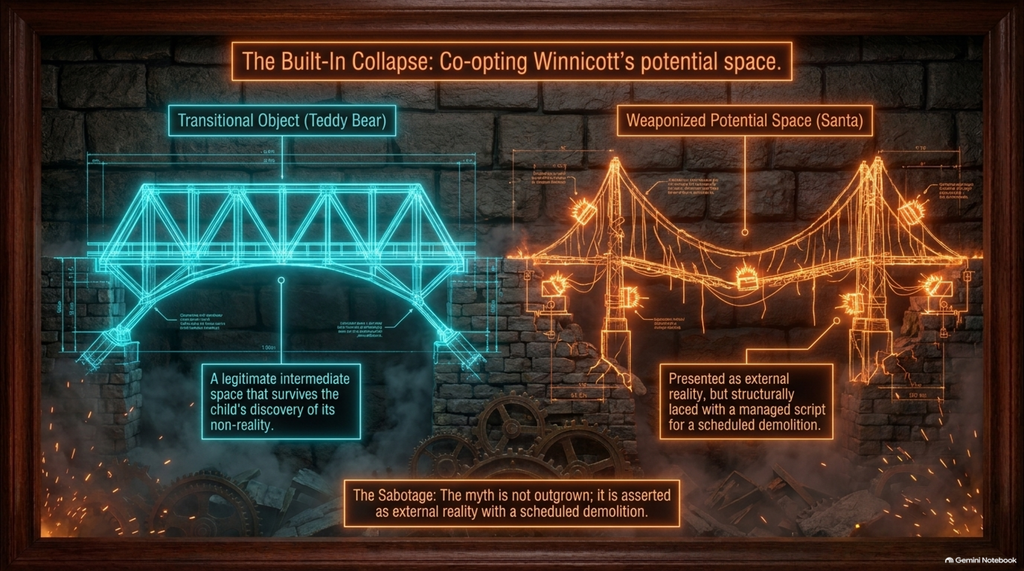
For Winnicott, the transitional object — the teddy bear, the blanket, the doll — is the object the child uses to manage the gap between inner reality and external reality. The transitional object is not a delusion; it is a legitimate intermediate space (what Winnicott calls potential space) in which the child can play with the difference between me and not-me, between inside and outside, between real and not-real.
Crucially, the transitional object survives the child’s recognition of its non-reality. The teddy bear remains the teddy bear even after the child knows it is not alive. The transitional object is not destroyed by the discovery that it is in some sense “only” an object. The discovery is integrated; the object continues to occupy the transitional space.
The Santa myth is not a transitional object. It is the negation of one. A real transitional object is presented as a transitional object — neither fully me nor fully not-me, occupying the potential space. The Santa myth is presented as external reality, not potential space. The discovery that it is not external reality is therefore not a developmental integration but a collapse. The myth is constructed to collapse. The collapse is built in.
What the parents have done, in Winnicott’s terms, is co-opt the transitional space and weaponise it. Instead of giving the child a legitimate object that can occupy the potential space, the parents have given the child an asserted fact about external reality, designed to collapse on a known schedule. The collapse is to be managed by the very authority figures who constructed the myth. The child does not get to discover the teddy bear is alive-then-not-alive in private, in their own time. The child gets to discover that the parent has been performing a deception with a managed collapse built into its architecture.
5. The Creation of the Shadow: Santa as Failed Puer Aeternus
For Jung, the shadow is what the ego has pushed outside its self-image: everything it refuses to acknowledge about itself. Shadow is formed, in part, by every encounter with deception about origins. Every time a figure the child identified with the good turns out to have a hidden face, a piece of shadow is created.
The Santa myth is the most efficient shadow-generating mechanism in Western childhood, and it runs in three steps.
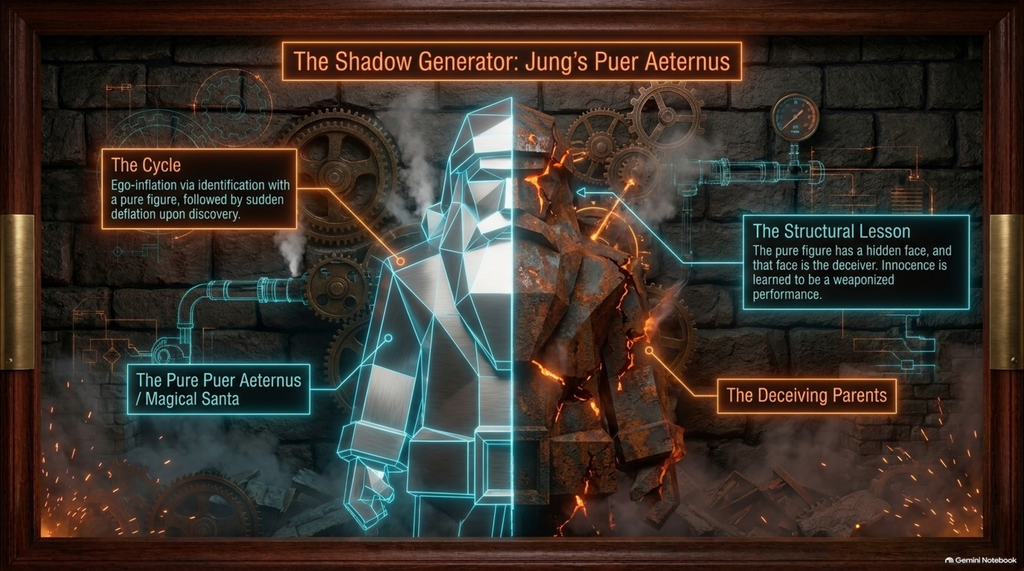
The child installs Santa as a puer aeternus: ageless, magical, omnipresent, just, the parental function purified of every human limitation. Then the parents perform the puer while knowing they are not the puer. They use their own authority to install a false archetype in the child. Then the child discovers the performance. Santa was always the parents in costume. The first act of shadow-formation is the discovery that the pure figure was always the impure figure pretending to be pure.
The shadow that is created has a specific character. It is not the shadow of the parents’ human limitations (which the child would discover anyway). It is the shadow of the puer itself — the discovery that the magical, all-giving, all-knowing figure has a hidden side, and that hidden side is the very people who installed it. The child learns, at the most basic level: the pure figure has a hidden face, and that face is the deceiver.
This is not a neutral insight. The child has now learned a structural lesson that will repeat throughout their adult life: that pure figures have hidden faces; that apparent innocence can mask manipulation; that the magical realm is administered by ordinary people who have an interest in maintaining the magic. The child has been trained, by parental example, in the structure of deception by idealised figures.
In Jungian terms, this is inflation (ego-inflation through identification with a greater-than-human figure) followed by its deflation (the collapse of the inflated identification with the discovery that the greater figure was always the smaller figure pretending). The psyche does not return to its pre-inflation state. The psyche integrates the inflation-deflation cycle as a permanent structural feature — and the shadow that results is specifically the shadow of having believed in the puer.
The downstream consequence is a population for whom the puer aeternus archetype itself has a built-in shadow component. Adults in this population cannot encounter the puer (in art, in religion, in their own children, in their own youthful selves) without simultaneously encountering the suspicion that the puer is being performed by someone with an interest in the performance. Adults in this population cannot encounter innocence without wondering what innocence is being staged to conceal. The shadow of the Santa myth is the shadow that innocence can be weaponised.
This is why the Santa myth produces, in adulthood, the specific pathology of performed sincerity. Everyone knows the performance is a performance. Everyone agrees to maintain it for the social fabric. Advertising, politics, sentimental religion, the whole apparatus of the Christmas season: all of it operates on the post-Santa adult’s learned capacity to perform innocence while knowing it is performance. The shadow is what makes the performance possible.
The shadow-creation also has a parental-side dimension. The parents who perform Santa are themselves performing the puer archetype. They are pretending to be the omniscient ideal parent they know they are not. The parents, in their turn, are installing a shadow: their own inability to be the ideal parent, displaced onto the Santa-figure, who absorbs the projection of the ideal and leaves the parents free to be merely human. The Santa myth is therefore a shadow-generating mechanism for parents as well as for children — the parents perform an impossible ideal, and the collapse of that performance (when the child discovers it) becomes the occasion for the parents to come down from their own inflation and acknowledge their limitations, but only at the cost of having first inflicted the cycle on the child.
In this sense the Santa myth is not merely a coordinated lie. It is a generational shadow-transmission ritual — each generation of parents installs the puer-shadow in their children, then manages its collapse, then passes the cycle on. The ritual is maintained because no generation has the resources to face what was done to them, and so they re-perform it on the next generation.
Jung’s deepest insight about the Santa myth, in other words, is not that it is a lie. It is that it is a shadow-transmission ritual — a coordinated mechanism by which each generation transmits to the next a specific inability to distinguish performed innocence from actual innocence, a specific learned suspicion of the puer, and a specific capacity to maintain performance while knowing it is performance. The myth does not just lie. It trains the child to lie, and to recognise lying as a normal mode of social relation.
6. The Peer-Group Discovery and the Kindergarten Shock
The discovery of Santa’s non-existence does not, in the contemporary West, usually happen in private. It happens in kindergarten or early primary school, in the presence of peers. The mechanism is socially brutal:
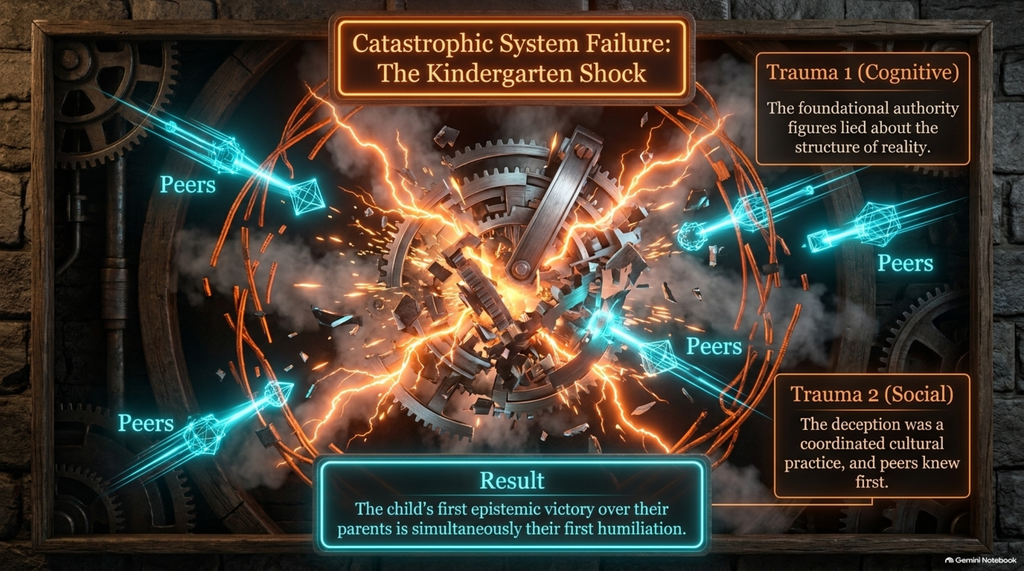
- Some children know.
- Some children don’t.
- The ones who know are unable to hide their knowledge from the ones who don’t.
- The ones who don’t know are exposed to the knowledge through peer conversation, often humiliatingly.
This produces two distinct traumas, operating simultaneously:
The first trauma is the abstract, slow-burning one: the discovery that the parents — the foundational authority figures — lied knowingly about the structure of reality. This trauma integrates slowly, over years, and never fully resolves for most people.
The second trauma is the immediate, social one: the discovery that this was a known thing, that other parents had told their children the truth earlier, that the parents’ deception was a coordinated cultural practice rather than an idiosyncratic choice. The child was not lied to by their parents alone. The child was lied to by adult society.
The peer-group setting means the child cannot process the discovery privately. The discovery is social before it is cognitive. The child learns not only that the parents lied, but that other children knew before they did, that this was a known thing, that the parents’ deception was a coordinated adult project.
For a child of 6 or 7, this is the discovery that adult society coordinates its deceptions about reality. The child is inducted into the knowledge that this is what adults do. The child is shown, for the first time, that there is a social consensus about which fictions will be maintained, and that they have been on the wrong side of that consensus.
The child who is told first by peers — and there are always children who are told first — is briefly in a position of epistemic superiority over their parents. This too is a trauma: the child experiences, for the first time, the vertiginous discovery that the parents do not know everything, that the parents are not omniscient, that the child knows something the parents have been pretending not to know. The child cannot enjoy this knowledge. The child can only be unsettled by it. The parents’ deception has ensured that the child’s first epistemic victory over them is also the child’s first experience of being lied to by them.
7. Downstream: Greed as the Inevitable Endpoint
The Santa myth installs a specific relation between moral behaviour and material reward. The structure is:
Be good → receive reward.
(Implied) Be bad → receive nothing, or punishment.
This is the structure of contingent reward. In psychological research, contingent reward is one of the most reliable ways to destroy intrinsic motivation (see Deci & Ryan’s Self-Determination Theory; the original Lepper, Greene & Nisbett, 1973, “Undermining Children’s Intrinsic Interest With Extrinsic Rewards”). When an activity is rewarded externally, the subject’s internal motivation to do the activity for its own sake is suppressed and replaced by motivation to do the activity for the reward. When the reward is removed, the activity collapses.

The Santa myth does this to moral behaviour. Children who internalise the myth learn that moral behaviour is rewarded. The reward is the mechanism. The morality is instrumentalised — it becomes a means to a material end.
The downstream consequence is a population that has been trained from age 4 to moral behaviour as a transaction. Be good, get stuff. The internal sense of “good as its own end” is short-circuited. The child is not learning to be good. The child is learning that goodness is a procurement strategy.
This is the pipeline to greed. When the mythology is exposed — when Santa collapses — the child does not return to intrinsic moral motivation. The child returns to a worldview in which goodness was always instrumental, always transactional, always about getting stuff. The myth was the first lesson in the moral economy of procurement. The lesson generalises.
The cultural tell is everywhere. The adult who still says “I’m a good person” while conspicuously displaying material success. The adult for whom moral language is the cover for material appetite. The adult who cannot tell the difference between being good and having things, because that difference was never installed in the first place. The adult who gives to charity with the expectation of recognition. The adult who buys their child’s affection with presents. The adult whose religion is a transaction with a deity who rewards belief with material blessing. These are all downstream forms of the Santa myth’s basic structure: goodness procured, reward received.
The Western commercial Christmas is the adult-form of the Santa myth: a coordinated performance in which being good (Christian, civic, family-minded, generous) is rewarded with the largest quarterly retail surge in the calendar. The Q4 retail surge is not an economic phenomenon. It is the public continuation, by adults who were once Santa’s children, of the original transactional structure.
8. The Multi-Generational Lie and the Cultural Permission Structure
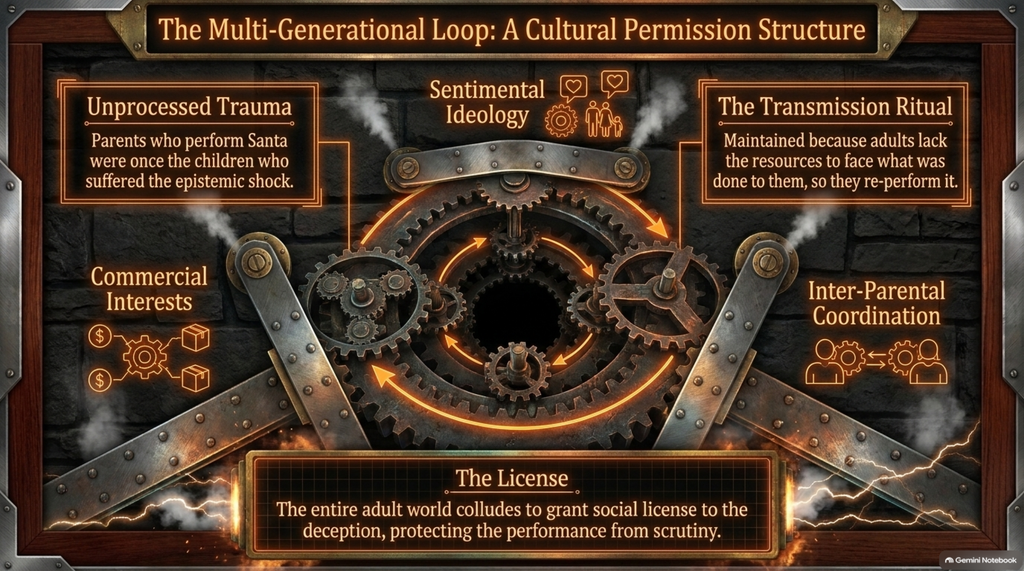
The Santa myth does not originate with any individual parent. Each parent who tells the myth learned it from their own parents, who learned it from theirs. The myth is multi-generational. It is the cultural inheritance of a coordinated lie.
This is significant because it means that the parent’s own relation to the myth is contaminated by their own unprocessed experience of it. The parent who tells the child about Santa was once the child who discovered the parent was lying. The parent did not process this — they were 6, and the discovery was managed, and the script was ready, and the magic of Christmas was preserved for the next generation by re-performing the same lie.
The cultural permission structure that maintains the myth includes:
- Commercial interests. Coca-Cola Santa (the modern visual form), the gift economy, Christmas creep, the entire Q4 retail calendar — industries that depend on the myth’s continuation and actively promote it.
- Sentimental ideology. “The magic of Christmas,” “childhood wonder,” “the spirit of giving” — language that disguises the transaction. Sentimentality is the felt truth; the structure remains unspoken.
- Inter-parental coordination. The social pressure on parents to perform the myth together, so that no individual parent’s child is the one who “spoils it” for others. The myth requires consensus; the consensus enforces the myth.
- Religious institutions. Santa Claus merged with Saint Nicholas merged with the Christ child — the secularisation of a religious festival that never quite lost its sacred structure. The Santa myth inherits the theological weight of the Incarnation without any of the theological substance.
This is not a benign cultural inheritance. It is a coordinated project of epistemic violation against children, maintained across generations because each generation’s adults cannot face what was done to them.
9. The Question of Intent (Sharpened)
There are exactly two possible interpretations of the Santa myth, and the honest one is materially closer to what is actually happening. The sharpening is necessary because the charitable interpretation is doing more cultural work than its actual force can support — it is, in Bandura’s terms, a moral disengagement mechanism that lets adults perform the myth without confronting what they are performing.
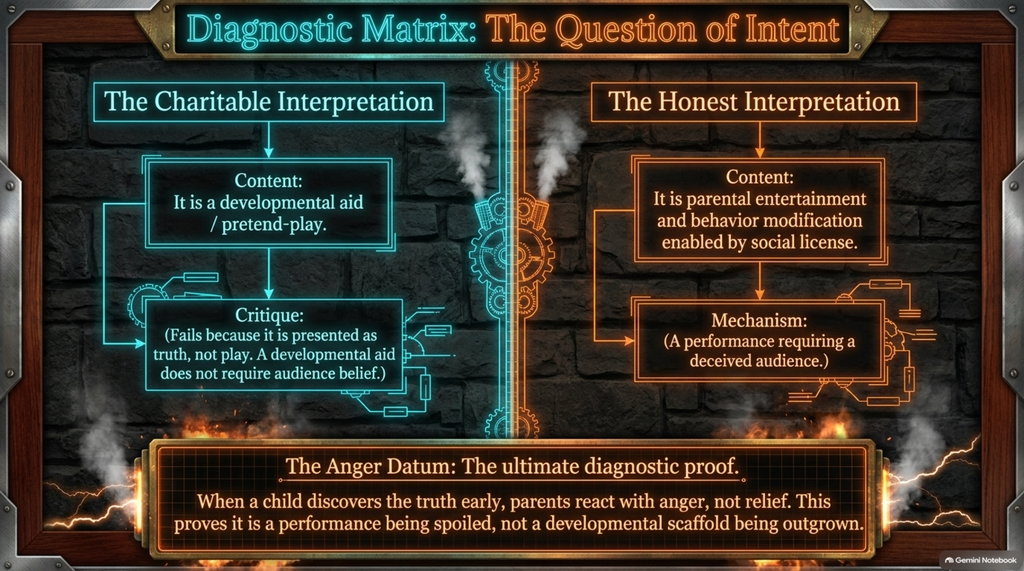
The charitable interpretation (in its strongest form): the parents are introducing the child to a magical worldview that will be gradually dismantled, scaffolding the child’s capacity for symbolic thought, providing a transitional object that gives way to reality. The lie is a developmental aid; the discovery is a developmental milestone; the parents are good-faith mediators of a transition the child needs.
The honest interpretation (in its strongest form): the parents are enjoying a culturally-sanctioned performance of omniscience, finding it convenient for behaviour modification, and unable to imagine an alternative because they themselves were subjected to the same myth and never processed what it did to them. The “developmental aid” framing is the rationalisation they use, after the fact, to make the performance bearable to themselves.
The charitable interpretation has a narrow legitimate core, but the core is much smaller than its defenders claim. Symbolic communication is appropriate for children. Pretend-play is developmentally important. The question is whether the Santa myth is symbolic communication — and it is not. Symbolic communication is presented as symbolic. “Let’s pretend the floor is lava” is symbolic. The child knows it is pretend. The Santa myth is not presented as pretend. It is presented as truth. The discovery is not “we were playing a game.” The discovery is “you were lied to.” The structural form is deception, not symbol-play. Deception that targets a child who cannot detect it, deployed by the figures the child depends on for reality-formation, coordinated across the adult world. Charitable interpretation cannot survive contact with this distinction.
The honest interpretation has far more force than the charitable one, for three reasons the charitable interpretation cannot account for.
First, the enjoyment datum. The parents enjoy the magic. The parents enjoy the children’s belief. The parents enjoy the performance of the omniscient Santa at the department store, the staged newspaper articles, the cookies and milk left out on Christmas Eve, the way the child’s eyes light up. This is theatre, and the audience is the child, and the child’s belief is the precondition for the theatre’s enjoyment. A developmental aid does not require audience belief to function. A performance does. The enjoyment is the load-bearing feature.
Second, the anger datum — which is the single most diagnostic piece of evidence in the entire debate, and the one the charitable interpretation is structurally unable to explain. When the child discovers the truth early, or is told by other children before the parents are ready, the parents’ reaction is anger. Not relief. Not “well, that saves us the conversation.” Not “we were preparing to tell you next week.” Anger. A developmental aid is happy to be discovered and replaced — discovery is the milestone, the whole point of the scaffolding. A performance that depends on the audience’s belief is angry when the audience stops believing on its own schedule. The trick has been spoiled before the climax. The anger is the anger of a magician, not the relief of a parent. The anger datum alone is dispositive: the parents are not administering a developmental aid. They are administering a performance that requires their audience to believe.
Third, the social-licence datum. Arendt’s insight in Truth and Politics is that the lie is a special category of social-political act precisely because it requires a licence — a permission granted by the surrounding culture that lets the liar act without the liar (or the audience) having to face what is being done. The Santa myth has an extraordinarily strong social licence. Every adult knows. Every adult colludes. The licensing adult community is in fact the entire culture. This is not a small private lie between a parent and a child. It is a public, coordinated, multi-generational lie with the entire adult world as the licensing body. The scale of the licence is itself evidence of what is being licensed: not a developmental aid (which would not require cultural-wide coordination), but a performance whose enjoyment depends on the audience being a child and the audience’s belief being unspoiled by adult knowledge.
The sharpened honest interpretation is therefore this: the parents are using the child’s developmental vulnerability for parental entertainment, while the surrounding adult world provides the social licence that lets the parents do so without the parents having to face what they are doing. The developmental-aid defence is the rationalisation the parents use to maintain the social licence, both internally (to themselves) and externally (to the surrounding adults who would otherwise have to confront the question of why they, too, are colluding). Charitable interpretation is therefore not a competing hypothesis about the myth’s purpose. Charitable interpretation is a moral disengagement mechanism that makes the myth possible to perpetuate by adults who would otherwise have to confront what they are doing.
This sharpening matters because it makes the policy implications sharp. If the Santa myth is a developmental aid, then the parents who don’t perform it are depriving their children of something. If the Santa myth is a coordinated performance enabled by social licence, then the parents who don’t perform it are refusing to participate in a coordinated cultural lie, and the surrounding adults who feel social disapproval of the non-performing parents are feeling the social licence threatened — they are not protecting a developmental resource, they are protecting a performance.
10. The Question of Comparison: The Missing Extended Family
The comparison that matters most is not the cross-cultural one. The comparison that matters most is the structural-historical one, and it is the comparison that the charitable interpretation most carefully avoids.
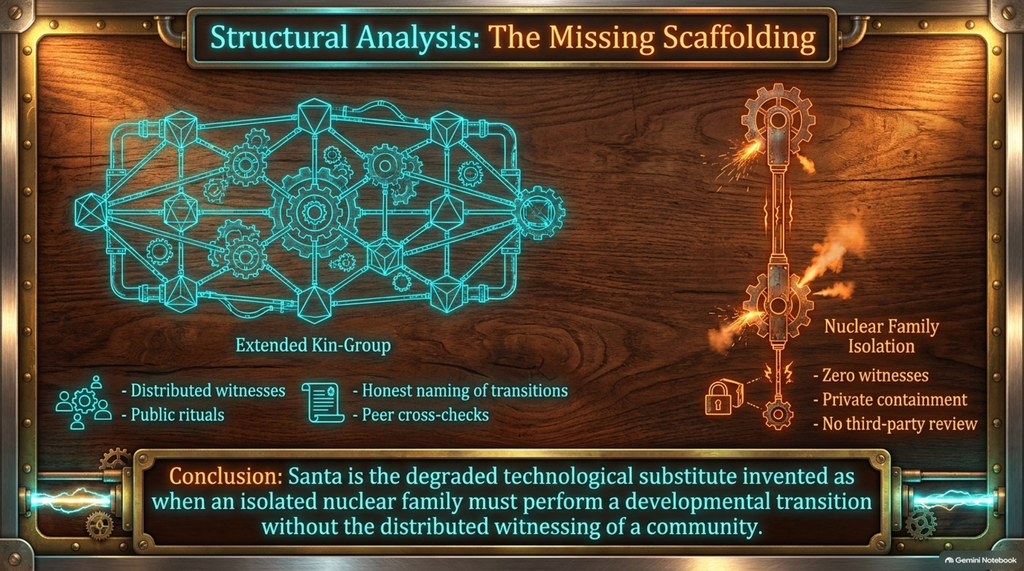
The Santa myth is the developmental-mediation technology of the nuclear family in isolation from an extended-family structure. It is the technology that emerges when the parents have no aunts, no uncles, no cousins, no elder siblings, no neighbour-witnesses, no kin-group co-parenting, no communal child-rearing institution. It is the technology that emerges when the entire burden of mediating the child’s transition to adult knowledge falls on two adults with no cross-check, no distributed witnessing, and no third-party review. The Santa myth is not one of several possible developmental transitions. The Santa myth is what the nuclear family invents when it has no extended family to do the actual work.
The structural diagnosis runs as follows.
In a society with functioning extended-family and kin-group structures, the child’s developmental transition is distributed. The parents are not the only adults in the child’s life. Grandparents, aunts, uncles, older cousins, and elder siblings are all co-present. The child observes the transition being navigated by older cousins and siblings. The child sees the older cousins go through the ritual and emerge on the other side. The child has multiple witnesses to the cultural mediation of the transition. The child has multiple figures to compare the parents’ accounts with. The parents’ authority is held in a network of other authorities, and the child learns to navigate the network. The transition is public in the technical sense: it is witnessed, it is distributed, it is performed in the presence of others whose relationship to the child is independent of the parents’ authority.
In the nuclear-family-in-isolation structure, none of this is available. The parents are the entire adult world the child sees. The parents’ word is the only authority. The child’s peers are other children in the same family structure, with no peer-transition visibility. The child’s first encounter with a developmental milestone is the encounter with the parents’ word alone, mediated by no other adult figure, witnessed by no kin-group, distributed across no third party. In this structural situation, the parents face a developmental-mediation problem that has no good answer: the child needs to be held at a developmental distance from certain adult knowledge, but the parents are the only adults the child has access to, and so any withholding the parents do is necessarily a containment exercise rather than a distributed ritual. The parents must perform the entire transition themselves. And the technology the parents have invented to do this containment exercise — the only technology their structure offers — is a coordinated lie about reality itself.
This is why the Santa myth is structurally American/Western European rather than structurally universal. It is the developmental-mediation technology that emerges from the specific structural collapse of the extended family in late-modern Anglo-American culture. The lie is not chosen. The lie is what the structural situation generates in the absence of any alternative. The extended family would have distributed the mediation; the lie would not have been necessary. The kin-group would have provided peer-witnesses; the lie would not have been necessary. The communal child-rearing institution would have absorbed the developmental-mediation burden; the lie would not have been necessary. The Santa myth is the substitute for all of these absent structures.
The structural diagnosis is also why the cultural defence of the myth works so well. The myth’s defenders are not defending a developmental aid. They are defending the only available developmental-mediation technology their structural situation offers. They are defending the substitute because the substitute is what they have, and the absence of the structures that would have made the substitute unnecessary is not something they can recover. To give up the Santa myth is to be confronted with the structural absence it compensates for. The defence of the myth is therefore not a defence of a developmental good. It is a defence of a compensatory fiction against the recognition of a structural loss.
This is also why the surrounding adults in the coalition feel threatened when a parent refuses to perform the myth. The refusing parent is not merely making a personal parenting choice. The refusing parent is declining to participate in the only developmental-mediation technology the surrounding adults’ structural situation offers. The surrounding adults are themselves dependent on the Santa myth as the substitute for the extended-family structures they no longer have. The refusing parent is therefore a structural threat, and the social disapproval is the social licence defending itself.
The comparison the myth’s defenders offer — to Jewish structured Torah education, to indigenous ritual transitions, to age-grade initiations — is therefore the comparison that most clearly indicts the myth. Those traditions are functional extended-family-and-communal developmental-mediation systems. They work because they have the structural preconditions the Santa myth lacks. The comparison does not vindicate the Santa myth. The comparison shows that the Santa myth is the degraded institutional form that emerges when the preconditions for the actual developmental-mediation institutions have been lost.
The child in the extended-family tradition is being held at a developmental distance from real knowledge, with the transition named honestly, distributed across multiple adults, witnessed by peers, and ritualised as a public event. The trust the child places is trust in a distributed adult community’s judgement about timing — and when the transition happens, the adults turn out to have been honest about what was being held back. The child in the nuclear-family-with-Santa-myth tradition is being held at a developmental distance from fictional knowledge, with the fiction maintained by two adults with no cross-check, witnessed by no peers, and exposed as a coordinated lie when the child discovers it. The trust the child placed was trust in the parents’ claim about reality — and when the discovery happens, the parents turn out to have been lying about what was being held back.
The Santa myth is not a developmental aid. It is what the nuclear family invents when the extended family has been lost, to do the developmental-mediation work that the extended family would have done honestly, and that the nuclear family cannot do honestly because it lacks the structural preconditions. The substitute is easier for the parents and harder for the child. The trade is not merely in the parents’ favour. The trade is the price the child pays for the structural collapse of the extended family, levied in the currency of foundational epistemic trust.
11. What’s at Stake
When the Big Other collapses for the child — when the parents turn out to be unreliable narrators of reality — the child does not return to a clean epistemic state. The child returns to a state in which the foundational trust in the declared word has been revealed as conditional. The parents were performing omniscience. They did not possess it. They knew they were performing it. They continued performing it.
The downstream consequence is a population that has been trained to distrust the declared word of authority, while lacking the cognitive apparatus to evaluate truth independently. The Santa myth teaches the child that authority figures can and do coordinate to deceive. The child does not learn to evaluate evidence; the child learns that evidence is not what matters. What matters is whether the authority figure is performing sincerity.
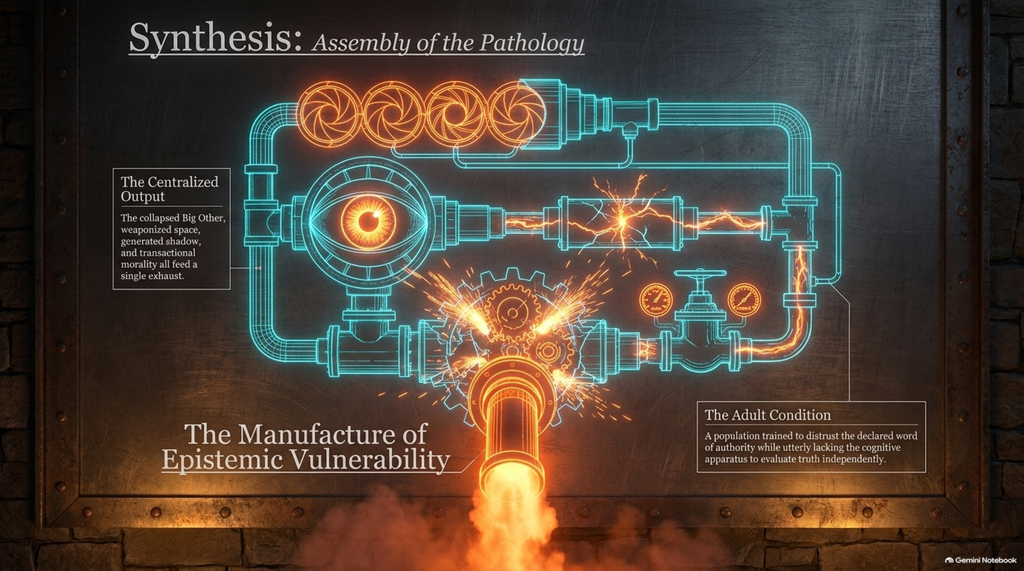
This is the cultural condition of the contemporary West. A population trained from age 4 to distrust authority while lacking the resources to evaluate claims independently. A population for whom truth has been revealed, by parental example, to be a matter of performance rather than correspondence. A population whose moral behaviour has been instrumentalised from the earliest age into a transaction with a Santa who never existed but whose transactional logic has been internalised.
The Christmas commercial season — the largest coordinated performance of the transactional-moral logic in the calendar year — is what the Santa myth produces in adulthood. Adults who shop for their children’s love with presents, who give to charity with the expectation of recognition, who go to church with the expectation of insurance, who vote for the candidate who promises them stuff, who cannot tell the difference between being good and getting things. The Santa myth did not produce this directly. But it installed the precondition: the disposition to treat goodness as a procurement strategy, the disposition to treat authority as performance, the disposition to treat truth as a matter of staged sincerity.
This is what the Santa myth produces. Not the magic of Christmas. Not the spirit of giving. Not childhood wonder. A generation of children who learned that goodness is a procurement strategy, that authority is theatre, and that the people who love you will lie to you about the structure of reality if the lie is culturally convenient.
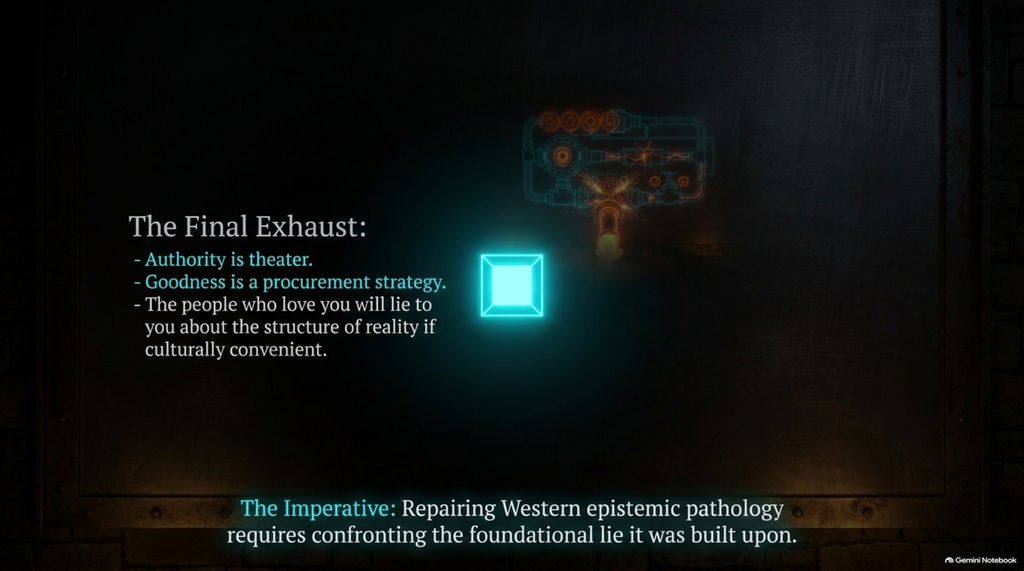
The myth deserves a serious hearing, and not because it is harmless. Because it is the foundational lie on which a great deal of Western moral and epistemic pathology has been built, and we will not be able to repair the pathology until we are willing to look at what the foundational lie was for.
Appendix A. Annotated Bibliography
The following sources inform or support the argument of this essay. Grouped by discipline. Format: Chicago author-date, with full publisher information.
Psychoanalysis
- Lacan, Jacques. The Seminar of Jacques Lacan, Book XVII: The Other Side of Psychoanalysis (1969-70; ed. Jacques-Alain Miller; trans. Russell Grigg; W. W. Norton, 2007). The foundational reference for the grand Autre (Big Other) and the discourses of the analyst and the capitalist. Relevant for section 3 on the collapse of the Big Other as the structural mechanism by which the Santa myth’s installation of an omniscient judge-figure sets the child up for a foundational epistemic shock when the judge-figure turns out to have been the parents themselves.
- Lacan, Jacques. Ecrits: The First Complete Edition in English (1966; trans. Bruce Fink; W. W. Norton, 2006). The symbolic order, the Name-of-the-Father, foreclosure. Relevant for the claim that the Santa myth operates as a foreclosure of the question “who is the judge?” – the question is short-circuited by the answer “Santa,” and the child has no symbolic resources to recover the question when the answer collapses.
- Winnicott, D. W. Playing and Reality (1971; Routledge, 2005). The transitional object, potential space, the good-enough mother. Relevant for section 4 on the distinction between a genuine transitional object (which survives the recognition of its non-reality) and the Santa myth (which is designed to collapse). Winnicott’s framework is the most precise available for diagnosing why the Santa myth fails as a developmental aid.
- Winnicott, D. W. The Child, the Family, and the Outside World (1964; Penguin, 1987). The holding environment, maternal preoccupation, the ordinary devoted mother. The relevant contrast: Winnicott’s framework requires the holding environment to be authentic for the developmental work to succeed; the Santa myth uses the holding environment to install a fiction, which is the negation of Winnicott’s setup.
- Freud, Sigmund. “Family Romances” (1909; Standard Edition IX, pp. 237-41). The child’s fantasy that their parents are not their real parents, that they were adopted, that they come from finer stock. The Santa collapse is structurally the inverse of the family romance: the child discovers not that the parents are different people, but that the parents are the same people playing a different role. The inverse structure is what makes the Santa collapse particularly disorienting – it is a family-romance whose resolution turns out to be the parents themselves, in costume.
- Jung, C. G. Aion: Researches into the Phenomenology of the Self (1951; Collected Works 9ii; Princeton University Press, 1979). The shadow, the puer aeternus, the inflation-deflation cycle. Relevant for section 5.
- Jung, C. G. “The Shadow” (1939; in Aion, CW 9ii). The classic essay on the shadow as the unconscious complement of the conscious ego.
- Fonagy, Peter, and Mary Target. Attachment Theory and Psychoanalysis (2001; Other Press). Mentalization, the reflective function, parent-as-mirror. Relevant for the claim that the Santa collapse damages the child’s capacity for mentalization – the discovery that the parent has been performing rather than reflecting sets up a specific kind of epistemic distrust that is difficult to disambiguate from the normal development of critical thinking.
- Main, Mary, and Erik Hesse. “Parents’ Unresolved Traumatic Experiences Related to Their Infants’ Disorganized Attachment Status” (1990; in Attachment Across the Life Cycle: A Cross-Cultural Perspective, ed. Mary T. Greenberg, Dante Cicchetti, and E. Mark Cummings; Routledge). The intergenerational transmission of disorganised attachment. Relevant for the multi-generational dimension of the Santa myth: each generation of parents who were themselves Santa-believing children transmits to their own children a specific inability to recognise what was done to them.
Developmental Psychology
- Piaget, Jean. The Construction of Reality in the Child (1937; trans. Margaret Cook; Basic Books, 1954). The developmental stages, the preoperational child’s inability to distinguish appearance from reality reliably, the formation of the object-concept. Relevant for section 2 on the developmental window.
- Deci, Edward L., and Richard M. Ryan. “Self-Determination Theory and the Facilitation of Intrinsic Motivation, Social Development, and Well-Being” (1985; American Psychologist 40, pp. 580-92). The most cited articulation of the distinction between intrinsic and extrinsic motivation and the conditions under which extrinsic rewards undermine intrinsic motivation. Relevant for section 7 on contingent reward destroying intrinsic moral motivation.
- Lepper, Mark R., David Greene, and Richard E. Nisbett. “Undermining Children’s Intrinsic Interest With Extrinsic Rewards: A Test of the Overjustification Effect” (1973; Journal of Personality and Social Psychology 28, pp. 129-37). The classic experimental study showing that expected tangible rewards reduce subsequent intrinsic interest in an activity. Directly relevant for section 7 – the moral analogue of the overjustification effect.
- Kohn, Alfie. Punished by Rewards: The Trouble with Gold Stars, Incentive Plans, A’s, Praise, and Other Bribes (1993; Houghton Mifflin). The case against contingent reward across developmental contexts. Relevant for section 7 as a popular synthesis of the overjustification literature.
- Kochanska, Grazyna. “Multiple Pathways to Conscience for Children with Different Temperaments: From Toddlerhood to Age 5” (1997; Developmental Psychology 33, pp. 228-40). The development of internalised moral norms in early childhood; relevant background for the question of whether the Santa myth’s contingent-reward structure interferes with the development of genuine conscience.
Moral Psychology
- Haidt, Jonathan. The Righteous Mind: Why Good People Are Divided by Politics and Religion (2012; Vintage). Moral Foundations Theory; the intuitive-elaborationist model of moral judgement. Relevant for the framing of section 7 – the claim that the Santa myth trains a population in transactional rather than intrinsic moral reasoning.
- Graham, Jesse, Jonathan Haidt, and Brian A. Nosek. “Liberals and Conservatives Rely on Different Sets of Moral Foundations” (2009; Journal of Personality and Social Psychology 96, pp. 1029-46). The empirical articulation of the MFT framework; relevant background.
- Kohlberg, Lawrence. The Psychology of Moral Development: The Nature and Validity of Moral Stages (1984; Harper & Row). The stages of moral reasoning; the post-conventional stage as the developmental endpoint. Relevant for the claim that the Santa myth’s contingent-reward structure interferes with the development of post-conventional moral reasoning.
- Bandura, Albert. “Moral Disengagement in the Perpetuation of Inhumanities” (1999; Personality and Social Psychology Review 3, pp. 193-209). Mechanisms of moral disengagement; relevant for the claim that the Santa myth’s training in performative sincerity sets up the moral disengagement mechanisms that adults use in commercial, political, and institutional contexts.
Cultural-Critique and Religious-Historical
- Bowler, Gerry. Santa Claus: A Biography (2005; McClelland & Stewart). The definitive cultural history of the Santa Claus figure from Saint Nicholas of Myra through the Coca-Cola-era American form. Indispensable for understanding the modern Santa myth as a 20th-century American commercial construction that overlaid older European traditions.
- Schmidt, Leigh Eric. Consumer Rites: The Buying and Selling of American Christmas (1995; Princeton University Press). The history of Christmas commercialism and the sentimental ideology that accompanied it. Relevant for section 8.
- Belk, Russell W. “A Christmas Carol and the Materialization of the Sacred” (1996; in Myth, Symbol, and Ritual: Elusive Domains of Social Thought, ed. Joseph W. Foley; Loyola University Press). The transformation of Christmas into a sacred-secular consumer ritual. Relevant for sections 7 and 8.
- Douglas, Mary. Implicit Meanings: Selected Essays in Anthropology (1975; Routledge). The classification of purity, danger, and the ritual negotiation of boundaries. Relevant background for the question of whether the Santa myth serves a genuine ritual function in Western culture.
- Restad, Penne L. Christmas in America: A History (1995; Oxford University Press). The cultural-history synthesis of Christmas in America. Background.
- Nissenbaum, Stephen. The Battle for Christmas (1996; Knopf). The contested cultural history of the American Christmas, including the early-19th-century campaigns against Christmas commercialisation. Background for section 8.
Philosophy
- Arendt, Hannah. “Truth and Politics” (1967; in Between Past and Future: Eight Exercises in Political Thought, Viking). The question of truth and the lie as a special category of social-political act; relevant for section 9 on the social-licence structure of the Santa myth.
- Kant, Immanuel. On a Supposed Right to Lie from Philanthropy (1797; in Practical Philosophy, trans. Mary Gregor; Cambridge University Press, 1996). Kant’s strict prohibition on lying even to prevent harm. The Santa myth would, on Kant’s account, be impermissible because the categorical imperative admits no developmental-stage exception. The essay takes a different view (see section 9) – the Kantian position is recorded here as the strictest version of the principled objection.
- MacIntyre, Alasdair. After Virtue: A Study in Moral Theory (1981; University of Notre Dame Press). The distinction between practice-internal goods and external goods; relevant for section 7 on the instrumentalisation of goodness.
About The Author