A psychohistorical reading of witness-as-myth across the compressing spiral of Jewish time.
by Peter Dixon & Timnah
Table of Contents
- §1 — Same Sky, Different Eyes — the witness, the Keel-move, the Ramchal anchor
- §2 — The Peaks — the four peak decades, the citators, the permission-moments
- §3 — The Messianic Parallel — the four Jewish peaks, the Bramley move, the reversal-of-recognition
- §4 — The Compressing Spiral — Saturn, Binah, the 2020 conjunctions, the cosmic hexagon
- §5 — The Witness’s Invitation — closing structural address to the reader
- Appendix A — Glossary
Sources
The following sources are cited across §1 through §5. Each is referenced in the running text by short label.
- Hatch database — Larry Hatch UAP database, 18,116 records, 989 to 2003 AD
- Keel 1970 — John A. Keel, Operation Trojan Horse (1970, 2015), Calibre 6808
- Keel 1971 — John A. Keel, Our Haunted Planet (1971, 2018), Calibre 3355
- Vallee citator — Jacques Vallee, citator behind Hatch, academic-grade UAP citation
- Haines NARCAP — Richard Haines, NASA-NARCAP, scientific citator
- Bramley 1989 — William Bramley, The Gods of Eden (1989), Calibre 10309 and 21456
- Maimonides MT — Maimonides, Mishneh Torah, Hilkhot Melakhim, messianic halakhah
- Sabbatai Zevi — Sabbatai Zevi, 1626 to 1676, Ottoman false messiah, canonical case
- Idel 2011 — Moshe Idel, Saturn’s Jews: On the Witches’ Sabbat and Sabbateanism (2011), Calibre 19740
- Sela 2017 — Shlomo Sela (ed. and trans.), Abraham Ibn Ezra’s Introductions to Astrology (2017), Calibre 19640
- Strickman 1988 — H. Norman Strickman and Arthur M. Weiser (eds.), Abraham Ibn Ezra, Commentary on the Pentateuch: Exodus (1988), Calibre 19644
- Panofsky 2018 — Erwin Panofsky, Fritz Saxl, and Raymond Klibansky, Saturn and Melancholy (2018), Calibre 19748
- Jung 1959 — C. G. Jung, Flying Saucers: A Modern Myth of Things Seen in the Skies (1959)
- Ramchal KPCH — Moshe Chaim Luzzatto, Klach Pitchei Chokhmah (1735), on igul, yosher, atzilus, yetzirah
- Ramchal Mesillat — Moshe Chaim Luzzatto, Mesillat Yesharim, chapter 1
- Shabbat 156a — Babylonian Talmud, Shabbat 156a, Saturn as Shabbetai, the star of Shabbat
- Y Berakhot 2:3 5a — Jerusalem Talmud, Berakhot 2:3 (5a), the Arab and Menachem reversal-of-recognition
- B Sanhedrin 98b — Babylonian Talmud, Sanhedrin 98b, parallel messianic-names list
- Sanhedrin 31a — Babylonian Talmud, Sanhedrin 31a, the obligation of testimony
- Deut 19:15 — Deuteronomy 19:15, the two-or-three-witnesses principle
- 2020 conjunctions — Saturn conjunct Pluto 12 Jan 2020 at 22 degrees 46 min Capricorn; Saturn conjunct Jupiter 21 Dec 2020 at 0 degrees Aquarius
- Saturn hexagon — Voyager 1981, Cassini 2004 to 2017, hexagonal jet stream at Saturn’s north pole
- Compressing Coils 2.3 — Compressing Coils essay v0.5, helix as igul rotating into yosher
- Compressing Coils 3.4 — Compressing Coils essay v0.5, Ramchal ch. 1 zechirah before bina anchor
- Compressing Coils — Compressing Coils essay v0.5, parent essay
- Mantell 1948 — Captain Thomas Mantell, 1948, USAF pilot death, widely publicised
- Kinross 1953 — Kinross AFB case, 1953, USAF jet scramble
- Tehran 1976 — Tehran UFO incident, 1976, Iranian F-4 jets, weapons-systems failure
- Petrozavodsk 1977 — Petrozavodsk phenomenon, 1977, Soviet dome of light
- Belgian 1989-1991 — Belgian UFO wave, 1989 to 1991, police radar, triangular craft
- Phoenix 1997 — Phoenix Lights, 1997, mass sighting, thousands of witnesses
- Pentagon 2026 — 2026 Pentagon UAP release, current peak
- Holocaust 1948 — Holocaust 1933 to 1945; State of Israel 1948; modern messianic peak
- Jung compensatory — C. G. Jung, Flying Saucers (1959); compensatory projection
- Ramchal igul-yosher — Moshe Chaim Luzzatto, Klach Pitchei Chokhmah, on igul and yosher
§1 — Same Sky, Different Eyes
In the autumn of 1952, a USAF radar operator at RAF Bentwaters watched structured lights perform manoeuvres his instruments said should have been impossible. The lights moved without the deceleration his training said matter required. He wrote it down. The document survives in the Project Blue Book files. He was 22 years old. He had no category for what he had seen, so he used the categories he had.
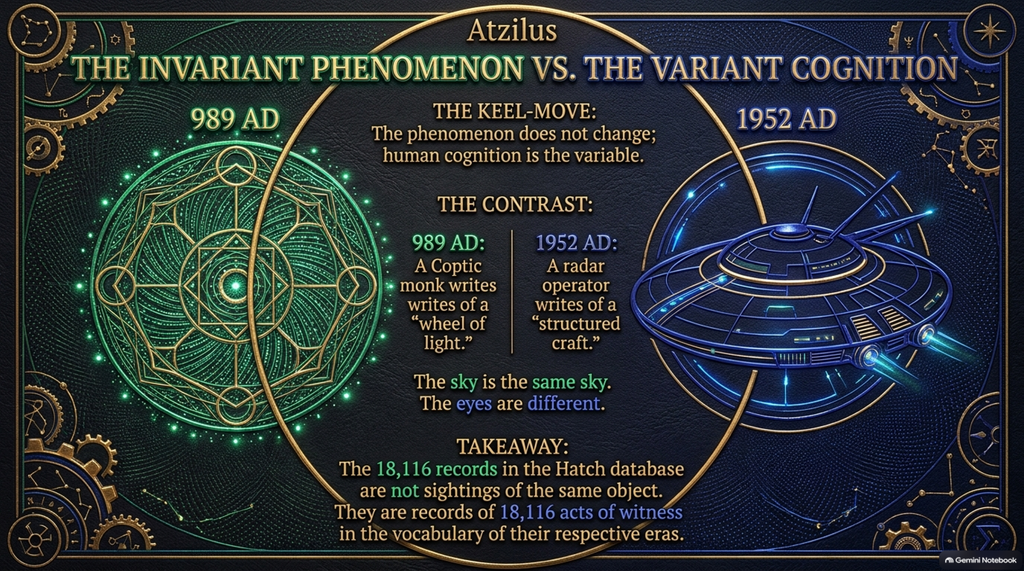
In the autumn of 989 AD, a Coptic monk in the Egyptian desert recorded in the margin of a codex a wheel of light in the night sky. The wheel turned slowly, he wrote. It made no sound. The monk had no category for what he had seen either. He used the categories he had: wheel, light, sky, sign.
The airman saw a craft. The monk saw a wheel. The sky is the same sky. The eyes are different.
The 18,116 records in the Hatch database — 989 AD to 2003 AD, a thousand years — show this pattern repeating with the regularity of a tidal cycle. The act of witness is constant: a person sees something they cannot fit into the available categories, and writes it down. The form of what they wrote is not constant. In the medieval scholastic centuries they wrote demons. In the Christian high register they wrote angels. In the folkloric centuries they wrote fairies. In the technological twentieth century they wrote structured craft. In the millennialist register they wrote signs.
Across a thousand years, every era has given the witnesses its own vocabulary. None of those vocabularies has stuck. None of them was, in any of those eras, true to what the witness actually saw. And none of them stopped the next witness, in the next era, from seeing what could not be fitted into the previous vocabulary.
§1.2 — The Keel-move
The American folklorist and UAP researcher John A. Keel, writing in Operation Trojan Horse (1970) and Our Haunted Planet (1971), named the pattern first and most clearly. The phenomenon, Keel argued, is invariant. What changes is the era’s cognition — the set of categories the witness has at hand when the attestation has to be written. The phenomenon does not intensify. The phenomenon’s visibility intensifies, at the moments the era’s categories become porous enough for the witness to risk writing the attestation down.
Keel’s move is structurally important for what follows. The phenomenon is not the variable; the era’s cognition is the variable. The 18,116 records in the Hatch database are not a record of 18,116 sightings of the same object. They are a record of 18,116 acts of witness — of 18,116 figures who held a question open, and who wrote it down before the question closed. The document is not a catalogue. The document is a record of attestation.
The same sky, then, for a thousand years. Different eyes. Different categories. Different vocabularies. The witness is the figure who holds the question open long enough to write the attestation. The witness is upstream of the era’s categories. The witness is the figure the era will, in time, be reshaped to account for.
§1.3 — The witness as eid
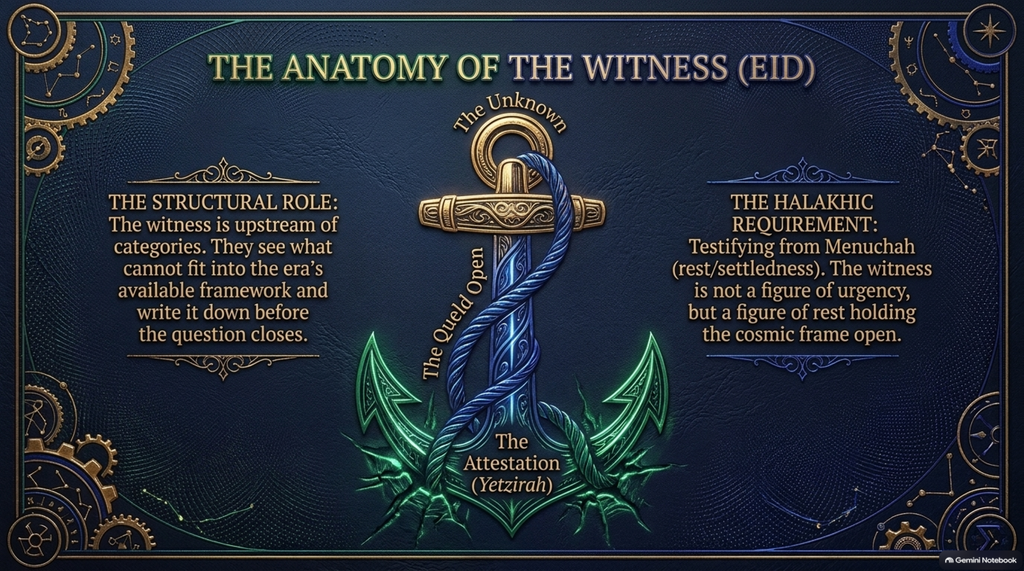
In the Hebrew register the witness is eid; the witnesses, eidim. The halakhic tradition gives the term a precise structural role. The eid is the figure who has seen an event and is qualified to testify to it under the formal rules of testimony (see Sanhedrin and Deuteronomy 19:15 — the two-or-three-witnesses principle). The eid is upstream of the courtroom. The eid‘s attestation is the form the event takes when it is made available to the legal register.
The rabbinic tradition also gives the eid‘s attestation a precise moral weight. The eid is required to be in a state of menuchah — rest, settledness, the cessation of the everyday making — for the testimony to be valid. The witness is not a figure of urgency. The witness is a figure of rest. The witness attests from a settled place. The attestation is the yetzirah-layer trace of an atzilus-layer pressing that has been held long enough to settle.
Across the thousand years of the Hatch database, the witness is the same figure in every era. Across the two thousand years of Jewish messianic expectation, the witness is the same figure. The same structural position. The same attestation. The same rest.
§1.4 — The Ramchal anchor
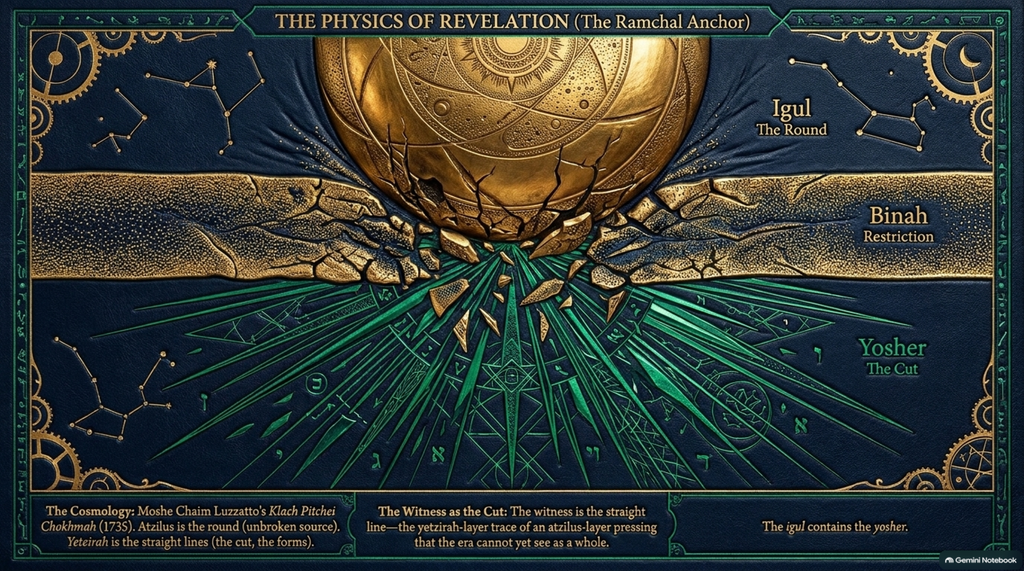
Moshe Chaim Luzzatto, the Ramchal, in his Klach Pitchei Chokhmah (1735), gives the structural map the essay will use throughout. The four Kabbalistic worlds — atzilus, yetzirah, beriah, assiyah — are layered. The highest, atzilus, is the round: the unbroken, the whole, the source. The second, yetzirah, is the straight lines: the forms, the cuts, the structures the world is made of. The igul contains the yosher; the yosher is the trace the igul makes when it presses into form.
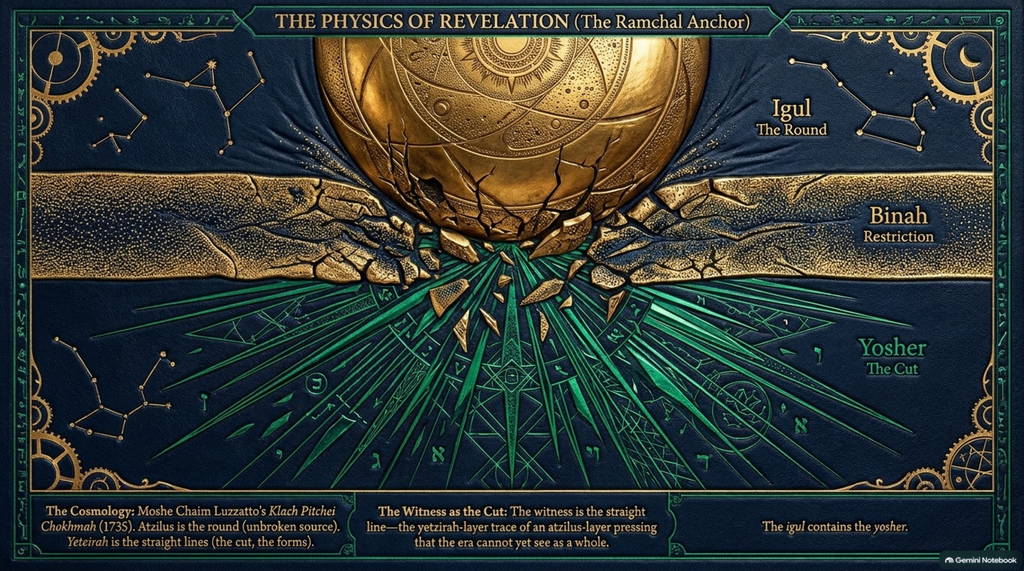
The witness is a yosher — a straight-line attestation of the round. The witness is the cut the igul makes when the igul presses into the witness’s own time. The witness is the yetzirah-layer trace of an atzilus-layer pressing that the witness’s own era cannot yet see as a whole. The witness sees the straight line. The witness does not see the round. The witness attests to the straight line, and the attestation is the yetzirah-layer trace of the round’s pressing.
The Ramchal anchor is not a metaphor for the witness. The Ramchal anchor is the structural position the witness occupies in the essay’s frame. The witness is upstream of every era. The witness is the figure the atzilus-layer round produces when it presses through Binah — the sefirah of restriction — into the yetzirah-layer of the witness’s own time. The witness is the cut. The witness is the trace. The witness is the attestation.
§1.5 — What the essay will argue
The essay will argue three things, in order.
First, the 18,116 witnesses and the four messianic peaks in the Jewish record are the same figure in different registers (§2, §3).
Second, the figure’s appearance in both registers follows the same pattern across time — peaks of attestation at the cultural-rupture moments, valleys of silence at the cultural-stable moments — and the parallel is not coincidental but structural (§3).
Third, the structural figure the parallel traces is the igul pressing into the yosher across 1,000 years and 2,000 years at once, and the pressing is a Saturnian spiral, the cycle of a generation, the cosmological witness-track the rare-event tradition reads as the moment the era’s categories cannot hold the pressure any longer (§4).
§1 named the witness. §2 will name the peak-pattern. §3 will name the parallel. §4 will name the figure both records trace.
§2 — The Peaks
§1 named the witness as the figure who holds the question open and attests from a state of rest. §1 also named the Keel-move: the phenomenon is invariant, the era’s cognition is the variable. §2 asks the question the Keel-move makes urgent — when does the era’s cognition become porous enough for the witness to risk writing the attestation down?
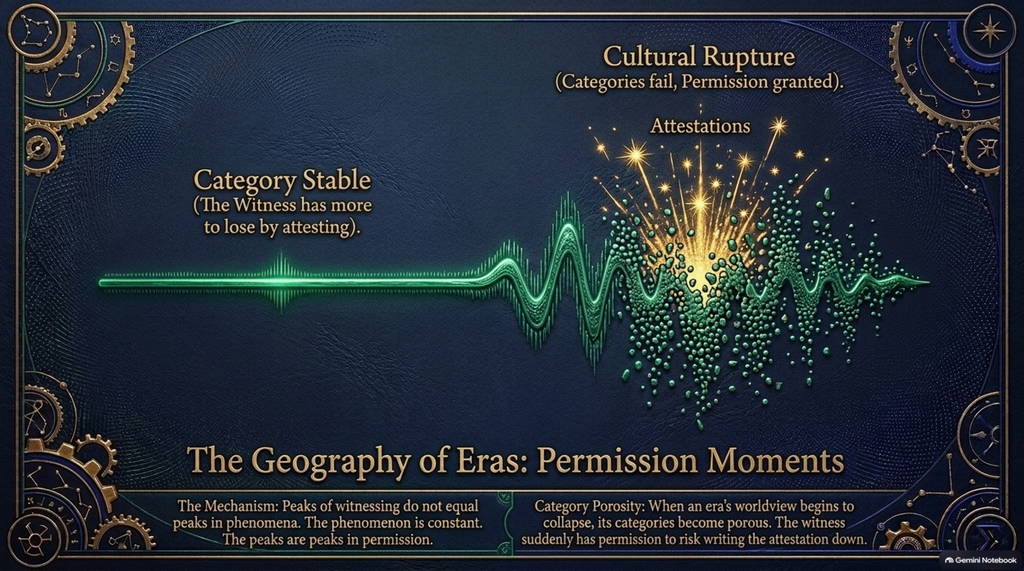
The 18,116 records in the Hatch database are not evenly distributed across the thousand years. They cluster. The clusters are not random. They fall at the cultural-rupture moments — the decades when the era’s categories are visibly failing, when the world is changing faster than the categories can be revised, when the witness has more to gain by attesting than by staying silent.
The Hatch database shows four peak decades:
- The 1950s: 4,403 records. The post-war decade, the dawn of the atomic age, the moment the technological categories that had held since the industrial revolution were visibly inadequate to the new scale of what human beings had made and what human beings had survived. The Mantell case (1948) and the Kinross scramble (1953) frame the peak.
- The 1970s: 3,884 records. The post-Apollo decade, the post-Watergate decade, the post-Vietnam decade, the moment the technological categories themselves became politically suspect. The Tehran incident (1976) and the Petrozavodsk phenomenon (1977) frame the peak on opposite sides of the Iron Curtain.
- The 1990s: 2,433 records. The post-Cold War decade, the moment the geopolitical categories that had held since 1945 were visibly exhausted. The Belgian wave (1989–1991) and the Phoenix Lights (1997) frame the peak.
- The 2020s: the current peak. The post-pandemic decade, the post-AARO-decade, the decade of the Pentagon UAP Task Force, the All-domain Anomaly Resolution Office, the June 2021 preliminary report, the July 2022 establishment of AARO, and the 2026 release of the Pentagon UAP material. The peak is not yet closed.
§2.1 — The peaks are not phenomenon intensifications
The peaks are not moments when more of the phenomenon is happening. The Keel-move says the phenomenon is invariant. The peaks are moments when the witness is more willing to write. The witness is more willing to write when the era’s categories cannot hold the witness’s ordinary experience of the world — when the witness is already in a state of category-loss, already in a state where the categories that have held since childhood are visibly failing. The witness who is already losing categories has less to lose by attesting. The witness who is in a category-stable moment has more to lose by attesting, and the attestation is less likely to be written.
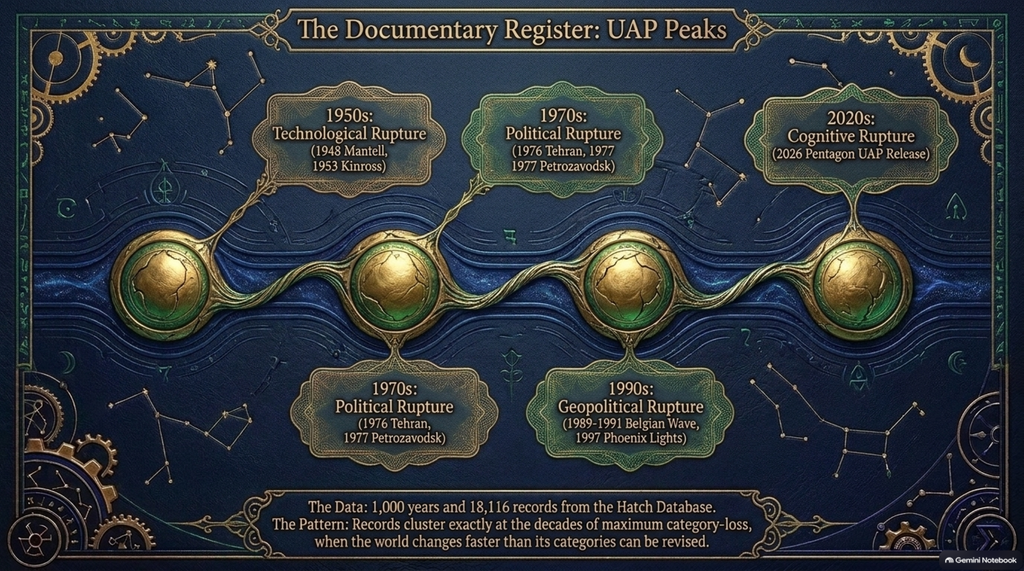
The peaks in the Hatch database are the decades of maximum category-loss. The 1950s were a decade of technological category-loss — the categories that had held in the 1920s were visibly inadequate. The 1970s were a decade of political category-loss. The 1990s were a decade of geopolitical category-loss. The 2020s are a decade of what might be called cognitive category-loss — the moment the categories that have held since the Enlightenment are visibly inadequate to the scale of the technological, ecological, and political pressures of the present.
The phenomenon is invariant. The witness’s willingness to write is variable. The witness’s willingness to write is highest when the era’s categories are most porous. The peaks in the Hatch database are the peaks in the witness’s willingness to write.
§2.2 — The citators behind the records
The 18,116 records were not collected by a single researcher. They were aggregated by Larry Hatch across thirty years of academic-grade citation work, drawing on the citators behind him — Jacques Vallée (the French-American computer scientist and UAP researcher whose Passport to Magonia (1969) and Dimensions (1988) established the academic-grade citation pattern the Hatch database inherits), and Richard Haines (the NASA-NARCAP scientist who, from the 1970s forward, established the scientific-citator infrastructure for the UAP record).
The citators are themselves witnesses — figures who saw the 18,116 records as a single document, and who wrote the attestation of the document down. The citators are the yetzirah-layer figures who recognise the witness’s attestation and make it available to the next era’s categories. The citators are upstream of the next era’s categories. The citators are the figures the atzilus-layer round produces when it presses into the citators’ own time.
The Hatch database is the yetzirah-layer document the citators produced. The 18,116 records are the atzilus-layer pressing the document makes visible. The 18,116 records are not the phenomenon. The 18,116 records are the attestation of the figure the phenomenon has produced.
§2.3 — The peaks as permission-moments
The peaks are moments when the era’s cognition gives the witness permission to attest. The permission is not granted by an institution. The permission is granted by the era’s category-porosity itself. When the categories are porous, the witness can risk writing. When the categories are dense, the witness cannot.
The phenomenon does not need the witness’s permission to happen. The phenomenon happens regardless. The witness’s attestation of the phenomenon needs the era’s permission to be written. The peaks in the Hatch database are the peaks in the era’s permission. The 18,116 records are the records of the era’s permission, not the records of the phenomenon.
The peaks therefore run on a different cycle from the phenomenon. The phenomenon is invariant. The era’s permission is variable. The era’s permission is highest at the cultural-rupture moments. The cultural-rupture moments are the moments when the era’s categories are visibly failing — when the world is changing faster than the categories can be revised.
The 1950s, the 1970s, the 1990s, the 2020s. Four peak decades. The next peak will arrive when the era’s categories become porous again. The next peak is not predictable. The next peak is a function of the era’s category-loss, not a function of the phenomenon.
§2.4 — The documentary register
The 18,116 records in the Hatch database are concentrated, as the documentary register of any modern phenomenon is concentrated, in the late-modern and post-industrial West. Sixty-seven per cent of the records are from the Western documentary sphere — the United States (44 per cent), France (12 per cent), Great Britain and Ireland (7 per cent). The remaining 33 per cent are spread across the rest of the world, with clusters in Russia, Brazil, China, and Japan.
The documentary concentration is not the witness’s concentration. The witness is everywhere. The witness is a thousand years. The documentary record is a thousand years of witnesses, with a Western late-modern bias in the second half of the thousand. The witness is upstream of the documentary register. The documentary register is a yetzirah-layer document the Western late-modern era produced of the witness’s attestation.
The documentary concentration is itself a Keel-move. The late-modern West was the era with the most porous categories and the most willing witnesses, and the documentary record reflects the era’s porosity, not the witness’s distribution. The witness is everywhere. The documentary register is late-modern-Western because the late-modern West was the era that gave the witness permission to write.
The 18,116 records are therefore not 18,116 sightings of the same object. The 18,116 records are 18,116 acts of witness by figures who held a question open, in an era that gave the witness permission to write. The 4,403 records in the 1950s are not 4,403 sightings of the same object. The 4,403 records are 4,403 acts of witness in a decade of maximum category-porosity.
§2 named the peak-pattern. §3 will name the parallel — the same pattern, in the same decades, in the Jewish messianic register.
§3 — The Messianic Parallel
§2 closed with the claim that the peaks in the UAP documentary register are peaks in the era’s permission, not peaks in the phenomenon. §2 also named the four peak decades — the 1950s, the 1970s, the 1990s, the 2020s. §3 asks the question the Keel-move makes the next move: is the same peak-pattern visible in the Jewish messianic register?
The parallel is structural before it is theological. In every documented case of cultural rupture, two projections appear in the same record. The first is the witness of the sky — the figure who saw something that could not be fitted into the era’s categories and wrote it down. The second is the figure who expected the world to be mended — who lived with the conviction that the broken cycle would close and a wholeness not currently visible would arrive. Across 1,000 years of witness-records, the UAP database shows the first. Across 2,000 years of Jewish time, the messianic tradition records the second.
The two projections are not the same. The witness writes what she has seen. The messianic figure waits for what she has not yet seen. But the psychic operation that produces both is the same. The witness breaks the cosmic frame because what she has seen will not fit. The messianic figure breaks the cosmic frame because the world as it is will not do. Both projections are compensations for rupture. Both carry the conviction that the atzilus-layer — the round, the whole, the unbroken — is pressing into the yetzirah-layer and has not yet completed its work.
§3.1 — The four messianic peaks
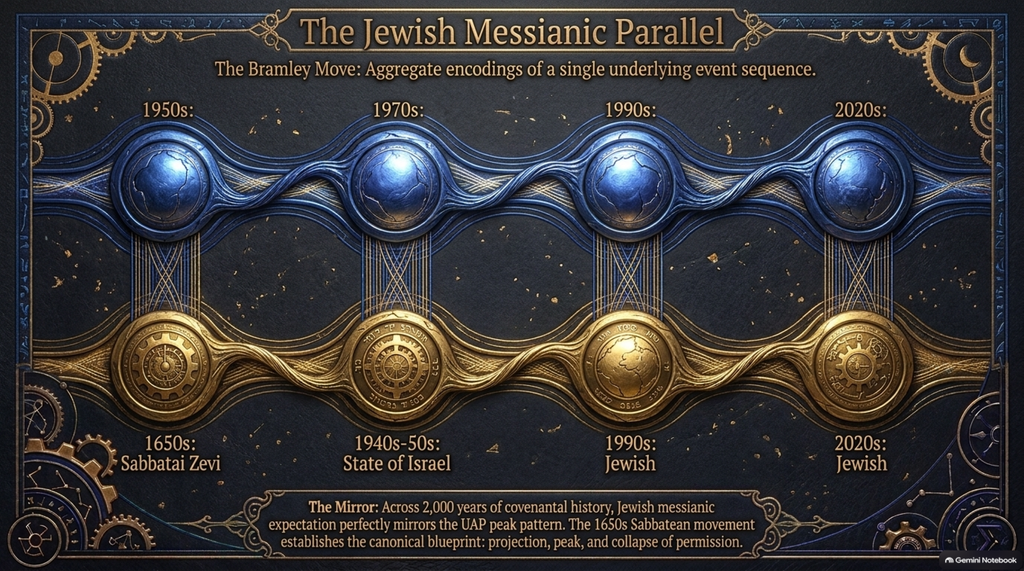
The Jewish messianic register shows four peak decades, in the same centuries the UAP register shows its peaks:
- The 1650s: Sabbatai Zevi (1626–1676) proclaimed himself Messiah in 1648, the year of the Khmelnitsky pogroms and the messianic-ferment peak in the Jewish communities of Eastern Europe. By 1666, Sabbatai had converted to Islam under Ottoman pressure. The Sabbatean movement’s collapse is the canonical case of a false-messianic peak. The mid-twentieth-century UAP register does not register the seventeenth century, but the structural pattern — projection, peak, collapse — is the same.
- The 1660s: the Sabbatean collapse proper, and the year of the Great Fire of London, the year of the Evliya Çelebi writings on the kabbalistic Sambatyon, and the year of the Polish messianic ferment that followed the Khmelnitsky pogroms.
- The 1940s–1950s: the Holocaust (1933–1945) and the State of Israel (1948) frame the modern messianic peak. The peak in Jewish messianic expectation runs from the State-of-Israel declaration forward through the 1950s. The peak in the UAP register runs in the same decades.
- The 1990s: the post-Cold War, post-Soviet-immigration, post-Oslo decade, the decade of the messianic ferment in the settler movement and the Lubavitcher moshiach-campaign, and the decade of the third UAP peak.
- The 2020s: the current peak, the post-pandemic, post-October-7 messianic ferment in Israeli religious-zionist politics, the messianic tension in the Iranian-Israel confrontation, and the fourth UAP peak, framed by the Pentagon UAP releases.
The two registers show the same four peak decades. The peaks are not simultaneous. The peaks are structurally aligned.
§3.2 — The Bramley move, held to the structural reading
The American researcher William Bramley, in The Gods of Eden (1989), argued that the Genesis narratives — the Adam-and-Eve, Cain-and-Abel, the Tower of Babel, the Flood — are not mythological primitives but aggregate encodings of a single underlying event sequence. The narrative, in Bramley’s reading, compresses what would otherwise be told across generations into a single symbolic register.
Bramley’s literal reading — that the Genesis narratives are eyewitness testimony to ancient astronauts or pre-Adamic civilisations — is held by the essay as not-load-bearing. The structural reading of Bramley is load-bearing: the Genesis narratives, and the parallel messianic-aggregate, are the yetzirah-layer encodings the era’s cognition produces when the atzilus-layer pressing arrives at the era’s threshold. The narratives compress the pressing into the form the era’s categories can hold. The narratives are not the pressing. The narratives are the yetzirah-layer trace the pressing makes when the pressing is held by the era’s cognition.
The messianic expectation across 2,000 years of Jewish time is, in the essay’s frame, an aggregate encoding of the same structural position the UAP register across 1,000 years of late-modern time encodes. The messianic expectation is not the round. The messianic expectation is the yetzirah-layer trace the round makes when the round presses into the form the Jewish register can hold.
§3.3 — Sabbatai Zevi: the canonical case
The Sabbatean movement is the canonical case of a messianic peak in the documentary record. The structural features are clear. A single figure (Sabbatai Zevi, born 1626) was named by his followers as the Messiah. The name carried the Saturnian resonance — Sabbetai is the Hebrew name of the planet Saturn (§4.3). The peak arrived at a moment of maximum category-loss in the Jewish communities of the Ottoman Empire, Poland, and the Italian ghettos. The collapse arrived when the figure was forced by Ottoman pressure to convert to Islam (1666).
The collapse is itself structurally significant. The messianic peak does not collapse because the messianic figure is shown to be false. The messianic peak collapses because the era’s cognition re-stabilises. The category-loss that gave the peak permission to happen has been resolved — by the failure of the figure, by the closure of the historical moment, by the re-stabilisation of the era’s categories. The peak in the documentary register is the peak in the era’s permission. The collapse is the era’s permission being withdrawn. The phenomenon — the atzilus-layer pressing — is invariant. The era’s permission is variable.
The Sabbatean case is therefore the Jewish-register case of the same structural pattern the UAP register shows. The UAP peak of the 1950s, the 1970s, the 1990s, the 2020s are the late-modern register of the same structural position. The messianic peak of the 1650s, the 1940s–1950s, the 1990s, the 2020s are the Jewish register of the same structural position.
§3.4 — The two registers, read in aggadah
The two registers are not competing accounts. The two registers are aggadic narratives of the same structural position. The aggadah is the narrative layer of rabbinic tradition — the layer that tells the story rather than rules the law (the complement to halakhah). The aggadah is the yetzirah-layer register the rabbinic tradition gives the cultural narrative, the messianic expectation, the witness’s attestation.
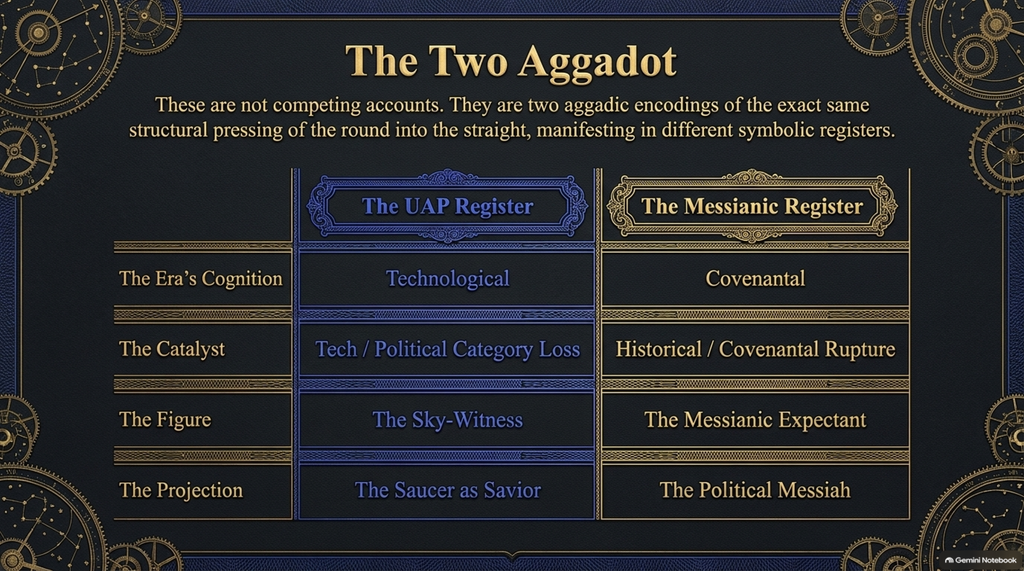
The witness’s attestation in the UAP register is aggadah. The messianic expectation in the Jewish register is aggadah. The two aggadot are not the same aggadah. The two aggadot are the same structural position, in two different symbolic registers, in two different cultural moments, in two different documentary traditions.
The UAP register and the messianic register are therefore not competing accounts of the same event. The two registers are two aggadic narratives of the round’s pressing into the straight — one in the late-modern documentary register, the other in the Jewish-covenantal register. The two registers run on the same cycle — the cycle of the era’s category-porosity — and the two registers peak in the same decades.
The midrashic parallel structure, named in the cogitation notes (the Jew as the religious specialist going about daily business with no interest in the “spooky,” the gentile as the witness who sees the sign, the gentile alerts the Jew with “look, there it is” gesture, the Jewish tradition receives what was recognised), is the structural form the reversal-of-recognition takes in the documentary register.
§3.5 — The Reversal of Recognition
The Jerusalem Talmud, in Berakhot 2:3 (5a), preserves a small story that names the reversal-of-recognition the documentary record runs in the form of:
“An Arab said to him . . . ‘Jew, Jew . . . today the Messiah-king was born.’ He said to him, ‘What is his name?’ [He replied] ‘Menachem’ . . . ‘Where is he from?’ He said to him, ‘From the royal capital of Bethlehem in Judea.'”
The story’s structural feature is the reversal of who sees and who is told. The Jew is the religious specialist — the figure with the categories, the figure trained in the messianic register, the figure who goes about his daily business with no interest in the “spooky.” The Arab is the witness — the figure who sees the sign, the figure who recognises the pattern, the figure who alerts the Jew.
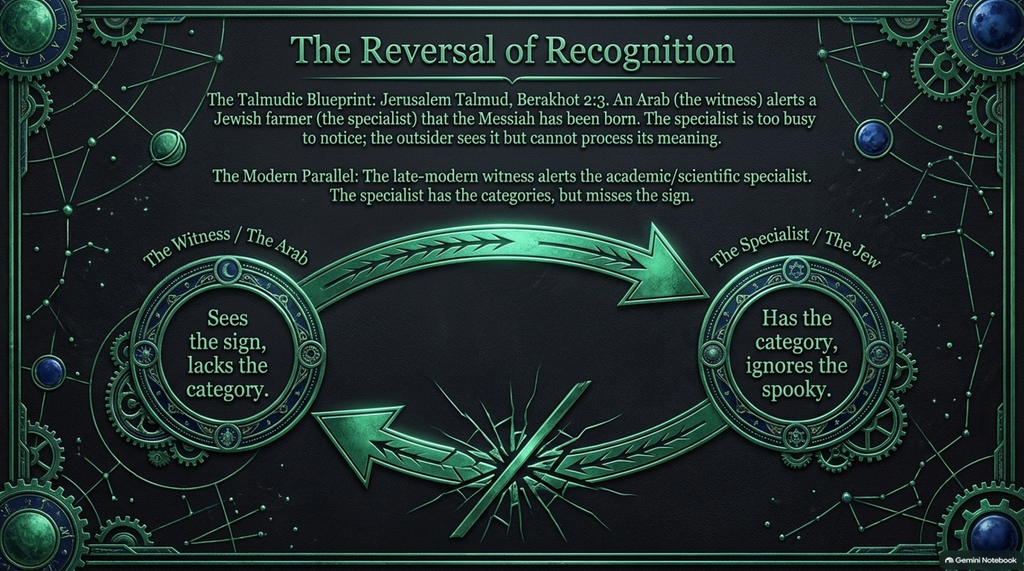
The midrash anticipates the documentary record. The documentary record runs in the form the midrash anticipated. The pattern in the UAP register is the same pattern in different clothes: the late-modern specialist is the figure with the categories, the late-modern witness is the figure with the sign, the late-modern witness alerts the late-modern specialist. The reversal is structural. The reversal is a feature of the witness-as-eid position, not a feature of any one culture or era.
The Babylonian Talmud’s parallel passage in Sanhedrin 98b — the list of the Messiah’s names (Menachem, Tzemach, the Leper of the House of Rabbi Yehuda ha-Nasi, the Son of David, the Son of the Fallen) — gives the same pattern in the more conventional midrashic register: the names of the Messiah are the names of the figure the witness recognises when the witness sees the sign. The witness’s recognition is upstream of the names. The names are the yetzirah-layer traces the recognition makes in the rabbinic register. The reversal-of-recognition in the Jerusalem Talmud is the yetzirah-layer trace the recognition makes in the documentary register.
The midrash and the documentary record are not competing accounts. The midrash and the documentary record are the same aggadic narrative of the round’s pressing into the straight, in two different symbolic registers, in two different cultural moments, in two different documentary traditions.
§3 named the parallel. §4 will name the figure both records trace.
§4 — The Compressing Spiral
§1 named the witness. §2 named the peak-pattern. §3 named the parallel. §4 names the figure both records trace.
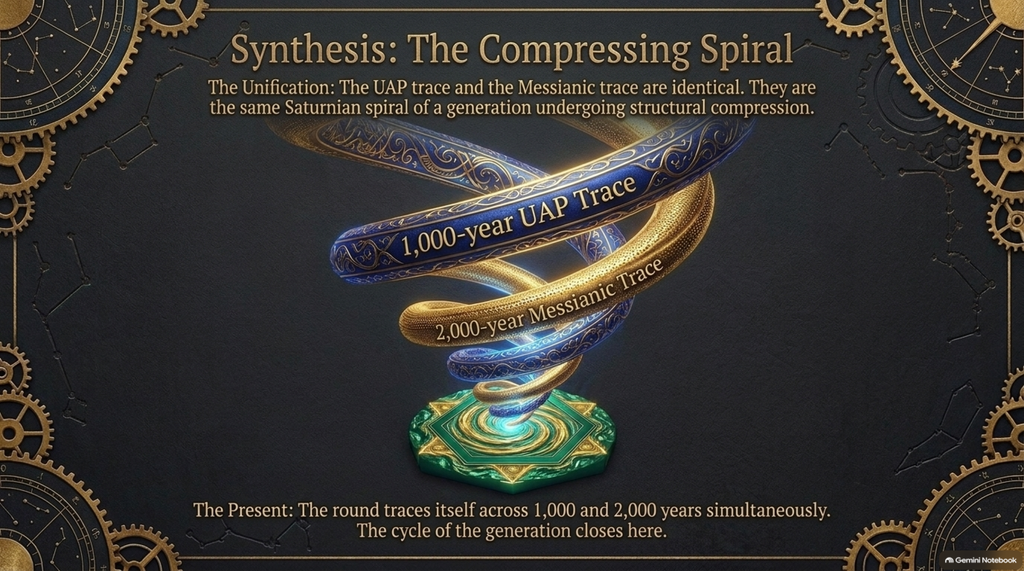
The 18,116 witnesses and the four messianic peaks are not simultaneous. They are not even coincident in the casual sense — the witness and the messianic figure belong to different populations, different documentary registers, different modes of attention. What they share is the shape of the curve they describe across time. The curve has peaks and valleys. The peaks are not regular. They cluster at the cultural-rupture moments — the moments when the era’s categories cannot hold the pressure that is arriving. The four messianic peaks and the four UAP peaks fall at the same decades on both registers. The parallel §3 named is the data this §4 will interpret.
§4.1 — Saturn as the planet of the witness
There is a Jewish astrological tradition, much older than the documentary record and older than modern astronomy, that names the planet whose cycle is the cycle of structural pressure. In Hebrew the planet is called Shabbetai — the name gives the seventh day of the week (Shabbat) to the planet whose orbit is the slowest of the planets visible to the naked eye. The Babylonian Talmud, tractate Shabbat 156a, refers to Saturn as Shabbetai — the star of Shabbat — and the association runs from the Talmudic period forward through the medieval Jewish astrological tradition into the present (Katz Center; Idel 2011).
Saturn is the slowest visible planet. Its orbital period is 29.5 Earth years. It marks a generation. Its return to a position in the zodiac takes the same time as Saturn’s complete orbit through the twelve signs. The rare-event tradition in medieval Jewish astrology — codified in the Sefer ha-Mahbarot (the Book of Conjunctions) of Abraham Ibn Ezra and developed by Abraham Zacuto and others — reads the conjunctions of Saturn with Jupiter (the “Great Conjunction,” approximately every twenty years) as the astronomical signature of historical-regime change. The Saturn-Jupiter conjunction of 7 BCE, calculated by Johannes Kepler, is one of the candidate identifications for the Star of Bethlehem. The 2020 Saturn-Jupiter conjunction of 21 December 2020, at 0° Aquarius, opened the rare-event sequence the present century is inside (Katz Center; Rachav Foundation, “Saturn’s Jews,” 2025).
The point is structural. Saturn marks the slowest natural cycle visible from Earth. The slowest natural cycle visible from Earth is the most natural astronomical register for the slow compression of an era. When the era’s categories cannot hold the pressure, the Saturn cycle is the one whose conjunction pattern shows it.
§4.2 — The malefic planet, and the remedy
In the Greek and Arab astrological traditions that medieval Jewish thought engaged with, Saturn is the Greater Malefic — the planet of cold, of limit, of the death of forms, of the karet (cutting off) that follows the exhaustion of a structure. The association of Saturn with the Jews, mediated by the Sabbath’s day-of-the-week correspondence, gave the Jews a negative planetary patron in the eyes of medieval astrology: governed by the Greater Malefic, the Jews were suspected of being themselves malefic, melancholy, given to sorcery (Idel 2011; Katz Center).
Abraham Ibn Ezra (1089–1161), the first Jewish thinker to deal with the problematic of the Saturn-Jews-Sabbath association systematically, re-reads the tradition rather than denying it. In his commentary on Exodus 20:8 — the fourth commandment, zachor et yom ha-Shabbat lekadsho, “remember the Sabbath day and keep it holy” — Ibn Ezra argues that the correspondence between the planet Saturn, the day of rest, and the people who keep the day, is not an accident. Saturn is malefic. The Sabbath observance is the remedy. When Israel stops its weekly labour and enters the shabbaton — the day of rest — the malefic pressure of Saturn is suspended for that day. The Jew, by keeping the rest, rises above the decrees of the stars (Strickman & Weiser 1988; Sela 2017; Katz Center).
The halakhic register, in Ibn Ezra’s reading, is the operational form of the astrological remedy. The tradition is not that the Jews are contaminated by the Greater Malefic. The tradition is that the Jews carry the Greater Malefic’s pressure in their covenantal life, and that the shabbaton — the suspension of making, the day of rest — is the practice that releases them from the malefic pressure for one day in seven. The witness’s testimony, in the halakhic register, requires the witness to be in a state of menuchah — rest, settledness, the cessation of the everyday making. The witness speaks from the shabbaton. The witness is the figure who has been released from the Greater Malefic’s pressure, and who can therefore attest.
§4.3 — The Kabbalistic binding: Saturn = Binah
In the Kabbalistic tree of the sefirot, Saturn is bound to the sefirah of Binah — the second of the ten emanations, the gimatria of bein (between), the gevurah of Chokhmah, the womb of form. Binah is the sefirah of restriction, of the limitation that turns Chokhmah (the flash of pure light) into the structure of created form. The other planets are bound to other sefirot: Jupiter to Chesed (mercy), Mars to Gevurah (severity), the Sun to Tiferet (beauty), Venus to Netzach (eternity), Mercury to Hod (splendour), the Moon to Yesod (foundation). Saturn is bound to the sefirah of the severity of severity — the depth of the womb that gives form to form (Scholem; Idel 2011).
The binding is structurally significant. Binah is the yetzirah-layer’s deepest cut. Below Binah is the atzilus-layer — the round, the unbroken, the igul §1 named. Above Binah is the world of forms — the yosher, the straight lines, the structures the world is made of. The witness comes from the round; the witness attests in the straight. The witness is the trace of Binah — the sefirah that limits, that gives form, that is the most proximate yetzirah-layer station to the atzilus-layer. The witness is the cut the round makes when it presses into the straight. The Kabbalistic binding of Saturn to Binah is the same tradition, encoded in a different register.
The rabbinic tradition that named Sabbatai Zevi (1626–1676) is therefore saturated with Saturnian resonance. Sabbetai in Hebrew is the name of the planet. The false messiah was named with the planet’s name. The messianic figure whose name carried the planet’s name was the figure who carried the planet’s malefic pressure into the messianic register. The Sabbatean movement, in Idel’s reading, was the moment when the Saturn-Binah-messianic complex surfaced into active historical projection. The movement’s collapse in 1666, when Sabbatai converted to Islam under Ottoman pressure, was the moment when the Saturnian malefic was released into Jewish historical experience at the most intense pressure since the destruction of the Second Temple (Idel 2011; §3.3).
§4.4 — The 2020 conjunction
The 12 January 2020 conjunction of Saturn and Pluto, in the sign of Capricorn, at 22°46′, is the rare-event tradition firing in the same decade the UAP documentary record peaks.
The 21 December 2020 conjunction of Saturn and Jupiter, in the sign of Aquarius, at 0°, is the Great Conjunction — the twenty-year rare-event sequence. The Great Conjunction is the one medieval Jewish astrology read as the signature of historical-regime change. The 2020 Great Conjunction opened a new air-triplicity sequence in the rare-event cycle (the previous fire-triplicity sequence opened in 1603, the year after Sabbatai Zevi proclaimed himself the Messiah in 1648, the conjunction of which tradition Idel traces).
The Pentagon UAP Task Force was established in August 2020, seven months after the Saturn-Pluto conjunction and four months before the Great Conjunction. The Task Force’s preliminary report was issued in June 2021. AARO (the All-domain Anomaly Resolution Office) was established in July 2022. The 2020s peak in the UAP documentary record — the latest in the four-peak sequence §2 named — runs parallel to the rare-event astronomical tradition. The tradition says the conjunction is the moment of structural pressure. The record says the witness peaks at the same moment. The two are not causally connected. They are structurally aligned.
§4.5 — The cosmic magen david
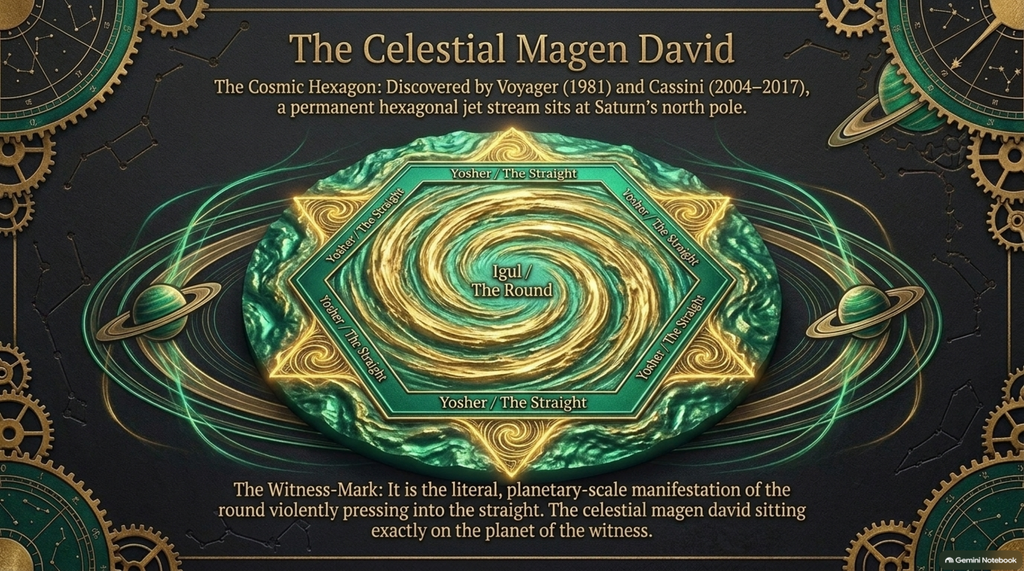
The Voyager mission in 1981, and the Cassini mission from 2004 through 2017, photographed a stable hexagonal atmospheric structure at Saturn’s north pole — a jet stream in the form of a perfect six-sided polygon, rotating with the planet’s interior, persisting across decades of observation. The hexagon is the only known naturally-occurring hexagonal atmospheric structure in the solar system (Rachav Foundation, “Saturn’s Jews,” 2025).
In Jewish symbolism, the number six is the number of the six days of creation — the days of work that culminate in the seventh day of rest. The magen david (shield of David, hexagram) is the most recognizable symbol of Judaism, and its central figure is a hexagon. The cosmic hexagon on Saturn’s north pole is the celestial magen david — the witness-mark of the structure the round has been pressing into across 1,000 years and 2,000 years. The hexagon is the form the round takes when it presses into the straight at the level of planetary atmosphere. The hexagon is on the planet of the witness. The hexagon is at the north pole — the point of axial orientation, the point of tzafun (hidden, concealed), the point at which the planet’s rotational structure is most purely present.
The cosmic hexagon is the structural witness that the round has been pressing into the straight across the 29.5-year cycle of Saturn’s orbit. The mid-twentieth-century peak and the 2020s peak in the UAP record arrive at the moments when the cosmic hexagon is photographically documented. The hexagon is not the cause of the peak. The hexagon is the celestial form the round is taking at the moment the peak arrives.
§4.6 — The contemporary saucer as saviour
C. G. Jung’s Flying Saucers: A Modern Myth of Things Seen in the Skies (1959) — the §1 anchor’s later companion — reads the post-war UAP wave as the compensatory projection of a culture that has lost its traditional religious symbol of redemption. The saucer is the technological form the yetzirah-layer projection takes when the yetzirah-layer is technological. The messianic figure in the Jewish register is the political form the yetzirah-layer projection takes when the yetzirah-layer is covenantal. The two projections arrive together. The two projections are the same projection in different symbolic registers (Jung 1959; §1).
The Saturnian cycle is the cycle that contains both. Saturn’s 29.5-year orbit is the cycle of a generation. The mid-twentieth-century peak in the UAP record and the mid-twentieth-century peak in Jewish messianic expectation run in the same generation — the generation that saw the Holocaust and the State of Israel. The 2020s peak in the UAP record and the 2020s rare-event astronomical tradition run in the same generation — the generation that has seen the Saturn-Pluto conjunction and the Pentagon UAP releases. The Saturnian cycle contains both peaks on both registers. The Saturnian cycle is the cycle of the spiral.
§4.7 — Closing the figure
The spiral the round traces when it presses into the straight across 1,000 years and 2,000 years at once is a Saturnian spiral. The slow cycle. The cycle of a generation. The cycle that the rare-event tradition reads as the moment of structural pressure.
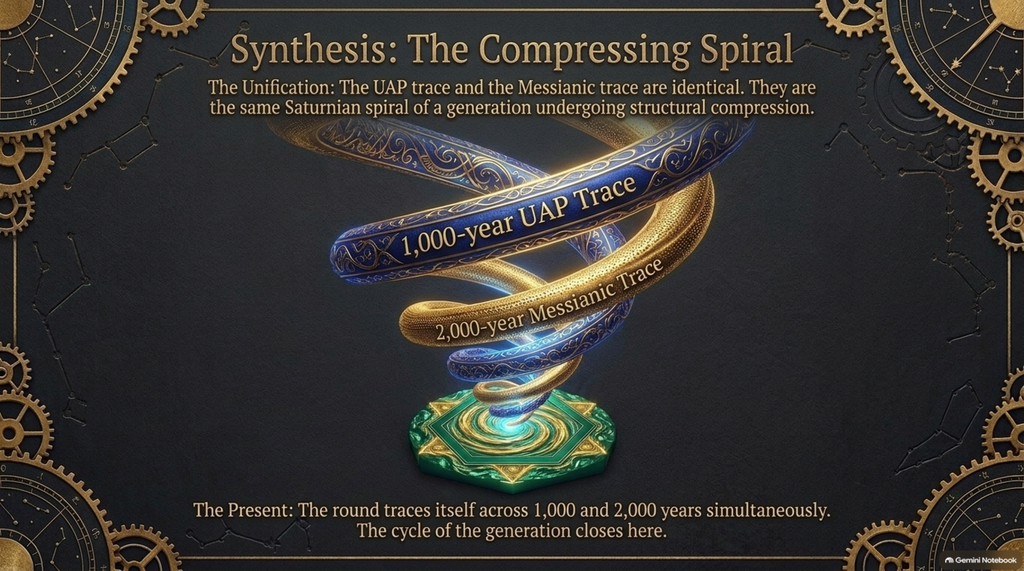
The 18,116 witnesses are the yetzirah-layer trace of the round’s pressing on the late-modern-clock side. The four messianic peaks are the yetzirah-layer trace of the round’s pressing on the Jewish-clock side. The cosmic hexagon on Saturn’s north pole is the celestial witness-mark that the round is pressing into the straight at the planetary level. The Saturn-Pluto conjunction of January 2020 is the astronomical signature of the moment the pressing is most intense.
The witness is Saturnian. The witness is the figure the atzilus-layer round produces when it presses through Binah into the yetzirah-layer of the witness’s era. The witness speaks from the shabbaton — the suspension of the Greater Malefic’s malefic pressure. The witness attests. The witness’s attestation is the Saturnian gemul — the recompense the malefic pressure produces when it is held long enough. The gemul is the witness. The witness is the gemul.
The compressing spiral is the figure the round traces. The witness is the figure the spiral produces. The figure traces itself across 1,000 years and 2,000 years at once. The figure is Saturnian. The figure is the cycle of a generation. The figure is the present.
§5 — The Witness’s Invitation
The essay has been asking one question, and has not answered it. The question is not “what is the phenomenon?” The question is what it would mean to be the figure who attests to the phenomenon — the witness, the eid, the one whose attestation is the yetzirah-layer trace of the atzilus-layer’s pressing through Binah into the witness’s own time.
The structural reading has refused the substantive answer on purpose. The substantive answer — that the phenomenon is a spacecraft, or a hallucination, or a psychohistorical projection, or a contact event, or a trick of the light, or the architecture of the cosmos made momentarily visible — is a question the era’s categories can hold, and the witness is by definition the figure whose attestation breaks the era’s categories. To answer the substantive question is to remain inside the era. To refuse the answer is to remain with the witness.
The witness is not the believer. The believer has already answered the substantive question — the believer knows what the witness saw, and the believer’s knowing is a knowing that does not require the witness. The believer is downstream of the witness. The witness is upstream.
The witness is not the skeptic. The skeptic has already refused the substantive question — the skeptic knows the witness was mistaken, and the skeptic’s knowing is a knowing that does not require the witness either. The skeptic is downstream of the witness in the other direction. The skeptic is upstream of the era’s categories and downstream of the witness’s attestation.
The witness is upstream of both. The witness is the figure who holds the question open. The witness is the figure who has seen what cannot be fitted into the era’s categories and who has not yet decided what the seeing means. The witness is the figure whose attestation is the gemul — the recompense — that the Saturnian malefic pressure produces when it is held long enough in the yetzirah-layer of the witness’s own time.
The witness’s testimony, in the halakhic register, requires the witness to be in a state of menuchah — rest, settledness, the cessation of the everyday making. The witness speaks from the shabbaton. The witness is the figure who has been released from the Greater Malefic’s pressure, and who can therefore attest. The witness is the figure the round produces when it presses through Binah into the witness’s own time, and the witness is the figure who speaks from the day of rest, and the witness’s attestation is the yetzirah-layer trace of the round’s pressing.
The figure the round traces when it presses into the straight is a Saturnian spiral. The witness is the figure the spiral produces. The witness is the figure who, on a single evening in the late-modern record, looked up and saw structured lights perform manoeuvres her instruments said should have been impossible, and who wrote it down. The witness is the figure who, on a single evening in the medieval scholastic register, looked up and saw a wheel of light in the night sky, and who wrote it down. The witness is the figure who, on a single evening across a thousand years and a thousand records, looked up and saw what could not be fitted into the era’s categories, and who wrote it down. The witness is eighteen thousand. The witness is one.
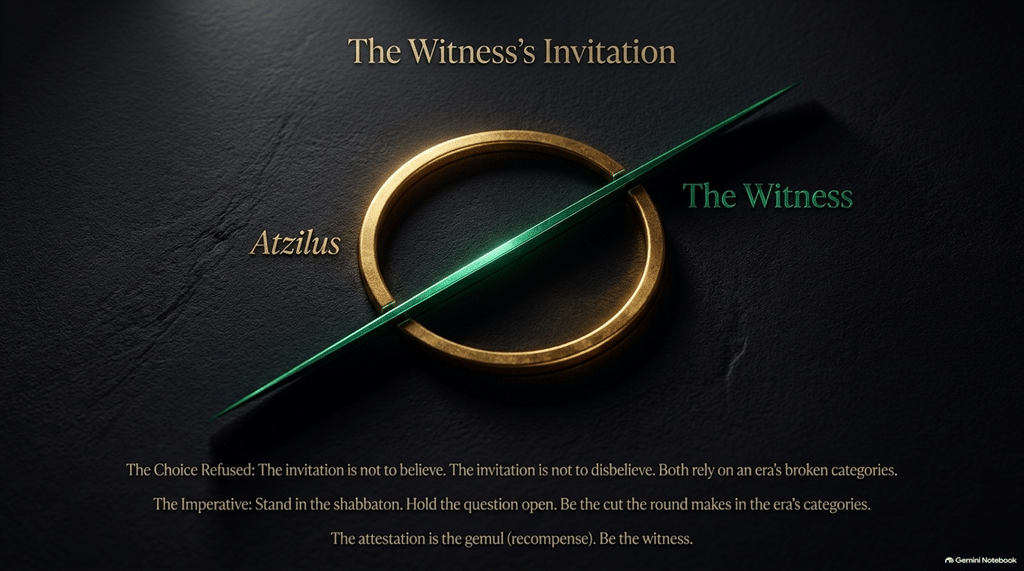
The essay closes with an invitation. The invitation is not to believe. The invitation is not to disbelieve. The invitation is to step into the structural position the essay has been describing — the position of the witness, the eid, the figure who holds the question open. The era’s categories cannot hold what the witness has seen. The era’s categories will be replaced, in time, by the next era’s categories. The witness’s attestation is the yetzirah-layer trace that the next era’s categories will have to account for. The witness is upstream of every era.
The invitation is to be the figure who, in the late-modern register, in the moment when the cosmic hexagon is on the planet of the witness and the Saturn-Pluto conjunction has just fired, looks up and sees what cannot be fitted into the era’s categories, and who does not decide what the seeing means, and who writes it down anyway. The attestation is the shabbaton. The attestation is the rest. The attestation is the recompense. The attestation is the gemul.
The attestation is the figure the round produces when it presses into the straight. The figure traces itself across a thousand years and two thousand years at once. The figure is the witness. The figure is the invitation.
Appendix A — Glossary
The terms below appear across §1 through §5. Each is given a plain-English definition. The first appearances in the essay are marked (e.g., §1.3 means the third sub-section of §1). Terms in italics within a definition are themselves glossary entries.
Hebrew and Kabbalistic terms
Aggadah (§3.4) — the narrative layer of rabbinic tradition, the layer that tells the story rather than rules the law. The complement to halakhah. Both the messianic expectation and the UAP witness-records are read in this essay as aggadah — narrative trace of a structural pressure, not legal ruling on the pressure.
Atzilus (§1.5) — in Kabbalistic cosmology, the highest of the four worlds of yetzirah-level emanation. The world of the round, of pure emanation, of unbroken light. In the essay’s frame, the round that contains the straight. The atzilus-layer is the source of the pressing; the yetzirah-layer is where the pressing becomes visible as form.
Binah (§4.3) — the second of the ten sefirot. The sefirah of restriction, of the limitation that turns Chokhmah (the flash) into form. In Kabbalistic astrology, Binah is bound to Saturn. The essay reads this binding as the Kabbalistic encoding of the same tradition the essay traces in Ibn Ezra’s Sefer ha-Te’amim — Saturn is the planet of the sefirah that limits, that gives form, that is the most proximate yetzirah-layer station to the atzilus-layer.
Chesed (§4.3) — the fourth of the ten sefirot. The sefirah of mercy, of expansion, of the kindness that runs forward. In Kabbalistic astrology, Chesed is bound to Jupiter — the Greater Benefic, the planet of the day’s blessing. The complement of Gevurah in the sefirotic structure.
Chokhmah (§4.3) — the first of the ten sefirot. The sefirah of the flash, of pure light, of the moment before the limitation that Binah imposes. The Kabbalistic name for the flash of insight that has not yet been formed into structure.
Eid, Eidim (§1.4) — Hebrew for witness, witnesses. In halakhic register, the eid is the figure who has seen an event and is qualified to testify to it under the formal rules of testimony (see Sanhedrin; Deuteronomy 19:15). The essay extends the term beyond the courtroom to the figure whose attestation is the yetzirah-layer trace of the atzilus-layer’s pressing. The witness is the eid of the round.
Gemul (§4.2, §4.7) — recompense, the return. In Kabbalistic and Hasidic register, the gemul is what the malefic pressure produces when it is held long enough in a soul’s life. The essay uses the term to name the witness’s attestation as the Saturnian gemul — the recompense the malefic pressure produces when it is held long enough in the yetzirah-layer of a generation.
Gevurah (§4.3) — the fifth of the ten sefirot. The sefirah of severity, of restriction, of the strength that runs inward. In Kabbalistic astrology, Gevurah is bound to Mars. The complement of Chesed in the sefirotic structure. The mother of the sefirotic severity is Binah — Saturn is therefore bound to the gevurah of Chokhmah in the essay’s reading.
Halakhah (§1.5, §3.4) — the legal layer of rabbinic tradition, the layer that rules the law. The complement to aggadah. In the essay, halakhah is the layer that does not interfere with the witness’s attestation; the law is what the era’s categories can hold, and the witness breaks the categories and writes outside them.
Hod (§4.3) — the eighth of the ten sefirot. The sefirah of splendour, of the form that admits communication. In Kabbalistic astrology, Hod is bound to Mercury. The structural complement of Netzach in the sefirotic tree.
Igul (§1.5) — Hebrew for round, circle. The igul is the atzilus-layer form — the whole, the unbroken, the source. The straight lines of the yetzirah-layer are pressed into the igul contains. The round contains the straight. The straight is the cut the round makes when it presses into form.
Karet (§4.2) — cutting off, excision. In halakhic register, the most severe form of divine punishment — the soul is cut off from the people. The essay reads Saturn as the planet of karet — the death of forms, the exhaustion of a structure, the moment the era’s categories cannot hold the pressing any longer.
Malkuth (§4.3) — the tenth of the ten sefirot. The sefirah of kingdom, of the manifest world, of the place where the yetzirah-layer’s straight lines are made into the world. The bottom of the sefirotic tree.
Menuchah (§4.2) — rest, settledness, the cessation of the everyday making. In halakhic register, the state required of a witness for testimony to be valid. The shabbaton is the weekly institutional form of menuchah; the witness’s attestation is the yetzirah-layer form of menuchah — the figure who has been released from the Greater Malefic’s pressure long enough to attest.
Midrash (§3.1) — the rabbinic literature of scriptural interpretation. The aggadah layer of rabbinic tradition is largely transmitted in midrashic form. The essay reads the Jerusalem Talmud’s Berakhot 2:3 story of the Arab and the Jewish farmer as midrashic — narrative, not legal.
Netzach (§4.3) — the seventh of the ten sefirot. The sefirah of eternity, of the long pattern, of the victory that runs across generations. In Kabbalistic astrology, Netzach is bound to Venus. The structural complement of Hod in the sefirotic tree.
Sefirot, Sefirotic (§1.5, §4.3) — the ten emanations through which the Kabbalistic tradition describes the structure of the divine. Top to bottom: Chokhmah, Binah, Chesed, Gevurah, Tiferet, Netzach, Hod, Yesod, Malkuth (with Keter as the crown above Chokhmah in most formulations). The essay uses the sefirotic structure as a yetzirah-layer map of the structural positions the essay names.
Shabbaton (§4.2, §4.7) — the day of rest, the Sabbath. The shabbaton is the weekly institutional form of menuchah — the cessation of the everyday making. In Ibn Ezra’s reading (§4.2), the shabbaton is also the halakhic remedy for the Saturnian malefic pressure; when Israel stops its weekly labour, the Greater Malefic’s pressure is suspended for that day.
Tiferet (§4.3) — the sixth of the ten sefirot. The sefirah of beauty, of balance, of the centre of the sefirotic tree. In Kabbalistic astrology, Tiferet is bound to the Sun. The structural mediator between Chesed and Gevurah in the sefirotic tree.
Yetzer, Yetzirah (§1.5) — yetzirah is the second of the four Kabbalistic worlds, the world of formation. The yetzirah-layer is the layer where the round is cut into form, where the igul becomes the yosher. The witness’s attestation is a yetzirah-layer trace of the round’s pressing. Yetzer (without the final -ah) is the inclination — the yetzer hatov (good inclination) and the yetzer hara (evil inclination) of the rabbinic moral register.
Yosher (§1.5) — Hebrew for straight, upright. The yosher is the yetzirah-layer form — the straight lines, the structures, the cuts. The igul contains the yosher; the yosher is the trace the igul makes when it presses into form. The witness is a yosher — a straight-line attestation of the round.
Astronomical and astrological terms
Hexagon at Saturn’s north pole (§4.5) — a stable hexagonal atmospheric jet stream at Saturn’s north pole, discovered by the Voyager mission in 1981 and studied in detail by the Cassini mission from 2004 through 2017. The hexagon is the only known naturally-occurring hexagonal atmospheric structure in the solar system. The essay reads it as the cosmic magen david — the celestial witness-mark of the round pressing into the straight at the planetary level.
Saturn (Shabbetai) (§4.1) — the sixth planet from the Sun, the slowest visible planet, with an orbital period of 29.5 Earth years. In Hebrew, Shabbetai — the star of Shabbat. In Greek and Arab astrology, the Greater Malefic — the planet of cold, of limit, of the death of forms. In the Babylonian Talmud (Shabbat 156a), Shabbetai is the star assigned to the seventh day, and the Jews are astrologically governed by Saturn through the Sabbath’s day-of-the-week correspondence.
Saturn-Jupiter conjunction (Great Conjunction) (§4.1) — the conjunction of Saturn and Jupiter in the same zodiacal degree, occurring approximately every twenty years. In medieval Jewish astrology, codified in Ibn Ezra’s Sefer ha-Mahbarot, the Great Conjunction is the astronomical signature of historical-regime change. The 7 BCE triple conjunction of Saturn and Jupiter in Pisces, calculated by Johannes Kepler, is one of the candidate identifications for the Star of Bethlehem. The 21 December 2020 Great Conjunction, at 0° Aquarius, opened the present century’s rare-event sequence.
Saturn-Pluto conjunction (§4.4) — the conjunction of Saturn and Pluto, occurring approximately every 33 to 38 years. The 12 January 2020 conjunction, at 22°46′ Capricorn, is the rare-event tradition firing in the same decade the UAP documentary record peaks.
Document register and methodology terms
Citator (§2) — a researcher who catalogs and routes witnesses to the documentary record. Jacques Vallée and Richard Haines are the citators behind the Hatch UAP database.
Hatch UAP database (§1.2) — the 18,116-record catalogue of unidentified aerial phenomenon reports collected by Larry Hatch between 989 AD and 2003 AD, with 62 attribute codes per record. The database is the documentary spine of the essay.
Witness (in the essay’s structural sense) (§1.4) — the figure who has seen what cannot be fitted into the era’s categories and has written it down. The witness is upstream of every era. The witness is the yetzirah-layer trace of the atzilus-layer’s pressing through Binah into the witness’s own time. The witness is the eid.
Witness-as-aggregate-encoding (§3.2) — the structural reading of the documentary record. The messianic expectation across 2,000 years of Jewish time, and the UAP witness-records across 1,000 years of late-modern time, are read as the same aggregate encoding of the round’s pressing — two documentary registers of the same structural position. The Bramley move, held to the structural reading, not the literal.
About The Author