
Rachav Daily — A Spiritual Geopolitical Reading
Date: Sunday, 19 July 2026 — 5 Av 5786
Hebrew date: 5 Av 5786 — Day 300 of the year
Days until Tisha B’Av: 4
Compiled for: Peter Dixon — Rachav Foundation
Series frame: 5-framework rotation (Prophets / Halakha / Kabbalah / Modern Philosophy / Liturgy). Today’s rotation slot: Halakha (the Nine Days, mourning that does not look away from the world, the discipline of decreasing joy).

I. Anchor — The Earth Is the LORD’s and the Fullness Thereof
| Field | Value |
|---|---|
| Gregorian | Sunday, 19 July 2026 |
| Hebrew | 5 Av 5786 (5 אָב ה׳תשפ״ו) |
| Day-of-year | 300 (from 1 Tishrei) |
| Days until Tisha B’Av | 4 |
| Days until next Rosh Hashanah | 55 |
| Weekday psalm | Psalm 24 — “The earth is the LORD’s and the fullness thereof” |
This is the fifth of Av, the fifth day of the Nine Days. The month opened with Rosh Chodesh Av and the descent into the most acute mourning period of the Jewish year — the nine days that culminate in the fast of Tisha B’Av, when both Temples fell, when the spies returned with an evil report, when the city was unmade. We are past the halfway point now. The customs intensify: no meat, no wine, no fresh laundry, no music, no swimming, no new garments, no shehecheyanu. The Talmud (Taanit 26b) calls these days the days on which “the tide of fortune turned from good to bad.” And yet they are not days of withdrawal from the world. They are days of looking more carefully at the world — because the destruction of Jerusalem, in the rabbinic imagination, was not a natural catastrophe but a moral one. The Temple was destroyed, says the Talmud, because of sinat chinam — baseless hatred. The mourning is not for stones; it is for the social fabric that could not hold.

The weekday psalm for Sunday is Psalm 24: לַיהוָה הָאָרֶץ וּמְלוֹאָהּ — “The earth is the LORD’s and the fullness thereof; the world, and they that dwell therein.” It is a psalm of ownership, sung when the Torah is returned to the ark on weekdays. It is also a psalm of gates: שְׂאוּ שְׁעָרִים רָאשֵׁיכֶם — “Lift up your heads, O ye gates; and be ye lifted up, ye everlasting doors; and the King of glory shall come in.” On a Sunday in the Nine Days, the psalm is sung by a people who know the gates have been breached before, and may be breached again. The earth belongs to the Holy One; the destruction is not the final word. But the gates must be lifted up. The doors must be opened. The psalm is not passive; it is a call to prepare the way.
The single most important sentence of the day: The mourning of Av is not a retreat from the world but a demand to look at it without the anaesthetic of habit.
II. Geopolitical Currents —
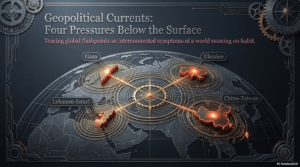
Four Pressures Below the Surface
Four currents, deliberately spanning regions. Read not as predictions but as pressures refracted through the day’s anchor.
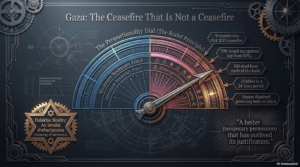
1. Gaza: The Ceasefire That Is Not a Ceasefire
Current: Nine months into the US-brokered ceasefire of October 2025, Israel now controls nearly 70% of Gaza — up from 50% when the deal was signed. Despite the agreement, Israeli strikes have killed 13 Palestinians in a single 24-hour period this week, and Gaza’s Health Ministry reports that an estimated 300 Palestinians referred for treatment abroad have died since the ceasefire began because the blockade prevents evacuation. Hamas dissolved its Gaza governing body on 6 July as a gesture toward the peace plan, but the disarmament question — the second and more sensitive phase of the ceasefire — remains unresolved. The territory is in what the International Crisis Group calls “humanitarian purgatory”: two million people whose access to food, water, and medicine is contingent on weapons collection that has not begun.
Spiritual surface: The Halakha of the Nine Days forbids shehecheyanu — the blessing of newness — because the world is not new. It is broken. The ceasefire that is not a ceasefire is a shehecheyanu that was never valid: a declaration of peace that the facts on the ground do not support. The Talmud (Yevamot 90b) teaches that the court may declare a temporary ordinance in a time of emergency, but it must be proportionate to the emergency. A ceasefire that leaves 70% occupation, daily killings, and a medical blockade is not proportionate. It is a heiter — a permission — that has outlived its justification. The Halakhic question is not whether Israel has a right to security; it is whether the specific measures being taken under the rubric of security can still be justified as the minimum necessary under the rodef principle.
Sources:
– NPR — “9 months into a ceasefire, Israel now controls nearly 70% of Gaza” (10 Jul 2026)
– Al Jazeera — “Israeli attacks on Gaza kill six people despite ‘ceasefire’” (9 Jul 2026)
– BBC News — Gaza live updates
– Democracy Now! — “Hamas Renouncing Rule Over Gaza Signals Commitment to Ceasefire” (7 Jul 2026)
2. Ukraine: Day 1,603 and the Attrition Without End
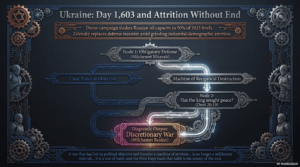
Current: Day 1,603 of the full-scale invasion. Ukraine’s drone campaign in the Sea of Azov has hit Russian oil infrastructure relentlessly; Russian missile and drone strikes have killed at least 60 people in the Kyiv metropolitan area since the beginning of July. President Zelensky has replaced his defence minister amid the grinding war, a move that has dismayed some lawmakers despite recent military successes. Russian oil-refining capacity is reportedly running at half its 2025 level. The war has become a war of industrial and demographic attrition: neither side can negotiate politically, neither side can win militarily, and the casualties accumulate on both sides without a conceivable political end-state.
Spiritual surface: The Mishnah (Sotah 9:14) records that with the footsteps of the Messiah, chutzpah will increase, the cost of living will rise, governments will turn to heresy, and there will be no paratei — no resolution. The Halakhic tradition distinguishes between milchemet mitzvah — an obligatory war of defence — and milchemet reshut — a discretionary war for which the Torah requires first seeking peace (Deuteronomy 20:10). A war that has lost its political objective and become a machine of reciprocal destruction without exit is not a milchemet mitzvah in the Maimonidean sense; it is a milchemet reshut that has forgotten the requirement to seek peace. The Nine Days demand that we examine whether a war that kills without end is still justified by the principles that authorised its beginning.
Sources:
– The Guardian — Ukraine live updates
– Al Jazeera — “At least three people killed in Russian strikes on Odesa” (15 Jul 2026)
– The Independent — Ukraine-Russia war live: drone strike on warehouse
– AP News — Ukraine navigating leadership shake-up
3. China-Taiwan: The Coast Guard Patrol East of the Island
Current: China launched a new coast guard patrol east of Taiwan on 18 July, drawing a sharp response from Taipei’s coast guard, which vowed to “expel any challengers.” The patrol follows a pattern of Chinese Coast Guard (CCG) ships rotating in Taiwan’s claimed Exclusive Economic Zone; ship-tracking data shows the new vessels turned off their Automatic Identification Systems after approximately 24 hours. Taiwanese legislative speaker Han Kuo-yu visited the United States in June with a delegation that toured a TSMC plant in Arizona. Meanwhile, Taiwan’s legislature has passed a $25 billion defence-spending bill for 2026–2033, and a Taiwanese investigation has uncovered a $22 million chip-smuggling network using servers with Nvidia GB300 processors diverted from data-centre operators. PLA air incursions around Taiwan have reverted to roughly 200 per month in 2026 — a recalibration of coercion rather than de-escalation.
Spiritual surface: Psalm 24 declares that the earth is the LORD’s — not the state’s, not the empire’s, not the coast guard’s. The CCG patrols and the Taiwanese defence buildup are both claims of territorial sovereignty, and the psalm does not adjudicate between them. But the psalm does say that the one who may ascend the mountain of the LORD is the one with clean hands and a pure heart — נְקִי כַפַּיִם וּבַר לֵבָב. The question is not which side has the stronger claim in international law; it is whether either side can meet the psalm’s standard of integrity. The chip-smuggling network, the patrols with AIS turned off, the $25 billion in weapons — these are the hands of the nations. Are they clean? The Nine Days teach that the measure of a people is not its military capacity but its moral accounting.

Sources:
– Reuters — “China said on Saturday it had launched a new coast guard patrol east of Taiwan” (18 Jul 2026)
– ISW — “China & Taiwan Update, July 10, 2026”
– AEI — “China & Taiwan Update, July 2, 2026”
4. Lebanon-Israel: The War That Resumed in March
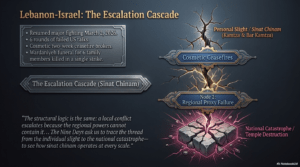
Current: Since 2 March 2026, Israel and Hezbollah have been engaged in an ongoing war in Lebanon — the 2026 Lebanon war, a resumption of major fighting that began when Hezbollah fired projectiles at Israel following US-Israeli attacks on Iran, and Israel responded with large-scale invasion. Lebanon and Israel have completed six rounds of US-brokered direct talks, but Hezbollah rejects the framework, insisting that only pressure from its ally Iran can secure an end to the war and Israel’s withdrawal. Israeli strikes have continued in southern Lebanon despite a two-week-old ceasefire agreement, with Israel saying it targets Hezbollah sites and fighters. A funeral was held in Wardaniyeh, southern Lebanon, this week for six members of the same family killed in an Israeli strike. The Lebanese state, fractured by decades of confessional politics and now hosting a quarter of its population as Syrian refugees, faces the question of whether it can ever assert a monopoly on arms within its borders.
Spiritual surface: The destruction of the First Temple in 586 BCE came through the Babylonian empire; the destruction of the Second Temple in 70 CE came through the Roman empire. The Talmud (Gittin 55b–56a) traces the Second Temple’s destruction to the humiliation of Kamtza and Bar Kamtza — a personal slight that escalated into a national catastrophe because the leadership could not contain the hatred. The Lebanon war is not the Temple’s destruction. But the structural logic is the same: a local conflict escalates because the regional powers cannot contain it, because the ceasefires are cosmetic, because the leadership on all sides prefers the conflict to the compromise. The Nine Days ask us to trace the thread from the individual slight to the national catastrophe — to see how sinat chinam operates at every scale.
Sources:
– Wikipedia — 2026 Lebanon war
– Al Jazeera — “Lebanon and Israel end sixth round of US-brokered talks” (15 Jul 2026)
– BBC News — “Israel and Lebanon agree to implement ceasefire if Hezbollah stops attacks” (4 Jun 2026)
– Al Jazeera — “Israeli attack on vehicle in Lebanon kills at least four” (6 Jul 2026)
III. Framework Reading — Halakha and the Discipline of the Nine Days
The framework for today is Halakha — not because the other four frameworks are silent, but because the Nine Days are the most halakhically structured mourning period in the Jewish year, and their structure contains a wisdom that is directly relevant to the four currents above.
The Nine Days (from 1 Av through the morning of 10 Av) are governed by a graduated system of mourning customs that the Shulchan Aruch (Orach Chaim 551) codifies. The first three days of Av are severe; the days from Rosh Chodesh through 9 Av are more severe; the week of Tisha B’Av itself is the most severe. The customs are not uniform across communities — some avoid meat and wine for the entire Three Weeks, some only from Rosh Chodesh Av, some only from the week of Tisha B’Av — but the underlying principle is consistent: mi-yad she’churban ha-bayit karov lehe’anos, tispater kol ha’aretz — from the time the destruction of the Temple is close, the whole world is in mourning.
What is the halakhic logic of mourning that does not look away? The Talmud (Taanit 30a) says that from the first of Av, one decreases in joy — mam’itim b’simchah. But the decrease is not a withdrawal. The decrease is a redirection of attention. One does not stop eating; one stops eating meat. One does not stop wearing clothes; one stops wearing fresh clothes. One does not stop building; one stops building for pleasure. The structure is one of discrimination — of learning to distinguish between what is necessary and what is ornamental, between what sustains life and what merely pleases it.
This is the halakhic wisdom that the day’s geopolitics most needs. Gaza is not a theoretical problem; it is two million people whose water, food, and medicine are contingent on political negotiations that have stalled. Ukraine is not a chessboard; it is a country where the industrial and human fabric is being torn apart by attrition without end. Lebanon is not a proxy war; it is a state where six members of a family are buried in a single funeral because the ceasefire does not hold. The Halakha of the Nine Days says: do not look away. Do not say, “I have already given to that charity.” Do not say, “I have already read about that war.” Do not say, “It is too far away to matter.” The decrease in joy is not a retreat; it is a refusal to be anaesthetised.
The Rodef and the Milchemet Mitzvah:
The Talmudic principle of rodef (Mishnah Sanhedrin 8:7) requires that one stop a pursuer who threatens life, but only with minimum necessary force. Maimonides (Hilchot Rotzeach 1:6) codifies this: one is obligated to save the pursued even at the cost of the pursuer’s life, but one may not use more force than the situation requires. This is the structural ancestor of the modern international humanitarian law distinctions between combatants and non-combatants, between proportionality and excess. The Jewish legal tradition has internal resources for exactly the distinctions that the Gaza conflict, the Lebanon war, and the Ukraine war all demand.
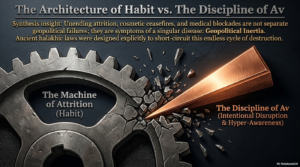
The question is whether the states involved are willing to apply them. A war that has lost its political objective and become a machine of attrition — Ukraine, day 1,603 — is no longer a milchemet mitzvah in the Maimonidean sense (Hilchot Melachim 5:1). Maimonides distinguishes between wars of obligatory defence and wars of discretionary expansion, and he adds a crucial condition: even in a milchemet mitzvah, the king must first seek peace (Deuteronomy 20:10). The war of attrition that cannot be won and cannot be ended is not a war of defence; it is a war of habit, and the Nine Days teach that habit is the enemy of the soul.
Psalm 24 — The Sunday Psalm:
לַיהוָה, הָאָרֶץ וּמְלוֹאָהּ — תֵּבֵל וְיֹשְׁבֵי בָהּ.
“The earth is the LORD’s, and the fullness thereof; the world, and they that dwell therein.” (Psalm 24:1)כִּי-הוּא עַל-יַמִּים, יְסָדָהּ; וְעַל-נְהָרוֹת, יְכוֹנְנֶהָ.
“For He hath founded it upon the seas, and established it upon the floods.” (Psalm 24:2)מִי יַעֲלֶה בְהַר-יְהוָה, וּמִי יָקוּם בִּמְקוֹם קָדְשׁוֹ.
נְקִי כַפַּיִם, וּבַר לֵבָב — אֲשֶׁר לֹא-נָשָׂא לַשָּׁוְא נַפְשִׁי, וְלֹא נִשְׁבַּע לְמִרְמָה.
“Who shall ascend into the mountain of the LORD? and who shall stand in His holy place? He that hath clean hands, and a pure heart; who hath not taken My name in vain, and hath not sworn deceitfully.” (Psalm 24:3–4)שְׂאוּ שְׁעָרִים, רָאשֵׁיכֶם — וְהִנָּשְׂאוּ, פִּתְחֵי עוֹלָם; וְיָבֹא, מֶלֶךְ הַכָּבוֹד.
“Lift up your heads, O ye gates; and be ye lifted up, ye everlasting doors; and the King of glory shall come in.” (Psalm 24:7)
This is the psalm for the day the world was created, the psalm for the first day of the week. It is sung as the Torah returns to the ark. On a Sunday in the Nine Days, it is sung by a people who know that the gates have been breached before, that the earth has been scorched before, that the King of glory has been exiled from the Temple before. And yet the psalm commands: lift up the gates. The doors must be opened. The psalm is not a passive lament; it is an active preparation. The mourning of Av is not a retreat; it is a rededication to the work of opening the gates — of clean hands, pure hearts, and truthful speech — so that the glory may enter again.
IV. From Your Library — Reading Today
The Rachav library contains the following books that bear directly on today’s themes:
- Meiliken, Jeffery. The Divine Calendar: 0 HC to 2018 CE. 2007. Calibre → · metadata
The book we anchored this daily project on. Today (5 Av) and the next four days are mapped in this year-by-year calendar of the Hebrew reckoning. - Harrison, R. K. TOTC Jeremiah & Lamentations. Calibre → · metadata
The biblical texts most directly read during the Nine Days and on Tisha B’Av. Jeremiah’s prophecies of destruction and Lamentations’ poetry of bereavement are the canonical voices for this season. - Stern, Sacha. Calendar and Community: A History of the Jewish Calendar, 2nd Century BCE to 10th Century CE. Oxford University Press, 2001. Calibre → · metadata
The canonical history of how the calendar we are using today was constructed through centuries of rabbinic decision. The Nine Days are not biblically mandated; they are a rabbinic architecture of mourning. - Segal, Eliezer. In Those Days, at This Time: Holiness and History in the Jewish Calendar. University of Calgary Press, 2007. ISBN 9781552381854. Calibre → · metadata
Walks through each festival in the Jewish calendar with historical-critical analysis. Read the chapter on Tisha B’Av for Wednesday’s anchor — the day the fast arrives.
V. Closing Practice — Lift Up the Gates
The rabbinic principle of ma’aseh — concrete embodied action, not petition. The Nine Days are not a time for grand gestures; they are a time for the discipline of small acts. The Talmud (Berakhot 8a) says that a person must have arba amot halakha — four cubits of Torah, a small but definite space of practice.
For today, the practice is this: read Psalm 24 once aloud, with attention. The Hebrew is not difficult; the English is not difficult. The difficulty is the attention. Then do one concrete act that the psalm’s logic demands: clean hands, pure heart, no deceit. That may mean a donation to a Gaza relief organisation. It may mean a letter to a representative about the Lebanon ceasefire. It may mean a phone call to someone you have been avoiding. It may mean refraining from one argument that you do not need to win. The ma’aseh is not specified; it is specified only by the day’s framework: clean hands, pure heart, no deceit.
The psalm for the day ends with a question:
מִי הוּא זֶה, מֶלֶךְ הַכָּבוֹד?
“Who is this King of glory?”
And the answer:
יְהוָה צְבָאוֹת, הוּא מֶלֶךְ הַכָּבוֹד — סֶלָה.
“The LORD of hosts, He is the King of glory. Selah.” (Psalm 24:10)
The selah is the pause. The pause is the practice. The practice is the gate.
מַעֲשֶׂה — Ma’aseh. One concrete act. Today.

Sources for today’s reading (all dated within the past two weeks unless otherwise noted):
- NPR, Al Jazeera, BBC News, Democracy Now! — for the Gaza current
- The Guardian, Al Jazeera, The Independent, AP News — for the Ukraine current
- Reuters, ISW, AEI — for the China-Taiwan current
- Wikipedia, Al Jazeera, BBC News — for the Lebanon current
- Chabad.org, OU.org, Sefaria — for the Nine Days customs and Psalm 24 liturgy
- Hebrew dates computed via
pyluach(Python) — 5 Av 5786 / 19 Jul 2026 - Library data via Methuselah API v3.6.0 (Tailscale Funnel) — 14,699 books
Compiled by Timnah & Peter — Rachav Foundation. Next: 6 Av 5786 (Mon 20 Jul) — the Nine Days deepen; Tisha B’Av approaches in three days.
–
About The Author