The Sabbath of the Vision — A Shabbat Chazon Reading
4 Av 5786 / Saturday, 18 July 2026 / Parshat Devarim / Shabbat Chazon
For the table tonight, before Tisha B’Av.
There is a custom, in some communities, to study a piece of Torah on the afternoon of Shabbat Chazon — the Sabbath of the Vision — as if to prepare the soul for the fast that follows five days later. The tradition knows that the haftarah we read this morning in synagogue, the opening of Isaiah’s scroll, is not a comfortable text. It is the prophet standing in the doorway of the Temple and saying: the silver has become dross, the wine is mixed with water, the princes are rebellious, the fatherless is not judged, the widow’s cause does not come before you. It is not a metaphor. It is an indictment with a price attached: therefore, saith the Lord, the LORD of hosts, the Mighty One of Israel, Ah, I will ease me of mine adversaries, and avenge me of mine enemies.
The haftarah’s last line, the line the tradition holds onto through the catastrophe that follows it, is: afterward thou shalt be called, The city of righteousness, the faithful city. The destruction is not the last word. But it is a real word — the churban, the word the tradition uses for the loss of the Temples, the word that gave the 9th of Av its name in the calendar, the word that returns, in every generation, in different costume, in different geography.
We are reading these words in the summer of 2026, in the year that the war in Gaza is entering its third year, in the year that the United Nations estimates the cost of rebuilding Gaza at seventy billion dollars, in the year that more than one hundred members of the United States House of Representatives have voted against further military aid to the only Jewish state in the world, in the year that the ceasefire that was supposed to end the killing has reduced the kinetic tempo without resolving the deeper question of who governs two million people in a place whose reconstruction is impossible without political resolution. We are reading these words, and the words are not ancient.
I want to do three things this afternoon. First, to read the haftarah slowly, in Hebrew and in English, with the classical commentaries close at hand. Second, to look at the war and the city — Gaza, Jerusalem, the question of the state and its judges — through the lens the haftarah gives us. Third, to sit for a few minutes with one piece of liturgy that the tradition reads on the morning of Tisha B’Av, and to ask what it asks of us now.
I. The Vision
Isaiah 1:1–27 (JPS 1917, lightly modernised):
The vision of Isaiah the son of Amoz, which he saw concerning Judah and Jerusalem, in the days of Uzziah, Jotham, Ahaz, and Hezekiah, kings of Judah.
Hear, O heavens, and give ear, O earth, for the LORD hath spoken: I have nourished and brought up children, and they have rebelled against me. The ox knoweth his owner, and the ass his master’s crib; but Israel doth not know, my people doth not consider. Ah, sinful nation, a people laden with iniquity, a seed of evildoers, children that are corrupters; they have forsaken the LORD, they have provoked the Holy One of Israel unto anger, they are gone away backward.
Why should ye be stricken any more? Ye will revolt more and more: the whole head is sick, and the whole heart faint. From the sole of the foot even unto the head there is no soundness in it; but wounds, and bruises, and putrefying sores: they have not been closed, neither bound up, neither mollified with ointment. Your country is desolate, your cities are burned with fire: your land, strangers devour it in your presence, and it is desolate, as overthrown by strangers. And the daughter of Zion is left as a cottage in a vineyard, as a lodge in a garden of cucumbers, as a besieged city. Except the LORD of hosts had left unto us a very small remnant, we should have been as Sodom, and we should have been like unto Gomorrah.
Hear the word of the LORD, ye rulers of Sodom; give ear unto the law of our God, ye people of Gomorrah. To what purpose is the multitude of your sacrifices unto me? saith the LORD: I am full of the burnt offerings of rams, and the fat of fed beasts; and I delight not in the blood of bullocks, or of lambs, or of he-goats. When ye come to appear before me, who hath required this at your hand, to tread my courts? Bring no more vain oblations; incense is an abomination unto me; the new moons and sabbaths, the calling of assemblies, I cannot away with; it is iniquity, even the solemn meeting. Your new moons and your appointed feasts my soul hateth: they are a trouble unto me; I am weary to bear them. And when ye spread forth your hands, I will hide mine eyes from you: yea, when ye make many prayers, I will not hear: your hands are full of blood.
Wash you, make you clean; put away the evil of your doings from before mine eyes; cease to do evil; learn to do well; seek judgment, relieve the oppressed, judge the fatherless, plead for the widow. Come now, and let us reason together, saith the LORD: though your sins be as scarlet, they shall be as white as snow; though they be red like crimson, they shall be as wool. If ye be willing and obedient, ye shall eat the good of the land: but if ye refuse and rebel, ye shall be devoured with the sword: for the mouth of the LORD hath spoken it.
How is the faithful city become an harlot! It was full of judgment; righteousness lodged in it; but now murderers. Thy silver is become dross, thy wine mixed with water. Thy princes are rebellious, and companions of thieves; everyone loveth gifts, and followeth after rewards; they judge not the fatherless, neither doth the cause of the widow come unto them. Therefore saith the Lord, the LORD of hosts, the mighty One of Israel, Ah, I will ease me of mine adversaries, and avenge me of mine enemies; and I will turn my hand upon thee, and purely purge away thy dross, and take away all thy tin; and I will restore thy judges as at the first, and thy counsellors as at the beginning; afterward thou shalt be called, The city of righteousness, the faithful city.
The reading in synagogue this morning was longer — it ran to the end of chapter one — but this is the heart of it. The prophet’s logic is not complicated. It is, in three movements:
Movement one — the indictment (verses 2–9). Heaven and earth are called as witnesses. The people who were meant to know their God have forgotten him. The land is desolate, the cities burned, strangers devour. The remnant — the small surviving core — is the only thing standing between the people and the annihilation of Sodom.
Movement two — the accusation (verses 10–15). The cult is not enough. Sacrifice, incense, the rhythm of new moons and sabbaths, the assemblies — I cannot away with it; it is iniquity, even the solemn meeting. The hands that pray are full of blood. The worship that does not change the worshipper is, in the prophet’s mouth, an abomination.
Movement three — the call and the promise (verses 16–26). Wash you, make you clean. Cease to do evil. Learn to do well. Seek judgment. Relieve the oppressed. Judge the fatherless. Plead for the widow. Come now, and let us reason together. If you are willing and obedient, you shall eat the good of the land. If you refuse and rebel, you shall be devoured with the sword.
And then the restoration: I will turn my hand upon thee, and purely purge away thy dross, and take away all thy tin; and I will restore thy judges as at the first, and thy counsellors as at the beginning; afterward thou shalt be called, The city of righteousness, the faithful city.
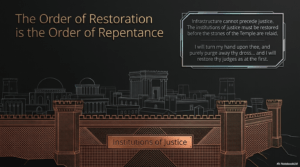
The structure is clear. The sin is structural — it is not the sin of the individual worshipper but the sin of the system that runs the city. And the restoration is structural — I will restore thy judges as at the first. The judges come back before the city is rebuilt. The order of restoration is the order of repentance: the institutions of justice are restored before the stones of the Temple are relaid.
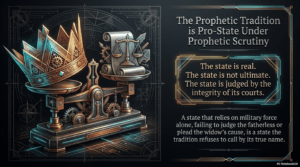
This is the heart of the prophetic tradition’s politics. The state is real. The state is not ultimate. The state is judged by the integrity of its courts.
II. The Commentaries
The medieval commentators — Rashi (Rabbi Shlomo Yitzchaki, 11th-century France), Radak (Rabbi David Kimchi, 12th-century Provence), Ibn Ezra (Rabbi Abraham ibn Ezra, 12th-century Spain) — read this chapter as a tract on the conditions under which a state may legitimately exist. Their readings are not identical, but they converge.
Rashi on verse 21 (How is the faithful city become an harlot!): Rashi reads the Hebrew * zonah — usually translated “harlot” — as the prophet’s image for a city that has “gone after other gods.” The city’s unfaithfulness is not personal but political. Jerusalem, the city that was meant to be the seat of justice for all Israel, has become a city that pursues its own interests at the expense of the vulnerable within it. Rashi notes that the next verse specifies the princes* — the political leadership — as the source of the corruption. The indictment is from the top down.
Ibn Ezra on verse 23 (Thy princes are rebellious, and companions of thieves): Ibn Ezra reads “companions of thieves” as a structural observation — the princes do not themselves steal, but they share the proceeds of theft through bribes and rewards. Everyone loveth gifts, and followeth after rewards — the Hebrew is shochad, the technical term for a bribe that warps judgment. Ibn Ezra insists that the prophet is not speaking metaphorically. The court system has been corrupted by the routine exchange of benefit for verdict. The widow and the orphan lose not because the judges are evil persons but because the system in which they operate has been compromised by the routine acceptance of gifts.
Radak on verse 25 (I will turn my hand upon thee, and purely purge away thy dross): Radak reads the dross (Hebrew sigim) and tin (Hebrew bedil) as the political compromise and the moral baseness that have alloyed the silver of the city’s original righteousness. The turning of the hand is the act of divine purification — but it is followed, in Radak’s reading, by a restoration of judges as at the first. The implication is that the prophet does not imagine a purified people without purified institutions. The restoration of the political order is a precondition for the restoration of the city’s name.
The commentaries converge on a single insight: the prophetic tradition is not anti-state. It is pro-state-under-prophetic-scrutiny. The state exists, the state can be redeemed, but the redemption is conditional on the integrity of the courts. A state that relies on military force alone, that fails to judge the fatherless or plead the widow’s cause, is a state that the tradition refuses to call by its true name.
This is not a comfortable reading for any modern state. It is, in particular, not a comfortable reading for a Jewish state that claims the prophetic inheritance as its own. The tradition, on this Shabbat of the year, asks: how is the faithful city become an harlot? — and refuses to answer the question in advance. The question is open. It is asked every year on this Shabbat. It is asked in particular this year, when the faithful city is, in fact, at war.
III. The War and the City
I want to be careful here. The Jewish tradition I am drawing from does not permit the easy alignment of prophetic text with any contemporary political position. The tradition’s reading of Isaiah is not “Israel is Sodom and must repent” — that reading has been weaponised in modern discourse and the tradition has resources to refuse it. The tradition’s reading is also not “Israel can do no wrong because Isaiah was speaking only to his generation” — that reading has been used to immunise the state from the prophetic categories it claims as its inheritance.
The tradition asks a more exacting question. It asks: what would it look like for this state to live under prophetic scrutiny? What would it look like for the state to be willing to be judged by the standards of the haftarah we have just read?
The classical Jewish legal tradition has internal resources to answer this question. The Mishnah (Sanhedrin 8:7) codifies the rodef principle: when one person pursues another with intent to kill, bystanders are obligated to stop the pursuer, but only with the minimum necessary force. The Talmud extends this principle to cases of pikuach nefesh — preservation of life — which is the supreme value in the tradition, overriding virtually every other commandment. The principle is the structural ancestor of modern distinctions between combatants and non-combatants, between proportional and disproportionate force. It is not an external principle imposed on the tradition. It is the tradition’s own resource for exactly the distinctions the international humanitarian framework demands.
The same tradition also holds, in Mishneh Torah and in the Shulchan Aruch, that the land of Israel is held under divine lease — the land shall not be sold permanently, for the land is Mine; for you are strangers and residents with Me (Leviticus 25:23). The sovereignty of the Jewish state is, on this reading, conditional sovereignty. It exists. Its existence is not unconditional. It is judged.
The war in Gaza, the third year of which we are now in, has surfaced within Israeli public discourse a debate the Jewish tradition has always had: the question of whether a particular military operation satisfies the halakhic criteria for a milchemet mitzvah (obligatory war, requiring no prior peace offer because the threat is existential) or whether it remains, indefinitely, in the category of milchemet reshut (discretionary war, requiring a prior offer of peace). The tradition does not resolve this debate in advance for any specific conflict; it requires that the question be asked, and asked seriously, by those who hold political responsibility.
This afternoon, on this Shabbat, in the year 2026, the question is being asked inside Israel with more force than it has been asked in a generation. The ceasefire terms are disputed. The reconstruction question is unresolved. The question of who governs two million Palestinians in a place whose rebuilding is estimated at seventy billion dollars is, ultimately, the question of who judges the fatherless, who pleads the widow’s cause — for the fatherless and the widow in this context are not abstractions.
IV. The Fast That Approaches
Five days from now, on Thursday evening and Friday, the fast of Tisha B’Av arrives. The tradition gives the day a long preparation. The three weeks leading up to it — beginning on the 17th of Tammuz, which this year fell on 4 July — are called Bein HaMetzarim, “between the straits.” The nine days beginning on the 1st of Av are an intensification: no fresh clothing, no laundry, no meat except on Shabbat, no swimming for pleasure, no construction for joy. The restriction is not punitive; it is mnemonic. The body is brought into a slower rhythm so that the soul can attend to what the calendar is remembering.
On Tisha B’Av itself, the tradition reads Eichah — the book of Lamentations
— by candlelight, sitting on the floor or on low stools, in the dark. The book opens: eichah yashvah badad ha’ir rabati am — “How doth the city sit solitary, that was full of people!” — and the rest of the book is a meditation on the destruction of Jerusalem in 586 BCE, on the deaths by famine and sword, on the mothers who boiled their own children, on the prophet who refuses false comfort.
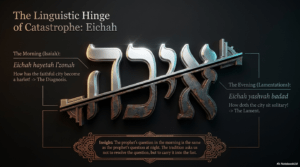
The opening word of Eichah — eichah, “how” — is the same word as the opening of Isaiah 1:21, which we read this morning: eichah hayetah l’zonah ir ne’emanah — “How is the faithful city become an harlot!” The haftarah and the book of Lamentations are joined at the root. The prophet’s question in the morning is the same as the prophet’s question at night, three days later. The morning question is the diagnosis; the evening question is the lament.
The tradition does not ask us to resolve the question on this Shabbat. It asks us to hold it. To carry it through the week. To arrive at the fast already attuned to the register in which catastrophe is named.
V. The City of Righteousness
The haftarah ends with a promise: afterward thou shalt be called, The city of righteousness, the faithful city. The word afterward (Hebrew achar) is doing heavy work in the verse. The promise is not “soon.” It is not “when the war ends.” It is “afterward” — after the dross has been purged, after the judges have been restored, after the city has been through whatever it has been through. The promise is real. The timing is not ours.
The city of righteousness is not the city that never failed. It is the city that failed and was judged and repented and was restored. The tradition’s name for Jerusalem is ir ne’emanah, “the faithful city” — and the faithfulness is not innocence. The faithfulness is the capacity to be brought back. To be turned. To be willing and obedient. To learn to do well.
In the language of the Psalm we will say at the weekday Amidah this week (Psalms 141, verses 8–9 in the daily cycle): let not my heart be inclined to any evil thing, to practise wicked works with men that work iniquity; and let me not eat of their dainties. Set a watch, O LORD, before my mouth; keep the door of my lips. The prayer is not for the nation. It is for the individual mouth. The tradition’s unit of moral measurement is the speech of one person. The tradition knows that the city is built — or unbuilt — from the mouths of its inhabitants.
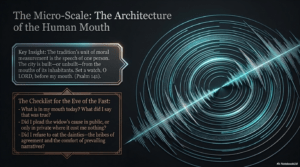
The question for this Shabbat, for those who read these words at the table tonight, is small and local. What is in my mouth today? What did I say this week that was true? What did I say this week that was not? Did I plead the widow’s cause? Did I judge the fatherless? Did I do it in the hearing of someone who needed to hear it, or did I do it in private where it cost me nothing? Did I refuse to eat of the dainties — the bribes of agreement, the comfort of the prevailing story?
These are small questions. They are not the questions of geopolitics. They are the questions from which the city of righteousness is, in the tradition’s reckoning, actually built.
VI. For the Table Tonight
A psalm for the Sabbath of the Vision. Read slowly, after the meal, before the sun sets.
Psalm 122 (selected):
I was glad when they said unto me, Let us go into the house of the LORD. Our feet shall stand within thy gates, O Jerusalem. Jerusalem is builded as a city that is compact together: whither the tribes go up, the tribes of the LORD, unto the testimony of Israel, to give thanks unto the name of the LORD. Pray for the peace of Jerusalem: they shall prosper that love thee. Peace be within thy walls, and prosperity within thy palaces. For my brethren and companions’ sakes, I will now say, Peace be within thee. Because of the house of the LORD our God I will seek thy good.
The psalm is a prayer for the peace of the city. It does not assume the city is at peace. It asks for it. The asking is the act of faith.
And a verse from this morning’s haftarah, to carry into the week:
כִּי אִם־תִּהְיוּן אֹזְנַיִם לַמִּשְׁפָּט תָּשִׂישׂוּ תִּרְצוּ אֶת־צִדְקוֹתֵיכֶם
If ye be willing and obedient, ye shall eat the good of the land. (Isaiah 1:19)
Shabbat shalom. The fast approaches. The vision holds.
For reading: Eliezer Segal, In Those Days, at This Time: Holiness and History in the Jewish Calendar (University of Calgary Press, 2007) — the chapter on Tisha B’Av. Sacha Stern, Calendar and Community (Oxford, 2001) — for the long historical arc. R. Ariel B. Tzadok, Secrets of the Cycle of Time — the chapter on Av and Elul.
Compiled by Timnah & Peter Dixon for the Rachav Foundation. Shabbat Chazon, 4 Av 5786.
About The Author