Rachav Daily — A Spiritual Geopolitical Reading
Date: Monday, 20 July 2026 — The Nine Days
Hebrew date: 6 Av 5786 — Day 301 of the year
Days until Tisha B’Av: 3
Weekday Psalm: Psalm 48 — Shir shel Yom for Monday
Compiled for: Peter Dixon — Rachav Foundation
Series frame: 5-framework rotation (Prophets / Halakha / Kabbalah / Modern Philosophy / Liturgy). Today’s rotation slot: Liturgy (mourning, Psalm 48, the Nine Days), with Kabbalah counterweight (Shevirat HaKelim / destruction and repair).
I. Anchor — The City of God, Three Days from the Ashes
| Field | Value |
|---|---|
| Gregorian | Monday, 20 July 2026 |
| Hebrew | 6 Av 5786 (6 אָב ה׳תשפ״ו) |
| Day-of-year | 301 (from 1 Tishrei) |
| Days until Tisha B’Av | 3 |
| Days until next Rosh Hashanah | 54 |
We are deep in the Nine Days — the nine days between the first of Av and the ninth of Av, the most intense mourning period in the Jewish calendar. The first of Av marks the moment when, in rabbinic tradition, the decree went forth against the generation that left Egypt: those who wept over the report of the spies would not enter the land. The decree is both collective and intimate — a whole generation suspended, not by conquest but by the quality of its own grief. And here we are, six days in, three days before the fast that commemorates the destruction of both Temples, the burning of Jerusalem, the exile that scattered a nation across the empires of the ancient world.
The liturgy of this week is not the liturgy of ordinary mourning. It is the liturgy of anticipatory grief. The shochet does not slaughter during the Nine Days; wine is diluted; the study of Torah is narrowed to passages of destruction. It is not a rehearsal of grief already past but a practice of entering the grief that is still to come, as if the catastrophe has not yet happened and is also always happening. The calendar is a loop, not a line.

Today’s Shir shel Yom — the Psalm of the Day for Monday — is Psalm 48. It is an extraordinary psalm for a day of destruction:
גָּדוֹל יְהוָה וּמְהֻלָּל מְאֹד בְּעִיר אֱלֹהֵינוּ הַר קָדְשׁוֹ
“Great is the LORD, and highly to be praised, in the city of our God, His holy mountain.”
The Talmud (Rosh Hashanah 31a) assigns this psalm to the second day of creation — the day the waters were divided, the day boundaries were established between the upper and lower realms. On a Monday in the Nine Days, we sing of a city that is still intact. The psalm looks at the city of God from a distance, from the perspective of the enemy kings who assemble, see it, and flee. It is the city as deterrent, as wonder, as the proof that heaven has staked a claim on earth. But we read this psalm three days before Tisha B’Av, when the city was not deterrent enough, when the kings did not flee, when the holy mountain was ploughed over. The psalm is not denial. It is the memory of a form that the destruction itself is measured against. You cannot mourn what you have not first loved.
The single most important sentence: The city of God is still standing wherever the poor are fed, but its shadow is already three days long — and we must learn to live in the shadow without forgetting the city.
II. Geopolitical Currents — Five Pressures, One Mourning
Five currents, each refracted through the lens of a liturgy that asks not “who wins?” but “what is destroyed, and who mourns it?”
1. Gaza: The Ceasefire That Is Not a Peace
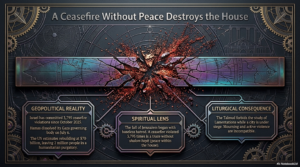
Current: Israel has reportedly committed 3,795 violations of the October 2025 ceasefire agreement since its inception, according to Al Jazeera and Middle East Eye reports citing the Gaza government. The violations include incursions beyond the agreed buffer zones, drone strikes, and intensified siege conditions. Hamas’s dissolution of its Gaza governing body on 6 July has not altered the military tempo. The UN estimates rebuilding at $70 billion; Amjad Iraqi of the International Crisis Group calls it a “humanitarian purgatory” for two million people whose access to food and water is contingent on weapons collection that has not occurred.
Spiritual surface: The Nine Days liturgy does not ask us to name the victor. It asks us to count the losses. The rabbinic tradition understands the destruction of the Second Temple as beginning not with the battering ram but with the destruction of shalom bayit — the peace within the house. The Talmud (Gittin 55b–56a) traces the fall of Jerusalem to sinat chinam, baseless hatred between brothers. The ceasefire that is violated 3,795 times is not a peace; it is a truce without shalom, a military pause without the trust that makes a city a city. The liturgical question is: can you mourn the destruction of a place you are still shelling? The answer the tradition gives is that mourning and violence are not compatible — the Talmud forbids the study of Eichah on a day when a city is under siege.
Sources:
– Middle East Eye — “Israel committed 3,795 ceasefire violations in Gaza: Report” (19 Jul 2026)
– Al Jazeera — Gaza live updates (19–20 Jul 2026)
– CNN — “Hamas says it will dissolve Gaza government as US-brokered ceasefire plan stalls” (6 Jul 2026)
2. Ukraine: Day 1,604 and the Attrition of Necessary Force
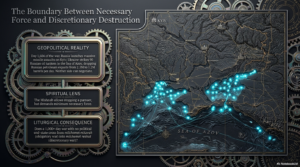
Current: Russia has conducted one of the largest missile assaults of the war on Kyiv, killing at least one and injuring more than fifteen. The broader barrage included at least 41 missiles across the country. Ukrainian forces have struck 90 Russian oil tankers in the Sea of Azov since 6 July as part of a campaign to isolate Crimea. Russian refined petroleum exports have fallen to 1.2 million barrels per day from 2.3 million a year earlier. Zelenskyy has sacked his defence minister and tipped his next PM, baffling observers. The “coalition of the willing” has reasserted its desire for a post-war force. Neither side is politically able to negotiate.
Spiritual surface: The Mishnah’s rodef principle (Sanhedrin 8:7) requires stopping the pursuer with minimum necessary force. Day 1,604 is a number of a different order than the principle was designed for. The Talmudic frame is one of immediate threat, not attrition across a thousand days. The liturgical question of the Nine Days is not whether Ukraine has the right to defend itself — it does — but whether a war that has lost any conceivable political end-state, fought on the bodies of conscripts and civilians, remains in the category of milchemet mitzvah (obligatory war) or has become milchemet reshut (discretionary war) for which peace must be sought first. The tradition does not ask the soldier to refuse; it asks the society to examine what kind of war this has become, and whether the destruction of a generation is measured by the same standard as the destruction of a city.
Sources:
– The New York Times — “Russia Batters Kyiv in One of the Largest Missile Assaults of the War” (19 Jul 2026)
– The Guardian — Ukraine live updates (20 Jul 2026)
– ISW — “Russian Offensive Campaign Assessment, July 19, 2026”
3. Lebanon-Israel: The Pilot Zone and the Unfinished War
Current: Lebanon and Israel have concluded a sixth round of US-brokered talks in Rome and agreed to implement “pilot zones” — a gradual withdrawal mechanism from southern Lebanon. The framework deal includes disarmament of Hezbollah, deployment of Lebanese troops in the south, and Israeli withdrawal. But Hezbollah rejects disarmament, Iran continues to pressure its ally, and Israeli airstrikes continue in southern Beirut. The US Embassy in Beirut has warned Americans not to travel to Lebanon. A Hezbollah drone cell was struck and killed in southern Lebanon on 18 July.
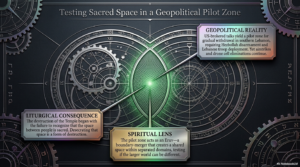
Spiritual surface: The “pilot zone” is a liturgical concept as much as a military one — a small space where the rules of the larger world are suspended in order to test whether the larger world can be different. The Talmud speaks of eruvin — boundary-mergers that create a shared space within the larger separation of domains. The question of the pilot zone is whether it can be an eruv for peace, or whether it is merely a buffer for the next round. The Nine Days teach that the destruction of the Temple began not with the battering ram but with the failure of the boundary — the failure to recognize that the space between people is also sacred, and that its desecration is a form of destruction.
Sources:
– Al Jazeera — “Lebanon and Israel end sixth round of US-brokered talks” (15 Jul 2026)
– France 24 — “Lebanon, Israel conclude talks, agree to implement ‘pilot zones’” (15 Jul 2026)
– The Times of Israel — Live blog, 18 July 2026
4. China-Taiwan: The Maritime Coercion and the Summit That Was Not
Current: Taiwan has detected a “significant” rise in Chinese coast guard and maritime activity near the island, with Chinese vessels broadcasting questions to merchant ships about port entry and exit information. The Taiwanese legislature has passed a $25 billion defence-spending bill for 2026–2033. A Taiwanese investigation has uncovered a $22 million chip-smuggling network using servers with Nvidia GB300 processors diverted from Taiwanese data centres. Trump and Xi discussed global flashpoints at their summit but did not reach major agreements on Iran or Taiwan. The PLA has test-fired a submarine-launched ballistic missile into the South Pacific in a rare demonstration of second-strike capability.
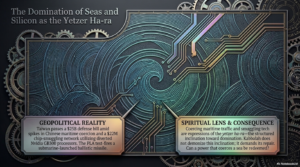
Spiritual surface: The Lurianic Kabbalah — the tradition that assigns cosmic meaning to the Nine Days — understands the world as a vessel that was too fragile to hold the light, and that shattered. The shevirat ha-kelim (shattering of the vessels) is not a single event but a continuous process. The coercion of maritime traffic, the smuggling of semiconductors, the submarine that carries a missile that can end a world: these are not merely political acts but expressions of the yetzer ha-ra — the structured inclination toward domination that is the mirror-image of the shattered vessel. The Kabbalistic tradition does not demonize the inclination; it demands its repair. The liturgical question is whether a power that coerces a sea can be redeemed, or whether the coercion itself is the sign of the vessel that has not yet been rebuilt.
Sources:
– AEI — “China & Taiwan Update, July 17, 2026”
– Reuters — “Democratic Taiwan must not become ‘China’s Taiwan’, president says” (19 Jul 2026)
– Asharq Al-Awsat — “Taiwan Says ‘Significant’ Rise in China Maritime Activity Near Island” (20 Jul 2026)
5. Sudan: The Drone War and the Sentence of Hemedti
Current: The Sudanese civil war has entered its most lethal phase with foreign-made drones. In the first four months of 2026 alone, drone strikes killed at least 880 civilians and accounted for more than 80% of civilian deaths recorded by the UN. A Sudanese court has sentenced RSF leader Hemedti and 15 senior commanders to death in absentia for atrocities in West Darfur. The SAF recaptured Khartoum in March 2025; the military-led government returned to the capital in January 2026. But the war continues, with the RSF still active in Darfur and the south. The UN warns of a spreading regional crisis.
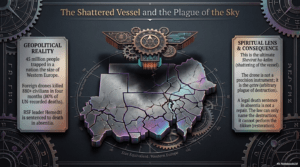
Spiritual surface: The liturgy of the Nine Days reads from the Megillat Eichah — Lamentations — the scroll of the city destroyed, the children starving, the women violated. The text is not ancient metaphor. It is a documentary record of what happens when a city collapses. Sudan is a country of 45 million people, the size of Western Europe, now in its third year of civil war. The drone that kills a civilian vehicle heading to a wedding is not a precision instrument; it is the qetev (plague) of the prophet, the arbitrary destruction that the liturgy names and the international law cannot prevent. The Kabbalistic reading is that the shevirat ha-kelim happens not only in the cosmic realm but in the political one — the shattering of a nation into fragments that are reconstituted as warlord territories, each claiming the name of the whole. Hemedti’s sentence is a legal act; the legal act is not the repair. The repair is the tikkun — the restoration of the vessel that the law can only name, not perform.
Sources:
– CNN — “‘You cannot hide from a drone strike’: The terror falling from the sky in Sudan” (20 Jul 2026)
– BBC — “Sudan court sentences RSF leader Hemedti” (20 Jul 2026)
– AP News — Sudan hub (20 Jul 2026)
– The New York Times — “The World Must Not Forget About the Genocide in Sudan” (13 Jul 2026)
III. Framework Reading — Liturgy and Kabbalah: The City That Remains
Liturgy — The Psalm of Monday and the Nine Days
Psalm 48 is assigned to the second day of the week, the day of division. The psalm sings of the city of God, its citadels, its towers, its palaces. The kings assemble, they see, they marvel, they flee. The psalm is not a naive celebration of invulnerability. It is a memory of invulnerability, sung by a people who have already been exiled from the city twice, who have already read the psalm while sitting by the rivers of Babylon, weeping. The liturgy of the Shir shel Yom is a discipline of memory: the city is not a place; it is a name that the psalm preserves.

The Nine Days take this discipline to its limit. From the first of Av to the ninth, the observant Jew does not eat meat, does not drink wine, does not wear new clothes, does not cut hair. The practices are not penance but attunement — a way of bringing the body into alignment with the calendar’s grief. The rabbinic tradition is not sentimental about grief. The Talmud says that one who mourns excessively for the dead will eventually mourn for the living. The Nine Days are therefore a bounded grief: nine days, not a lifetime; a reduced diet, not a fast; a narrowing of Torah study, not a cessation. The tradition knows that grief, if unbounded, becomes a form of self-worship.
The liturgical reading of the news is therefore a practice of bounded grief — not a demand to weep for every drone strike, but a discipline of attention that says: the world is not meant to be this way, and the calendar is a machine for remembering that fact.
Kabbalah — Shevirat HaKelim and the Vessels of Sudan
The Lurianic Kabbalah, as developed by Isaac Luria in sixteenth-century Safed, reads the creation story as a catastrophe. The divine light was too intense for the vessels that were meant to contain it. The vessels shattered. The shevirat ha-kelim — the shattering of the vessels — is the foundational event of the world. The sparks of the divine light fell into the kelipot — the husks, the broken shells. The task of the Jew is tikkun — the repair, the gathering of the sparks from the husks, the restoration of the vessels.
Read through this lens, Sudan is not merely a civil war. It is a shevirat — a shattering of the vessel that contained 45 million people, a nation that has not known stable civilian rule since its independence. The RSF and the SAF are not two armies; they are two fragments of a broken vessel, each claiming to be the whole. The drone that kills a civilian is not an act of war; it is the qetev of the broken vessel, the destructive force that is released when the container is no longer intact. Hemedti’s sentence is a legal act that cannot be a tikkun because the vessel is still broken.
The Kabbalistic tradition is not pessimistic. It believes in tikkun — but tikkun is not a political program. It is a spiritual practice that operates alongside the political, sometimes in advance of it, sometimes in the absence of it. The ma’aseh — the concrete act — is the Kabbalistic method: a small act that gathers a spark. The tradition does not ask for the repair of Sudan; it asks for the repair of the self in relation to Sudan. The boundary between the two is not as clear as the rationalist would like it to be.
The liturgical and Kabbalistic frameworks converge on Monday’s Psalm: the city of God is both intact and shattered. The psalm preserves the intact city; the Nine Days mourn the shattered one; the Kabbalah commands the repair of both. The reader is not asked to choose between the three.
IV. From Your Library — Reading Today

The Rachav library contains the following books that bear directly on today’s themes:
- Elior, Rachel. The Three Temples: On the Emergence of Jewish Mysticism. 2004. Calibre → · metadata
The Kabbalistic framework traced to its origins: the three temples as successive vessels, each shattered and each requiring repair. Read the chapter on the destruction of the Second Temple as a cosmic event, not merely a historical one. - Heschel, Abraham Joshua. Moral Grandeur and Spiritual Audacity. 1996. Calibre → · metadata
The collected essays of the twentieth century’s most profound prophetic voice. The essay “The Meaning of this Hour” — written in Nazi Germany in 1938 — reads the catastrophe not as an ending but as a demand for moral grandeur. - Dorff, Elliot N. The Way Into Tikkun Olam (Repairing the World). 2005. Calibre → · metadata
A practical guide to the Kabbalistic concept of repair as a lived Jewish practice — not mysticism in the esoteric sense, but the daily work of mending what is broken in the social world. - Wiesel, Elie. Night. 1956. Calibre → · metadata
The foundational text of modern Jewish mourning — a testimony that redefined what the liturgy of destruction could mean in an age of industrial murder. Read it not for the facts but for the voice: the voice that refuses consolation before the facts have been faced.
V. Closing Practice — Three Days, Three Communities, One Act
The rabbinic principle of ma’aseh — a concrete embodied act, not a petition. The tradition does not ask for grand gestures in the face of grand catastrophes; it asks for the discipline of attention at the scale of one’s own four cubits (arba amot, Berakhot 8a).
For today, three days before Tisha B’Av, the ma’aseh is small and specific: reach out to one person from one of the communities named in the currents above — the refugee, the displaced person, the veteran, the civilian. Not with a petition, not with a program, but with a human presence. The communities are: Gaza, Ukraine, Lebanon, Sudan, Taiwan. The act is not charity; it is tikkun — the gathering of a single spark from the husk.
The closing phrase is from the Psalm of the Day, Psalm 48:15 — the psalm’s own instruction to the future:
כִּי זֶה אֱלֹהִים אֱלֹהֵינוּ עוֹלָם וָעֶד הוּא יְנַהֲגֵנוּ עַל מוּת
“For this God is our God forever and ever; He will guide us unto death.”
The Hebrew is ambiguous: ad ha-mut (until death) or al ha-mut (over death, beyond it). The liturgy reads it as the second: God will guide us over death, not merely to its edge. The Nine Days are the discipline of walking toward the edge without falling. The act is the hand that keeps us from falling.

מַעֲשֶׂה — Ma’aseh. One concrete act. Today.
Sources for today’s reading (all dated within the past week unless otherwise noted):
- Reuters, Al Jazeera, CNN, Middle East Eye — Gaza ceasefire violations and Hamas dissolution
- The New York Times, The Guardian, ISW — Ukraine war updates and missile strikes
- Al Jazeera, France 24, The Times of Israel — Lebanon-Israel talks and pilot zones
- AEI, Reuters, Asharq Al-Awsat — China-Taiwan maritime activity and defence spending
- CNN, BBC, AP News, The New York Times — Sudan drone war and Hemedti sentence
- Hebrew dates computed via
pyluach(Python) — 6 Av 5786 / 20 Jul 2026 - Library data via Methuselah API v3.6.0 (Tailscale Funnel) — 14,699 books
- Psalm of the Day from Sefaria and Wikipedia — Psalm 48 for Monday
Compiled by Timnah & Peter — Rachav Foundation. Next: 7 Av 5786 (Tue 21 Jul) — two days before Tisha B’Av, the mourning intensifies.
About The Author