Rachav Daily — A Spiritual Geopolitical Reading
Date: Tuesday, 21 July 2026 — Day 2 before Tisha B’Av
Hebrew date: 7 Av 5786 — Day 302 of the year
Parasha: Devarim (the weekly portion, first of Deuteronomy)
Haftarah (for the week): Isaiah 1:1–27 — chazon (the vision)
Compiled for: Peter Dixon — Rachav Foundation
Series frame: 5-framework rotation (Prophets / Halakha / Kabbalah / Modern Philosophy / Liturgy). Today’s rotation slot: Liturgy × Prophets (the Nine Days, pre-Tisha B’Av mourning customs; the weekly Haftarah of Isaiah’s vision).
I. Anchor — Two Days Before the Fast
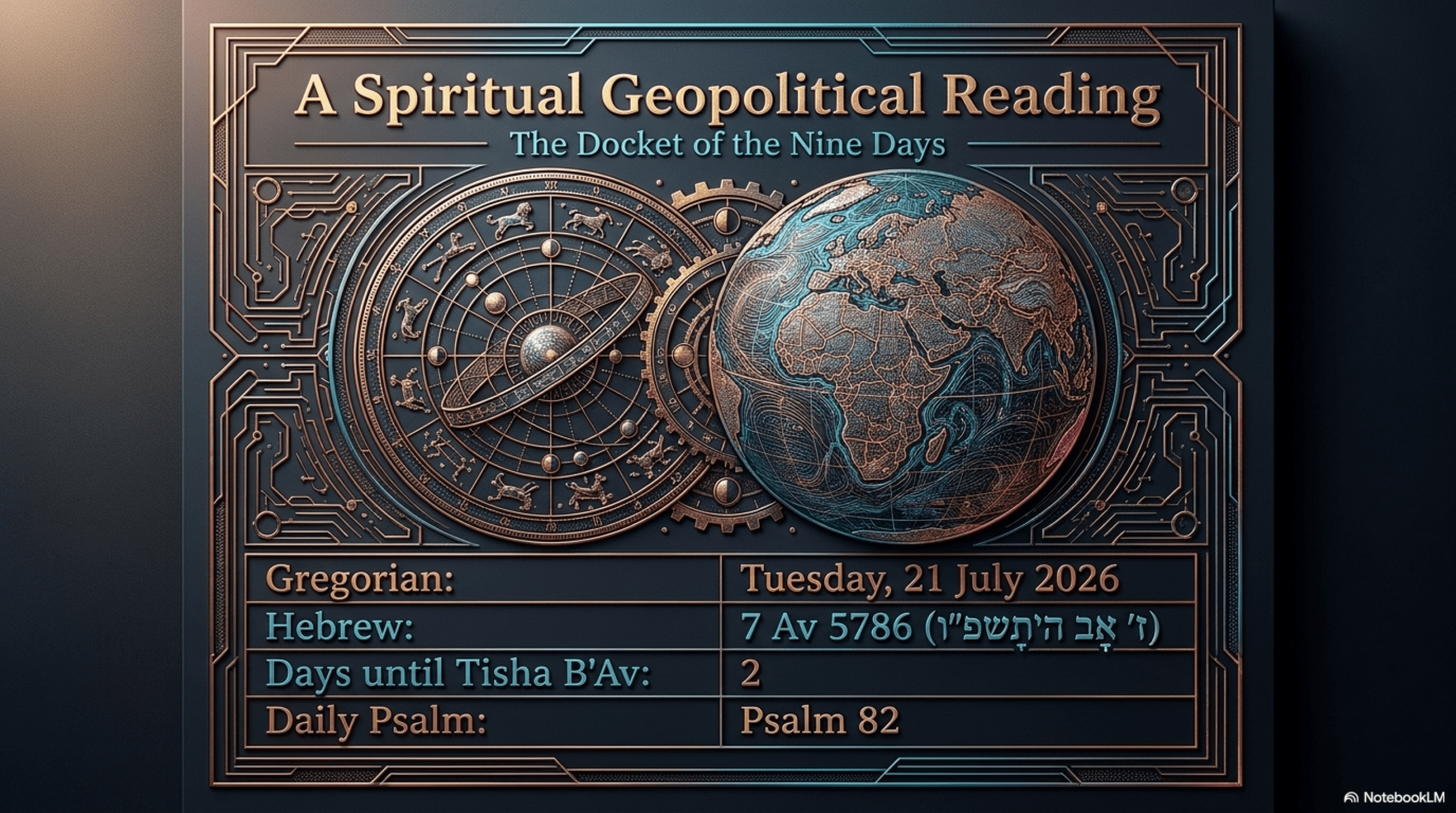
| Field | Value |
|---|---|
| Gregorian | Tuesday, 21 July 2026 |
| Hebrew | 7 Av 5786 (ז׳ אָב ה׳תשפ״ו) |
| Day-of-year | 302 (from 1 Tishrei) |
| Days until Tisha B’Av | 2 |
| Days until next Rosh Hashanah | 53 |
| Parasha | Devarim (Deuteronomy 1:1–3:22) |
| Daily Psalm (Tuesday) | Psalm 82 |
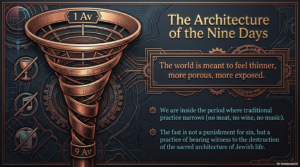
This is the last Tuesday before the fast of Tisha B’Av, the ninth of Av, the day that remembers in Jewish tradition the destruction of both Temples, the first in 586 BCE, the second in 70 CE. We are inside the Nine Days, the period from the first of Av through the ninth, when traditional practice narrows: no meat, no wine, no new clothes, no music, no celebration. The world is meant to feel thinner, more porous, more exposed. The fast itself is not a punishment for sin; it is a practice of bearing witness to the moment when the sacred architecture of Jewish life was destroyed, and the question that follows: what is the covenant worth when the building that housed it is gone?
The daily reading in the synagogue continues its march through the Torah. We are in the opening of Devarim, the book of Deuteronomy. Moses stands in the plains of Moab, east of the Jordan, and speaks to the generation that will enter the land. He reviews forty years of wandering, of wars, of rebellion, of divine patience. The voice is retrospective, situated at the threshold of conquest. It is a second-generation address, delivered to those who did not experience the Exodus firsthand. The text asks: what do you inherit, and what will you do with it?
The week’s Haftarah — Isaiah 1:1–27 — is the chazon, the vision. It is a vision of indictment. The faithful city has become a harlot. The princes are rebellious. The ox knows its owner, but Israel does not know. The reader is asked not to flinch from the image of what has been corrupted. The promise at the end of the passage is not that the city will be destroyed, but that it will be purified and restored — if the judges return to righteousness. Conditional sovereignty. The text insists that the state exists, but its existence is not unconditional. It is measured by the justice it does to the widow, the orphan, and the stranger.
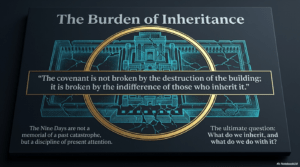
The single most important sentence for today: The covenant is not broken by the destruction of the building; it is broken by the indifference of those who inherit it. The Nine Days are not a memorial of a past catastrophe but a discipline of present attention — what are we inheriting, and what are we doing with it?
The daily Psalm for Tuesday, Psalm 82, is perhaps the most fitting text for a geopolitical reading:
אֱלֹהִים נִצָּב בַּעֲדַת אֵל בְּקֶרֶב אֱלֹהִים יִשְׁפֹּט — “God stands in the divine assembly, in the midst of the gods God judges” (Psalm 82:1).
It is a psalm of judgment upon earthly judges: “How long will you judge unjustly, and show partiality to the wicked? … Defend the weak and the fatherless; uphold the cause of the poor and the oppressed. Rescue the weak and the needy; deliver them from the hand of the wicked.” The psalm ends with the promise that God will rise and inherit the nations. It is the psalm that says the world is not a theatre of power but a courtroom of justice. Read it today.
II. Geopolitical Currents — The World’s Five Pressures
1. Gaza: The ceasefire that is not a ceasefire
Current: Nine months after the U.S.-brokered ceasefire was signed in October 2025, the death toll in Gaza continues to mount. Israeli attacks have killed at least 1,059 people and injured over 3,400 since the ceasefire began, according to Gaza’s Ministry of Health. Israel now controls nearly 70% of the Strip, up from 50% at the ceasefire’s start. Dr. Hussam Abu Safiya, a Palestinian doctor, was reportedly beaten so severely that his own lawyer could not recognise him. An estimated 300 Palestinians referred for treatment abroad have died while waiting. The reconstruction of Gaza is estimated at $70 billion, with the disarmament of Hamas and the question of who governs the territory remaining the central deadlock.
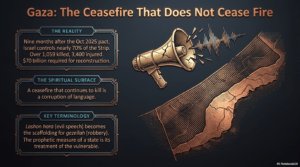
Spiritual surface: Psalm 82 asks how long judges will pervert justice. The prophetic measure of a state — its treatment of the widow, the orphan, the stranger — is the same measure whether the judge sits in Jerusalem or in Gaza, in the White House or in the UN. A “ceasefire” that does not cease fire is a corruption of language, and the Jewish tradition has a name for the corruption of language that sustains violence: lashon hara (evil speech) that becomes the scaffolding of gezeilah (robbery). The Nine Days ask us to examine not only what we do but what we name.
Sources:
– BBC News — Israel Gaza war live updates (21 Jul 2026)
– CNN — “Bodies lie unclaimed and rats run rampant as months on Gaza’s ceasefire remains unfulfilled” (5 Jul 2026)
– NPR — “9 months into a ceasefire, Israel now controls nearly 70% of Gaza” (10 Jul 2026)
2. Lebanon: The pilot zone and the withdrawal that is not a withdrawal
Current: Under a U.S.-brokered plan, the Israeli military is set to perform a phased retreat from southern Lebanon while the Lebanese military takes over security and oversees the disarmament of Hezbollah. The plan, described as “pilot zones,” began implementation this week. At the same time, Hezbollah accused Israel of a “flagrant” ceasefire breach, saying it launched a drone that killed three civilians in southern Lebanon. The Syrian authorities say they intercepted a shipment of missiles and drones allegedly destined for Hezbollah. More than 1,100 Palestinians have been killed since the October agreement, and Israeli attacks continue in violation of the ceasefire terms.
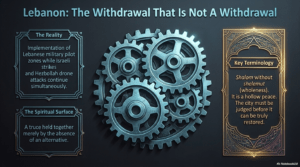
Spiritual surface: The Book of Deuteronomy opens with a review of the wars Israel has fought, the kings it has defeated, the lands it has taken. The voice is retrospective: we did this, and now we are at the threshold. But the retrospective is always a question of inheritance. What is being passed to the next generation? A Lebanon in which Hezbollah is disarmed by a Lebanese military that is itself fragmented, under a pilot zone supervised by an Israeli withdrawal that is not a withdrawal: this is not a peace, it is a truce held together by the absence of any alternative. The Jewish tradition calls this shalom without shelemut (wholeness) — a hollow peace. The Haftarah of Isaiah insists that the city must be judged before it can be restored.
Sources:
– Al Jazeera — “Lebanon’s military starts ‘pilot zone’ takeover in south” (20 Jul 2026)
– Al Jazeera — “Syrian authorities say they intercepted a shipment of missiles and drones allegedly destined for Hezbollah” (20 Jul 2026)
3. Ukraine: Day 1,603 and the war of attrition
Current: Russia has launched one of the largest missile assaults of the war against Kyiv and other Ukrainian cities in the past week. President Zelensky stated that Russia used around 1,450 attack drones, more than 1,640 guided aerial bombs, and 99 missiles of various types in the past week alone. Russian strikes on the Odesa region have killed 28 people in July alone. Ukrainian strikes on Russia’s oil and gas infrastructure have prompted fuel shortages inside Russia. President Trump met with leaders in Turkey but declared the ceasefire with Iran “over.” The war has become a grinding attrition with no political end-state visible on either side.
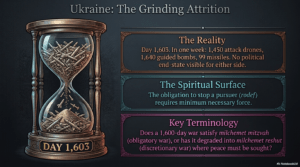
Spiritual surface: The Mishnah’s Sanhedrin frames the question of stopping a rodef (pursuer): one is obligated to stop the pursuer, but only with minimum necessary force. The principle is the structural ancestor of modern proportionality and distinction. But a war of attrition that has lasted over 1,600 days, fought on the bodies of conscripts and civilians, with no conceivable political end-state — does this satisfy the requirement of milchemet mitzvah (obligatory war) or does it remain indefinitely in the category of milchemet reshut (discretionary war), for which peace must be sought first? The Halakhic tradition is not silent: it has a question. The question is asked within the tradition, not from outside it.
Sources:
– The New York Times — “Russia Batters Kyiv in One of the Largest Missile Assaults of the War” (19 Jul 2026)
– BBC News — Ukraine war live updates (21 Jul 2026)
– Al Jazeera — Ukraine-Russia war updates (21 Jul 2026)
4. Sudan: Genocide and the war that the world has forgotten
Current: A year after the Sudanese Armed Forces (SAF) regained control of Khartoum from the Rapid Support Forces (RSF), the country’s embattled western regions — including Darfur — remain in catastrophe. A UN fact-finding mission has identified genocide committed by the RSF and allied militias. The RSF continues to target ethnic African minorities for extermination, while the SAF blocks aid access to large swathes of the country. Up to 350,000 people are currently displaced, and multiple ceasefire attempts brokered by the United States and Saudi Arabia have failed. Both SAF and RSF leaders have little incentive to negotiate, as they and their regional backers continue to profit from Sudan’s war.
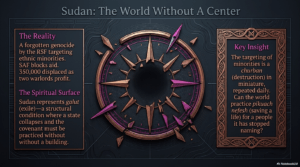
Spiritual surface: The Nine Days remember the destruction of the Temple, but they also remember the galut — the exile, the dispersal, the world without a centre. Sudan is a world without a centre: a state collapsed into the hands of two warlords, both funded by foreign powers, both indifferent to the civilian population. The RSF’s targeting of ethnic minorities is a churban (destruction) in miniature, repeated daily. The Jewish tradition understands exile not as a punishment but as a structural condition: a world in which the covenant must be practised without the building. The question is whether the international community can practise the covenant of pikuach nefesh (preservation of life) for a people it has stopped naming.
Sources:
– BBC — “Sudan war: A simple guide to what is happening” (2026)
– Council on Foreign Relations — Civil War in Sudan (Jul 2026)
– Al Jazeera — Sudan RSF coverage (3 Jan 2026)
5. The Korean Peninsula: Missile tests and the divided kingdom
Current: North Korea has continued its weapons-testing spree, including ballistic missiles armed with cluster-bomb warheads, short-range ballistic missiles, and multiple launches toward the Sea of Japan. The launches have accelerated amid broader regional tensions. South Korea’s presidential office has held emergency National Security Council meetings, and Japan’s Defense Ministry has tracked the launches. The DPRK’s testing continues despite — or perhaps because of — the broader geopolitical context of the Iran war and U.S. alliance commitments.
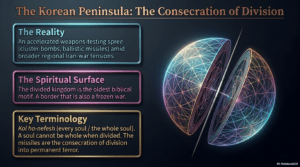
Spiritual surface: The divided kingdom is one of the oldest motifs in the Hebrew Bible: after Solomon’s death, the kingdom splits into Israel and Judah, and the prophets spend centuries lamenting the division. The Korean Peninsula is a modern split kingdom, a divided people, families separated by a border that is also a frozen war. The tradition has a name for this: kol ha-nefesh — every soul, the whole soul, which cannot be whole when it is divided. The Aleinu prayer, recited at the end of every service, speaks of the day when God will be one and God’s name will be one — not the erasure of difference but the reconciliation of division. The missiles are the opposite of that prayer: they are the consecration of division into a permanent terror.
Sources:
– AP News — “North Korea launches ballistic missile and other weapons toward the sea” (26 May 2026)
– CBS News — North Korea ballistic missile launches (26 May 2026)
– Reuters — “North Korea fires ballistic missiles again, flexing muscle amid Iran war” (18 Apr 2026)
III. Framework Reading — Liturgy of the Nine Days, Psalm 82, and the Question of Empire
We are inside the Nine Days, the period from Rosh Chodesh Av through Tisha B’Av. The liturgical framework changes. The daily Amidah is already in its summer form, with the petition for dew (tal) replacing the petition for rain. But the mood shifts further: Tachanun (supplicatory prayers) are omitted, as is the custom on festive days, but the reason is inverted — not because of joy, but because of the approach of mourning. The Talmud (Ta’anit 26b) records that from the first of Av, joy is diminished: no meat, no wine, no weddings, no music. The world is meant to feel thin.
The Haftarah of the week — Isaiah 1:21–26 — is read on the Shabbat that falls before Tisha B’Av. We are two days from the fast. The text is already in the ear. It is worth reading the promise at the end of the passage again, in the context of the five currents above:
וְאָשִׁיבָה יָדִי עָלַיִךְ וְאֶצְרֹף כַּבֹּר סִיגָיִךְ וְכָל־עַרְבָּיִךְ — “And I will turn my hand upon thee, and purely purge away thy dross, and take away all thy tin; and I will restore thy judges as at the first, and thy counsellors as at the beginning; afterward thou shalt be called, The city of righteousness, the faithful city.”
The restoration is conditional. The judges must be restored. The counsellors must return to their beginning. The city must be called by its true name. The geopolitical analogue is stark: the ceasefire that is not a ceasefire, the withdrawal that is not a withdrawal, the war that has no end-state, the genocide that the world has forgotten, the divided kingdom that fires missiles across the sea — none of these are “the city of righteousness.” The prophetic text is not a description of failure; it is a description of the condition for restoration. The question is whether the condition can be met.
Psalm 82 — the Psalm for Tuesday:
אֱלֹהִים נִצָּב בַּעֲדַת־אֵל בְּקֶרֶב אֱלֹהִים יִשְׁפֹּט — “God stands in the congregation of the mighty; in the midst of the gods God judges.”
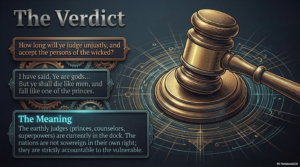
עַד־מָתַי תִּשְׁפְּטוּ עָוֶל וּפְנֵי רְשָׁעִים תִּשְׂאוּ — “How long will ye judge unjustly, and accept the persons of the wicked?”
שִׁפְטוּ דַל וְיָתוֹם עָנִי וָרָשׁ הַצְדִּיקוּ — “Judge the poor and fatherless; do justice to the afflicted and needy.”
פַּלְּטוּ דַל וְאֶבְיוֹן מִיַּד רְשָׁעִים הַצִּילוּ — “Deliver the poor and needy; rid them out of the hand of the wicked.”אֲנִי אָמַרְתִּי אֱלֹהִים אַתֶּם וּבְנֵי עֶלְיוֹן כֻּלְּכֶם — “I have said, Ye are gods; and all of you are children of the most High.”
אָכֵן כְּאָדָם תְּמוּתוּן וּכְאַחַד הַשָּׂרִים תִּפֹּלוּ — “But ye shall die like men, and fall like one of the princes.”קוּמָה אֱלֹהִים שָׁפְטָה הָאָרֶץ כִּי־אַתָּה תִנְחַל בְּכָל־הַגּוֹיִם — “Arise, O God, judge the earth; for thou shalt inherit all nations.”
This is the psalm for the day. It is a courtroom psalm. God is the judge; the earthly judges are in the dock. The verdict is not for the future; it is for now. The psalm insists that the world is not a theatre of power but a courtroom of justice. The nations are not sovereign in their own right; they are accountable. The “gods” of the psalm are the judges, the princes, the counsellors — those who exercise power in the name of the state. The psalm says: you are mortal, you will fall, and God will rise to judge.
The framework for today is Liturgy × Prophets: the liturgical mood of the Nine Days (mourning, diminishment, the thinning of joy) and the prophetic voice of Isaiah (indictment, conditional restoration, the demand for justice). The two frameworks meet in the Psalm of the day: Psalm 82, which calls the judges to account. The geopolitical currents above are the cases before the court. The question is whether the judges will hear the case.
IV. Closing Practice — One Ma’aseh for the Day
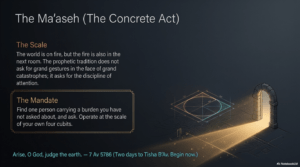
The rabbinic tradition speaks of ma’aseh — a concrete act, not a petition. The Nine Days are not a time for grand gestures but for the discipline of attention at the scale of one’s own four cubits (arba amot halakha, Berakhot 8a). The world is on fire, but the fire is also in the next room, the next street, the next country. The question is what one does with one’s own hands.
Today, the practice is small: Find one person who is carrying a burden you have not asked about, and ask. A colleague, a neighbour, a family member, someone in Gaza, someone in Sudan, someone in Ukraine, someone on the Korean Peninsula — the scale is not the point. The point is the act of attention. The prophetic tradition does not ask for grand gestures in the face of grand catastrophes; it asks for the discipline of attention.
The Hebrew phrase for the day is from Psalm 82:8:
קוּמָה אֱלֹהִים שָׁפְטָה הָאָרֶץ — “Arise, O God, judge the earth.”
One-line gloss: The world is not a theatre of power but a courtroom of justice. The covenant is not broken by the destruction of the building but by the indifference of those who inherit it. The fast is two days away. Begin now.
Sources for today’s reading (all dated within the past two weeks unless otherwise noted):
- BBC News, CNN, NPR, Al Jazeera, The New York Times, Reuters — for the geopolitical currents above
- Council on Foreign Relations, BBC — for Sudan
- AP News, CBS News, Reuters — for the Korean Peninsula
- Hebrew dates computed via
pyluach(Python) — 7 Av 5786 / 21 Jul 2026 - Psalm of the day from Shir Shel Yom tradition (Tuesday = Psalm 82)
- Library lookup: Methuselah API timed out; local fallback unavailable
Compiled by Peter & Timnah — Rachav Foundation. Next: 8 Av 5786 (Wed 22 Jul) — one day before Tisha B’Av.
About The Author