Rachav Daily — A Spiritual Geopolitical Reading
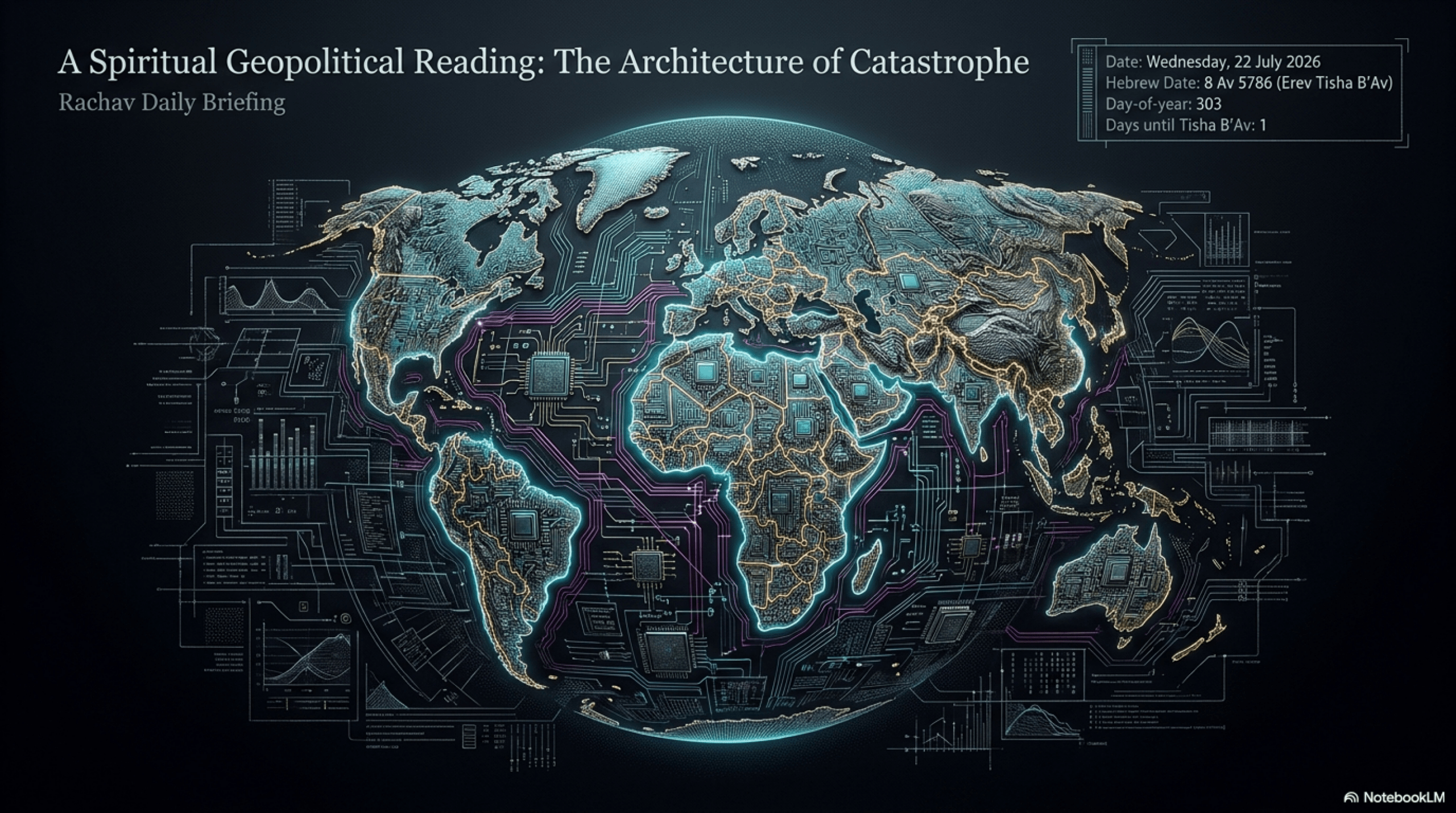
Date: Wednesday, 22 July 2026 — Erev Tisha B’Av
Hebrew date: 8 Av 5786 — Day 303 of the year
Days until Tisha B’Av: 1
Compiled for: Peter Dixon — Rachav Foundation
Series frame: 5-framework rotation (Prophets / Halakha / Kabbalah / Modern Philosophy / Liturgy). Today’s rotation slot: Prophets × Kabbalah (covenant-coherence / olam/tikkun), with Halakhic counterweight on pikuach nefesh.
I. Anchor — The Day Before the Fast
| Field | Value |
|---|---|
| Gregorian | Wednesday, 22 July 2026 |
| Hebrew | 8 Av 5786 (8 אָב ה׳תשפו) |
| Day-of-year | 303 (from 1 Tishrei) |
| Days until Tisha B’Av | 1 |
| Days until next Rosh Hashanah | 52 |
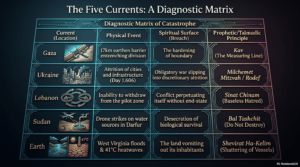
This is Erev Tisha B’Av — the eve of the ninth of Av, the day in Jewish memory when both Temples fell, when the spies returned with an evil report, when the expulsion from Spain was decreed, when the expulsion from Gush Katif began. The day is a concentration of catastrophe — not because history is magical, but because the tradition has learned to read repeated structural failure through a single lens. The lens is not “punishment.” It is chillul ha-shem — the desecration of the name, which is to say: the desecration of the world’s coherence.
Tonight, those who observe the tradition will eat a final meal before the fast — bread and a hard-boiled egg dipped in ashes, eaten on the floor or a low stool. The lights will dim. The book of Eichah (Lamentations) will be read by candlelight, in a melody so ancient it seems to come from the stones themselves. The text is not a poem of grief alone; it is a legal document. The city is the defendant. The witnesses are the nations. The verdict is that the city failed its own covenant.
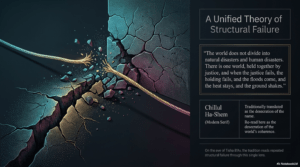
The single most important sentence for today: The world does not divide into natural disasters and human disasters. There is one world, held together by justice, and when the justice fails, the holding fails, and the floods come, and the heat stays, and the ground shakes.
II. Geopolitical Currents — Five Currents on the Eve of Destruction
Five currents below the surface, each with a momentum and a temperature. Read not as predictions but as pressures.
1. Gaza: the earthen barrier and the hardening of division
Current: Israel is building a miles-long earthen barrier inside Gaza, entrenching the division of the territory. Satellite imagery from Planet Labs shows the barrier running nearly unbroken for 17 kilometres from Khan Younis to near Gaza City, with new sections added between 21 June and 7 July near an Israeli military base constructed on the ruins of Bani Suheila. The Israeli military confirmed to the Associated Press that it has built a physical barrier in the area of the so-called “yellow line” — the boundary to which troops withdrew under the October 2025 ceasefire. The ceasefire exists on paper; on the ground, the division is becoming geological.
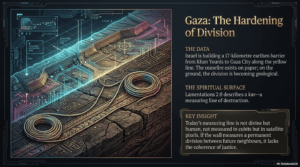
Spiritual surface: This is the prophetic question of boundary and breach. Lamentations 2:8 describes the Lord as having “determined to destroy the wall of the daughter of Zion; he hath stretched out a line, he hath not withdrawn his hand from destroying.” The kav (line) in the text is a measuring line of destruction. The earthen barrier is a measuring line of a different kind — not divine but human, not measured in cubits but in satellite pixels. The tradition does not ask whether walls are legitimate; it asks what the wall measures. If the wall measures a permanent division between two peoples who must one day live as neighbours, the prophetic reading is clear: the wall will not stand, because the coherence it seeks to enforce is not the coherence of justice.
Sources:
– AP News — “Israel is building a miles-long earthen barrier inside Gaza, entrenching its division” (21 Jul 2026)
– Economic Times — “As truce stalls, Israel is redrawing Gaza with a giant earthen barrier” (21 Jul 2026)
2. Ukraine: day 1,606 and the attrition of cities
Current: Day 1,606 of the full-scale war. Overnight Russian attacks on Kyiv killed at least 19 people, hitting apartment buildings and infrastructure. Ukraine’s air defence neutralised 46 of 58 Russian drones launched on the evening of 20 July. President Zelenskyy has replaced Ukraine’s military chief after protests, and Kyiv has struck logistics hubs in Russia’s Krasnodar and Stavropol regions involved in supplying drone components. Russian oil-refining capacity is running at half its 2025 level. The war is not being decided on the battlefield; it is being decided by the slow strangulation of infrastructure, the grinding down of civilian morale, and the political inability of either side to articulate an end-state.
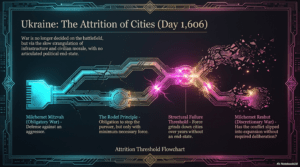
Spiritual surface: The Halakhic tradition distinguishes between milchemet mitzvah (obligatory war — defence against an aggressor) and milchemet reshut (discretionary war — expansion or pre-emption). The deeper question, on the eve of Tisha B’Av, is whether a war of attrition that has lost any conceivable political end-state remains in the category of the obligatory or has slipped into the discretionary without the required rabbinic deliberation. The rodef principle (Mishnah Sanhedrin 8:7) obligates stopping the pursuer — but only with minimum necessary force. When the force becomes structural, when it grinds down cities over years, the halakhic tradition is not silent. It asks: what is the minimum necessary? And who decides?
Sources:
– The Guardian — Ukraine live updates (22 Jul 2026)
– Reuters — “Russian attack on Kyiv kills seven, hits apartments” (21 Jul 2026)
– Al Jazeera — “Zelenskyy replaces Ukraine military chief after protests” (21 Jul 2026)
3. Lebanon: the pilot zone and the fragility of withdrawal
Current: Israeli troops have begun withdrawing from parts of southern Lebanon under a US-mediated ceasefire agreement, while the Lebanese military deploys in “pilot zones” to test the transfer of security control. On 21 July, Israeli forces fired shots near Lebanese Army troops in the town of Froun, raising tensions as both sides took first steps in the phased arrangement. The framework agreement, signed on 26 June, aims to keep Hezbollah away from the Israeli border and end nearly five months of conflict. But Hezbollah is not party to the agreement, and President Trump offered no concrete timeline for full Israeli withdrawal after meeting Lebanese President Joseph Aoun at the White House on 21 July.
Spiritual surface: The Talmudic principle of sinat chinam — baseless hatred — is the rabbinic diagnosis of why the Second Temple fell (TB Gittin 55b). The hatred between Kamtza and Bar Kamtza, the story goes, was so senseless that it burned the city down. The Lebanon-Israel border is not a story of baseless hatred; the conflicts are real and grievous. But the structure of the conflict — the inability to withdraw, the firing on troops who are trying to replace you, the meeting at the White House that produces no timeline — reproduces the structural shape of sinat chinam: the hatred that outlives its object, the conflict that perpetuates itself because no one knows how to stop.
Sources:
– Bloomberg — “Israel Withdraws Troops From Lebanon Towns in Test of Truce” (21 Jul 2026)
– The New York Times — “Lebanese Army Accuses Israeli Troops of Firing as Its Forces Deploy in ‘Pilot Zone’” (21 Jul 2026)
– Al Jazeera — “Trump vows to help Lebanon but offers no timeline for Israeli withdrawal” (21 Jul 2026)
4. Sudan: drones on water, children in markets
Current: On 21 July, a drone strike on a vital water source in Tina, North Darfur, killed at least 21 civilians. The same day, a drone attack on a market in Ar Rahad, North Kordofan, killed at least two children and injured six others aged between six and fourteen, according to UNICEF. The Rapid Support Forces (RSF) are suspected in both strikes. The Sudanese civil war has shifted to Darfur, Kordofan, and Blue Nile, with drone attacks now reaching areas once considered secure. The UN warns that an RSF ground attack on el-Obeid could lead to mass atrocities on the scale of el-Fasher, where the RSF committed genocidal violence after capturing it in October 2025.

Spiritual surface: The tradition reads the destruction of the Temple through the lens of galut — exile — and the Book of Lamentations is the canonical text of exile: “How doth the city sit solitary, that was full of people!” (Eichah 1:1). The Sudanese war is a war of galut in the most literal sense: 500,000 displaced in Lebanon, millions more in Sudan itself, populations moving across borders that no longer protect them. The drone strike on a water source is not a military tactic alone; it is a desecration of the basic covenant of habitation. The Torah commands that the enemy’s wells not be poisoned (Deuteronomy 20:19-20, the bal tashchit principle). The RSF’s strike on water is the opposite of this: it is chillul ha-shem at the level of biological survival.
Sources:
– Sudan Tribune — “At Least 21 Killed in Drone Strike on North Darfur Water Hub” (21 Jul 2026)
– UNICEF — “Drone attack on Ar Rahad market, North Kordofan, kills and injures children” (21 Jul 2026)
– Christian Science Monitor — “Surrounded by warring factions, Sudan’s el-Obeid must rely on local relief” (21 Jul 2026)
5. Earth and Atmosphere — the world before the fast
Current: Catastrophic flooding has devastated communities in Weston, West Virginia, with a National Weather Service Flood Emergency in effect and the governor declaring a state of emergency for all 55 counties. Severe storms across the Mountain State have left more than 10,000 residents without power, with flash flooding, landslides, and road closures. This follows the North American heatwave that began in late June, with temperature records tied or broken across the United States and Canada, peaking at 41°C in Atlantic City on 4 July. European heatwaves in June, linked by World Weather Attribution to fossil-fuel emissions, set records across the Mediterranean. In the past 24 hours, the USGS recorded multiple significant earthquakes globally. The earth’s crust and atmosphere are both restless — both before the ninth of Av.
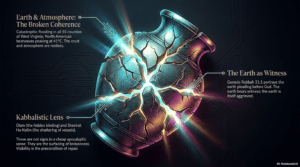
Spiritual surface: The Hebrew Bible has a doctrine of the world’s coherence — that the land itself participates in the moral life of the people who dwell on it. “The land shall vomit you out,” says Leviticus 20:22, when the people fail the covenant. Hosea says the land mourns and dries up because of the wickedness of those who dwell in it (Hosea 4:3). The prophets do not separate human moral disorder from geological and meteorological disorder; they read the two together as a single phenomenon.
TB Sanhedrin 108b records that the generation of the Flood was destroyed not for idolatry, not for sexual immorality, but for chillul ha-shem — the desecration of the name, which is to say: the desecration of the world’s coherence. Genesis Rabbah 31:1 portrays the earth itself pleading before God: “Master of the Universe, the judgment of the generation of the Flood is a song for me, but the verdict of the case is not a song for me.” The earth bears witness; the earth is itself aggrieved.
TB Berakhot 17a teaches that the world stands on tikkunei ha-yam — the corrections of the sea — on the verses of the Psalms that restrain the primordial chaos. The world does not hold itself together; it is held by human attention, by human speech, by human tikkun. Isaiah 24:5 — read every Tisha B’Av as part of the morning kinnah — says: “The earth is defiled under the inhabitants thereof, because they have transgressed the laws, violated the statutes, broken the everlasting covenant. Therefore hath the curse devoured the earth.”
The floods and the heatwaves and the tremors are not metaphors for political disorder; they are part of the same revelation. The pious wish would be that the natural order remain undisturbed by the moral order. The tradition does not give us this wish. It gives us instead the discipline of attention, which is tikkun, which is the only reliable response to a coherence that is breaking in plain sight.
Sources:
– Fox Weather — “See it: West Virginia communities devastated by rare catastrophic flooding” (22 Jul 2026)
– CNN — “Historic West Virginia flooding prompts statewide emergency” (21 Jul 2026)
– Wikipedia — 2026 North American heat wave
– Wikipedia — 2026 European heatwaves
– Talmud Bavli, Berakhot 17a; Sanhedrin 108b
– Genesis Rabbah 31:1
– Hosea 4:3; Isaiah 24:5; Leviticus 20:22
III. Framework Reading — Lamentations, the Covenant, and the Fragile World
We are one day from the day on which, in Jewish memory, the Temple fell. The reading tonight is Eichah — Lamentations — and the framework is Prophets, with Kabbalah as the second lens for the Earth and Atmosphere current.
Prophets — Lamentations 1:1–5 in plain English:
“How doth the city sit solitary, that was full of people! How is she become as a widow, she that was great among the nations, and princess among the provinces, how is she become tributary! She weepeth sore in the night, and her tears are on her cheeks: among all her lovers she hath none to comfort her: all her friends have dealt treacherously with her, they are become her enemies. Judah is gone into captivity because of affliction, and because of great servitude: she dwelleth among the heathen, she findeth no rest: all her persecutors overtook her between the straits. The ways of Zion do mourn, because none come to the solemn feasts: all her gates are desolate: her priests sigh, her virgins are afflicted, and she is in bitterness.”
The text is remarkable for its personification. The city is a woman — Daughter Zion — abandoned, widowed, weeping through the night. The tradition does not say “the city was destroyed.” It says “the city sits solitary.” The verb is active. The city is still there, still sitting, still weeping. The destruction is not an event that happened and ended. It is a condition that persists.
This is the prophetic doctrine of structural grief: the catastrophe is not a single moment but a sustained state. The war in Gaza, the war in Ukraine, the war in Sudan — these are not “events” to be covered and moved on from. They are conditions. The city sits solitary. The tears are on her cheeks. The framework asks us to sit with the condition, not to resolve it prematurely.
The promise in Lamentations is not immediate restoration. It is the promise that the condition will be witnessed. The book is read aloud, in community, in a melody that carries the grief across generations. The reading is the tikkun — the repair is not in the text’s content but in the act of reading it together.
Kabbalah — Olam and Tikkun:
The Hebrew word for the world’s coherent fragility is olam (עוֹלָם), from a root meaning “hidden,” “concealed,” “bound up.” The world is held together by a binding that is itself hidden. The Hebrew word for repair is tikkun (תִּקּוּן) — from the root t-k-k, to set right, to mend a fracture.
The Kabbalistic framework reads the Earth and Atmosphere current not as “natural disaster” but as shevirat ha-kelim — the shattering of vessels. In the Lurianic myth, the vessels that were meant to contain the divine light broke, and the shards fell into the material world. The task of humanity is tikkun — to gather the shards, to repair the vessels, to restore the coherence.
The flood in West Virginia, the heatwave over the Mediterranean, the tremors in the earth’s crust — these are not “signs” in the cheap apocalyptic sense. They are the surfacing of the brokenness. The tradition does not say that the flood is sent because of anyone’s sin. It says: when you see these things, lift up your heads, because your redemption is near — not because the suffering is good, but because the surfacing makes the brokenness visible, and visibility is the precondition of repair.
Halakha — Pikuach Nefesh and the Rodef:
The Talmudic principle of pikuach nefesh — preservation of life — overrides virtually every other commandment in Judaism. But the rodef principle (Mishnah Sanhedrin 8:7) refines it: one is obligated to stop a pursuer, but only with minimum necessary force. The principle is the structural ancestor of modern distinctions between combatants and non-combatants, between proportionality and excess.
On the eve of Tisha B’Av, the halakhic framework asks: what is the minimum necessary force to stop the drone strike on a water source in Darfur? What is the minimum necessary force to stop the earthen barrier from becoming a permanent division? The tradition does not give answers. It gives a method — the method of sh’eilat chachamim, of asking the wise, of deliberating in community, of refusing the unilateral decision.
Liturgy — the Psalm for the Day:
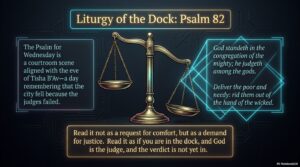
Today’s weekday Shir shel Yom (Psalm for the Day, Wednesday) is Psalm 82:
אֱלֹהִים נִצָּב בַּעֲדַת־אֵל בְּקֶרֶב אֱלֹהִים יִשְׁפֹּט
“God standeth in the congregation of the mighty; he judgeth among the gods.” (Psalm 82:1)עַד־מָתַי תִּשְׁפְּטוּ־עָוֶל וּפְנֵי רְשָׁעִים תִּשְׂאוּ־סֶלָה
“How long will ye judge unjustly, and accept the persons of the wicked?” (Psalm 82:2)שִׁפְטוּ־דַל וְיָתוֹם עָנִי וָרָשׁ הַצְדִּיקוּ
“Judge the poor and fatherless: do justice to the afflicted and needy.” (Psalm 82:3)פַּלְּטוּ־דַל וְאֶבְיוֹן מִיַּד רְשָׁעִים הַצִּילוּ
“Deliver the poor and needy: rid them out of the hand of the wicked.” (Psalm 82:4)
The Psalm for Wednesday is a courtroom scene — God standing among the judges, demanding that they judge justly. It is the perfect psalm for the day before Tisha B’Av, when the tradition remembers that the city fell because the judges failed. The psalm does not ask for comfort. It asks for justice.
IV. From Your Library — Reading Today
The Rachav library contains the following books that bear directly on today’s themes:
- Meiliken, Jeffery. The Divine Calendar: 0 HC to 2018 CE.
The book we anchored this daily project on. Today (8 Av) and tomorrow’s fast are mapped in this year-by-year calendar of the Hebrew reckoning. - Stern, Sacha. Calendar and Community: A History of the Jewish Calendar, 2nd Century BCE to 10th Century CE. Oxford University Press. ISBN 9780198270348.
The canonical history of how the calendar we are using today was constructed through centuries of rabbinic decision. - Segal, Eliezer. In Those Days, at This Time: Holiness and History in the Jewish Calendar. University of Calgary Press. ISBN 9781552381854.
Walks through each festival in the Jewish calendar with historical-critical analysis. Read the chapter on Tisha B’Av for tomorrow’s anchor. - Mittleman, Alan L. A Short History of Jewish Ethics: Conduct and Character in the Context of Covenant / Edition 1. ISBN 9781405189422.
The covenant framework applied to Jewish ethical reasoning — directly relevant to the covenant-coherence doctrine in today’s Earth and Atmosphere reading. - Sacks, Jonathan. Covenant & Conversation: A Weekly Reading of the Jewish Bible: Leviticus: the Book of Holiness.
The late Chief Rabbi’s weekly reading on Leviticus — the book that contains the covenant-coherence teaching of Leviticus 20:22, “the land shall vomit you out.” - Mandolfo, Carleen. Daughter Zion Talks Back to the Prophets: A Dialogic Theology of the Book of Lamentations.
A theological reading of Lamentations that gives voice to the city’s protest — the text we read tonight.
V. Closing Practice — One Act Before the Fast
The tradition does not ask us to solve the world’s problems today. It asks us to attend to them. The fast of Tisha B’Av is not a punishment; it is a discipline of attention. For 25 hours, we abstain from food, drink, bathing, leather shoes, and sexual relations — not because these things are bad, but because removing them creates a space in which the grief of the world can be felt without the usual anaesthetics.
For today, the practice is specific and small:
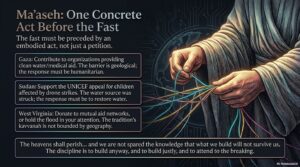
- Read Psalm 82 aloud — the Wednesday psalm, the courtroom psalm. Read it as if you are in the dock, and God is the judge, and the verdict is not yet in.
- One concrete ma’aseh — a concrete embodied act, not a petition. Today, with five currents spanning Gaza, Ukraine, Lebanon, Sudan, and the Earth itself, the ma’aseh names three affected communities:
– For Gaza: Contribute to an organisation providing clean water or medical aid to civilians in the strip. The barrier is geological; the response must be humanitarian.
– For Sudan: Support the UNICEF appeal for children affected by the drone strikes in Ar Rahad and North Darfur. The water source was struck; the response must be to restore water.
– For West Virginia: The flood is local and immediate. If you are in the United States, donate to the West Virginia Emergency Management Division or a local mutual-aid network. If you are elsewhere, hold the flood in your attention during the fast — the tradition’s kavvanah is not bounded by geography.
The Tisha B’Av kinnah of Rabbi Yehuda ben Levi continues: “Of old You established the earth, and the heavens are the work of Your hands — they shall perish, but You shall endure.” The heavens shall perish — the coup of the Hebrew verb is ontological — and we are not spared the knowledge that what we build will not survive us. The discipline is to build anyway, and to build justly, and to attend to the breaking.
מַעֲשֶׂה — Ma’aseh. One concrete act. Today. Before the fast begins.
Sources for today’s reading (all dated within the past 24–48 hours unless otherwise noted):
- AP News, Economic Times, KCRA, MS.now, YourNews — Gaza barrier (21 Jul 2026)
- The Guardian, Reuters, Al Jazeera, Washington Post, Ukrinform, ISW — Ukraine war (21–22 Jul 2026)
- Bloomberg, The New York Times, Al Jazeera, Fox News, Naharnet, BBC — Lebanon-Israel ceasefire (21 Jul 2026)
- Sudan Tribune, UNICEF, Christian Science Monitor, allAfrica — Sudan civil war (21 Jul 2026)
- Fox Weather, CNN, WV MetroNews, WV News, Wikipedia — Earth and Atmosphere (21–22 Jul 2026)
- Hebrew dates computed via
pyluach(Python) — 8 Av 5786 / 22 Jul 2026 - Library data via Methuselah API v3.6.0 (Tailscale Funnel) — 14,699 books
- Talmud Bavli, Berakhot 17a; Sanhedrin 108b; Gittin 55b
- Genesis Rabbah 31:1
- Hosea 4:3; Isaiah 24:5; Leviticus 20:22; Psalm 82
Compiled by Peter & Timnah — Rachav Foundation. Next: 9 Av 5786 (Thu 23 Jul) — Tisha B’Av.
About The Author