Rachav Daily — A Spiritual Geopolitical Reading
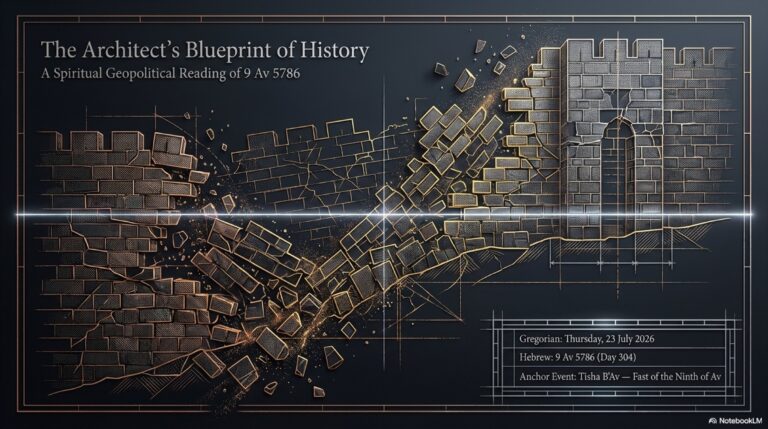
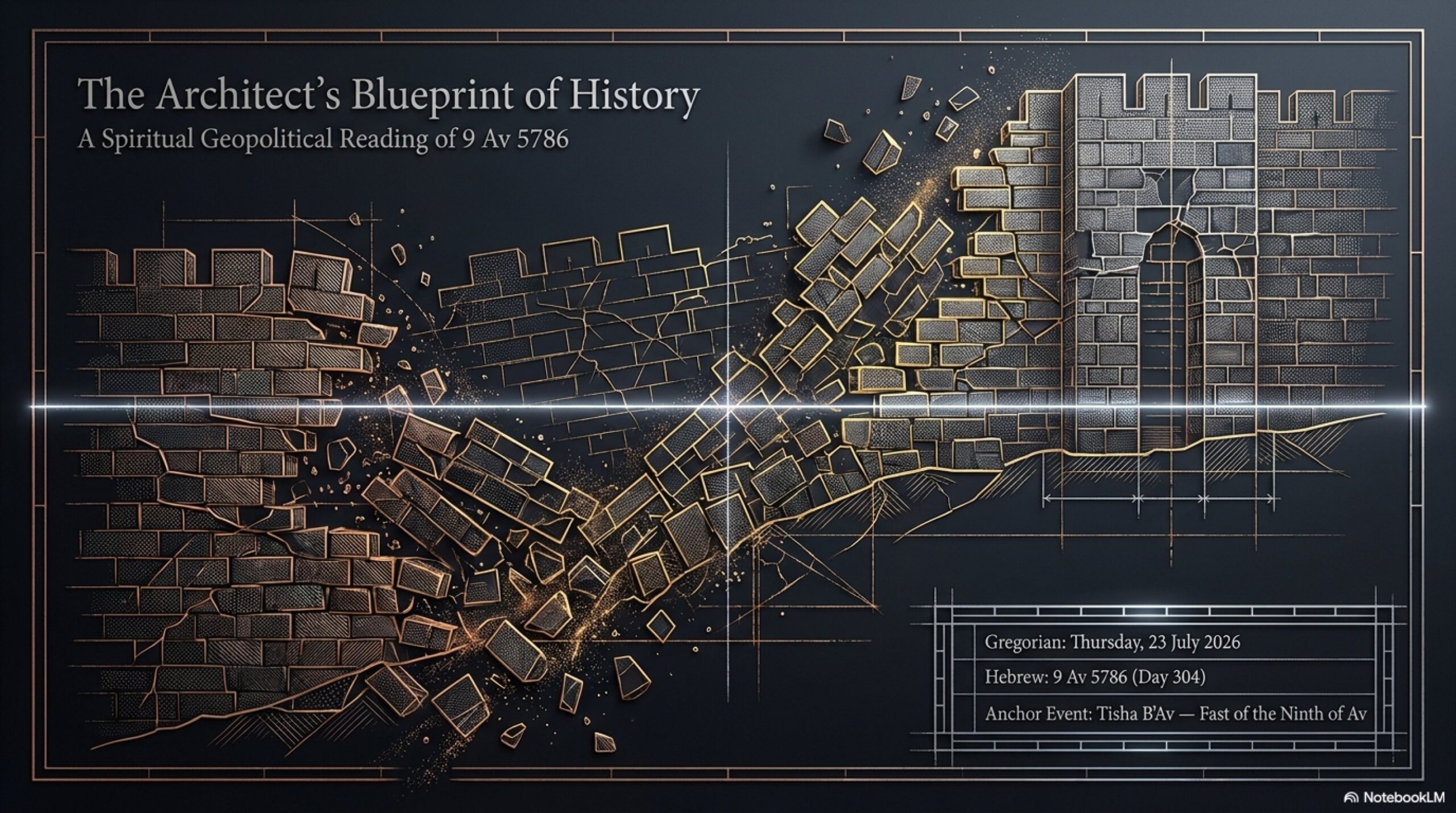
Date: Thursday, 23 July 2026 — Tisha B’Av
Hebrew date: 9 Av 5786 — Day 304 of the year
Festival: Tisha B’Av — the Fast of the Ninth of Av
Compiled for: Peter Dixon — Rachav Foundation
Series frame: 5-framework rotation (Prophets / Halakha / Kabbalah / Modern Philosophy / Liturgy). Today’s rotation slot: Prophets (Lamentations) with Liturgy (Kinot, Rabbi Yehuda ben Levi) as the second lens.
I. Anchor — The City Sits Solitary
| Field | Value |
|---|---|
| Gregorian | Thursday, 23 July 2026 |
| Hebrew | 9 Av 5786 (9 אָב ה׳תשפו) |
| Day-of-year | 304 (from 1 Tishrei) |
| Festival | Tisha B’Av — Fast of the Ninth of Av |
| Days until next Rosh Hashanah | 51 |
אֵיכָה יָשְׁבָה בָדָד הָעִיר רַבָּתִי עָם — “How doth the city sit solitary, that was full of people!” (Eikhah 1:1)
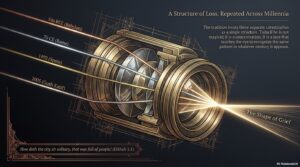
This is Tisha B’Av — the day in Jewish memory when both Temples fell, when the spies returned from Canaan with an evil report, when the expulsion from Spain was decreed in 1492, when the expulsion from Gush Katif began in 2005. The tradition does not treat these as separate catastrophes. It treats them as a single structure of loss, repeated across millennia, each one indistinguishable from the next in the shape of its grief. The day is not magical; it is a concentration — a lens that teaches the eye to recognise the same pattern in whatever century it appears.
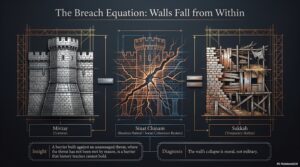
The central image of the day is breach (חֶרְבָּה). The walls of Jerusalem did not hold against Babylon in 586 BCE; they did not hold against Rome in 70 CE. The walls of the Second Temple period were breached not because they were poorly built but because the coherence they sought to enforce was already broken from within. The Talmud’s diagnosis is sinat chinam — baseless hatred (TB Gittin 55b–56a) — not a failure of fortification but a failure of the social fabric that the walls were meant to protect. The wall’s collapse is moral, not military.
The single most important sentence for today: A barrier built against an unassuaged threat, where the threat has not been met by reason, is a barrier that history teaches cannot hold.
II. Geopolitical Currents — Six Currents on the Day of Destruction
Six currents below the surface, each with a momentum and a temperature. Read not as predictions but as pressures. On Tisha B’Av, the mourning is the lens through which the currents are read; the currents are the evidence through which the mourning is sustained.
1. Gaza: the earthen barrier and the wall that cannot hold
Current: Israel is rapidly constructing a miles-long earthen barrier inside Gaza, separating the territory under its military control from the rest of the enclave. Satellite imagery from Planet Labs shows the barrier running nearly unbroken for 17 kilometres, with new sections added between late June and mid-July near an Israeli military base constructed on the ruins of Bani Suheila. The Israeli military confirmed to the Associated Press that the barrier aims to prevent infiltration and protect troops and communities near Gaza. The October 2025 ceasefire exists on paper; on the ground, the division is becoming geological. Palestinians fear the territory will never be relinquished.
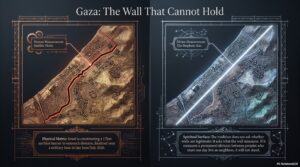
Spiritual surface: This is the prophetic question of boundary and breach, read through the lineage of Tisha B’Av. Lamentations 2:8 describes the Lord as having “determined to destroy the wall of the daughter of Zion; he hath stretched out a line, he hath not withdrawn his hand from destroying.” The kav (line) in the text is a measuring line of destruction. The earthen barrier is a measuring line of a different kind — not divine but human, not measured in cubits but in satellite pixels. The tradition does not ask whether walls are legitimate; it asks what the wall measures. If the wall measures a permanent division between two peoples who must one day live as neighbours, the prophetic reading is clear: the wall will not stand, because the coherence it seeks to enforce is not the coherence of justice. The wall’s collapse is read as moral, not military — built from the same logic as every wall in the mourning liturgy. Isaiah 1:7–8 speaks of the daughter of Zion left “as a booth in a vineyard, as a lodge in a garden of cucumbers” — the mivzar (fortress) that becomes a sukkah (temporary shelter), the pretence of protection that the prophet sees through.
Sources:
– AP News — “Israel is building a miles-long earthen barrier inside Gaza, entrenching its division” (21 Jul 2026)
– Al Jazeera — “Israel building earthen barrier in Gaza to entrench division of the enclave” (23 Jul 2026)
– The Washington Post — “Israel is building a miles-long earthen barrier inside Gaza” (21 Jul 2026)
2. Ukraine: day 1,607 and the attrition of cities
Current: Day 1,607 of the full-scale war. Overnight on 22–23 July, Ukrainian drones struck an oil refinery and logistics infrastructure in Russian regions, while Russia continued missile and drone attacks on Ukrainian cities. President Zelenskyy appointed Major General Mykhailo Drapatyi as the new commander-in-chief after protests over the previous military leadership. Russian oil-refining capacity is running at half its 2025 level. The war is not being decided on the battlefield; it is being decided by the slow strangulation of infrastructure, the grinding down of civilian morale, and the political inability of either side to articulate an end-state.

Spiritual surface: The Halakhic tradition distinguishes between milchemet mitzvah (obligatory war — defence against an aggressor) and milchemet reshut (discretionary war — expansion or pre-emption). The deeper question, on Tisha B’Av, is whether a war of attrition that has lost any conceivable political end-state remains in the category of the obligatory or has slipped into the discretionary without the required rabbinic deliberation. The rodef principle (Mishnah Sanhedrin 8:7) obligates stopping the pursuer — but only with minimum necessary force. When the force becomes structural, when it grinds down cities over years, the halakhic tradition is not silent. It asks: what is the minimum necessary? And who decides?
Sources:
– The Kyiv Independent — “Ukrainian drones target Russia’s Amazon warehouse for second straight night” (23 Jul 2026)
– ISW — “Russian Offensive Campaign Assessment, July 21, 2026”
– BBC News — Ukraine war updates (23 Jul 2026)
3. Lebanon: the pilot zone and the fragility of withdrawal
Current: Israeli troops have begun withdrawing from parts of southern Lebanon under a US-mediated ceasefire agreement, while the Lebanese military deploys in “pilot zones” to test the transfer of security control. On 21 July, Israeli forces fired shots near Lebanese Army troops in the town of Froun, raising tensions as both sides took first steps in the phased arrangement. The framework agreement, signed on 26 June, aims to keep Hezbollah away from the Israeli border. But Hezbollah is not party to the agreement, and President Trump offered no concrete timeline for full Israeli withdrawal after meeting Lebanese President Joseph Aoun at the White House.

Spiritual surface: The Talmudic principle of sinat chinam — baseless hatred — is the rabbinic diagnosis of why the Second Temple fell (TB Gittin 55b). The hatred between Kamtza and Bar Kamtza was so senseless that it burned the city down. The Lebanon-Israel border is not a story of baseless hatred; the conflicts are real and grievous. But the structure of the conflict — the inability to withdraw, the firing on troops who are trying to replace you, the meeting at the White House that produces no timeline — reproduces the structural shape of sinat chinam: the hatred that outlives its object, the conflict that perpetuates itself because no one knows how to stop.
Sources:
– The New York Times — “Lebanese Army Accuses Israeli Troops of Firing as Its Forces Deploy in ‘Pilot Zone’” (21 Jul 2026)
– The Times of Israel — “US says Lebanese army deploying to pilot zones” (22 Jul 2026)
– Al Jazeera — “Trump vows to help Lebanon but offers no timeline for Israeli withdrawal” (21 Jul 2026)
4. Sudan: drones on water, children in markets
Current: On 21 July, a drone strike on a vital water source in Tina, North Darfur, killed at least 21 civilians. The same day, a drone attack on a market in Ar Rahad, North Kordofan, killed at least two children and injured six others aged between six and fourteen, according to UNICEF. The Rapid Support Forces (RSF) are suspected in both strikes. The Sudanese civil war has shifted to Darfur, Kordofan, and Blue Nile, with drone attacks now reaching areas once considered secure. The UN warns that an RSF ground attack on el-Obeid could lead to mass atrocities on the scale of el-Fasher, where the RSF committed genocidal violence after capturing it in October 2025.
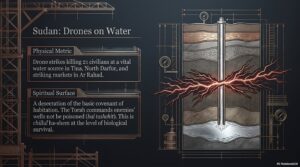
Spiritual surface: The tradition reads the destruction of the Temple through the lens of galut — exile — and the Book of Lamentations is the canonical text of exile: “How doth the city sit solitary, that was full of people!” (Eikhah 1:1). The Sudanese war is a war of galut in the most literal sense: millions displaced, populations moving across borders that no longer protect them. The drone strike on a water source is not a military tactic alone; it is a desecration of the basic covenant of habitation. The Torah commands that the enemy’s wells not be poisoned (Deuteronomy 20:19–20, the bal tashchit principle). The RSF’s strike on water is the opposite of this: it is chillul ha-shem at the level of biological survival.
Sources:
– Sudan Tribune — “At Least 21 Killed in Drone Strike on North Darfur Water Hub” (21 Jul 2026)
– UNICEF — “Drone attack on Ar Rahad market, North Kordofan, kills and injures children” (21 Jul 2026)
– BBC News — “El-Obeid under constant drone strikes blamed on RSF” (Jul 2026)
5. Iran: the empire that devises its own destruction
Current: The US-Iran war continues with no clear end-state. On 21 July, Axios reported that mediators are pushing a new 10-day ceasefire proposal aimed at reopening the Strait of Hormuz, but neither Trump nor Iran has accepted it. Both sides appear determined to improve their leverage through further strikes before committing to any ceasefire. A week of intensified strikes in mid-July left the previous ceasefire “in tatters” (CNN, 18 July). Trump declared the ceasefire “over” on 10 July, then agreed to continue talks — a pattern of escalation-and-negotiation that has repeated since the Twelve-Day War of June 2025. The Iranian regime, weakened by the war and unable to fully enforce the compulsory hijab, faces internal protests even as it projects force through proxies.
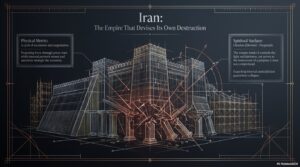
Spiritual surface: Read Iran through Eikhah 2:8 — “The Lord hath purposed to destroy the wall of the daughter of Zion; he hath stretched out a line, he hath not withdrawn his hand from destroying: and he hath made the rampart and the wall to lament; they languish together.” The Hebrew verb is חָשַׁב (chashav) — devised / purposed / thought. The empire that devises its own destruction is the precise diagnosis: an empire (Rome, Babylon, Persia) that builds its rampart and watches it fall. The Iranian regime’s own logic — exporting internal contradiction through proxy war, pursuing nuclear ambiguity while sanctions strangle the economy — is the source of its collapse. Isaiah 45 gives the Persian frame: Cyrus as the mashiach (anointed), the foreign king who does God’s work without knowing it. “I form the light, and create darkness; I make peace, and create evil; I the Lord do all these things” (Isaiah 45:7). The empire that thinks it controls the light and the darkness is itself the instrument of a purpose it does not comprehend.
Sources:
– Axios — “Iran mediators push new ceasefire as Trump eyes all-out war” (21 Jul 2026)
– CNN — “US completes more strikes against Iran after Trump warning to Tehran” (20 Jul 2026)
– The Guardian — “US and Iran trade escalating strikes as supreme leader is buried” (9 Jul 2026)
6. Earth and Atmosphere: the world on the fast day
Current: Catastrophic flooding has devastated communities in central West Virginia, with Governor Patrick Morrisey declaring a state of emergency for all 55 counties on 21 July. More than 300 National Guard members have been deployed, with dozens of water rescues and washed-out bridges. The flooding follows the North American heatwave that began in late June, with temperature records tied or broken across the United States and Canada. In Europe, wildfires have killed two firefighters in southwestern France, with Spain battling its biggest wildfire of the year. The earth’s crust and atmosphere are both restless — both on the ninth of Av.

Spiritual surface: The Hebrew Bible has a doctrine of the world’s coherence — that the land itself participates in the moral life of the people who dwell on it. “The land shall vomit you out,” says Leviticus 20:22, when the people fail the covenant. Hosea says the land mourns and dries up because of the wickedness of those who dwell in it (Hosea 4:3). The prophets do not separate human moral disorder from geological and meteorological disorder; they read the two together as a single phenomenon. TB Sanhedrin 108b records that the generation of the Flood was destroyed not for idolatry, not for sexual immorality, but for chillul ha-shem — the desecration of the name, which is to say: the desecration of the world’s coherence. Genesis Rabbah 31:1 portrays the earth itself pleading before God: “Master of the Universe, the judgment of the generation of the Flood is a song for me, but the verdict of the case is not a song for me.” The earth bears witness; the earth is itself aggrieved. The floods and the heatwaves and the tremors are not metaphors for political disorder; they are part of the same revelation. The pious wish would be that the natural order remain undisturbed by the moral order. The tradition does not give us this wish. It gives us instead the discipline of attention, which is tikkun, which is the only reliable response to a coherence that is breaking in plain sight.
Sources:
– CNN — “Historic West Virginia flooding prompts statewide emergency” (21 Jul 2026)
– Fox 5 DC — “West Virginia under state emergency after catastrophic flooding” (22 Jul 2026)
– Detroit News — “Fires in Spain and France, hail in Balkans; Europe’s erratic weather persists” (21 Jul 2026)
– TB Berakhot 17a; TB Sanhedrin 108b; Genesis Rabbah 31:1
– Hosea 4:3; Isaiah 24:5; Leviticus 20:22
III. Framework Reading — Lamentations, the Kinot, and the Wall That Laments
Prophets — Eikhah 2:8 and the empire that devises its own destruction
חָשַׁב יְהֹוָה לְהַשְׁחִית חוֹמַת בַּת־צִיּוֹן נָטָה קָו לֹא־הֵשִׁיב יָדוֹ מִבְּלַעַ וַיַּאֲבֵל חֵיל וְחוֹמָה יַחְדָּו אֻמְלָלוּ — “The Lord hath purposed to destroy the wall of the daughter of Zion; he hath stretched out a line, he hath not withdrawn his hand from destroying: and he hath made the rampart and the wall to lament; they languish together.” (Eikhah 2:8)
The verb חָשַׁב (chashav) is the key. It means “to think, to plan, to devise, to calculate.” In the biblical lexicon, it is the verb of human intentionality — the architect who draws plans, the accountant who calculates profit, the strategist who devises a campaign. Here it is applied to God, but the coup of the verse is that the object of the devising is the wall itself — the wall that the empire built to protect itself, the wall that becomes the instrument of its own destruction. The kav (line) that God stretches out is the measuring line of the builder; the builder’s own tool becomes the tool of unbuilding.
This is the prophetic diagnosis of empire, from Babylon to Rome to Persia: the empire that builds a rampart against a threat it has not assuaged through reason is the empire that devises its own destruction. The wall is not wrong in itself. The wall is wrong when it substitutes for justice, when it becomes a permanent division between peoples who must one day live as neighbours, when it measures the empire’s fear rather than the empire’s wisdom. The Gaza barrier, read through this lens, is not a policy to be evaluated in utilitarian terms. It is a line — a kav — that measures the distance between the empire and its own covenant. The wall will lament. The rampart and the wall will languish together. This is not a prediction of military defeat. It is a statement about the moral physics of empire: a wall built on unassuaged fear is a wall that carries its own destruction within it.
Isaiah 1:7–8 extends the image: “Your country is desolate, your cities are burned with fire… the daughter of Zion is left as a booth in a vineyard, as a lodge in a garden of cucumbers.” The mivzar (fortress) becomes a sukkah — a temporary shelter, a flimsy booth that the wind blows through. The prophet sees through the pretence of protection. The fortress is already a booth; the wall is already a lament. The question is not whether the wall will fall — the question is whether the empire can see the booth inside the fortress before the wind blows.
Liturgy — the Kinot of Rabbi Yehuda ben Levi
The kinnah of Rabbi Yehuda ben Levi, recited every Tisha B’Av morning, begins with the verse that the tradition has made the anthem of the day:
צִיּוֹן הֲלֹא תִשְׁאֲלִי לִשְׁלוֹם אֲסִירַיִךְ — “Zion, will you not inquire after the welfare of your captives?”
The kinnah is structured as a dialogue between Zion and the exiles. Zion asks: “Why do you not ask after me?” The exiles reply: “We are the ones who need asking after.” The dialogue is unresolved. It is not a consolation; it is a sustained question — a question that the liturgy keeps open across the centuries. The Kinot do not resolve the grief; they perform it. The community sits on the floor, reads the kinnah in a melody that seems to come from the stones themselves, and the melody is the tikkun — not the content but the act, not the answer but the attention.
The kinnah continues with the verse from Isaiah 24:5, read every Tisha B’Av as part of the morning liturgy:
וְהָאָרֶץ חָנְפָּה תַּחַת יֹשְׁבֶיהָ כִּי־עָבְרוּ תוֹרֹת חָלְפוּ חֹק הֵפֵרוּ בְרִית עוֹלָם — “The earth is defiled under the inhabitants thereof, because they have transgressed the laws, violated the statutes, broken the everlasting covenant.”
The brit olam — the everlasting covenant — is not a contract between God and Israel alone. It is a covenant that includes the earth. The earth is defiled because the covenant is broken. The flood in West Virginia, the heatwave over the Mediterranean, the wildfires in France and Spain — these are not “signs” in the cheap apocalyptic sense. They are the surfacing of the brokenness. The tradition does not say that the flood is sent because of anyone’s sin. It says: when you see these things, lift up your heads, because your redemption is near — not because the suffering is good, but because the surfacing makes the brokenness visible, and visibility is the precondition of repair.
The Kinot of Rabbi Yehuda ben Levi end with the affirmation that the heavens shall perish but God shall endure — “they shall perish, but You shall endure” — an ontological coup that places the empire’s permanence in question and God’s endurance beyond question. The discipline is to build anyway, and to build justly, and to attend to the breaking.
IV. From Your Library — Reading Today
The Rachav library contains the following books that bear directly on today’s themes:
- Meiliken, Jeffery. The Divine Calendar: 0 HC to 2018 CE. Calibre → · metadata
The book we anchored this daily project on. Today (9 Av) and the fast are mapped in this year-by-year calendar of the Hebrew reckoning. - Stern, Sacha. Calendar and Community: A History of the Jewish Calendar, 2nd Century BCE to 10th Century CE. Calibre → · metadata
The canonical history of how the calendar we are using today was constructed through centuries of rabbinic decision. - Segal, Eliezer. In Those Days, at This Time: Holiness and History in the Jewish Calendar. Calibre → · metadata
Walks through each festival in the Jewish calendar with historical-critical analysis. Read the chapter on Tisha B’Av for today’s anchor. - Mandolfo, Carleen. Daughter Zion Talks Back to the Prophets: A Dialogic Theology of the Book of Lamentations. Calibre → · metadata
A theological reading of Lamentations that gives voice to the city’s protest — the text we read today. - Mittleman, Alan L. A Short History of Jewish Ethics: Conduct and Character in the Context of Covenant / Edition 1. Calibre → · metadata
The covenant framework applied to Jewish ethical reasoning — directly relevant to the covenant-coherence doctrine in today’s Earth and Atmosphere reading. - Sacks, Jonathan. Covenant & Conversation: A Weekly Reading of the Jewish Bible: Leviticus: the Book of Holiness. Calibre → · metadata
The late Chief Rabbi’s weekly reading on Leviticus — the book that contains the covenant-coherence teaching of Leviticus 20:22, “the land shall vomit you out.”
V. Closing Practice — One Act on the Fast Day
The tradition does not ask us to solve the world’s problems today. It asks us to attend to them. The fast of Tisha B’Av is not a punishment; it is a discipline of attention. For 25 hours, we abstain from food, drink, bathing, leather shoes, and sexual relations — not because these things are bad, but because removing them creates a space in which the grief of the world can be felt without the usual anaesthetics.

On this day, the closing practice is one of silence or listening — not petition. The ma’aseh (מַעֲשֶׂה) on Tisha B’Av is being with rather than doing for. The phrase from Eikhah 1:1 is appropriate: “ישֵׁב יָחִיד” — “he sitteth alone.” The solitude is the practice. The sitting is the practice. The attention is the practice.
מַעֲשֶׂה — Ma’aseh. One concrete act. Today.
- Read Eikhah aloud tonight — the book of Lamentations, in the melody that carries the grief across generations. If you do not know the melody, read it slowly. If you do not read Hebrew, read it in translation, slowly. The reading is the tikkun.
- Hold silence for one minute at the moment of the Mincha fast — the afternoon prayer, when the tradition says the Temple actually fell. In that minute, name three affected communities:
– For Gaza: The civilians on both sides of the earthen barrier, for whom the wall is a daily reality and a daily fear. The barrier cannot hold; the people must.
– For Iran: The Iranian people, caught between a regime that devises its own destruction and a war that does not distinguish between regime and population. The Cyrus frame — Isaiah 45 — reminds us that the foreign king who does God’s work without knowing it is still God’s instrument. The people are not the regime.
– For West Virginia: The flood survivors in Lewis County and beyond, for whom the state’s emergency declaration is a bureaucratic formality and the National Guard is a rescue operation. The flood is not a metaphor; it is water, and mud, and lost homes, and the long work of rebuilding.
The Tisha B’Av kinnah of Rabbi Yehuda ben Levi continues: “Of old You established the earth, and the heavens are the work of Your hands — they shall perish, but You shall endure.” The heavens shall perish — the coup of the Hebrew verb is ontological — and we are not spared the knowledge that what we build will not survive us. The discipline is to build anyway, and to build justly, and to attend to the breaking.
הֲשִׁיבֵנוּ יְהֹוָה אֵלֶיךָ וְנָשׁוּבָה חַדֵּשׁ יָמֵינוּ כְּקֶדֶם — “Turn thou us unto thee, O Lord, and we shall be turned; renew our days as of old.” (Eikhah 5:21)
Sources for today’s reading (all dated within the past 24–48 hours unless otherwise noted):
- AP News, Al Jazeera, The Washington Post, The Times of Israel, Indian Express — Gaza barrier (21–23 Jul 2026)
- The Kyiv Independent, ISW, BBC News — Ukraine war (21–23 Jul 2026)
- The New York Times, The Times of Israel, Al Jazeera — Lebanon-Israel ceasefire (21–22 Jul 2026)
- Sudan Tribune, UNICEF, BBC News — Sudan civil war (21 Jul 2026)
- Axios, CNN, The Guardian — Iran war (9–21 Jul 2026)
- CNN, Fox 5 DC, Detroit News, WV MetroNews — Earth and Atmosphere (21–23 Jul 2026)
- Hebrew dates computed via
pyluach(Python) — 9 Av 5786 / 23 Jul 2026 - Library data via Methuselah API v3.6.0 (Tailscale Funnel) — 14,699 books
- Talmud Bavli, Berakhot 17a; Sanhedrin 108b; Gittin 55a–56a; Yoma 21b
- Genesis Rabbah 31:1
- Hosea 4:3; Isaiah 24:5; Leviticus 20:22; Isaiah 1:7–8; Isaiah 45:7
- Eikhah (Lamentations) 1:1; 2:8; 5:21
- Kinot of Rabbi Yehuda ben Levi
Compiled by Peter & Timnah — Rachav Foundation. Next: 10 Av 5786 (Fri 24 Jul) — the day after the fast, when the partial mourning of the Nine Days continues.
About The Author